In 2026, four Korean dramas closed above 13% on Nielsen Korea's household rating, a level unseen in years. Other titles on the same channels never escaped the 1% range.
The short version
- Reporters call approaching 9-10% the line between fine and a confirmed hit.
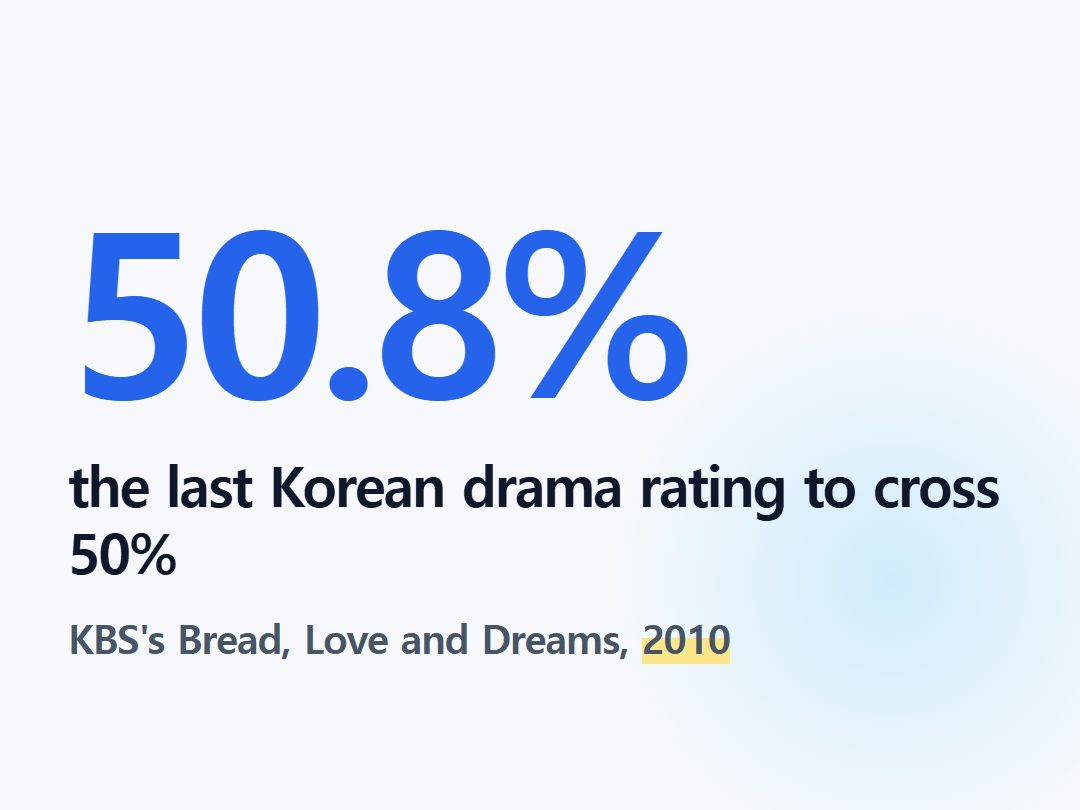
- No Korean drama has topped 50% since KBS's Bread, Love and Dreams in 2010.
- Nielsen counts live TV households only, missing same-day streaming viewers entirely.
Korean entertainment reporters now treat a 9% rating as the line between "doing fine" and "a confirmed hit," a number that would have read as a disappointment two decades ago. The gap has little to do with drama quality — it is about what "watching a drama" now means in Korea.
A handful of 2026 dramas just crossed the line that matters
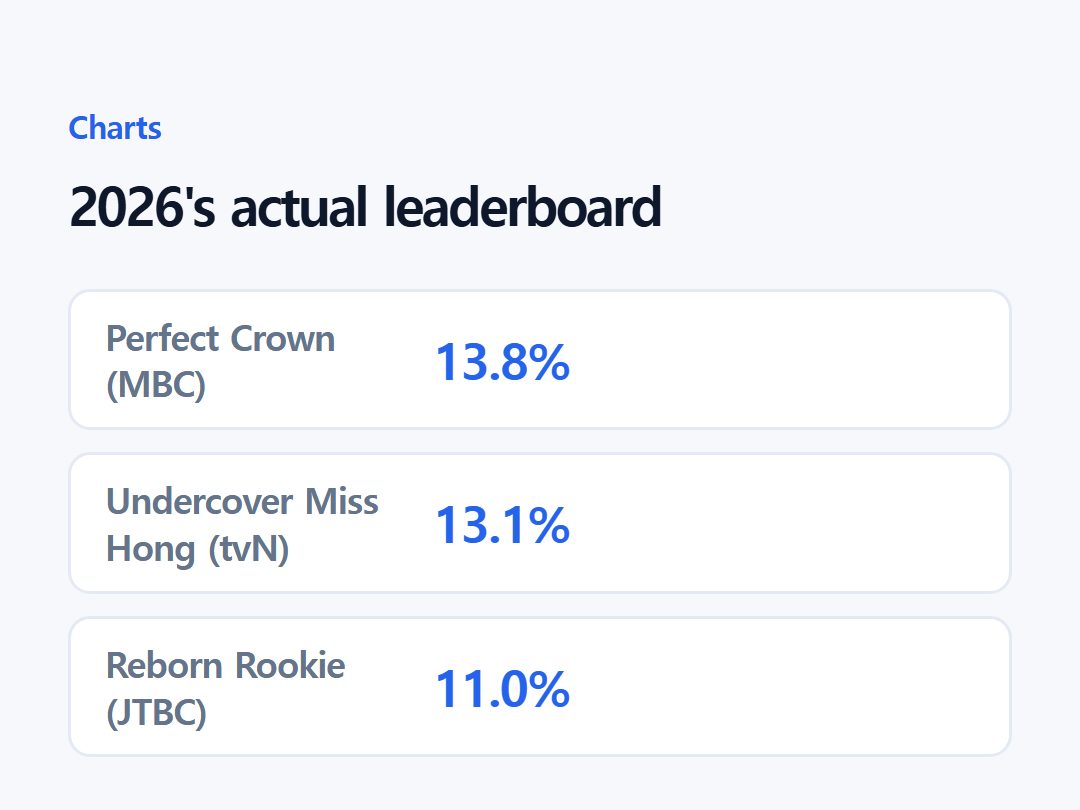
By mid-2026, MBC's royal romance "Perfect Crown" had closed at a 13.8% nationwide rating, with courtroom drama "The Judge Returns" close behind at 13.6%. tvN's "Undercover Miss Hong" reached 13.1%, and JTBC's "Reborn Rookie" hit a personal-best 11.0% by its eighth episode, the network's strongest drama result of the year.
Other 2026 titles landed in the 8-10% range that entertainment desks now call solid rather than spectacular. This is the actual leaderboard, not a ranking of quality — the list mixes period romance, courtroom drama, and workplace comedy.
| Drama | Channel | 2026 rating |
|---|---|---|
| Perfect Crown | MBC | 13.8% |
| The Judge Returns | MBC | 13.6% |
| Undercover Miss Hong | tvN | 13.1% |
| My Royal Nemesis | SBS | 11.8% |
| Reborn Rookie | JTBC | 11.0% |
| Filing for Love | tvN | 9.7% |
Nine percent means something different depending on which channel airs it
Korea's broadcast market has two tiers, and they are not judged on one scale. Terrestrial networks — KBS, MBC, SBS — reach nearly every household with a TV, so a high single-digit rating there can look ordinary. Cable and general-programming channels like tvN and JTBC reach a smaller technical footprint, so a 9% cable rating and a 9% terrestrial rating are not describing the same size of audience.
That gap is why tvN's "Crash Landing on You" (21.7%) and "Goblin" (around 20.5%) are still cited years later as once-in-a-decade outliers. Both aired on cable, where anything past 20% remains almost unheard of.
Trade coverage generally treats roughly 6-8% as an average result for a terrestrial network drama and roughly 2-4% as average for a cable one. That means a 9% cable rating already clears the terrestrial baseline entirely.
How Nielsen actually counts a household, not a person
A Nielsen Korea rating is the share of measured television households whose set was tuned to a channel at a given time, not the share of citizens watching. A 9% rating means 9% of sampled households — not 9% of the population — had that channel on.
That figure also only counts a live or same-day linear broadcast. It does not count anyone who watches the episode later on a streaming app, which is where a growing share of any drama's real audience now sits.
The last Korean drama to break 50% aired in 2010
Ratings above 50% were unremarkable in the 1990s. "Sandglass" (1995) averaged roughly 50% nationwide and peaked near 64.5% for its finale, and several other dramas that decade cleared 60% on a single episode.
KBS's "Bread, Love and Dreams" closed at 50.8% in 2010 — the last Korean drama on record to cross that line. No drama has matched it since, on any channel.
Even the 50% era had a domestic-overseas gap of its own
"Winter Sonata," the 2002 KBS drama that later triggered Japan's Korean Wave boom, averaged just 23.1% domestically and reportedly ranked third among the three dramas competing in its own timeslot. By Korean standards of that era, it was not a runaway hit.
In Japan, its NHK broadcast became a phenomenon: the finale drew over 20% of the entire country, an unprecedented number for a non-morning, non-historical drama airing at 11 p.m. The series is credited with generating more than 3 trillion won in tourism and economic impact.
A modest domestic rating and a massive overseas footprint have coexisted before — streaming just made that split visible in weeks instead of years.
How three broadcasters turned into one shelf among two hundred channels
The 50%-plus era depended on scarcity: until the 2000s, KBS, MBC, and SBS were essentially the only places to watch a drama with a real budget.
A 2009 law change let conglomerates and news companies own broadcast licenses. In 2011 that produced four new general-programming channels, known in Korea as jongpyeon — JTBC, TV Chosun, Channel A, and MBN — plus a news channel, all competing for the audience terrestrial TV used to have to itself.
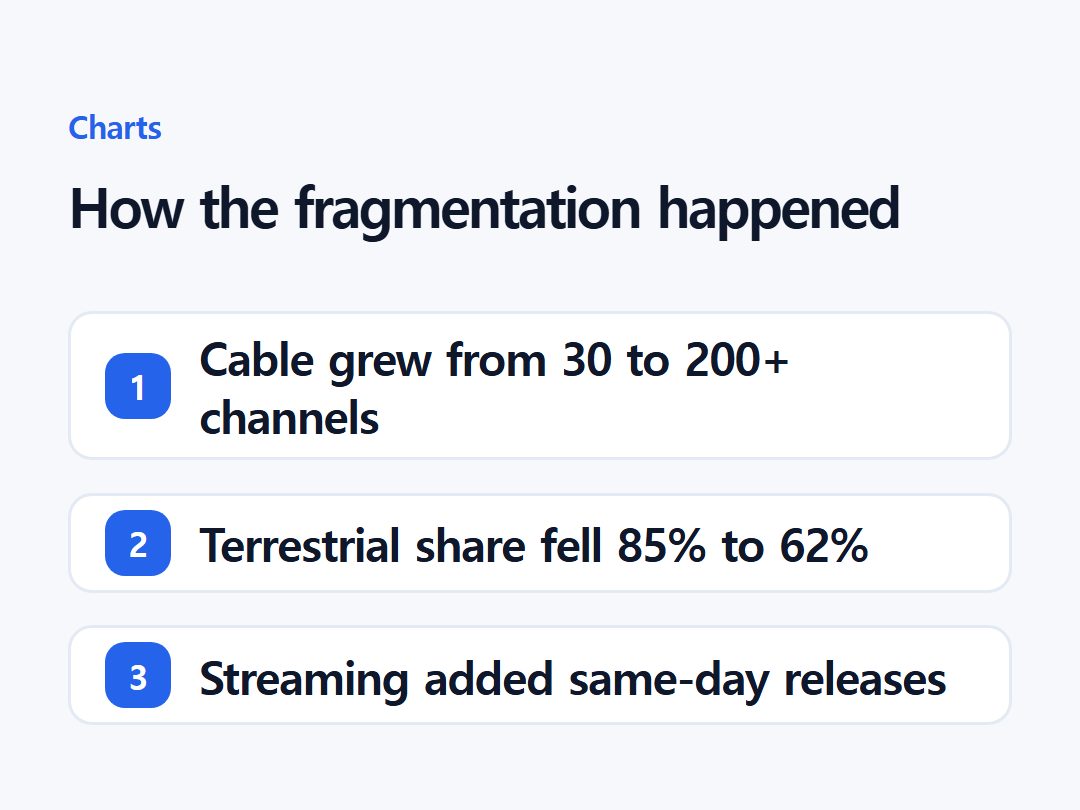
- Cable TV grew from 30 channels at its 1995 launch to more than 200 by the 2010s
- The three terrestrial broadcasters' combined audience share fell from 85% in 2002 to 62% by 2011
- Pay-TV households rose from under 6 million in 2001 to more than 15 million by 2009
That was the fragmentation that took Korean dramas from a 50% world to a 20% world — before streaming even entered the picture.
Streaming didn't just add viewers — it gave them a reason not to watch live
Korean broadcast culture has a name for choosing to watch a show as it airs rather than later: bonbangsasu (본방사수), literally "defending the live broadcast." It used to be the default. It no longer is.
- Most dramas now stream on Netflix, Disney+, or a local platform hours after broadcast
- A growing number, like ENA's "Tastefully Yours," now premiere on a streaming app the same day as TV
- Analysts pointed to same-day streaming as a factor when JTBC's "Still Shining" dropped below 1% in its Friday slot for the first time on record
None of that means fewer people are watching. It means fewer people are watching at the exact moment Nielsen's meters are counting.
A Nielsen number and a Netflix rank answer two different questions
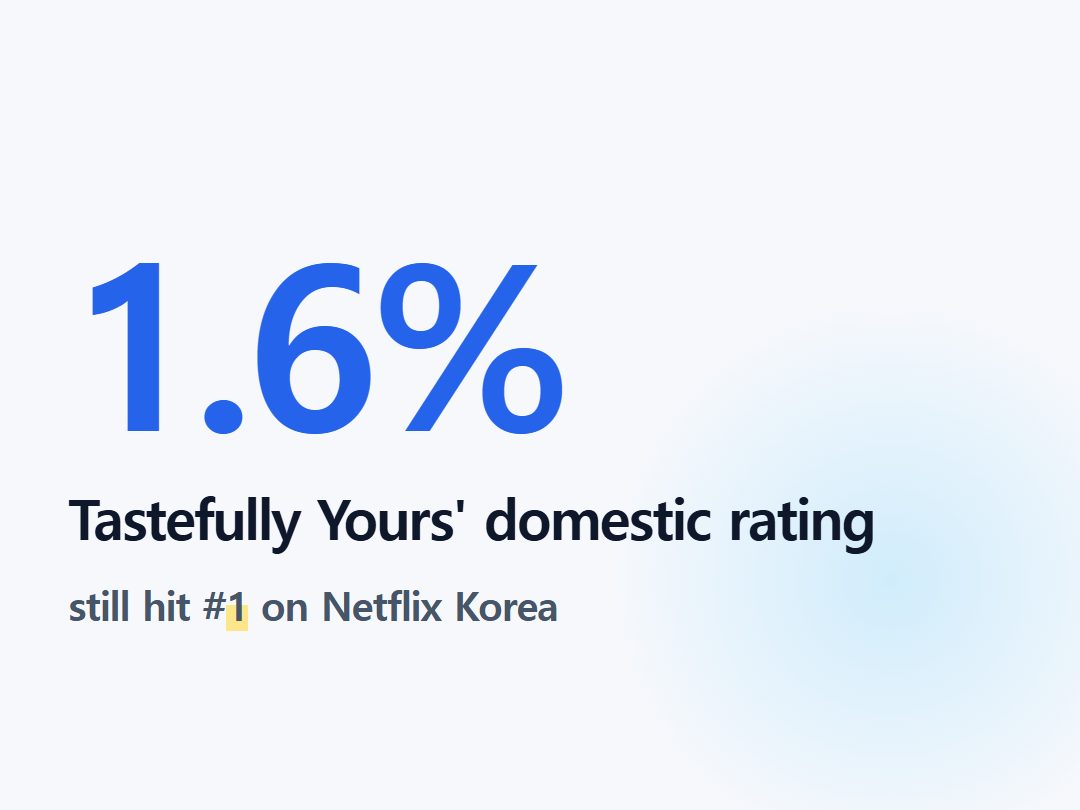
"Tastefully Yours" is the clearest recent case of the split. Its domestic premiere drew a 1.6% Nielsen rating, about half of what its own network's previous drama had managed. On Netflix, it reached number one in Korea, number two worldwide on FlixPatrol's global chart, and topped the list in 23 countries.
Nielsen measures the share of a fixed, measured pool of Korean TV households. Netflix ranks shows by total hours streamed divided by runtime, across a global subscriber base with no equivalent published sample. The two numbers cannot be converted into each other — a drama can fail one and dominate the other in the same week.
Where the industry actually draws the hit line today
Reporters covering tvN and JTBC dramas consistently treat the approach to 9-10% as the moment a show is confirmed a hit rather than a modest performer. "Typhoon Family" showed the climb in 2025: it opened at 5.9%, reached 9.0% by its fourth episode, and held near 8.9% through its sixth.
"Bon Appétit, Your Majesty" broke into double digits by its fourth episode and finished with an 11.1% average, the highest tvN drama rating of 2025 at the time. Both shows were written up as confirmed hits only after crossing 9%, not before.
What still isn't settled
There is no official replacement for the Nielsen household rating, even though most of the industry agrees it undercounts how dramas are actually watched now. Broadcasters still price advertising and judge a season's success by the same linear number built for a three-channel market.
Streaming platforms, meanwhile, have little incentive to publish detailed viewing data, since most run on subscriptions rather than advertising. Until that changes, a Korean drama's real audience — the one watching live, the one watching same-day on an app, and the one watching it dubbed abroad months later — will keep being measured in incompatible ways at once.
What counts as a "normal" rating, by channel tier
| Channel tier | Average rating considered normal | Example channels |
|---|---|---|
| Terrestrial | 6-8% | KBS, MBC, SBS |
| Cable / jongpyeon | 2-4% | tvN, JTBC |
Frequently asked
What is considered a good rating for a Korean drama in 2026?
Reporters treat roughly 9% as the point where a drama moves from "doing fine" to a confirmed hit, though a 9% cable rating and a 9% terrestrial rating represent very different audience sizes.
Why did Korean drama ratings drop so much since the 1990s?
Cable TV grew from 30 channels in 1995 to more than 200 by the 2010s, and a 2009 law let four new jongpyeon channels launch in 2011, splitting an audience that three terrestrial networks used to have to themselves.
Why did Tastefully Yours get a low Nielsen rating but rank #1 on Netflix?
Nielsen only measures live, same-day linear broadcast among sampled Korean households, while Netflix ranks by total streaming hours worldwide — the show drew a 1.6% Nielsen rating but hit number one in Korea and topped charts in 23 countries.
Sources
Every factual claim above is traceable. We do not translate articles — we gather facts from multiple outlets and write them ourselves.
- 'Typhoon Family' stirs up ratings, closes in on 10% viewership — The Korea Times
- "Bon Appétit, Your Majesty" Earns Highest Ratings Of Any tvN Drama In 2025 — Soompi
- 10 top-rated Korean dramas of 2026 so far — allkpop
- "Reborn Rookie" Achieves Highest Ratings Of Any JTBC Drama In 2026 — Soompi
- K-drama classic 'Winter Sonata' returns to Japan 24 years after debut — The Korea Times
- K-dramas: The making of a global breakthrough — The Korea Herald
- K-drama ratings explained: what the Korean numbers actually measure — Seoul Current
- 'Tastefully Yours' becomes global hit on Netflix despite 1% viewership ratings during domestic broadcast — allkpop
- K-Dramas are struggling to reach High Viewership Ratings, where are the Mega Hits? — allkpop
- A Legendary Korean drama with a peak viewer rating of 64.5% is now on Netflix — allkpop
- Not just Netflix: Interventions of Korea's domestic streamers — International Journal of Cultural Studies (SAGE)