International fans scrolling between Korean and American entertainment news keep running into the same puzzle: a Korean drama tops Netflix's global chart, dominates social media, and gets discussed as a genuine phenomenon — yet the "rating" reported back in Korea is a single-digit or low-teens percentage, a number that would read as a cancellation notice for an American network show. The two figures are not measuring the same thing, and stacking them side by side produces a false impression that Korean dramas draw far smaller audiences than they actually do.
The short version
- Korean ratings measure only linear TV — Netflix hits still post single-digit numbers.
- A Korean rating point is worth far fewer households than a US rating point.
- 1990s hits topped 50%; today's cable ceiling is under half that, split across more channels.

Two Netflix hits with single-digit Korean ratings
There is no single incident behind this — it is a recurring pattern in how Korean television numbers travel into English-language coverage.
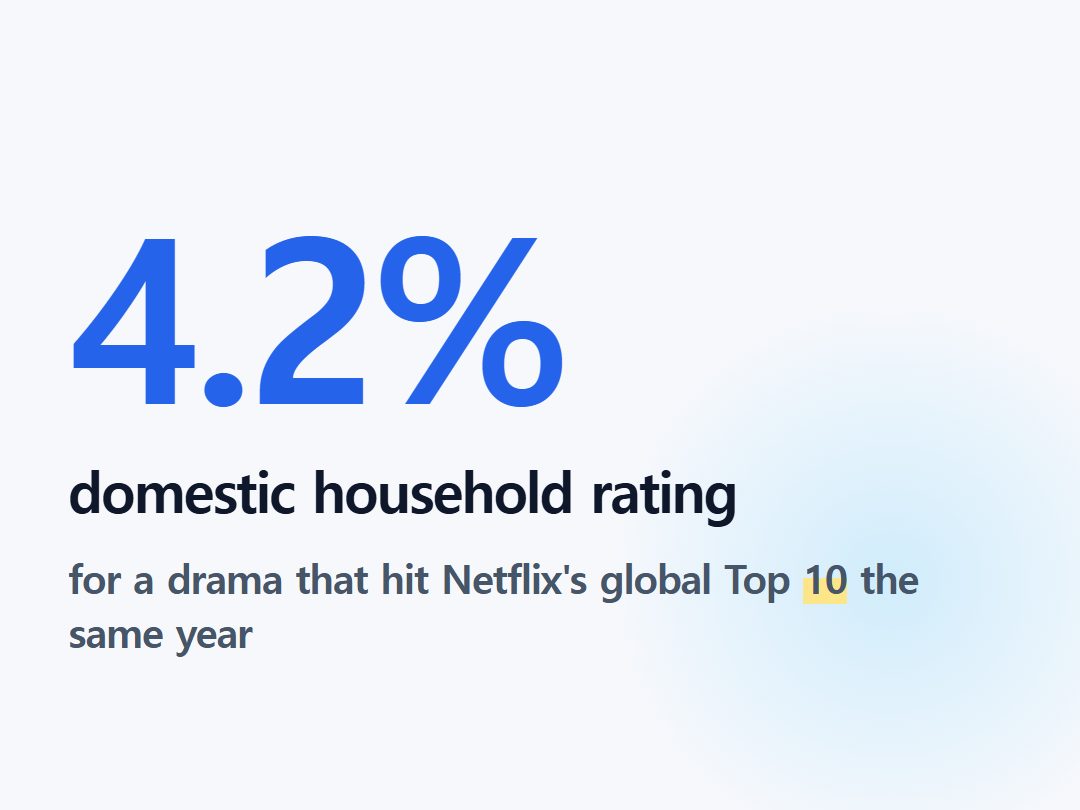
A drama such as It's Okay to Not Be Okay (tvN, 2020) ranked as the second most-watched Korean drama on Netflix worldwide that year, while its domestic household rating from Nielsen Korea fell as low as 4.2% for one episode. The King: Eternal Monarch (SBS, 2020) placed among Netflix's ten most-watched titles globally, while its Korean rating dropped to 5.2% for episode 11.
Neither number is wrong. They are simply answering different questions — one about a global streaming platform's internal ranking, the other about a fixed, sample-based panel that only counts what airs on linear Korean television.
Why are Korean and US ratings not comparable?
The confusion starts with a term that looks self-explanatory but is not: "rating." In both Korea and the United States, a television rating is a percentage — the share of a defined group of households, out of all households in a measured panel, whose television was tuned to a given program.
Korea's ratings are compiled by Nielsen Korea (the successor to AGB Nielsen) and a second company, TNmS, using People Meter devices installed in a panel of roughly 2,000 households each, built to represent Korea's estimated 20 to 21 million television-owning households nationwide.
Having two competing rating companies is itself unusual — most countries, including the United States, rely on one dominant provider.
Nielsen Korea and TNmS have historically produced numbers that diverge by two to three percentage points for the same broadcast, and the two firms have even taken each other to court over accusations of skewed methodology.
The core math, though, is the same basic idea used in the United States: a household rating point represents one percent of the relevant television-household universe, and both countries define "rating" as distinct from "share" (the percentage of only the sets that are switched on at that moment, not all households).
What differs is scale and convention. Nielsen's U.S. national panel has grown to roughly 42,000 households covering more than 100,000 individually measured viewers, drawn from an estimated television-household base of well over 120 million — more than five times Korea's entire TV-owning population.
A rating point in the two countries is therefore not the same-sized audience at all: one percentage point of Korea's household base is a few hundred thousand homes, while one percentage point in the U.S. represents well over a million.
Reporting convention compounds the gap. Korean entertainment coverage almost always leads with the household rating percentage itself — "episode 4 recorded 12.3%" — because that is the number Nielsen Korea and TNmS publish daily and free of charge.
American entertainment journalism, by contrast, usually translates the underlying rating into a raw viewer count in the millions for headlines, because round numbers like "9.4 million viewers" read as more dramatic and require no explanation of what a rating point actually means.
A reader comparing a Korean percentage to an American viewer count is not comparing two ratings; they are comparing a percentage to a headcount, expressed in units that were never meant to sit next to each other.
Geography adds another layer specific to Korea: outlets may report a nationwide rating or a Seoul-metropolitan-area rating for the same episode, and the two numbers are usually different, since Seoul concentrates a large, closely tracked share of the national audience.
A headline that quotes the higher regional number without saying so can make a drama look bigger — or, if a reader assumes the opposite convention, smaller — than the nationwide figure supports.
Then there is the audience that never shows up in either country's panel at all. Nielsen Korea and TNmS measure linear broadcast and cable viewing only.
A viewer who watches a same-day Netflix release of a Korean drama, rather than the live cable broadcast, contributes nothing to that drama's official household rating, no matter how many times they watch.
This is precisely why shows like It's Okay to Not Be Okay could be a global Netflix hit while posting some of the lowest domestic ratings of their broadcast run — a meaningful slice of their real audience, including inside Korea, was never counted by the system producing the percentage international readers see quoted.
How three networks became many channels
Korean television ratings look small today partly because the competitive field they are measured against has grown enormously more crowded. Through the 1990s, three terrestrial networks — KBS, MBC, and SBS — held near-total control of the national audience, with cable barely present.
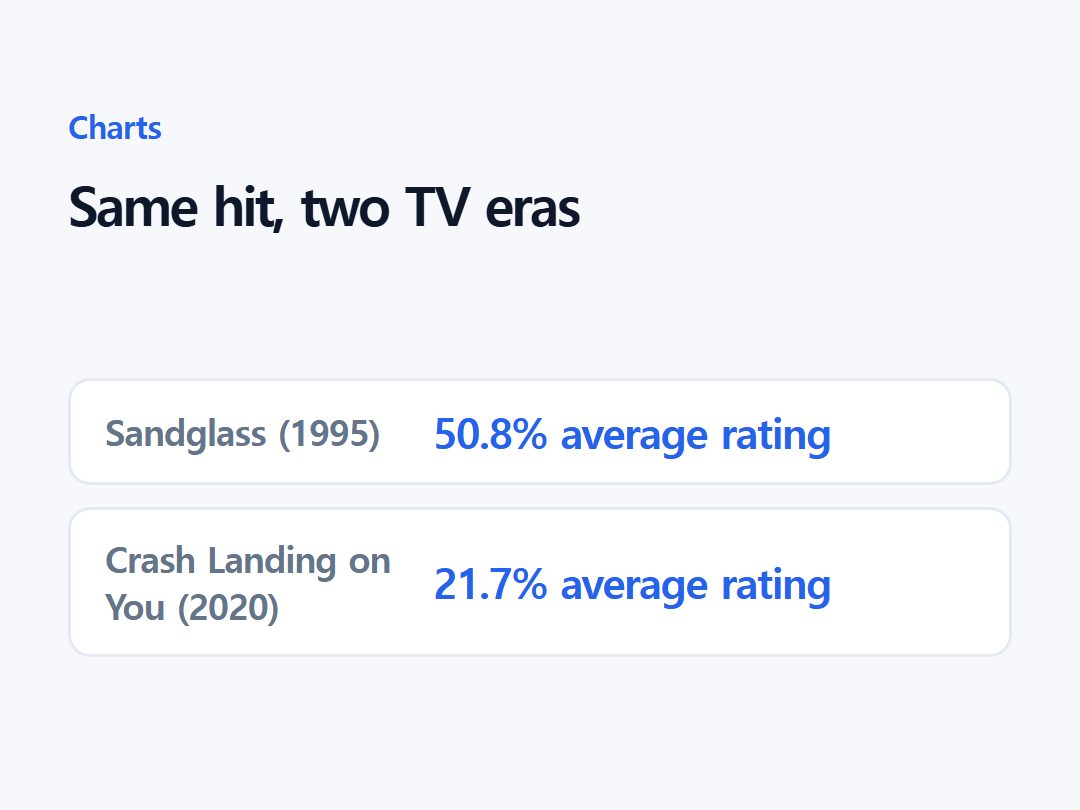
Under that setup, a hit drama could post numbers unthinkable today: 1995's Sandglass averaged a 50.8% nationwide rating across its run and peaked at 64.5% for its finale, while 1999–2000's Hur Jun hit 63.5% for a single episode.
Those figures reflect a market where a handful of channels split the entire national audience essentially three ways.
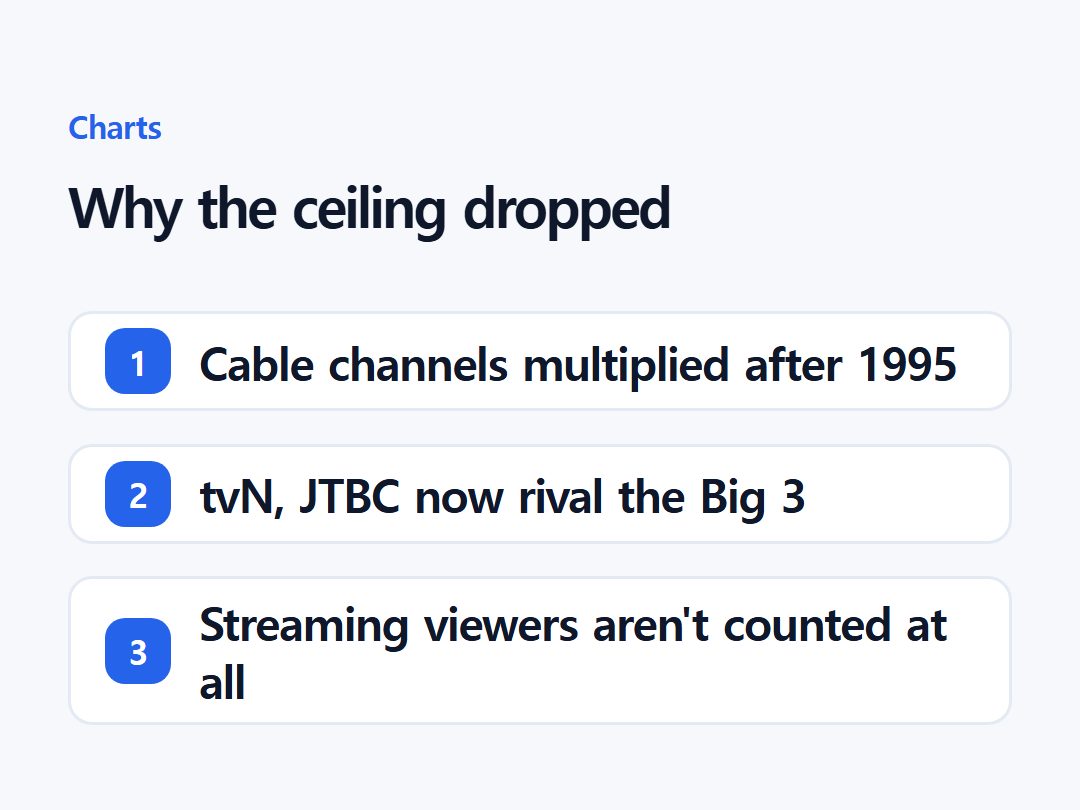
Cable television began expanding after 1995 deregulation, and it kept fragmenting the field for the following three decades.
CJ ENM's tvN and JTBC — both newcomers relative to the terrestrial trio — eventually grew large enough to rank alongside KBS, MBC, and SBS among Korea's top television networks, alongside a long tail of other cable channels competing for the same fixed pool of roughly 20 million TV households.
Against that backdrop, tvN's Reply 1988 set a new cable-era ratings record with an 18.8% finale in 2016, a number that stood until Crash Landing on You broke it in 2020 with a 21.7% series average and a 24.1% finale peak — genuinely historic numbers for cable, celebrated in Korean media as such, yet still less than half of what a terrestrial hit drew in the mid-1990s.
The ceiling did not disappear because dramas got worse; it dropped because the audience is now split across far more channels, and, more recently, across streaming platforms the ratings panel does not measure at all.
Will streaming ever count toward the rating?
Neither Nielsen Korea nor TNmS has published an official methodology for folding streaming viewership into the household rating figures that still anchor Korean television coverage, so the gap between a drama's linear rating and its actual total audience is likely to keep widening as more viewers, in Korea and abroad, watch same-day Netflix or other platform releases instead of the live cable or terrestrial broadcast.
Netflix periodically releases its own internal hours-viewed and Top 10 data, but that is a different metric built for a different purpose, and no public formula converts one into the other.
Nielsen itself has begun building a comparable streaming-meter panel in the United States — roughly 21,000 households as of 2022 — suggesting the industry is aware of the same measurement gap, without yet having solved it in either country.
Until a unified figure exists, the household rating percentage that leads Korean entertainment coverage will keep measuring a shrinking slice of who is actually watching, and readers comparing it to an American viewer count will keep comparing two different instruments rather than two different outcomes.
Korea's ratings ceiling, then and now
| Drama | Year | Era | Rating |
|---|---|---|---|
| Sandglass | 1995 | Terrestrial | 50.8% average, 64.5% finale |
| Hur Jun | 1999–2000 | Terrestrial | 63.5% (single episode) |
| Reply 1988 | 2016 | Cable | 18.8% finale |
| Crash Landing on You | 2020 | Cable | 21.7% average, 24.1% finale |
Frequently asked
Why do Korean dramas have such low ratings if they're popular?
Korean ratings only count linear broadcast and cable viewing, so same-day Netflix streams contribute nothing — that's how It's Okay to Not Be Okay posted a 4.2% domestic rating while ranking as Netflix's second most-watched Korean drama worldwide.
What counts as a good drama rating in Korea now versus in the past?
In the 1990s, when three terrestrial channels split the whole audience, Sandglass averaged 50.8% and Hur Jun hit 63.5%; today's cable audience is split across far more channels, so Crash Landing on You's 21.7% average was still a historic record.
Can I compare a Korean TV rating directly to a US viewer count?
No — Korean coverage reports a household rating percentage while American coverage translates ratings into raw viewer counts, and Korea's entire TV-household base (about 20-21 million) is less than a fifth the size of the US panel's base.
Sources
Every factual claim above is traceable. We do not translate articles — we gather facts from multiple outlets and write them ourselves.
- South Korea TV Ratings: TNmS vs. AC Nielsen — Soompi
- K-drama ratings explained: what the Korean numbers actually measure — Seoul Current
- Here's Why These International Hit K-Dramas Got Such Low Ratings In Korea — Koreaboo
- "Crash Landing on You" ends with tvN's highest ratings yet — The Korea Herald
- 'Reply 1988' sets another ratings record — The Korea Times
- A Legendary Korean drama with a peak viewer rating of 64.5% is now on Netflix — allkpop
- Nielsen's industry-leading U.S. National TV Panel reaches over 42,000 households, comprised of 101,000 directly measured viewers — Nielsen
- What Are Nielsen Ratings And How Are They Calculated? — Forbes