Every few months, international fans notice the same strange pattern: a Korean drama dominates Netflix's global Top 10 for weeks, yet Korean entertainment news reports its domestic "viewership rating" barely cleared 1 percent.
Readers unfamiliar with how Korean TV is measured often assume this means the show quietly bombed at home before finding an audience abroad.
That is not quite what is happening. The two numbers are not measuring the same thing, and understanding why is key to understanding how the Korean drama industry actually works today.
The short version
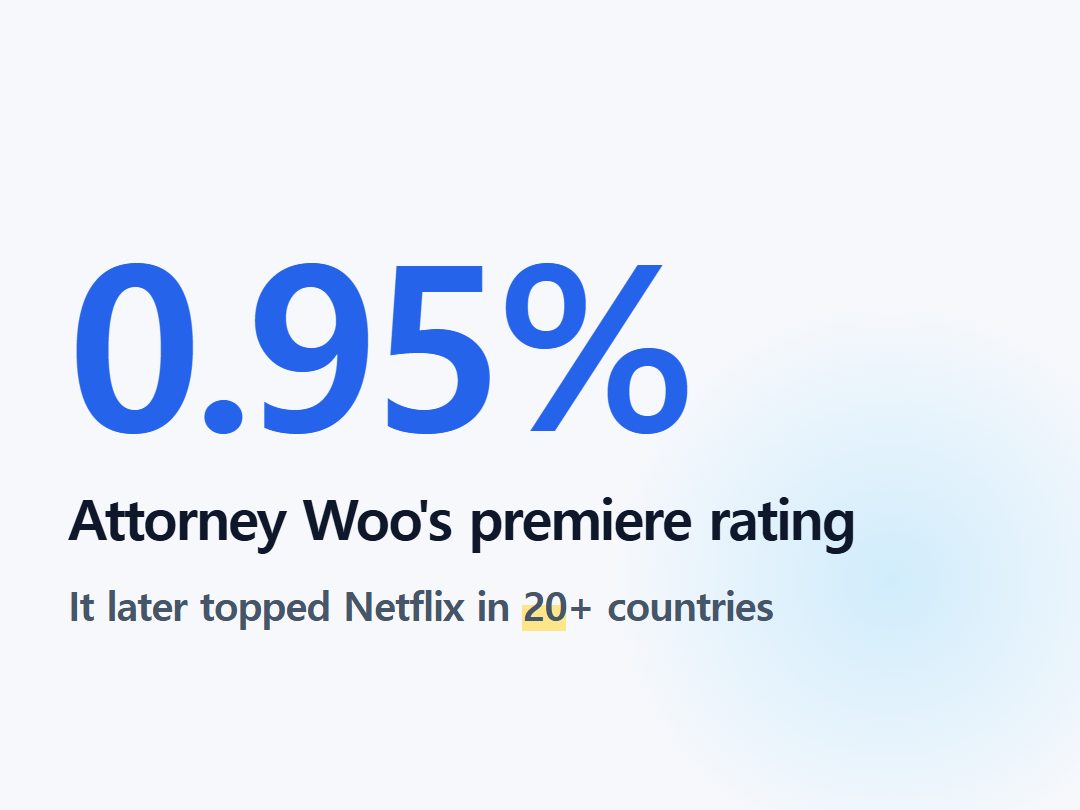
- Extraordinary Attorney Woo opened at a 0.95% domestic rating but hit No. 1 worldwide.
- Nielsen only counts live TV viewing among roughly 4,000-5,000 measured households nationwide.
- Netflix originals like Squid Game never get a Nielsen rating at all.
Extraordinary Attorney Woo wasn't a one-off
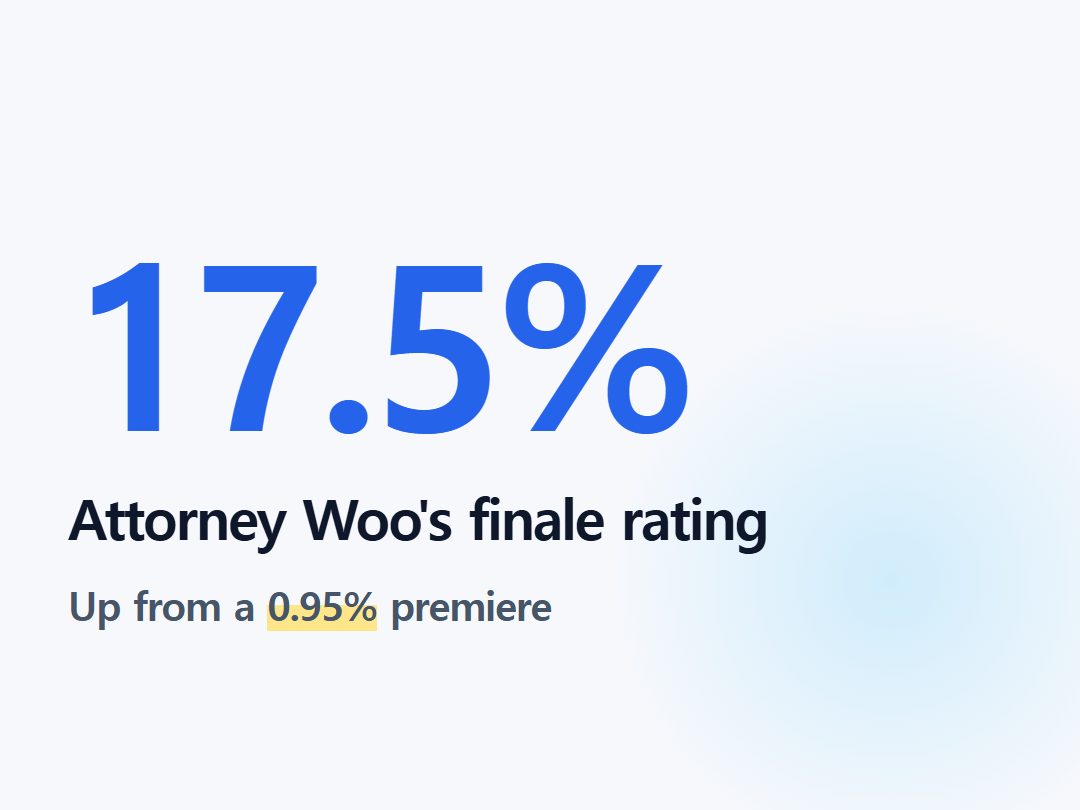
The clearest recent case is "Extraordinary Attorney Woo" (2022), which premiered on ENA, a small cable channel, with a nationwide household rating of just 0.95 percent — about 400,000 households, according to Nielsen Korea, the country's dominant TV ratings provider. Within a month, the same show was the No.
1 non-English series on Netflix worldwide, topping the platform's Top 10 chart in more than 20 countries.
Its domestic rating did eventually climb, reaching 17.5 percent by the finale, but for its first several weeks it was, by the traditional metric, a niche show — even as it was becoming one of the most-watched series on Earth.
The same disconnect shows up repeatedly. "Tastefully Yours" premiered on ENA in 2025 with a 1.6 percent domestic rating, then reached No. 6 on global Netflix charts and topped the platform in seven countries within days.
"Weak Hero Class 1" drew little domestic attention on its original platform before a Netflix release sent it into the global Top 10 for a month.
Netflix's own Korean originals — "Squid Game," "The Glory," "Sweet Home" — never even generate a Nielsen number, because they never air on Korean broadcast or cable television at all.
Why do Korean ratings look so low?
The reason these numbers diverge so sharply is structural, not a reflection of a show being unpopular at home before becoming popular abroad.
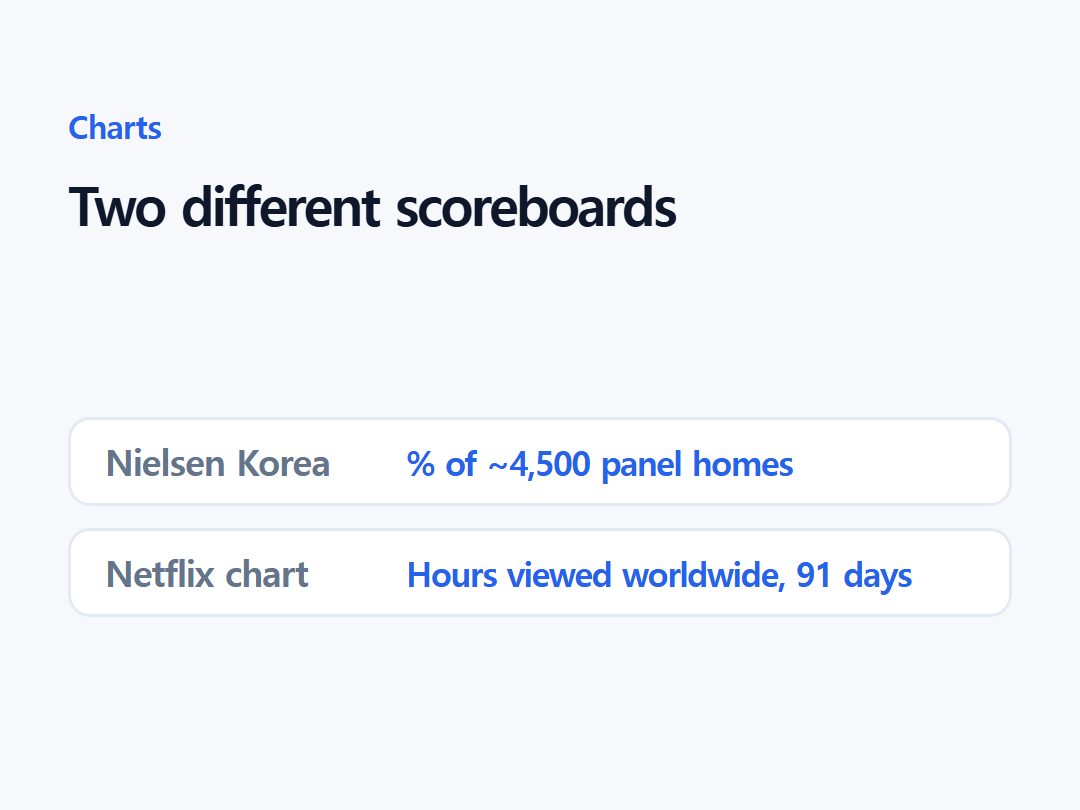
Nielsen Korea, the country's main ratings agency, measures viewing through a "people meter" panel of roughly 4,000 to 5,000 households nationwide — a small fraction of Korea's more than 20 million TV households.
Every time someone in a panel household watches, they log in on the device, and Nielsen reports what percentage of that panel was tuned to a given program during its scheduled broadcast slot, or 본방송 (bon-bangsong), the original linear airing.
Crucially, terrestrial networks (KBS, MBC, SBS) and cable channels have been tracked as separate categories since cable measurement began in 2013, and ratings are published separately for the whole country and for the Seoul metropolitan area, since the two frequently diverge.
This matters because most of the dramas that go on to become Netflix hits do not premiere on the three big terrestrial networks. They air on cable or general-entertainment channels like ENA, tvN, or JTBC, which have historically drawn smaller and often older panel audiences than terrestrial prime time.
A 1 percent rating on a channel like ENA is a completely different scale than a 1 percent rating would be on SBS — and neither is comparable to a Netflix chart position at all, because Nielsen's number describes only people watching live, on schedule, through a television set that happens to belong to a measured panel household.
Netflix, by contrast, does not publish anything resembling a percentage of a national population.
Its public "Most Popular" figures are calculated as total hours viewed divided by a title's runtime, aggregated across roughly 300 million paying-member households in over 190 countries, over a rolling 91-day window from release.
A show does not need to move the needle in Korea specifically to top that chart — it needs enough combined viewing from Seoul to São Paulo.
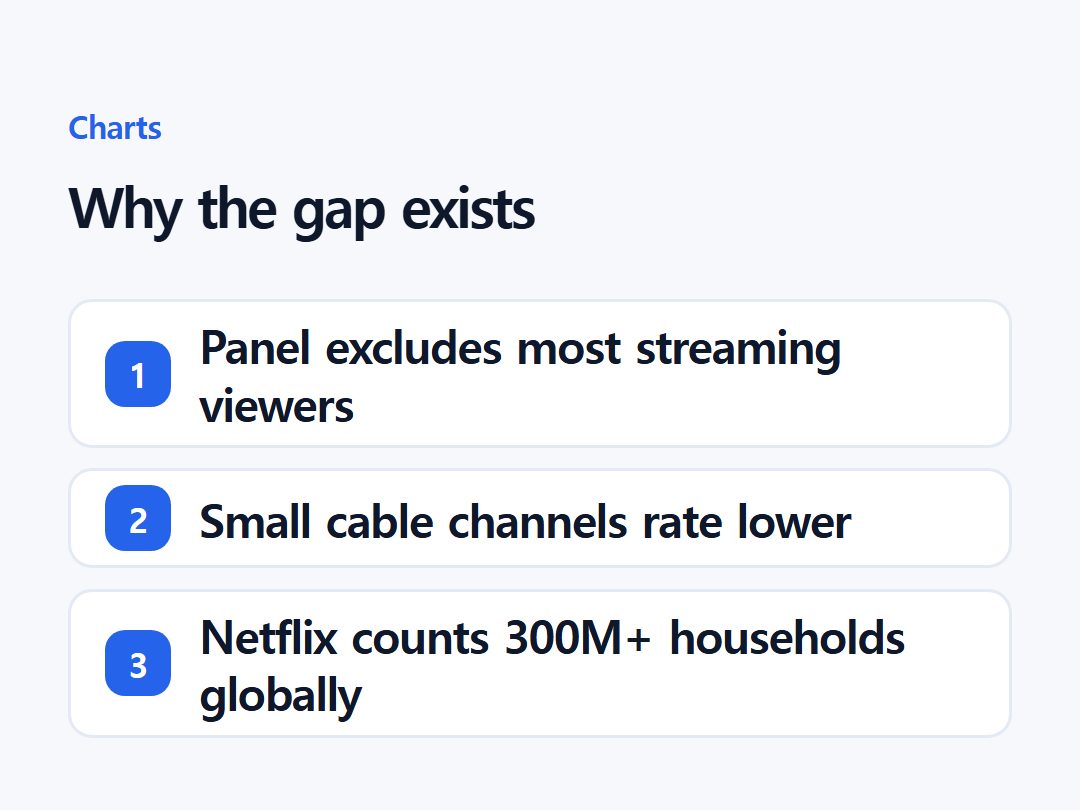
This is also why a drama's domestic rating can look small even though, in absolute terms, plenty of Koreans watched it: many Korean viewers, especially younger ones, now watch same-day Netflix simulcasts instead of the live broadcast, and that streaming audience does not show up in Nielsen's people-meter panel at all.
The low rating does not mean Korea ignored the show; it means Korea increasingly watches it a different way than the rating is built to detect.
Put simply: Nielsen Korea answers "how many measured households in Korea watched this at its scheduled time," while Netflix answers "how much combined viewing time did this get worldwide over three months." A drama can score low on the first question and extremely high on the second without any contradiction, because they are not the same question.
Two different systems built for two eras
Korea's people-meter ratings system dates to 2006 for terrestrial channels, with cable measurement following in 2013 — a setup designed for an era when nearly all TV viewing happened live, through a small number of broadcast channels.
That system has stayed largely the same even as the viewing landscape around it changed dramatically.
Netflix entered Korea in 2016 and spent the following years building local production and, increasingly, same-day licensing deals with Korean broadcasters and cable channels — arrangements known in the industry as 동시방영, or day-and-date simulcast, where a drama airs on Korean TV and drops on Netflix worldwide within hours of each other.
By the early 2020s, two parallel tracks had emerged. One is the simulcast model — a drama like "Extraordinary Attorney Woo" or "Tastefully Yours," produced for a Korean broadcaster or cable channel first, with Netflix licensing global rights on top.
These shows still generate a Nielsen number, but often on channels with modest reach to begin with. The other is the Netflix original model — "Squid Game," "Kingdom," "The Glory," "D.P." — commissioned and released by Netflix directly, with no domestic broadcast run and therefore no Nielsen rating to speak of, ever.
Confusion often arises when readers assume a show in the second category "failed" domestically; it was simply never eligible for the measurement in the first place.
Meanwhile, competition for domestic attention only fragmented further. Korean audiences now split their time across terrestrial TV, cable, and multiple streaming platforms — Netflix, Disney+, Coupang Play, Wavve, and Tving among them — making the old benchmark of a 20-plus percent terrestrial hit increasingly rare.
Industry observers have taken to calling a rating above 20 percent an "impossible wall" in the current environment, a threshold only a handful of terrestrial dramas still clear each year.
Will future K-dramas be written for Netflix first?
The gap between domestic ratings and global streaming performance has started to shape how some Korean dramas are made in the first place.
Some producers have said they now design shows to be more broadly and immediately accessible, with Netflix's international audience in mind from the writing stage onward, rather than treating a domestic broadcast run as the primary goal.
Culture critic Jung Duk-hyun has noted this shift has also raised the profile of Korean webtoon adaptations and newer actors who might not have broken through under the old ratings-driven system.
At the same time, some in the industry have voiced concern that leaning too heavily on one streaming platform's preferences could push Korean storytelling toward a more homogenized, "Netflix-flavored" style over time.
Not every recent hit fits the low-rating pattern, either.
Dramas like "Kim Bu-jang" and "Agent Kim Reactivated" have managed strong performances on both fronts at once — climbing past 20 percent domestically while also topping Netflix's global non-English chart — suggesting the two audiences are not always mutually exclusive, just measured on different scales.
Whether more productions can pull off that dual success, and whether Korea's ratings system evolves to account for streaming viewership at all, remains an open question as the industry keeps building shows for a global platform first and a domestic time slot second.
Domestic rating vs. Netflix performance, by show
| Drama | Domestic rating (Nielsen) | Netflix performance |
|---|---|---|
| Extraordinary Attorney Woo | 0.95% at premiere, 17.5% by finale | No. 1 non-English series worldwide, Top 10 in 20+ countries |
| Tastefully Yours | 1.6% at premiere | No. 6 global chart, topped charts in 7 countries |
| Weak Hero Class 1 | Little domestic attention | Global Top 10 for a month after Netflix release |
| Squid Game / The Glory / Sweet Home | No Nielsen rating (never aired on Korean TV) | Netflix originals, released directly worldwide |
| Kim Bu-jang / Agent Kim Reactivated | 20%+ domestically | Also topped Netflix's global non-English chart |
Frequently asked
Why does Extraordinary Attorney Woo have such a low rating?
Its 0.95 percent Nielsen rating only reflects live viewers within a small measured panel on ENA, not its huge global Netflix audience.
Why don't Squid Game or The Glory have Nielsen ratings?
They are Netflix originals that never aired on Korean broadcast or cable TV, so Nielsen Korea had nothing to measure.
How is Netflix's Most Popular chart calculated?
Netflix divides total hours viewed by a title's runtime, aggregated across roughly 300 million paying households in 190+ countries over a rolling 91-day window.
Sources
Every factual claim above is traceable. We do not translate articles — we gather facts from multiple outlets and write them ourselves.
- 'Extraordinary Attorney Woo' Ratings Spike Following Netflix Global Success — Variety
- 'Extraordinary Attorney Woo' rises to third on global Netflix chart — The Korea Times
- Why dramas with just 1% viewership in Korea are becoming global hits on Netflix — Korea JoongAng Daily
- K-drama ratings explained: what the Korean numbers actually measure — Seoul Current
- 'The Glory' debuts at No. 5 on global Netflix chart — The Korea Times
- 'Kim Bu-jang' Craze: K-IP Hit Goes Global While Staying Home — Seoul Economic Daily
- Why 'Agent Kim Reactivated' became Netflix's No.1 Non-English show worldwide — allkpop
- Nielsen Media Korea — NamuWiki