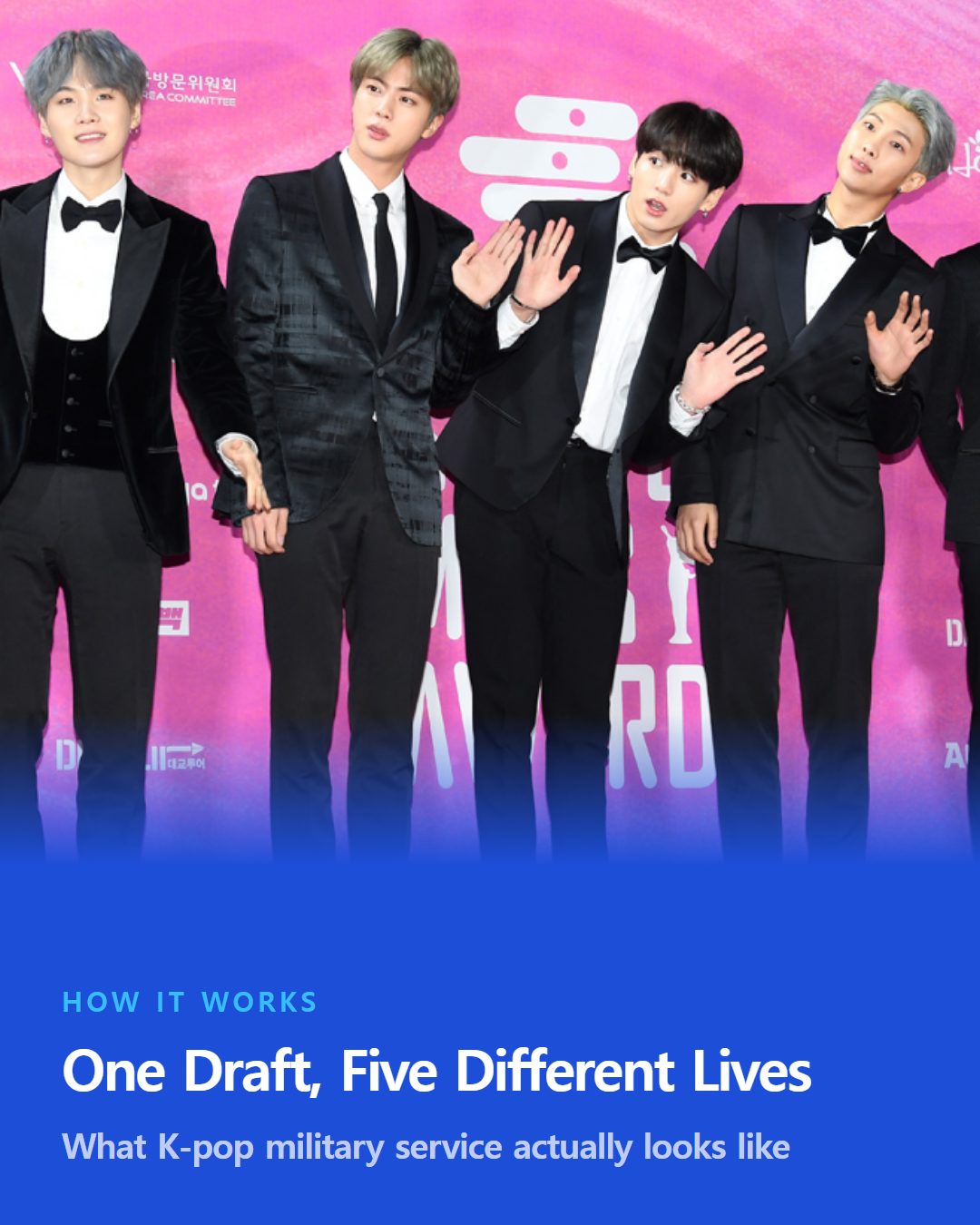
South Korea requires every able-bodied male citizen, K-pop idol and A-list actor included, to serve 18 to 21 months in the military, almost always before he turns 28. There is no fame exemption. All seven members of BTS worked through it between 2022 and 2025, and dozens of other stars are cycling through it right now.
For international fans used to celebrities choosing their own schedules, this is the single biggest, least flexible fact of a Korean entertainer's career.
The short version
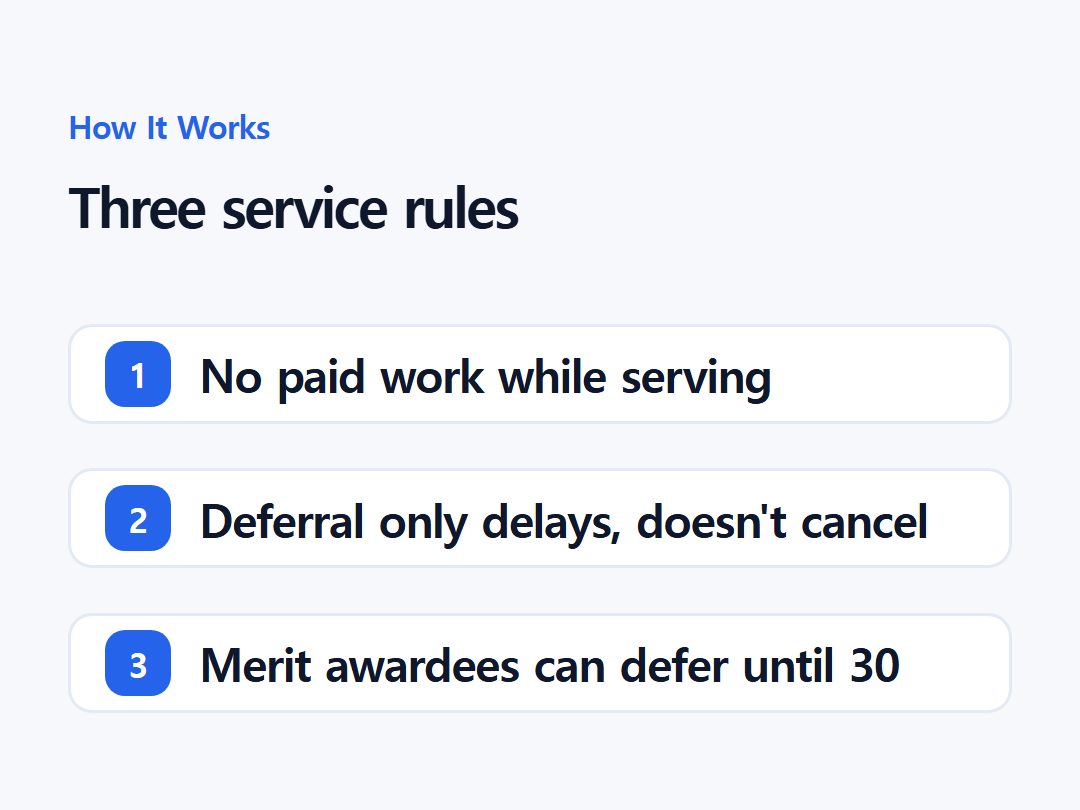
- Every able-bodied Korean man must serve 18 to 21 months, no celebrity exemption exists.
- A 2020 law only delays enlistment to age 30, never cancels the duty.
- BTS enlisted all at once; SEVENTEEN is staggering members' service through 2027.

How long can idols legally delay enlistment?
Conscription applies to all able-bodied Korean men; women are not drafted and serve only if they volunteer. At 19, men undergo a medical grading exam that determines where they serve.
Standard active duty runs 18 months in the Army and Marines, 20 months in the Navy, and 21 months in the Air Force or in alternative "social service" roles assigned to men with medical conditions that make combat duty unsuitable. Enlistment is normally required by age 28.
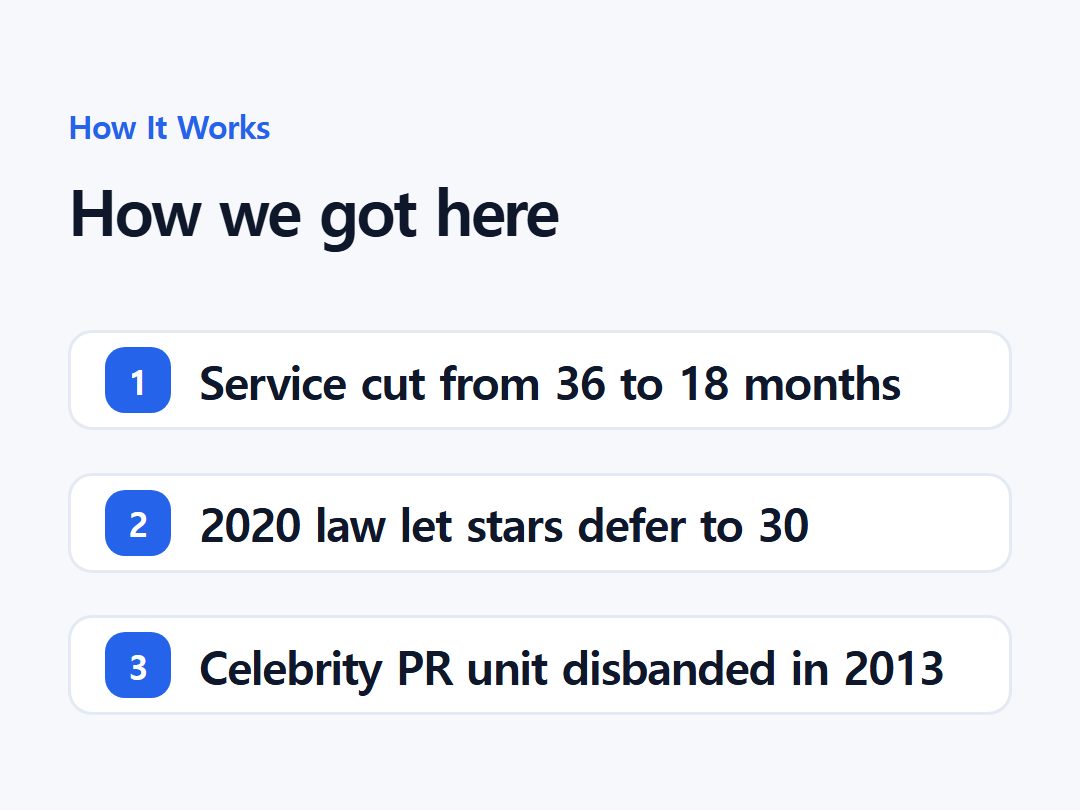
Since a December 2020 law, informally called the "BTS law," performers formally recognized by the Ministry of Culture, Sports and Tourism for enhancing Korea's international image can delay enlistment until 30 — but the law only postpones service, it does not cancel it.
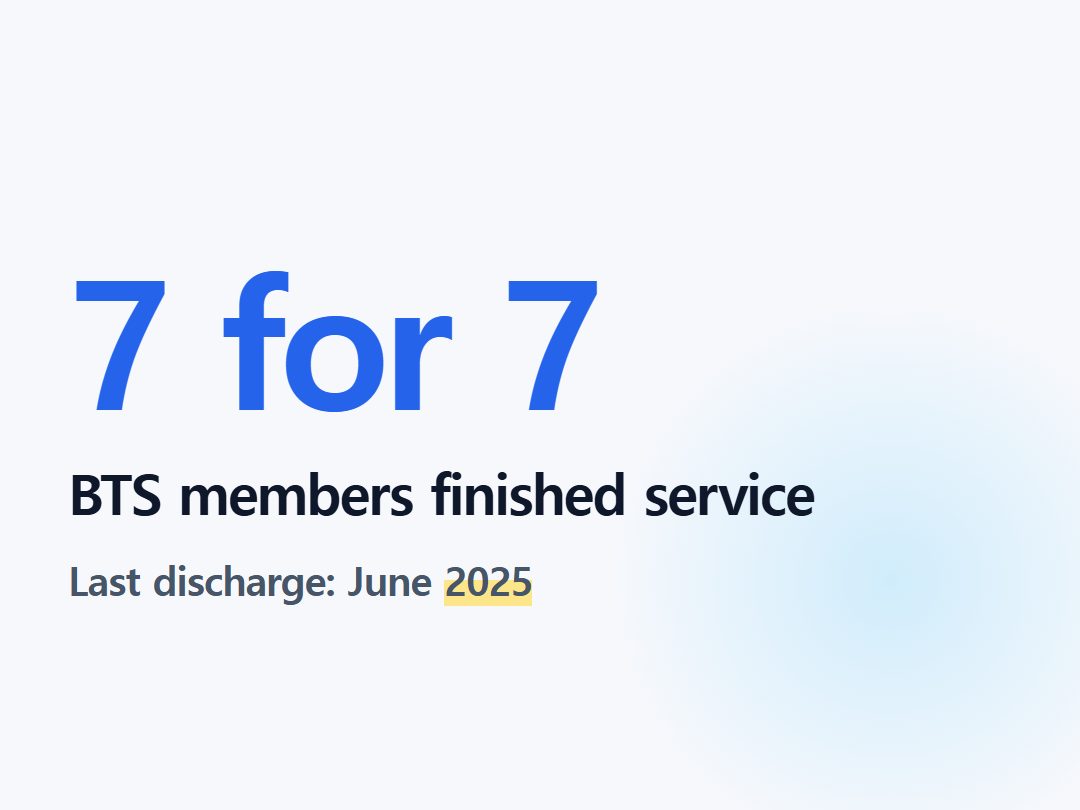
BTS's own agency stated the members would serve regardless, and by June 2025 all seven had completed their duty.
What happens to a K-pop career during military service?
For fans outside Korea, the confusing part usually isn't that service is mandatory — it's how completely it reorganizes an entertainer's calendar for one and a half to two years, and how much planning happens around it in advance.
The agency has to plan years ahead
In the Korean industry, an “agency” is the management company — HYBE, SM, JYP, Pledis and similar firms — that trains, produces, and manages an artist for years, often starting in their teens.
Because the enlistment deadline is a fixed date on the calendar rather than a choice, agencies build comeback schedules, world tours, and film slates around each member's draft window years in advance.
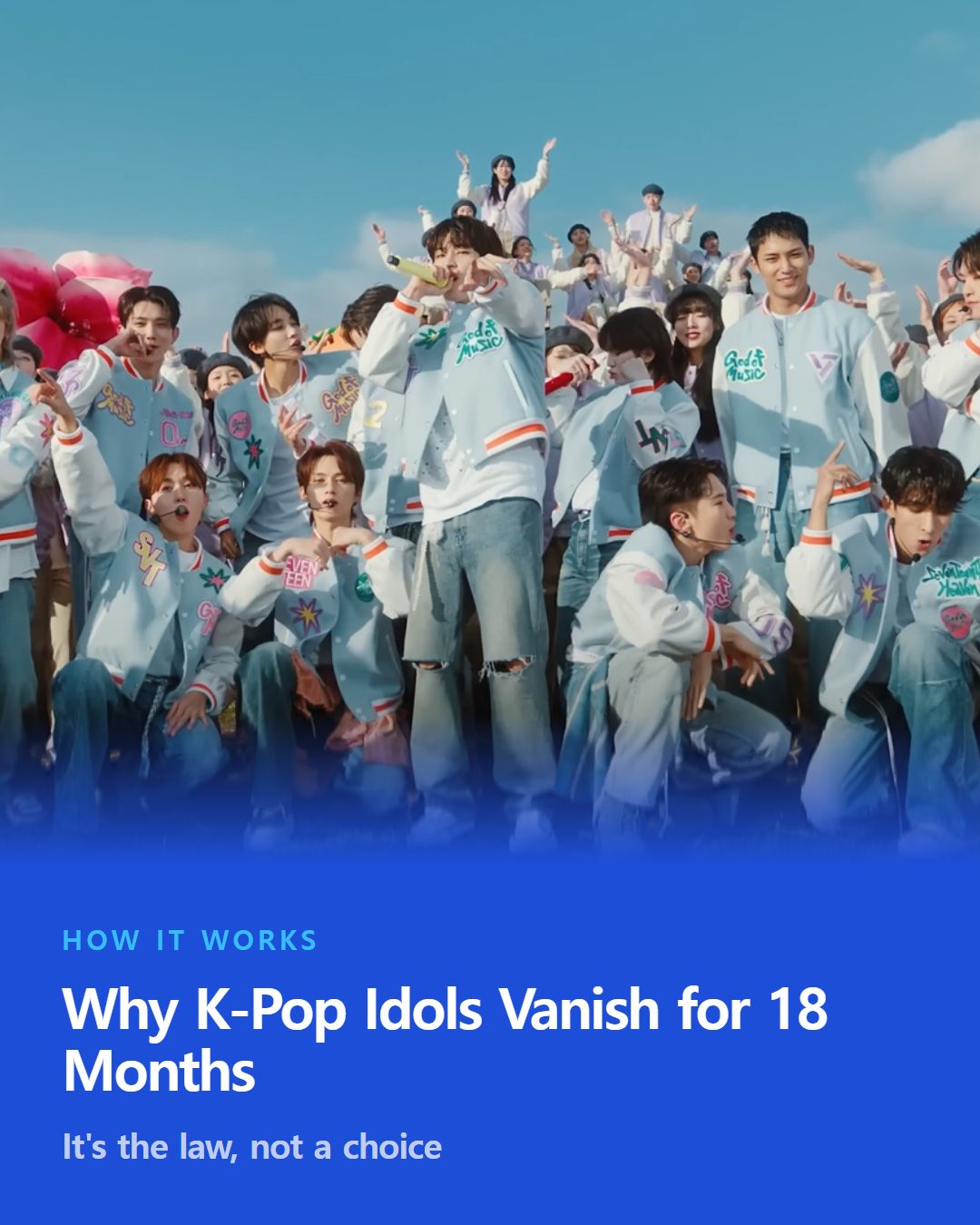
Boy group SEVENTEEN illustrates this well: with 13 members and no full exemption for most of them, the group has spent 2024 through 2026 sending members to serve on a rolling basis.
Jeonghan enlisted first, in September 2024, and became the first member discharged; Wonwoo, Hoshi and Woozi are currently serving; Mingyu began alternative service and Seungkwan and Dino enlisted together as army band soldiers in late 2026.
Three members — Chinese nationals The8 and Jun, and American-passport holder Joshua — are not subject to Korean conscription at all, letting the group keep some international promotion running throughout.
The financial planning runs alongside the creative planning.
Endorsement deals, brand ambassadorships and variety show contracts — the unscripted talk and game shows that make up a large share of Korean television, and a major source of income between album cycles — are typically written to pause rather than terminate during service, and agencies negotiate the timing of those pauses years in advance.
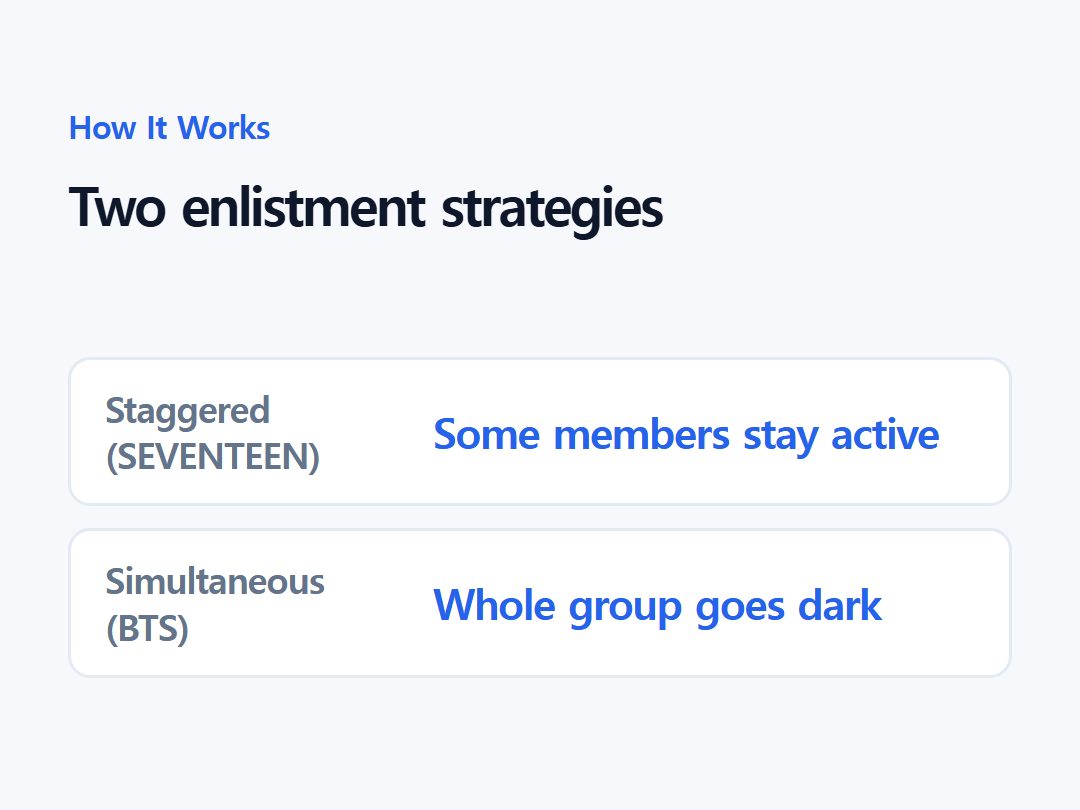
A group that enlists its members all at once, as BTS did between December 2022 and December 2023, accepts a clean but total shutdown of new group activity.
A group that staggers enlistment, as SEVENTEEN has, keeps some revenue and public presence flowing but stretches the disruption across several years instead of compressing it into one.
The blackout period
Once enlisted, an entertainer cannot take on new paid commercial work. What can still surface is content recorded before enlistment: labels routinely release banked music, and film studios release already-shot movies, while the star in question is unreachable for promotion.
Actor Lee Do-hyun's film “Exhuma” became a major box-office hit while he was serving in the Air Force, and he won a Best New Actor award for it without being able to do a normal promotional run.
This is why agencies front-load activity right before a member leaves — a concentrated stretch of comebacks, concerts, and drama or film releases designed to leave fans with new material to watch during the gap.
The comeback formula
A “comeback” — industry shorthand for an artist's return with new music or a new project — carries extra weight after military discharge, because it is the first real test of whether an audience waited.
Actor Song Joong-ki's first project after his 2015 discharge, war drama “Descendants of the Sun,” became one of the highest-grossing Korean dramas of the decade and reset his career trajectory.
The same pattern is visible in 2025 and 2026: actor Song Kang headlined tvN's “Four Hands Two Sonatas” as his first acting role in roughly two years after an October 2025 discharge, Lee Do-hyun returned in Netflix's “Grand Galaxy Hotel,” and Ong Seong-wu took his first villain role in “Spooky in Love” after completing service in 2024.
Each project functions as a deliberately chosen re-introduction, not a routine casting decision.
Returning idols face a second, quieter adjustment: the K-pop market keeps moving during the gap, and a group can come back to find two or three new competitors have debuted and built fandoms in its absence.
That is one reason agencies increasingly use the pre-enlistment period to launch solo tracks, sub-units, or acting roles for members not yet due to serve, so the group has something new to offer even while its full lineup is incomplete.
Length has shrunk, but scandals ended shortcuts
Mandatory service itself dates to the 1953 armistice that ended active fighting in the Korean War without a peace treaty, leaving the two Koreas technically still at war. Service length has shrunk steadily since then, from 36 months in the 1950s to the current 18 to 21 months.
The most recent cut came from “Defense Reform 2.0,” a plan under President Moon Jae-in that the Cabinet approved in 2018 and phased in through 2020, driven by the country's falling birth rate and improved military technology that required fewer conscripts for the same defense capability.
Korean public opinion around celebrities and the draft is shaped heavily by past scandals. Singer Psy served an alternative industrial-exemption program starting in 2003, but in 2007 prosecutors found he had spent that period touring and performing on television rather than fulfilling his assigned duties.
A court stripped his exemption and ordered him back into regular active duty, which he completed in 2009 — a second full stint that, unusually, boosted rather than damaged his public standing because he did not fight the order.
A separate scandal over a military public-relations unit that gave celebrities preferential postings led the Defense Ministry to disband that unit entirely in 2013.
Both episodes are why Korean audiences expect entertainers to serve on the same terms as everyone else, and why any hint of special treatment draws heavy scrutiny.
The 2020 deferral law softened that expectation only slightly. It emerged specifically because BTS's oldest member, Jin, was approaching the then-cutoff of 28 at the height of the group's global chart success.
Lawmakers extended the deferral ceiling to 30 for recognized pop-culture artists, but stopped well short of an exemption, and BTS's management said publicly the members intended to serve regardless of the legal option.
The deadline keeps moving, but never disappears
The staggered-service era is still playing out in real time. SEVENTEEN's rolling enlistment schedule continues into 2027, with several members still to serve and the group managing partial-lineup promotions in the meantime.
A wave of other groups formed in the late 2010s are approaching the age-28 cutoff over the next two years, meaning more pre-enlistment activity surges and blackout periods are coming, not fewer.
On the comeback side, 2025 and 2026 have already produced a cluster of high-profile returns — Song Kang, Lee Do-hyun, Ong Seong-wu — and more are scheduled as other stars complete their terms.
What remains unresolved is the deeper political question: whether cultural achievement should ever justify something beyond a later start date. So far, every legislative change, including the 2020 law, has only moved the deadline. It has never removed the requirement itself.
Standard active-duty length by service branch
| Branch / Role | Duration |
|---|---|
| Army | 18 months |
| Marines | 18 months |
| Navy | 20 months |
| Air Force / alternative social service | 21 months |
Frequently asked
How long is mandatory military service for K-pop idols in Korea?
Standard duty runs 18 months in the Army or Marines, 20 months in the Navy, and 21 months in the Air Force or alternative social-service roles, with enlistment normally required by age 28.
Can K-pop stars avoid Korea's military draft?
No, there is no fame exemption. A December 2020 law lets performers recognized by the Ministry of Culture, Sports and Tourism delay enlistment until age 30, but it only postpones service, it does not cancel it.
Have all the BTS and SEVENTEEN members finished military service?
All seven BTS members had completed their duty by June 2025, while SEVENTEEN is staggering its 13 members' enlistment on a rolling basis that continues into 2027.
Sources
Every factual claim above is traceable. We do not translate articles — we gather facts from multiple outlets and write them ourselves.
- South Korea Mandatory Military Service Length and Exemptions — LegalClarity
- S. Korea military seeks to cut service period to 18 months — The Korea Herald
- Cabinet approves proposal to shorten military service period — The Korea Times
- 7 BTS members are now done with mandatory service — NBC News
- South Korea passes law allowing BTS artists to postpone service — Al Jazeera
- Defense Ministry revises law to allow BTS members to defer military service until age 30 — Korea JoongAng Daily
- All about Psy — The Korea Times
- Scandals prompt South Koreans to dissolve celebrity soldier unit — CNN
- Seventeen renews record in Japan with best-of album, 3 members announce enlistment dates — The Korea Herald
- SEVENTEEN's DK and Vernon announce military enlistment — Forbes
- K-drama stars' post-military comebacks: From Song Kang to Lee Do-hyun — The Korea Herald
- How Descendants of the Sun Revived Song Joong-Ki's Career After a Break — AceShowbiz