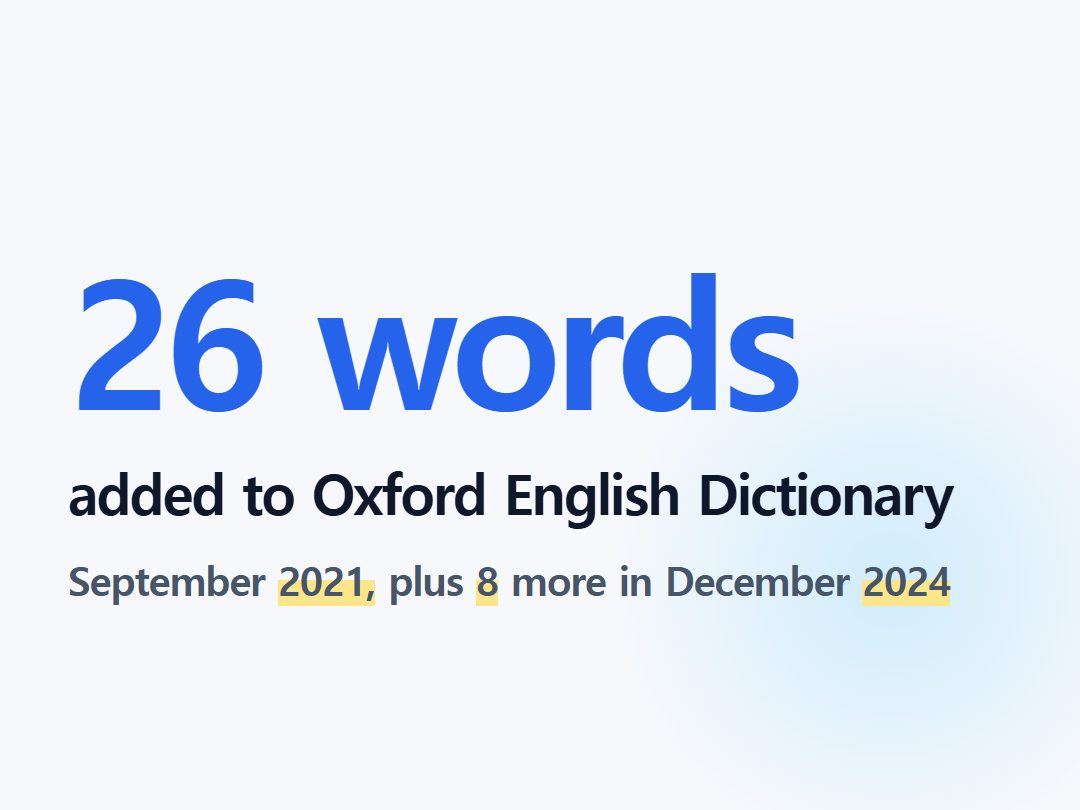
In September 2021, the Oxford English Dictionary (OED) added 26 words of Korean origin in a single update. Three of the most visible were mukbang, chimaek and daebak — words that now show up in English-language headlines, menus and captions without translation.
But the English versions of these words are not quite the same as the Korean ones they came from. Tracking how each word crossed over, and what got left behind, explains more about how Korean pop culture actually spreads than the fact of the dictionary entry does.
The short version
- Oxford added 26 Korean words in 2021, then 8 more in 2024.
- Each word changed meaning crossing into English — none matches its Korean sense exactly.
- Words like chimaek and mukbang are still slang, not standard, in Korean itself.
How many Korean words has Oxford added?
The OED's September 2021 update added 26 Korean-origin words, including mukbang, chimaek, daebak, hallyu, hanbok, aegyo, banchan, K-drama and skinship.
The entries were drafted under Danica Salazar, the OED's World English Editor, as part of the dictionary's ongoing project to document English as it is actually used outside Britain and the United States — not just new slang, but words borrowed wholesale from other languages.
The dictionary's own explainer, titled “Daebak! The OED gets a K-update,” credited the global success of Parasite, Squid Game, K-dramas and K-pop for pushing these words into everyday English usage.
It was not a one-off. In its December 2024 update, the OED added eight more Korean words: dalgona, dalgona coffee, hyung, noraebang (a private karaoke room), maknae (the youngest member of a group), jjigae (a broth-based stew), tteokbokki and pansori.
Merriam-Webster, the leading American dictionary, has moved more cautiously — it lists mukbang only in its separate online Slang Dictionary, and has no entries yet for chimaek or daebak, though its Unabridged edition has long carried older Korean loanwords like kimchi, taekwondo and bulgogi.
What English speakers kept, and left behind
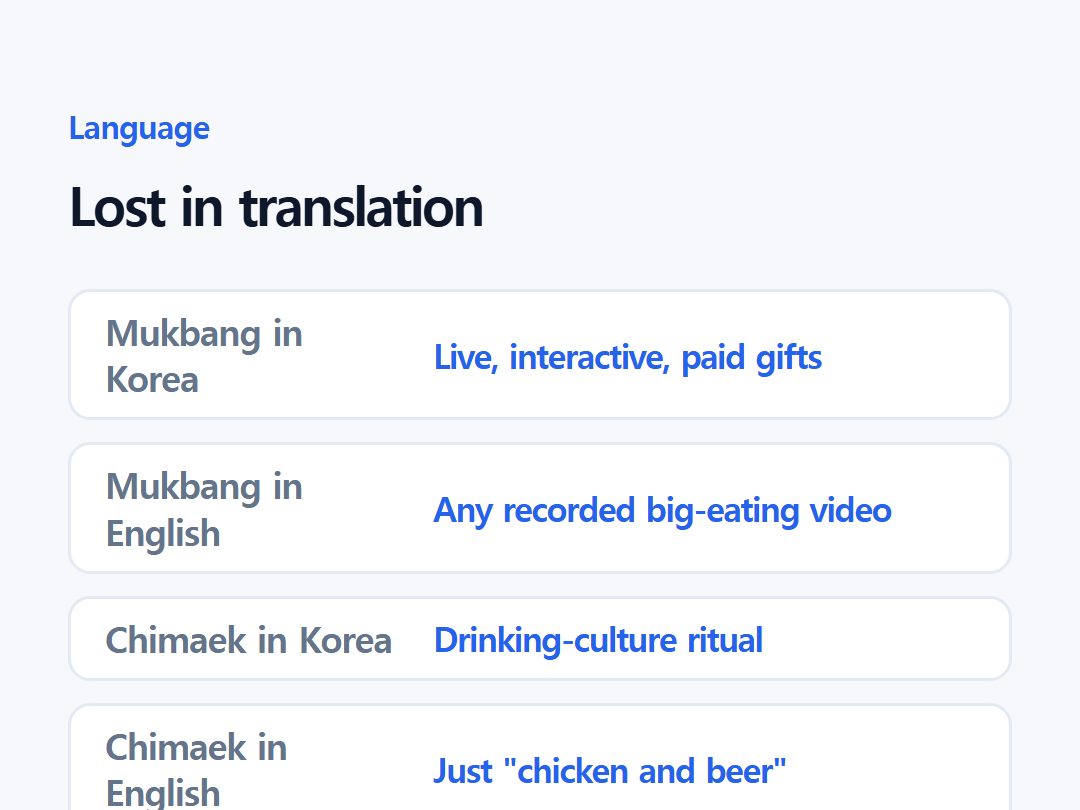
The headline fact — “Korean words are in the dictionary now” — is the easy part. What is harder to see from outside Korea is that each of these words changed shape on the way over. None of them means in English exactly what it means in Korean, and the gaps are not random; they show what English speakers actually noticed and kept.
Mukbang: the spelling English speakers invented
Mukbang is a Korean portmanteau of meok (eat) and bangsong (broadcast).
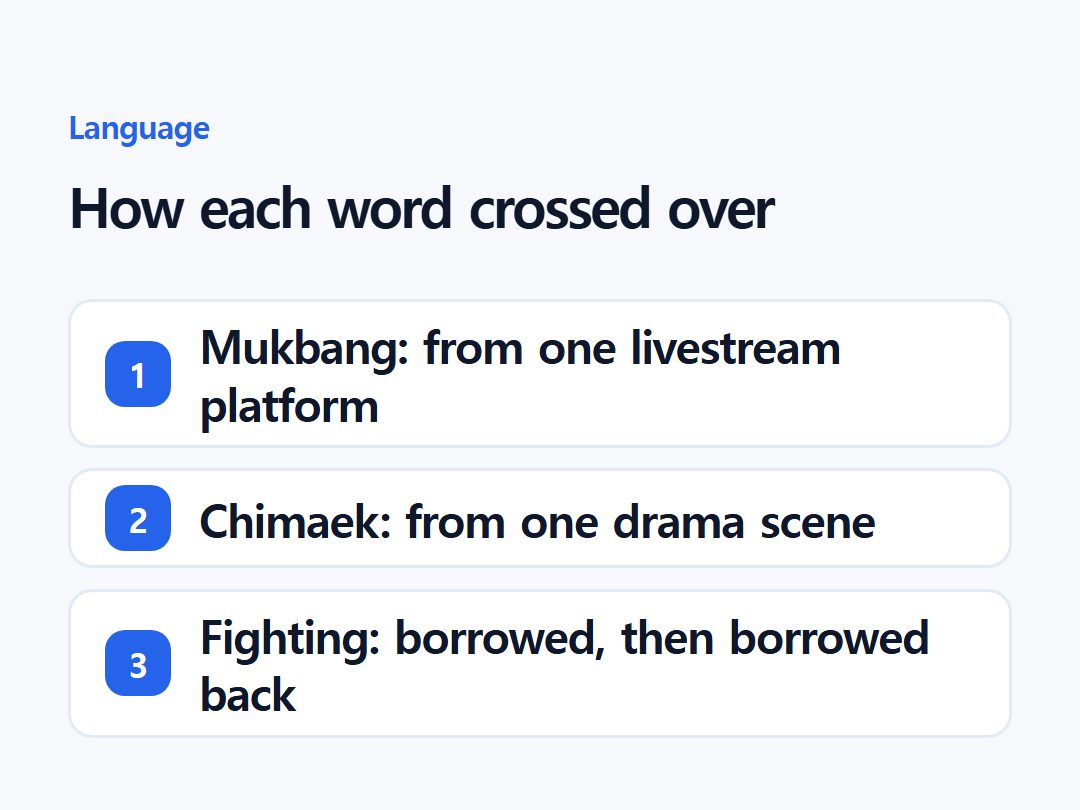
The genre began around 2009 on AfreecaTV, a Korean livestreaming platform, where individual streamers — called BJs, short for “broadcast jockeys,” the same naming pattern as DJ — ate on camera while chatting with viewers, who sent paid digital gifts called byeolpungseon (“star balloons”) in real time.
That interactive, live, gift-funded structure is central to how the word is used in Korea.
In English, mukbang has mostly come to mean any video of someone eating a large amount of food on camera, live or not — the interactive, monetized streaming culture that gave the format its name is largely invisible to international viewers who encounter it as a recorded YouTube genre.
The dictionary entry itself reflects this drift. The technically correct romanization of 먹방 is “meokbang,” but the OED entered the word as “mukbang” — the spelling English speakers had already settled on.
The editors chose to codify how the word was actually being used abroad rather than how it transliterates, which is itself a small piece of evidence for how much the term had already been reshaped before it reached the dictionary.
Chimaek: one TV scene did the work
Chimaek fuses chi, from chikin (fried chicken), with maek, from maekju (beer).
Fried chicken itself is a mid-20th-century import to Korea, introduced through contact with American soldiers, and the chicken-and-beer pairing as a fixture of Korean drinking culture dates to the late 1970s, growing further during the hard economic years after the 1997 Asian financial crisis.
In Korea, chimaek is anju — food eaten specifically to accompany alcohol — tied to a whole evening social ritual, not just a menu item.
The word barely existed outside Korea until a single television moment. In the 2013–2014 drama My Love from the Star, the lead character declares that a snowy day calls for chimaek.
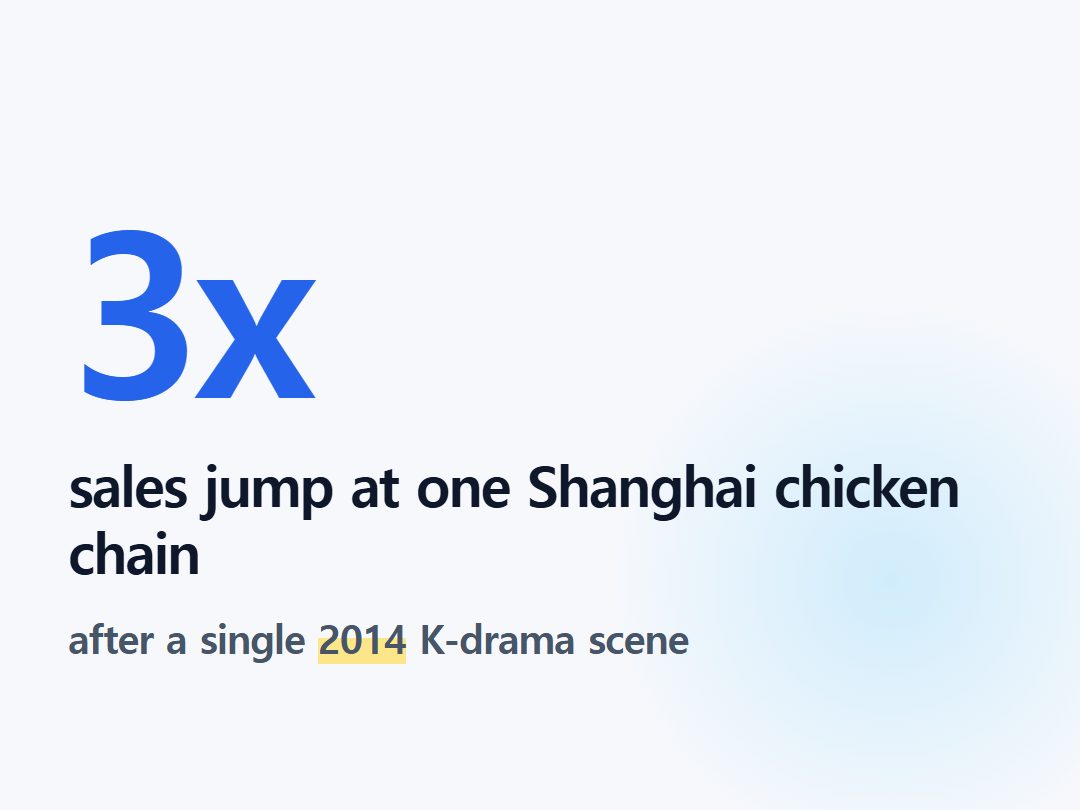
The line set off a documented craze in China: CNN reported that sales at one Kyochon Chicken branch in Shanghai more than tripled over the previous year, with customers waiting two hours in line, and Chinese state media credited the trend with helping revive chicken farms hit by avian flu concerns.
Variety covered the same wave in early 2014, describing a nationwide Chinese craze for “chi-mek.” The OED's entry for chimaek explicitly credits the drama with popularizing the term outside Korea.
Outside Korea, chimaek is now mostly just a novelty label for “chicken and beer” — the drinking-culture context that gives the word its meaning at home rarely travels with it.
Daebak: a word whose own origin is disputed
Daebak is used in Korean as both a noun (a windfall or jackpot) and an exclamation roughly equivalent to “no way!” or “awesome!” What makes it an unusual case is that Korean speakers themselves do not agree on where it comes from.
The most common folk explanation ties it to gambling — a big win against a stake.
The OED's own etymology instead breaks it down as dae (“large,” from Middle Chinese) plus bak (“pumpkin” or gourd), and notes flatly that “the semantic motivation is uncertain and disputed.” The dictionary's earliest documented use is from 2003.
In other words, daebak was already modern slang with a contested history before English adopted it — not an old, fixed word getting “translated,” but a moving target that K-pop and K-drama exposure simply carried further and stripped of most of its original financial sense, leaving mainly the exclamation.
Fighting: the loanword that went both ways
Most of these words travel in one direction, Korean into English. “Fighting” — written 화이팅 (hwaiting) or 파이팅 (paiting) in Korean — is the exception, and arguably the clearest illustration of how much meaning shifts in transit.
It started as the English word “fighting,” entered Korean sometime in the 20th century, and was repurposed there as a general cheer of encouragement with no combat meaning at all — closer to “you can do it!” than anything about a fight.
K-pop fandom and K-drama subtitles then carried that Korean sense back into English, where it now appears as a borrowed word meaning encouragement, distinct from the English word it originally came from. The OED's entry documents this Korean sense specifically, treating it as a Korean loanword despite its English root.
There is also a quieter, more surprising fact underneath all of this: several of these words are less official in Korean than they now are in English.
Academic analysis of the OED's Korean-origin entries has noted that terms like chimaek and skinship appear only in informal, crowd-sourced Korean references such as Urimal Saem, not in Korea's own Standard Korean Language Dictionary — and mukbang is even less formally recognized at home.
The words international readers now find defined in a dictionary are, in their home language, still treated as slang.
From trade routes to viral drama scenes
Korean words entered English in at least two distinct waves, and the mechanism changed between them. The earlier wave — kimchi, taekwondo, hanbok, bulgogi — arrived through more traditional channels: trade, martial arts instruction, Korean restaurants, immigrant communities.
These words moved roughly the way most loanwords always have, attached to physical goods and institutions that Korean communities exported directly.
The second wave, which includes mukbang, chimaek, daebak and fighting, moved through digital and broadcast media instead.
Mukbang spread from a niche livestreaming platform into mainstream Korean vocabulary partly because actor Ha Jung-woo's eating scenes in the 2010 film The Yellow Sea went viral online — one Korean film critic has said that film is where he first learned the word. Chimaek crossed over because of one line in one drama.
Daebak and fighting spread through the sheer volume of subtitled K-drama and K-pop content consumed by international fans, who picked up the words directly from context rather than from a phrasebook.
By the time Parasite won the Academy Award for Best Picture in 2020 and Squid Game became a global Netflix phenomenon in 2021, the volume of Korean vocabulary already circulating in English-language fan spaces was large enough that Oxford's editors treated it as a documentable trend rather than scattered slang, and built a dedicated 26-word update around it.
The December 2024 follow-up, adding maknae, hyung, noraebang and others, shows this was not a one-time acknowledgment but an ongoing editorial project tracking a still-expanding vocabulary.
Will Merriam-Webster ever add chimaek and daebak?
Merriam-Webster has not followed the OED's lead on chimaek or daebak, so it remains an open question whether the more slang-heavy end of this vocabulary will cross into mainstream American dictionaries or stay confined to the OED's broader “World Englishes” project.
K-pop fandom vocabulary is also still expanding faster than dictionaries can track it — terms like maknae and bias, common in English-language fan writing, are only beginning to get formal recognition.
And there is a reverse question worth watching too: whether South Korea's own language authorities eventually add words like chimaek and mukbang to the official Standard Korean Language Dictionary, now that they are documented abroad before they are documented at home.
How four Korean words changed meaning crossing into English
| Word | Meaning in Korea | Meaning in English |
|---|---|---|
| Mukbang | Live, interactive eating broadcast funded by viewer gifts (byeolpungseon) | Any video of someone eating a large amount of food, live or recorded |
| Chimaek | Anju — chicken and beer eaten as part of a social drinking ritual | Novelty label for "chicken and beer" |
| Daebak | Noun for a windfall/jackpot and an exclamation, with disputed origin | Mostly just an exclamation, stripped of the financial sense |
| Fighting | General cheer of encouragement, no combat meaning | Borrowed word for encouragement, distinct from the original English word |
Frequently asked
Why did the Oxford English Dictionary add Korean words?
The OED credited the global success of Parasite, Squid Game, K-dramas and K-pop for pushing words like mukbang, chimaek and daebak into everyday English use.
What does mukbang mean in Korean versus English?
In Korean it refers to interactive, live eating broadcasts funded by viewer gifts, but in English it has come to mean any video of someone eating a large amount of food, live or recorded.
Why is daebak's origin disputed?
Korean speakers disagree on daebak's origin — a folk theory ties it to a gambling win, while the OED traces it to Chinese-derived words for "large" and "pumpkin" and calls the link uncertain.
Sources
Every factual claim above is traceable. We do not translate articles — we gather facts from multiple outlets and write them ourselves.
- 26 Korean words added to Oxford English Dictionary — Korea.net
- 'Korean wave' sweeps Oxford English Dictionary as new words are added — CNN
- Oxford English Dictionary adds 26 Korean words to 'enrich the English language' — CBC Radio
- chimaek, n. — meanings, etymology and more — Oxford English Dictionary
- daebak, n., int., & adj. — meanings, etymology and more — Oxford English Dictionary
- Mukbang — Slang Dictionary — Merriam-Webster
- From 'dalgona' to 'hyung,' Oxford English Dictionary welcomes 8 new Korean words — The Korea Times
- Chimaek: Korean fried chicken and beer — CNN Travel
- Korean 'Star' Shines in China's Political, Online Firmaments — Variety