Scroll through K-pop fan accounts on any given week and you will likely see "ALL KILL" trending in capital letters. It sounds like a big deal, and sometimes it is — but most of the time, it is not the achievement people think it is.
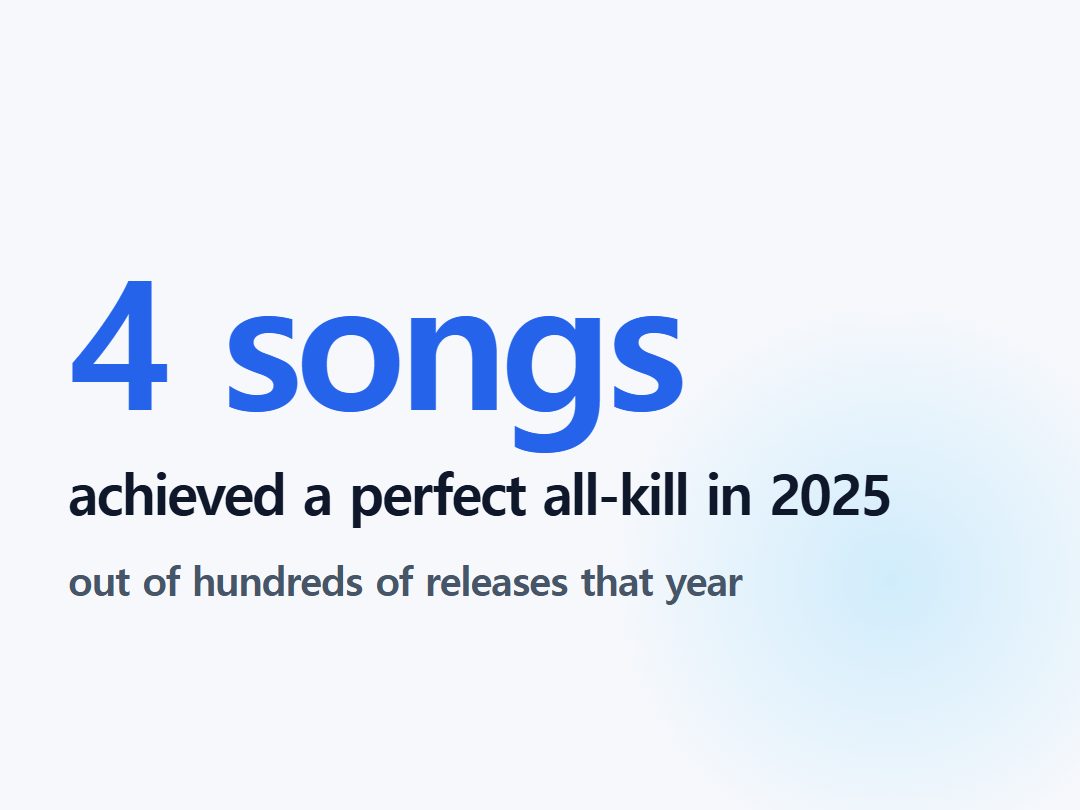
The real benchmark, a perfect all-kill (PAK), is far rarer: in all of 2025, only four songs achieved one, out of hundreds of releases that year. Understanding the gap between the two explains one of the more misunderstood numbers in Korean pop culture reporting.
The short version
- Only four songs achieved a perfect all-kill in all of 2025.
- "Golden" by HUNTR/X set the all-time PAK record with 1,484 hours.
- IU has scored the most PAK songs ever, over 20 tracks.
What actually makes an all-kill 'perfect'?
A perfect all-kill happens when a single song is simultaneously ranked No. 1 on every tier of South Korea's major digital charts at the same moment: the real-time charts, the daily charts, and the weekly chart.
In practice, that means topping the real-time and daily rankings of platforms such as Melon, Genie, Bugs, FLO, and VIBE, plus YouTube Music's chart, and the real-time and weekly rankings on iChart — an aggregator run by the online forum and media company Instiz that compiles data across all of these services into one composite ranking.
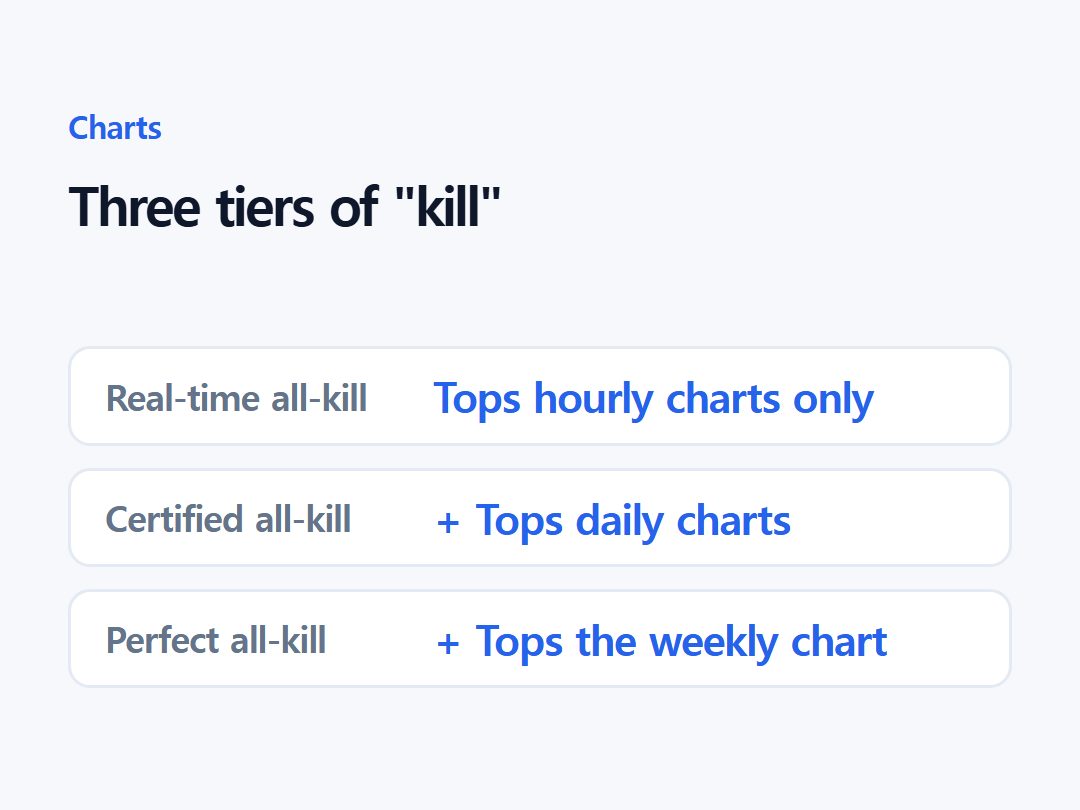
The term exists in a hierarchy, and most of what gets called an "all-kill" on social media is actually the lowest rung of it. A real-time all-kill only requires topping the hourly real-time charts, which can be done in a short, concentrated burst. A certified all-kill is a step up — the song has to hold No.
1 on both the real-time and daily charts, proving it survived a full day of listening, not just an hour. A perfect all-kill adds one more requirement on top of that: the song also has to be No. 1 on iChart's weekly chart, which only updates by aggregating a full week of listening data.
That extra week is what makes PAK the hardest of the three to reach, and it is also what makes it meaningful.
Why can't fandoms fake a weekly win?
This is the part international coverage tends to skip, and it is the actual point of the metric. Real-time charts reset by the hour and are the easiest of the three to move with concentrated effort — a dedicated fandom logging into streaming apps at the same time can push a song to No.
1 for a stretch, even if casual listeners never hear it. This is exactly why real-time all-kills happen constantly and rarely make news on their own: they mostly measure how well-organized a fanbase is, not how popular a song is with the general public.
The weekly chart works differently. It is built from seven days of aggregated listening across the entire population using these platforms, most of whom are not coordinating anything — they are simply choosing what to play.
A song cannot fake a full week of that through fan mobilization alone; it needs to be the thing casual, non-fan listeners are actually choosing on their commutes, in cafes, and on background playlists.
A perfect all-kill requires a song to win both games at once: the short, fandom-driven real-time sprint, and the long, public-driven weekly marathon.
That combination is precisely why Korean fans treat a PAK announcement as a genuine milestone, while international observers who only see "all-kill" headlines often cannot tell the difference between a coordinated fan push and an actual crossover hit.
2025 supplied an unusually clean illustration of this.
The song that ended up with the most perfect all-kills of the year, and the most in the history of the metric, was "Golden" by HUNTR/X — the fictional girl group from Netflix's animated film K-Pop Demon Hunters, voiced by session vocalists Ejae, Audrey Nuna, and Rei Ami.
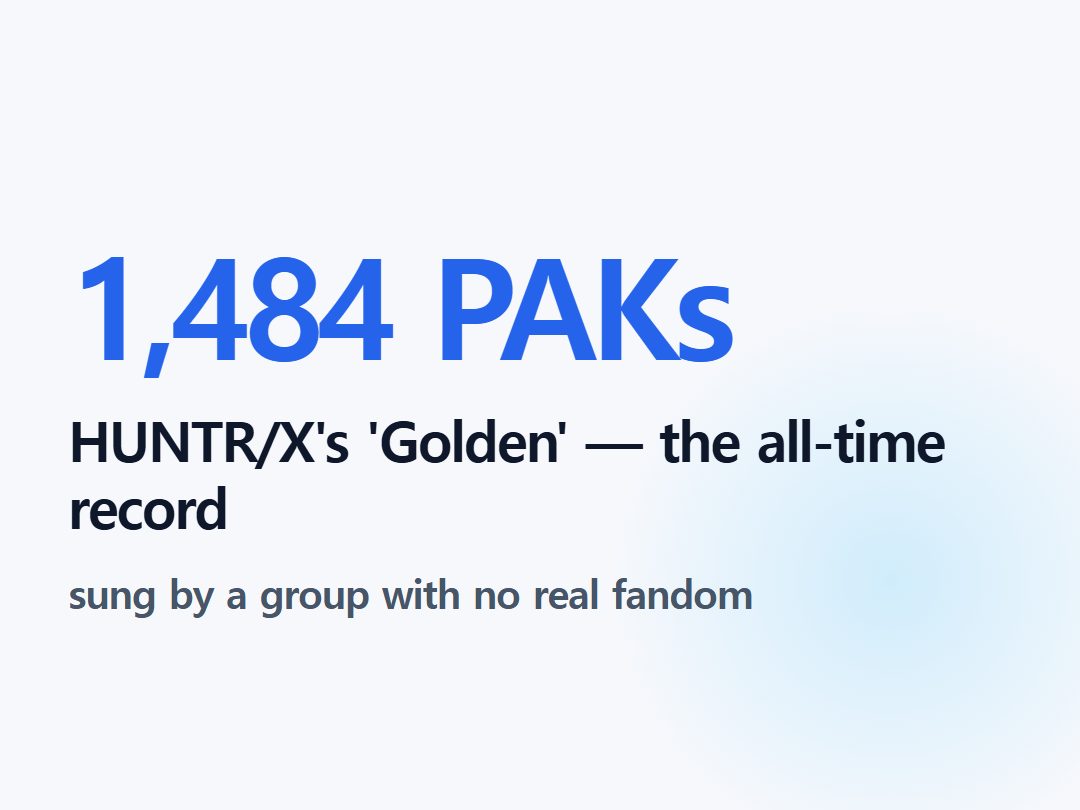
HUNTR/X is not a real idol group; it has no trainee system, no fandom name, and no organized streaming base behind it. Yet "Golden" broke every prior PAK record, becoming the first song ever to cross 1,000 individual PAK hours, en route to a final tally of 1,484 — more than double the previous record holder.
A song with literally no fandom to mobilize out-performed every idol comeback of the year specifically because the weekly chart cannot be gamed by fan coordination; it reflects what ordinary listeners were actually streaming.
The same logic explains why the artist with the most PAK-winning songs in Korean chart history is not a group with an especially large or vocal fandom, but the solo singer-songwriter IU, who has scored more than 20 individual songs to PAK status — more than double the tally of the next closest act.
IU's fanbase is loyal, but her chart dominance is driven mainly by consistent mainstream radio and streaming presence built over more than a decade, which is exactly the profile a weekly chart is designed to reward.
The 2010 IU duet that coined the term
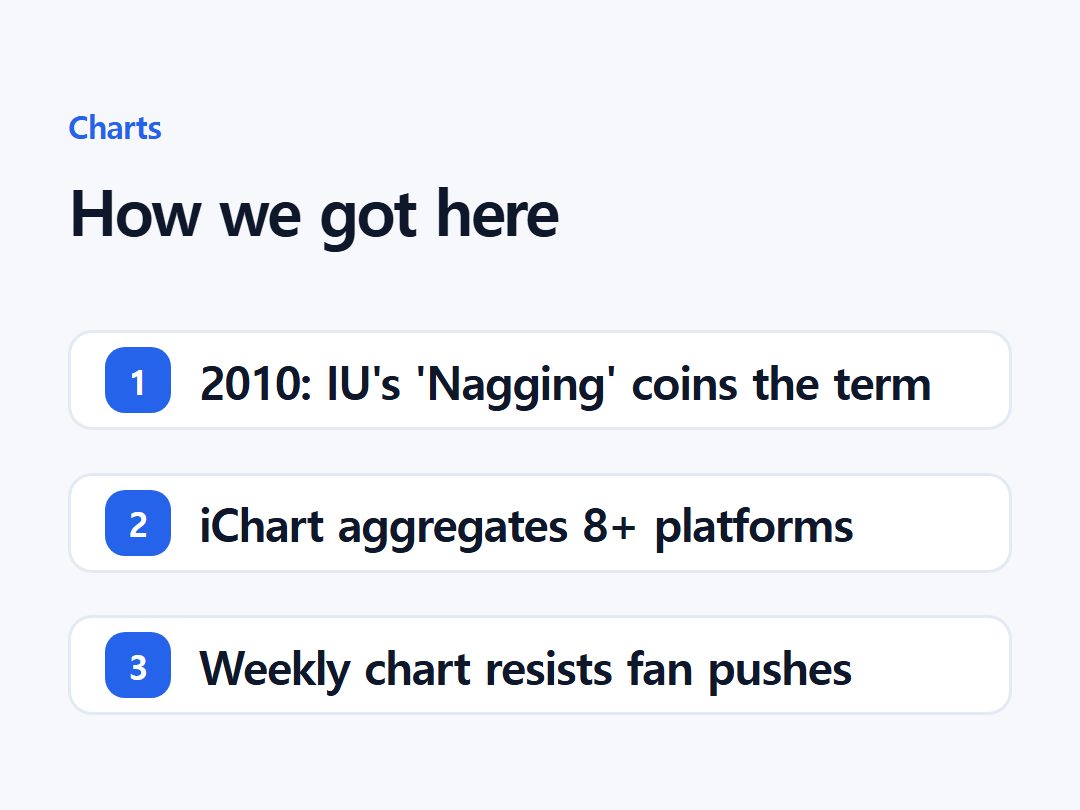
The term traces back to a specific week in Korean pop history. In June 2010, IU's duet with singer Seulong, "Nagging," swept every major domestic chart at once, and fans on the Instiz forum began describing the feat as a "perfect all-kill" to distinguish it from an ordinary all-kill.
Instiz's iChart, which had launched just a few months earlier in March 2010 as a way to combine rankings from multiple services into a single number, became the unofficial scoreboard for tracking the achievement going forward — and it remains the source every PAK announcement is credited to today.
Since then, the bar has stayed roughly constant even as the industry around it has changed dramatically, with far more comebacks — a K-pop act's return with new music and promotion — competing for the same handful of weekly No. 1 slots.
Wikipedia's tracking put the total number of songs to ever achieve PAK at a little over 80 as of late 2023, a small figure relative to the sheer volume of music released in Korea since 2010.
That scarcity is the entire reason the metric still carries weight with Korean fans: it has never been easy, and the four PAKs recorded across 2025 — IVE's "Rebel Heart," G-Dragon's "Too Bad" featuring Anderson .Paak, HUNTR/X's "Golden," and Hwasa's "Good Goodbye" (the year's first by a female soloist, confirmed on November 30) — were treated as genuine news events precisely because so few songs manage it in any given year.
A fan-tracked metric that could still evolve
It is worth being precise about what a PAK is not: it is not an official industry chart position issued by a government body or a record label association. It is a fan-coined, fan-tracked metric built on top of Instiz's private aggregation of commercial streaming data, which is why counts occasionally vary slightly between fan-run tracking accounts even when the underlying achievement is not in dispute.
That aggregation method is also still evolving. iChart has periodically expanded which platforms and metrics feed into its rankings, and further changes to which services count toward real-time and daily standings could make future PAKs either easier or harder to reach, depending on how the math shifts.
Whether "Golden" — a song with no traditional fandom behind it — remains the all-time PAK record holder, or whether a conventional idol act eventually overtakes it, will be one of the more interesting data points for tracking how much genuine crossover appeal, versus organized fan support, now drives Korea's biggest hits.
The three tiers of "all-kill," from easiest to hardest
| Tier | Requirement | What it proves |
|---|---|---|
| Real-time all-kill | No. 1 on hourly real-time charts | A fandom can mobilize for a short burst |
| Certified all-kill | No. 1 on both real-time and daily charts | The song held No. 1 through a full day |
| Perfect all-kill (PAK) | No. 1 on real-time, daily, and iChart's weekly chart | The song won over casual listeners for a full week |
Frequently asked
What is the difference between an all-kill and a perfect all-kill?
A real-time all-kill only requires topping the hourly real-time charts, while a perfect all-kill requires No. 1 on the real-time, daily, and weekly iChart rankings all at once.
How many perfect all-kills happened in 2025?
Only four songs achieved a perfect all-kill in 2025: IVE's "Rebel Heart," G-Dragon's "Too Bad" featuring Anderson .Paak, HUNTR/X's "Golden," and Hwasa's "Good Goodbye."
What song holds the record for the most perfect all-kill hours?
"Golden" by HUNTR/X holds the all-time record, becoming the first song to cross 1,000 individual PAK hours and finishing 2025 with a final tally of 1,484.
Sources
Every factual claim above is traceable. We do not translate articles — we gather facts from multiple outlets and write them ourselves.
- Perfect all-kill — Wikipedia
- MAMAMOO's Hwasa Becomes 1st Female Soloist To Achieve Perfect All-Kill In 2025 — Soompi
- G-Dragon's "TOO BAD" Becomes 2nd Song To Achieve Perfect All-Kill In 2025 — Soompi
- The Only Four Songs that Achieved the Coveted Perfect All-Kills in 2025 — allkpop
- Songs That Have Achieved A Perfect All-Kill (PAK) (Updated!) — Kpop Profiles
- K-pop songs with the most Perfect All-kills in history — allkpop