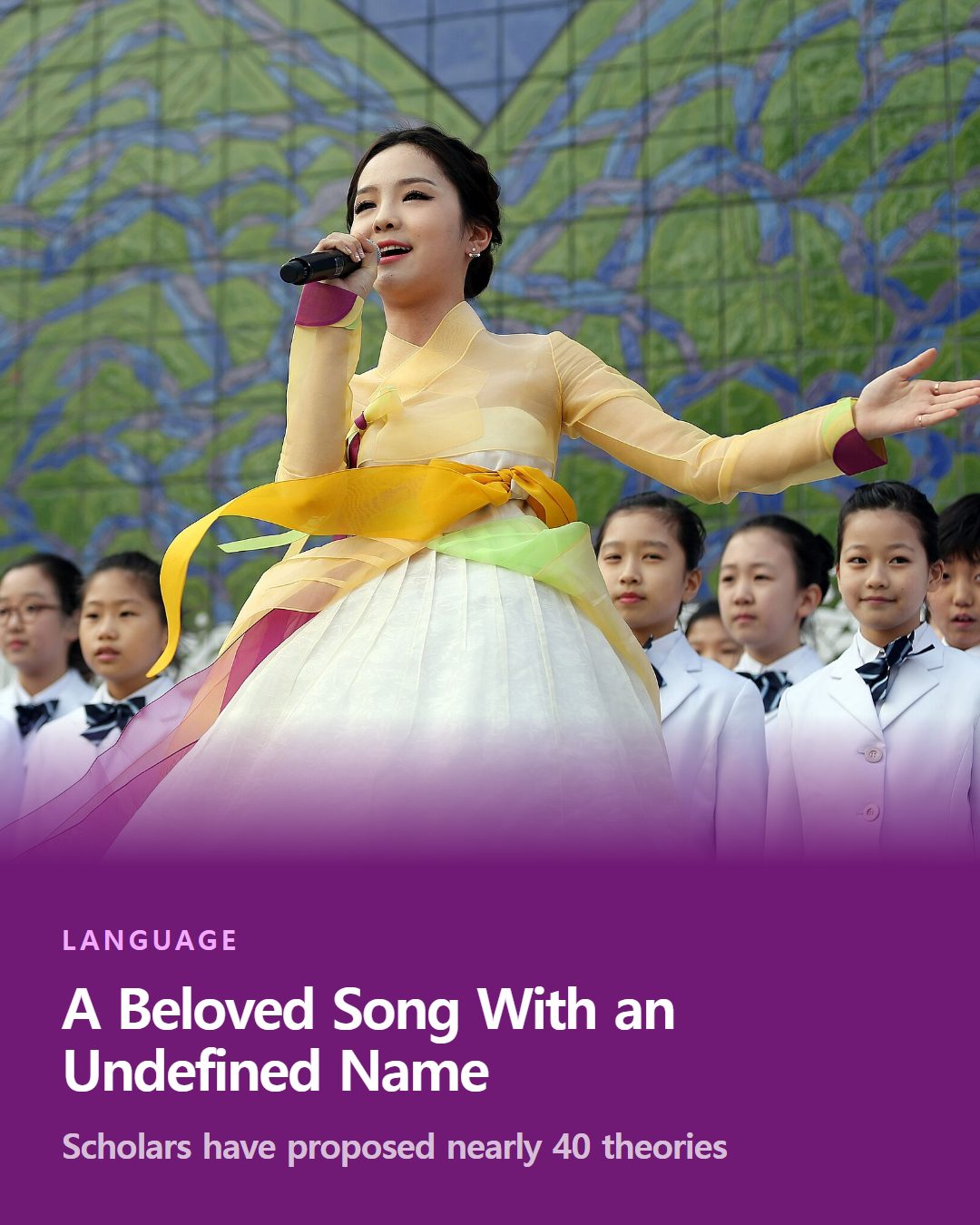
Arirang is the song most Koreans agree on and the word none of them can define. It is sung in Seoul and in Pyongyang, printed into two separate UNESCO heritage listings, and functions as something close to Korea's unofficial national anthem. Ask what the word "arirang" itself means, though, and even specialists start disagreeing.
The short version
- "Arirang" has no dictionary meaning — just a refrain sung in thousands of variants.
- Scholars have proposed roughly 40 rival etymologies, but none is widely accepted.
- UNESCO listed South Korea's Arirang in 2012 and North Korea's version in 2014.
That gap between a universally sung word and its missing definition is not a fringe curiosity. It has produced one of the longest-running open questions in Korean linguistics, and it is still unresolved.
A Word Missing From Korean Dictionaries
"Arirang" is not a standalone word in modern Korean. It carries no dictionary definition, no independent grammar, and no use outside the song itself. It survives only as a refrain, "arirang, arirang, arariyo," repeated across thousands of regional variants.
Researchers who study the song's history are blunt about the problem: nobody is certain when the term first arose, and nobody is certain what it originally meant, if it meant anything at all.
One Refrain, Thousands of Regional Versions
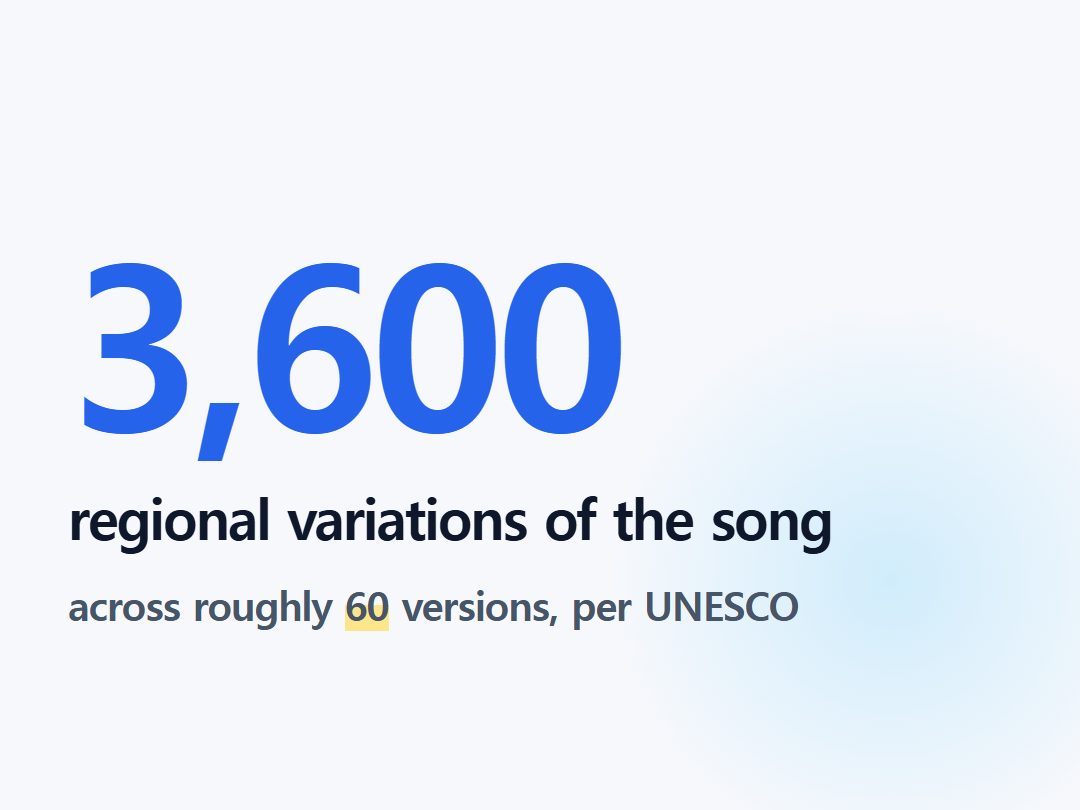
South Korea's own nomination to UNESCO put a number on the song's spread: an estimated 3,600 regional variations belonging to roughly 60 distinct versions, collected from across the peninsula.
Three versions are usually singled out as the most historically significant, together known as the "three great Arirangs":
- Jeongseon Arirang, from a mountain county in Gangwon Province, generally regarded as the oldest surviving form
- Jindo Arirang, from the southwestern Jeolla region
- Miryang Arirang, from the southeastern Gyeongsang region
A fourth, the "standard" Seoul-area Arirang popularized by a 1926 film, is the version most listeners today would recognize, despite being historically the newest of the major variants.
Nearly Forty Rival Theories, No Winner
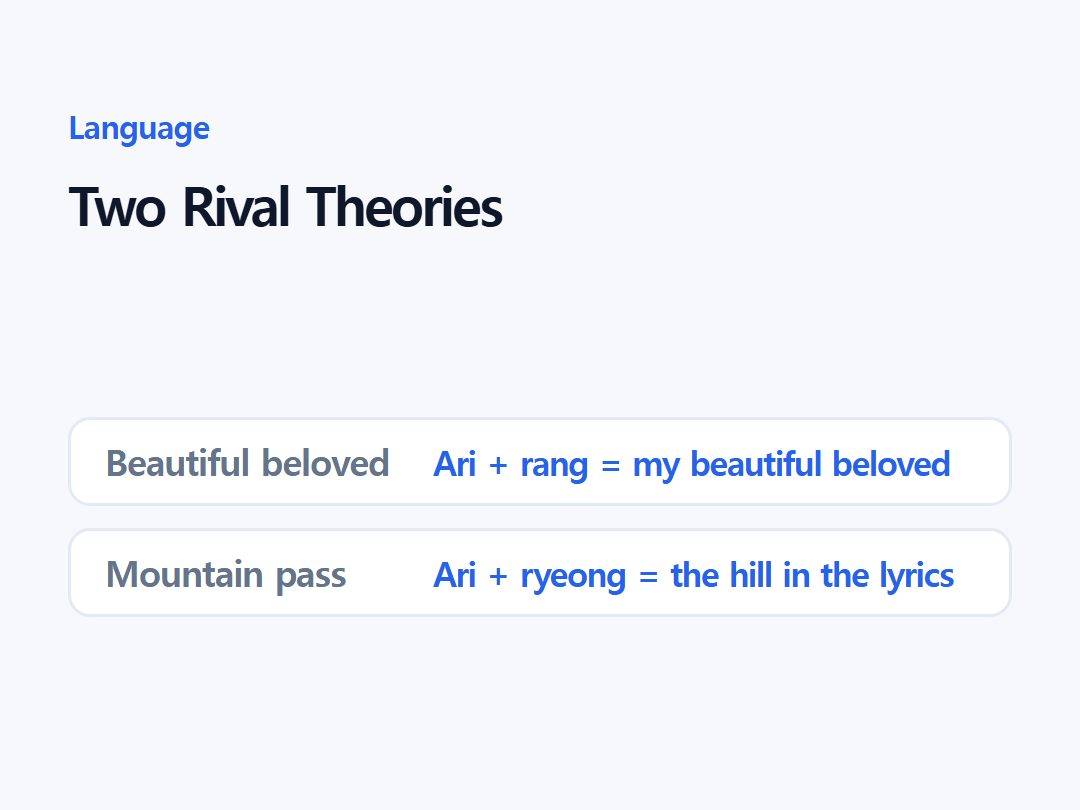
Korean researchers have counted roughly 40 separate proposed etymologies for the word "arirang," ranging from ancient personal names to Chinese-character wordplay. None has become the accepted answer.
That is unusual by the standards of folk-music scholarship. Most well-documented folk songs, even centuries-old ones, can be traced to a known origin point. Arirang cannot — and concrete written references to the song are thin before the 1800s, even though many scholars believe the melody itself is far older.
| Theory | Core claim |
|---|---|
| Beautiful beloved | "Ari" (beautiful) + "rang" (beloved) form a term of endearment |
| Mountain pass | "Ari" (long) + "ryeong" (pass) describe the hill in the lyrics |
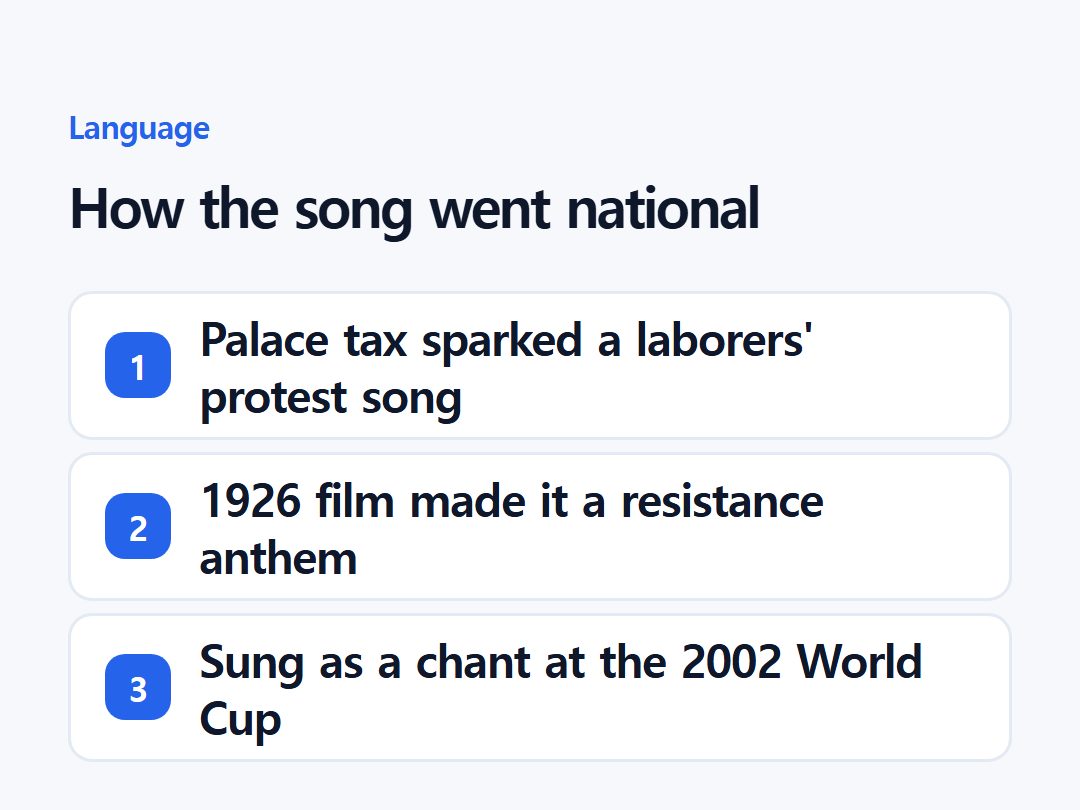
| Forced-labor protest | A 19th-century lament over a compulsory palace construction tax |
| Meaningless refrain | Pure sound, echoing an older nonsense chorus in Korean court poetry |
The Leading Theory: "Beautiful" Plus "Beloved"
The most frequently cited explanation, developed by sociologist Shin Yong-ha, splits the word into two old Korean roots: "ari," meaning beautiful or pleasant, and "rang," an old term of address for a beloved person. Together, he argues, they once meant something close to "my beautiful beloved."
It is a tidy fit for a song whose lyrics, in almost every regional version, center on separation from a loved one. Critics of the theory argue the underlying word roots do not hold up under closer linguistic analysis, and that the modern Korean word for "beautiful" actually traces to a different root entirely.
A Rival Theory Reads Arirang as a Mountain Pass
A separate camp, following literary scholar Yang Ju-dong, argues the word is geographic rather than romantic. In this reading, "ari" is an old Korean word for "long" or "high," and "rang" derives from a Chinese character for a mountain pass — so "arirang" simply names the hill a departing lover crosses in the song.
Other proposals go further afield. One connects "ari" to ancient roots for light or the sun. Another argues the whole phrase began as pure sound, a meaningless vocal refrain similar to nonsense choruses documented in centuries-old Korean court poetry, that only later got treated as if it carried meaning.
One Theory Traces the Song to a Forced-Labor Protest
The most politically loaded theory ties the word to a specific 1860s event: the reconstruction of Gyeongbokgung, Seoul's main royal palace, ordered by regent Heungseon Daewongun.
To fund the rebuilding, the government levied a tax officially described as a "voluntary donation" that was, in practice, compulsory. Commoners resented it bitterly. One theory holds that laborers conscripted for the project, separated from their families, coined a bitter lament that later blurred, phonetically, into "arirang."
How a Palace Construction Project May Have Spread the Song Nationwide
Whether or not that specific wordplay is accurate, the Gyeongbokgung project is credited with something more verifiable: turning a local Gangwon-province tune into a national one.
Tens of thousands of laborers were conscripted from provinces across the country to work on the reconstruction. Historians studying the period note that workers from Jeongseon brought their local version of the song to the capital, where it mixed with other regional tunes and, over years, produced the Seoul-area variants that eventually became the best known.
From a Silent-Film Resistance Anthem to a World Cup Chant
Arirang's political life did not end with the palace project. During Japan's colonial rule of Korea (1910 to 1945, when Korea was annexed and administered by Japan), the 1926 silent film "Arirang," directed by and starring Na Un-gyu, used the song as its closing theme over a story of a Korean farmer driven to violence by colonial injustice.
Audiences reportedly wept and sang along in theaters, and the film's use of the song is widely credited with turning it into a symbol of resistance under occupation. The same melody resurfaced decades later during South Korea's pro-democracy protest movements of the 1960s through 1980s, and again, in a very different register, as a stadium chant during the 2002 FIFA World Cup that South Korea co-hosted.
Two Koreas, One Song, Two Separate UNESCO Listings
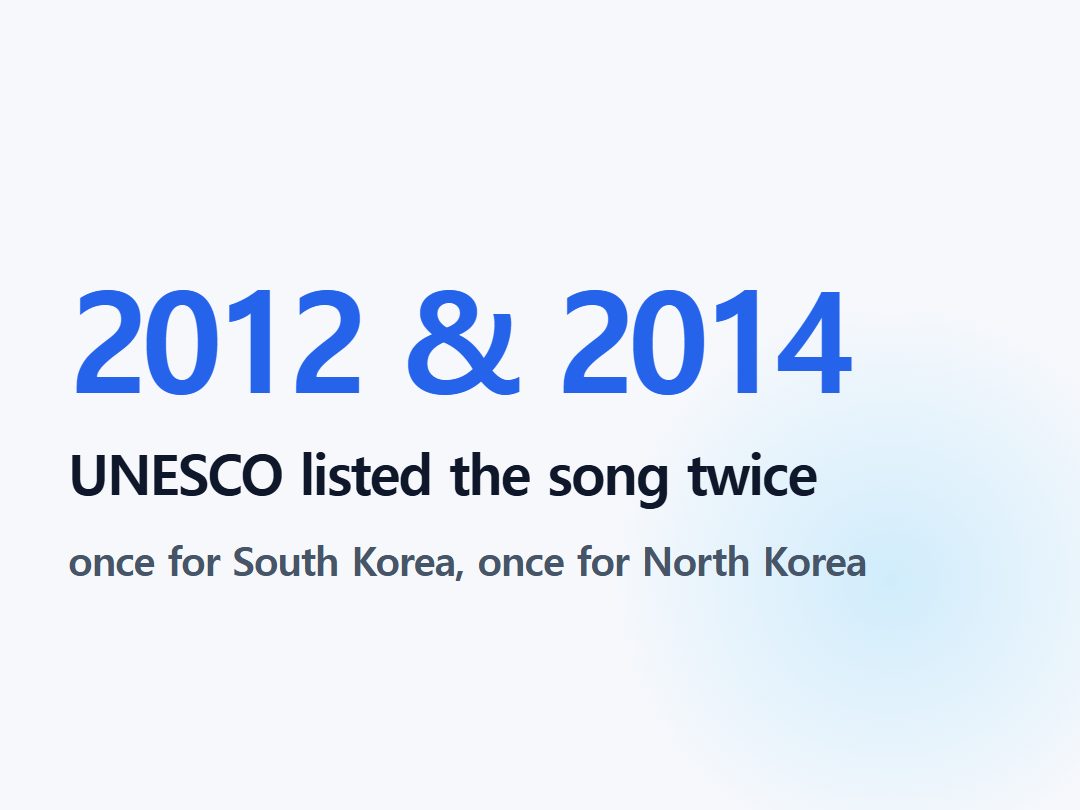
Arirang's cross-border reach is unusual enough that it has been formally recognized twice by the same UN body, in separate submissions eight years apart.
UNESCO added "Arirang, lyrical folk song in the Republic of Korea" to its Representative List of Intangible Cultural Heritage in 2012. North Korea, which had tried and failed to register its own version at that same 2012 session, succeeded two years later: in 2014, UNESCO inscribed "Arirang folk song in the Democratic People's Republic of Korea," covering six North Korean regional variants.
Why Linguists Doubt the Mystery Will Ever Be Solved
Korean historical linguistics has a structural problem underlying this whole debate: unlike English or Chinese, Korean still lacks a comprehensive, broadly accepted etymological dictionary. A serious academic project led by linguist Lee Ki-moon has been underway for years and remains unfinished.
University of Maryland linguist Bob Ramsey, who has written on the Arirang debate specifically, has described much of Korean folk etymology as "free-wheeling," noting that some proposed word histories require what he calls "considerable imagination" to work phonologically.
His conclusion, echoed by other specialists in the field, is that Arirang's origin may not be a puzzle awaiting a clever solution so much as a question the historical record simply cannot settle.
So What Does "Arirang" Actually Mean Today?
None of that unresolved debate has stopped Koreans from using the word constantly. Its meaning today is functional rather than linguistic: a shared refrain that every regional and political version of Korea can sing without needing to agree on where it came from.
That may be closer to an answer than any single etymology could offer. A word that unites two governments who agree on almost nothing else does not need a settled definition to do its job.
Four leading theories on what "arirang" means
| Theory | Core claim |
|---|---|
| Beautiful beloved | "Ari" (beautiful) + "rang" (beloved) form a term of endearment |
| Mountain pass | "Ari" (long) + "ryeong" (pass) describe the hill in the lyrics |
| Forced-labor protest | A 19th-century lament over a compulsory palace construction tax |
| Meaningless refrain | Pure sound, echoing an older nonsense chorus in Korean court poetry |
Frequently asked
What does the word Arirang actually mean?
No one knows for certain. Korean researchers have counted roughly 40 proposed etymologies, from "beautiful beloved" to a mountain pass name, but none has become the accepted answer.
Is Arirang the national anthem of Korea?
Not officially, but it functions as something close to Korea's unofficial national anthem and is sung in both Seoul and Pyongyang.
How many versions of Arirang are there?
South Korea's UNESCO nomination cited an estimated 3,600 regional variations belonging to roughly 60 distinct versions, with Jeongseon, Jindo, and Miryang Arirang considered the "three great Arirangs."
Sources
Every factual claim above is traceable. We do not translate articles — we gather facts from multiple outlets and write them ourselves.
- Arirang | Korea, Folk Song, Origins, History, & Cultural Significance — Encyclopaedia Britannica
- "Arirang" and Korean Etymology — languagehat.com
- Arirang — Language Log (Victor Mair)
- Arirang listed as UNESCO Intangible Cultural Heritage — The Korea Herald
- North Korea's Arirang wins UNESCO intangible heritage status — The Korea Herald
- From lyrical folk song to cheering song: variations of 'Arirang' in Korean history — The Korea Times
- Arirang (1926 film) — Wikipedia
- 아리랑 (Arirang) — Encyclopedia of Korean Culture, Academy of Korean Studies