Korean fans have a specific word for the moment someone stops following a K-pop group: 탈덕 (taldeok). International fans usually translate it as "unstanning," but the Korean term carries a structure that word doesn't.
The short version
- 탈덕 means leaving a fandom entirely, not just going quiet for a while.
- Korean fan slang tracks six stages, from joining (입덕) to leaving (탈덕).
- Fandom infighting, not dislike of the idol, is the top reason fans leave.
Taldeok is not a single choice made on a single day. It is one stop on a fan vocabulary that tracks an entire relationship with a fandom, from the day someone joins it to the day they formally leave.
For international fans in Korean-language fan spaces, that structure is not trivia. Using taldeok loosely, for a fan who is simply busy or a critic who's still emotionally invested, misreads what a Korean-speaking fan is actually signaling about their own identity.
Taldeok is an exit, not a synonym for quitting
The word splits into two parts: 탈 (tal), meaning to escape or break away, and 덕 (deok), short for 덕후 (deokhu) — Korean fandom slang for an enthusiast, itself adapted from the Japanese word otaku. Put together, taldeok literally means "escaping fan status."
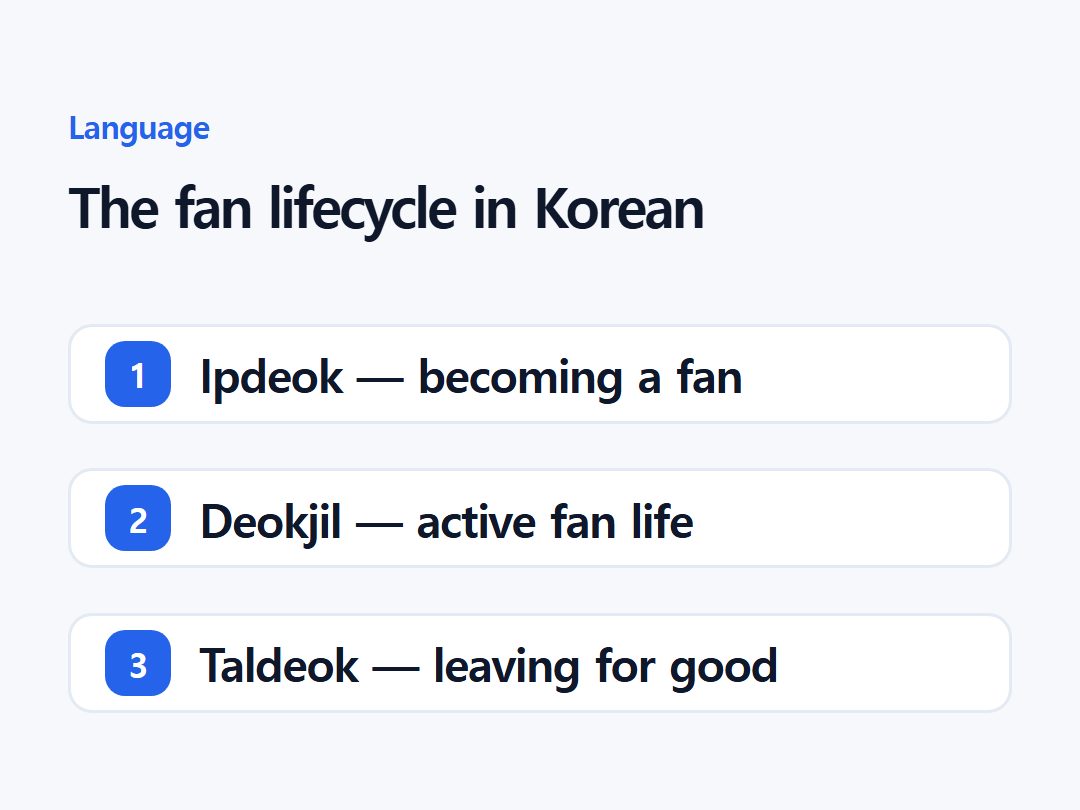
That makes it the direct opposite of 입덕 (ipdeok), "entering fandom," the term fans use for the moment they became one — often traced to one specific video or stage. Korean fan culture treats becoming a fan and leaving a fandom as two ends of the same named process.
Six Korean words map one fan's entire timeline
Korean fan communities describe this timeline with a vocabulary as specific as any industry jargon:
- 입덕 (ipdeok) — becoming a fan, often traced to one triggering clip
- 입덕부정기 (ipdeok-bujeonggi) — the denial phase, becoming a fan while still insisting you're not
- 덕질 (deokjil) — active fan activity: streaming, buying albums, following schedules
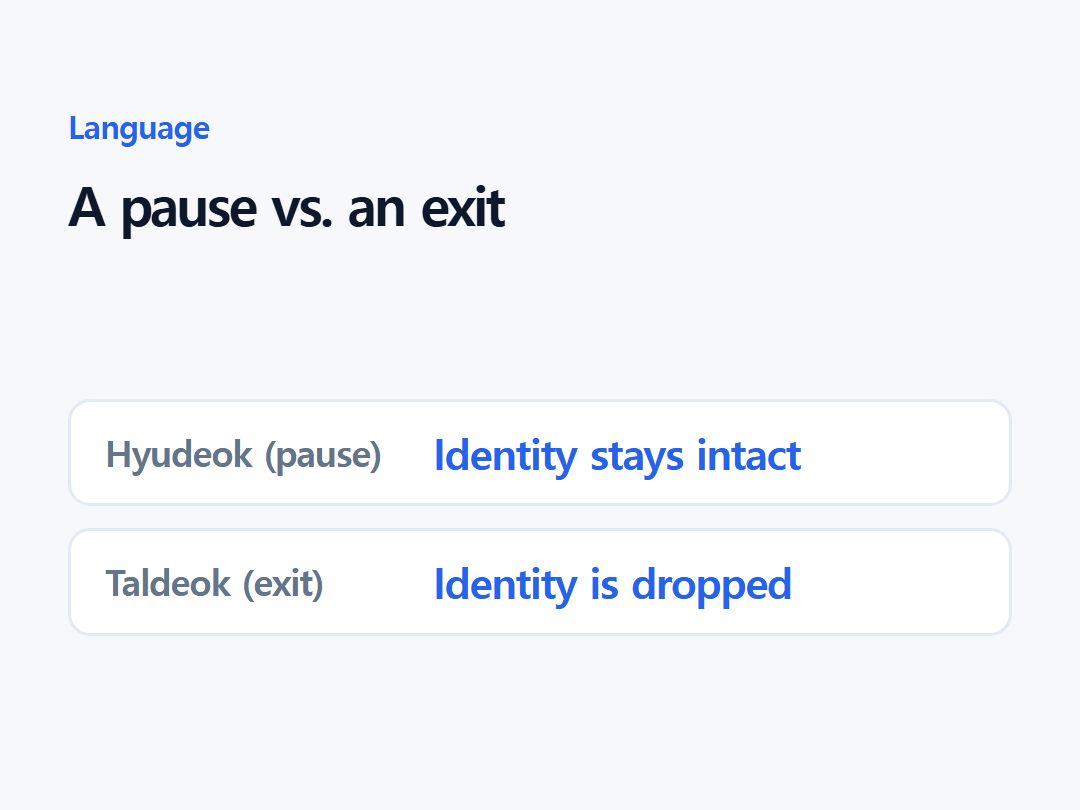
- 휴덕 (hyudeok) — a pause in fan activity, often for school, work, or money
- 탈덕 (taldeok) — leaving the fandom entirely
- 성덕 (seongdeok) — a "successful fan," one whose fandom paid off, sometimes by meeting the idol
English-language fan spaces have no equivalent set. "Obsessed," "casual," and "over it" are the closest available words, and none of them name a stage — only a mood.
Fans use these words as check-ins with each other, not just self-description. Asking whether someone is 휴덕 or already 탈덕 is a normal way to catch up after a quiet stretch, without assuming the answer either way.
A pause and an exit use two different words on purpose
Korean fans are careful to separate 휴덕 (a pause) from 탈덕 (an exit) in everyday conversation. A fan posting less often might write, "탈덕은 아니고 잠깐 쉬는 중이에요" — "I'm not leaving, just resting for a while" — specifically to head off the assumption that quieter fan activity means departure.
| 휴덕 (pause) | 탈덕 (exit) |
|---|---|
| Fan identity stays intact | Fan identity is dropped |
| Usually tied to school, work, or money | Usually tied to disappointment or burnout |
| Return needs no explanation | Return is its own word: 재입덕 (re-entering fandom) |
The distinction matters because it is considered intrusive in Korean fan spaces to ask a quiet fan whether they've left. The two words let a fan announce their own status instead of leaving others to guess.
What actually pushes a fan toward the door
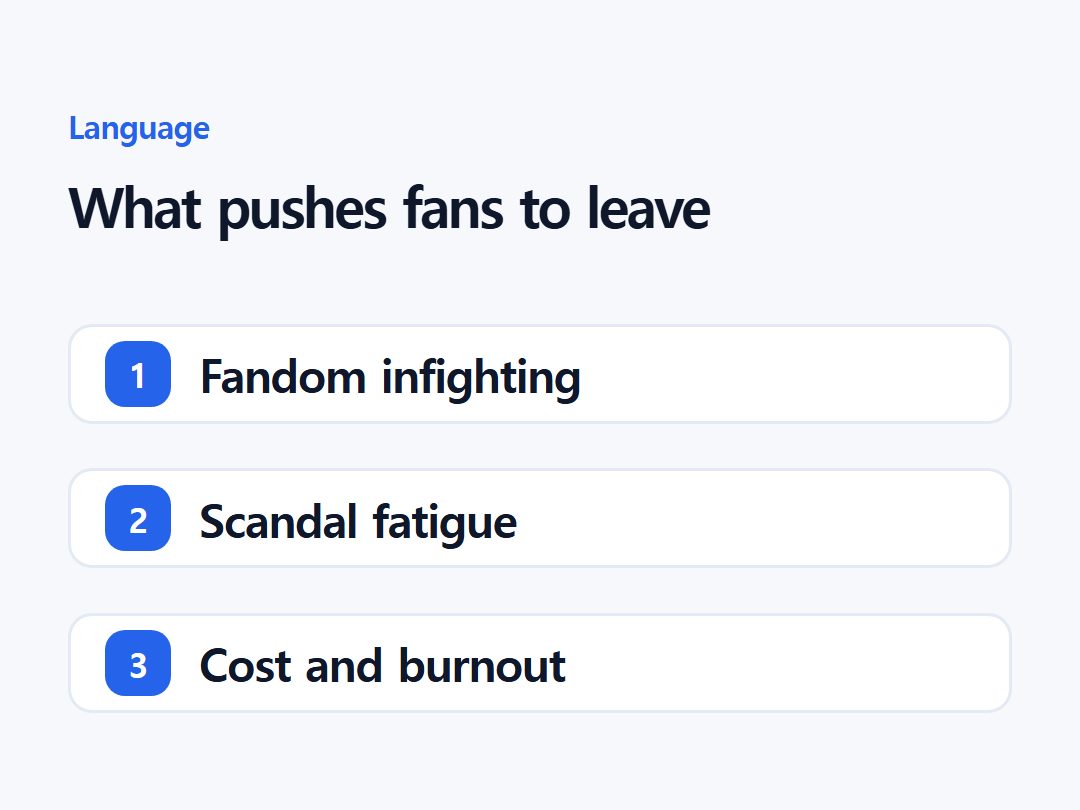
Namuwiki, the community-edited wiki that maintains one of the most detailed records of Korean fandom terminology, lists a consistent set of triggers behind taldeok. Fandom infighting comes up more often than dissatisfaction with the idol themselves.
- Repeated conflict or scandal inside the fandom, not around the idol
- Disillusionment with an idol's actions or an agency's handling of a controversy
- Exhaustion from the cost of streaming, albums, and events
- Losing interest gradually, with no single triggering event
Fans who leave this way describe a specific reaction, one Namuwiki quotes directly: "저런 상식없는 인간들이랑 같은 취미였다는 것에 현타가 온다" — a jolt of embarrassment at having shared a hobby with people whose behavior they can no longer defend. That reaction, more than losing interest in the group, is what tips a break into a full exit.
The merchandise has to go somewhere, and that's the hard part
Years of deokjil leave a physical trail — photocards, light sticks, slogans, posters, and albums bought in multiples for photocard odds. The pile usually mixes 공굿 (gonggut, official agency-issued merchandise) with 비공굿 (bigonggut, unofficial fan-made goods), since collecting both is simply part of being an active fan, not a sign any single item matters.
On 더쿠 (TheQoo), one of Korea's largest fan discussion boards, posts about taldeok are often less about the decision than about what to do with everything bought along the way.
One fan described packing years of concert and fan-meeting merchandise into a suitcase rather than throwing it out, unable to sell it but unwilling to keep displaying it either.
Some fans destroy what they can't bear to sell
Not everyone resells. On the fan forum Thredic, one user described breaking their own merchandise rather than letting a stranger own it, explaining that watching a memory pass to someone else felt worse than losing the object.
The dilemma is built into deokjil itself: buying goods is part of being an active fan, and once that identity ends, the same objects lose the meaning that justified buying them in the first place.
Where the word came from: a Japanese term for graduating obsession
덕후 (deokhu), the root of taldeok, is a Korean adaptation of the Japanese otaku, historically applied to people intensely devoted to anime, games, or idols. The word arrived in Korea carrying a negative charge — obsessive, socially withdrawn — before Korean fan communities reclaimed it as a neutral, even proud, self-description.
Japanese fan culture has its own parallel exit term, オタ卒 (otasotsu), literally "otaku graduation," using 卒業 (graduation) for quitting a fandom the way one finishes school. Taldeok and otasotsu both frame leaving as completing a stage, not abandoning a mistake.
English fan culture has no equivalent word, only "unstan"
International fans translate taldeok as "unstanning," but English fandom vocabulary largely stops there. There is no separate English word for the denial phase, no distinct term for a pause versus an exit, and no word for a fan whose devotion "paid off."
Fans discussing the gap on forums point to a structural difference. Korean fandom developed recognized subcategories — casual fans (얕덕), multi-fandom fans (잡덕 or 겸덕), single-fandom fans — while English-language "stan culture" tends to describe all fans as one undifferentiated group.
A fan identity specific enough to have subcategories is also specific enough to need its own exit word.
Leaving doesn't always mean walking away quietly
Namuwiki's breakdown of taldeok's aftermath lists several paths beyond simply going quiet: a denial phase about having left, sorting through merchandise, re-entering the fandom later (재입덕), or converting into an active critic of the group — 안티 (anti) or 덕혐 (deokhyeom, roughly "fan-hating").
That last path is treated as a recognized, if less common, outcome, most likely among fans who left over unresolved anger at the fandom rather than fading interest in the artist. The intensity that powered years of deokjil doesn't always disappear — sometimes it redirects.
Fans have a name for the ones who keep coming back
Korean slang even accounts for taldeok that doesn't hold. 회전문 (hwoejeonmun), literally "revolving door," describes a fan who repeatedly announces they're leaving and then returns, sometimes to the same fandom more than once.
The term is used affectionately, not as an insult — an acknowledgment that walking away from a parasocial attachment rarely happens as cleanly as flipping a switch. Korean fan communities still disagree on what makes an exit "real": a farewell post, selling every last item, or simply going quiet for good.
What is agreed on is what taldeok is not. It is not a decision made once. It is the last stage of a process the vocabulary had already mapped in five other words before any fan reached it.
The fan lifecycle in six Korean terms
| Term | Stage |
|---|---|
| 입덕 (ipdeok) | Becoming a fan, often traced to one triggering clip |
| 입덕부정기 (ipdeok-bujeonggi) | Denial phase — becoming a fan while still insisting you're not |
| 덕질 (deokjil) | Active fan activity: streaming, buying albums, following schedules |
| 휴덕 (hyudeok) | A pause in fan activity, often for school, work, or money |
| 탈덕 (taldeok) | Leaving the fandom entirely |
| 성덕 (seongdeok) | A "successful fan" whose fandom paid off |
Frequently asked
What does taldeok mean in K-pop fandom?
Taldeok (탈덕) is the Korean fan term for leaving a fandom entirely, combining 탈 (escape) and 덕 (fan) — the direct opposite of 입덕, entering a fandom.
What's the difference between hyudeok and taldeok?
휴덕 (hyudeok) is a temporary pause where fan identity stays intact, while 탈덕 (taldeok) is a full exit where that identity is dropped; returning from taldeok is called 재입덕.
Why do K-pop fans leave a fandom?
Namuwiki lists repeated conflict or scandal inside the fandom, disillusionment with an idol or agency's handling of controversy, exhaustion from streaming and merch costs, or simply losing interest gradually.
Sources
Every factual claim above is traceable. We do not translate articles — we gather facts from multiple outlets and write them ourselves.
- The K-Pop Fandom Dictionary — Korean Girl Explains
- Korean Fandom Vocabulary: 입덕, 탈덕, 성덕 and More — Chisu Mom's Blog
- Korean Words Every K-pop Fan Should Know — Chingu
- 탈덕 — Namuwiki
- 탈덕/원인 — Namuwiki
- 탈덕 후 굿즈 처리가 궁금한 아이돌 — TheQoo
- 탈덕하면 굿즈 처분 어떻게 하는 편이야? — Thredic
- Is there a difference between kpop stan culture and... — allkpop forums