Almost every week, a K-pop fandom somewhere is celebrating a "win." A group appears on a Korean TV music countdown, a presenter reads out a score, confetti drops, and the act is handed a small trophy. International fans often read this as proof that the song is, at that moment, the biggest song in Korea.
It usually isn't — at least not in the way a Billboard or Spotify chart position would suggest. The win is the result of a formula built by the broadcaster itself, and it can diverge sharply from what Koreans are actually streaming that week.
The short version
- A TV music show win is not the same as a real streaming chart position.
- In 2022, Music Bank gave Lim Young-woong zero broadcast points despite leading sales.
- Fandoms can win trophies by bulk-buying albums and voting, not just streaming more.
How does a K-pop show pick its winner?
Korea has five weekly music countdown shows that crown a No. 1 (called 1위, or "il-wi") every episode: KBS's Music Bank (Friday), MBC's Show! Music Core (Saturday), SBS's Inkigayo (Sunday), Mnet's M Countdown (Thursday), plus cable programs Show Champion and The Show.
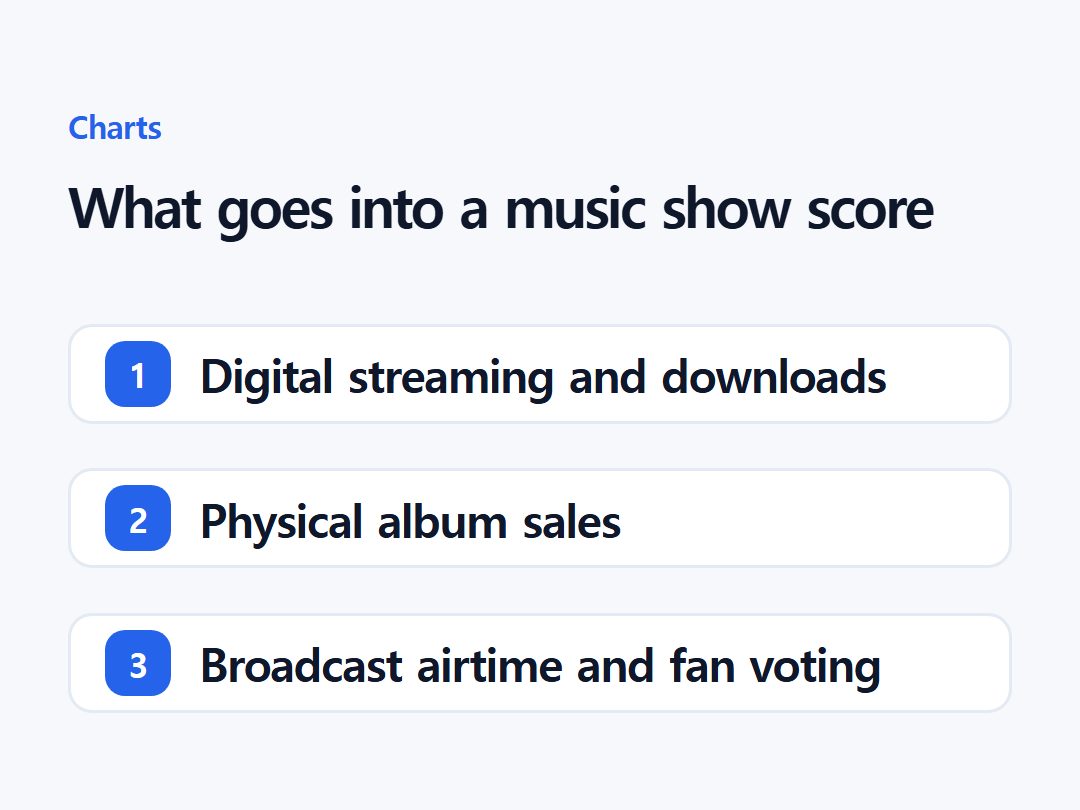
Each show calculates its own weekly score from a mix of digital sales, physical album sales, broadcast airtime, and fan voting, then hands the top-scoring act a trophy live on air. Crucially, none of these shows simply reports who topped Korea's actual streaming charts.
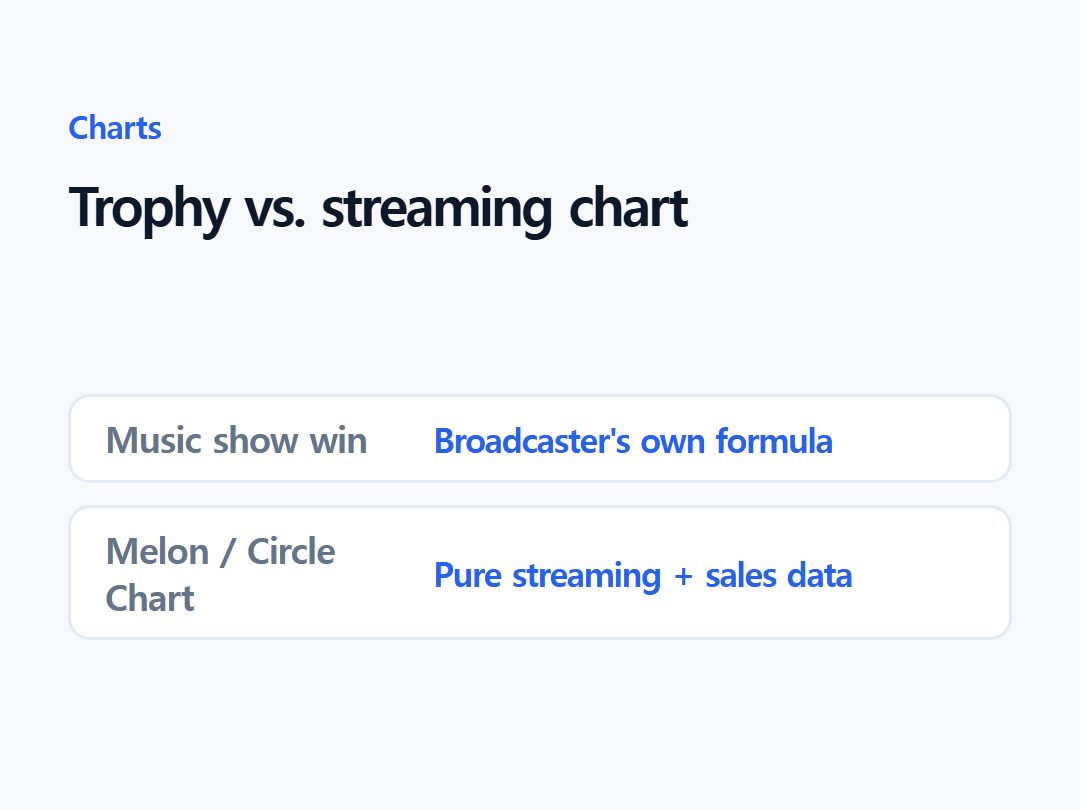
They run a proprietary point system, and each show weighs the ingredients differently — which is why the same song can win on one program and lose on another in the same week, and why a "win" is not interchangeable with topping a real chart like Melon or Circle Chart.
Broadcast points and album sales decide the winner
The gap that trips up international readers is this: Korea already has real, continuously updated popularity charts — Melon (the country's largest streaming app, whose in-house chart recalculates hourly) and Circle Chart, the government-linked industry standard formerly known as Gaon, which aggregates data from Melon, Genie, Bugs, FLO and other services into the closest thing Korea has to an official Billboard. Neither of those is what a music show trophy measures. A TV show's "1위" is a separate, broadcaster-owned scoring system that blends streaming data with things a pure chart never counts.
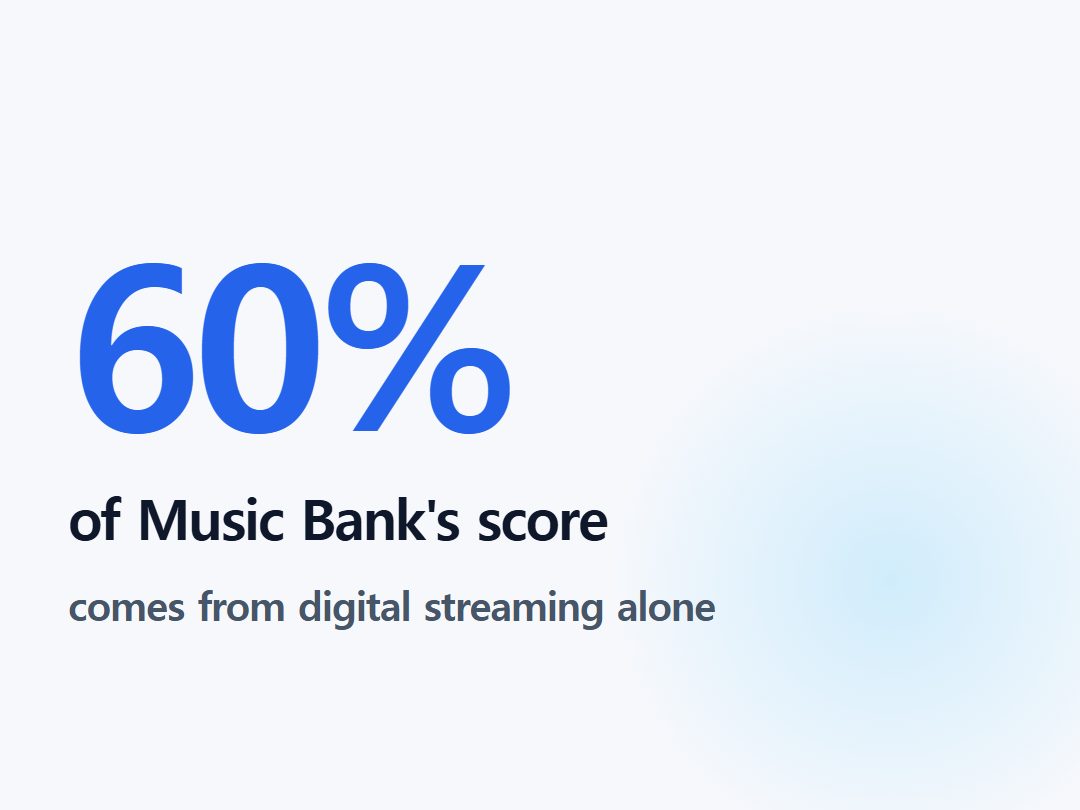
Take Music Bank, whose formula has stood since February 2022: roughly 60% of the score comes from digital sales and streaming pulled from Melon, Bugs, Genie, Vibe and Flo, 20% from a broadcast score, 10% from a studio-audience preference vote, and the remaining 10% split between physical album sales and social media activity.
The broadcast score counts how often a song's promotional content — the music video, performance clips, radio plays on specific KBS programs — actually aired on KBS's own channels that week. It has nothing to do with how many people streamed the song at home.
That distinction produced Korean pop culture's most-cited example of the gap. On the May 13, 2022 episode of Music Bank, rookie group Le Sserafim won with 7,881 points over trot singer Lim Young-woong, who scored 7,035 despite leading comfortably in both streaming and album sales that week.
The difference was the broadcast category: Le Sserafim earned 5,348 broadcast points to Lim's zero, because KBS said his song had not aired on any KBS television, radio or digital platform during the scoring window.
Fans who checked radio playlists disputed that KBS had counted correctly, and the broadcaster declined to say exactly which programs qualify for the broadcast score — a fight that made the formula's opacity, not just its existence, part of the story.
Physical album sales are the other structural factor that separates a music show win from a streaming chart position.
Under Korea's agency system — the model in which entertainment companies manage every part of an idol's career, from training to comebacks — fandoms are actively organized to buy physical CDs in bulk, often to collect the photocards randomly inserted inside, or to boost a group's numbers during a comeback (the term for a new single or album release and its promotional cycle).
Because streaming apps like Melon don't count physical sales at all, a group with a smaller streaming footprint but a highly mobilized fandom can out-score a song that is genuinely more streamed, simply by winning the album-sales and voting categories.
That dynamic is why music show trophies are treated within fandoms less as proof of mainstream popularity and more as a measurable output of fandom effort — streaming in coordinated blocks, pre-voting through each show's app, and bulk-buying albums during the comeback window.
M Countdown and Inkigayo use their own variants of the same idea.
M Countdown's formula, last revised in 2022, puts roughly half the total score on digital sales, adds about 15% for physical albums, and splits the remainder between social media reach, global fan pre-voting through Mnet's app, and a live real-time vote that decides between the top two nominees during the broadcast.
Inkigayo overhauled its system in October 2024, cutting its maximum score to 10,000 points and shifting more weight toward digital performance (about half the total) and YouTube/social-media activity (roughly a fifth), while expanding beyond Korean platforms to include global streaming data — a direct response to how large K-pop's overseas fanbase has become.
How today's formulas grew out of old broadcast charts
These shows predate Korea's streaming era by decades; they descend from a tradition of terrestrial broadcasters running their own weekly countdown programs long before digital charts existed.
As online listening took over in the 2010s, the shows had to fold streaming data into formulas originally built around broadcast performance and physical sales, rather than replace those older categories outright.
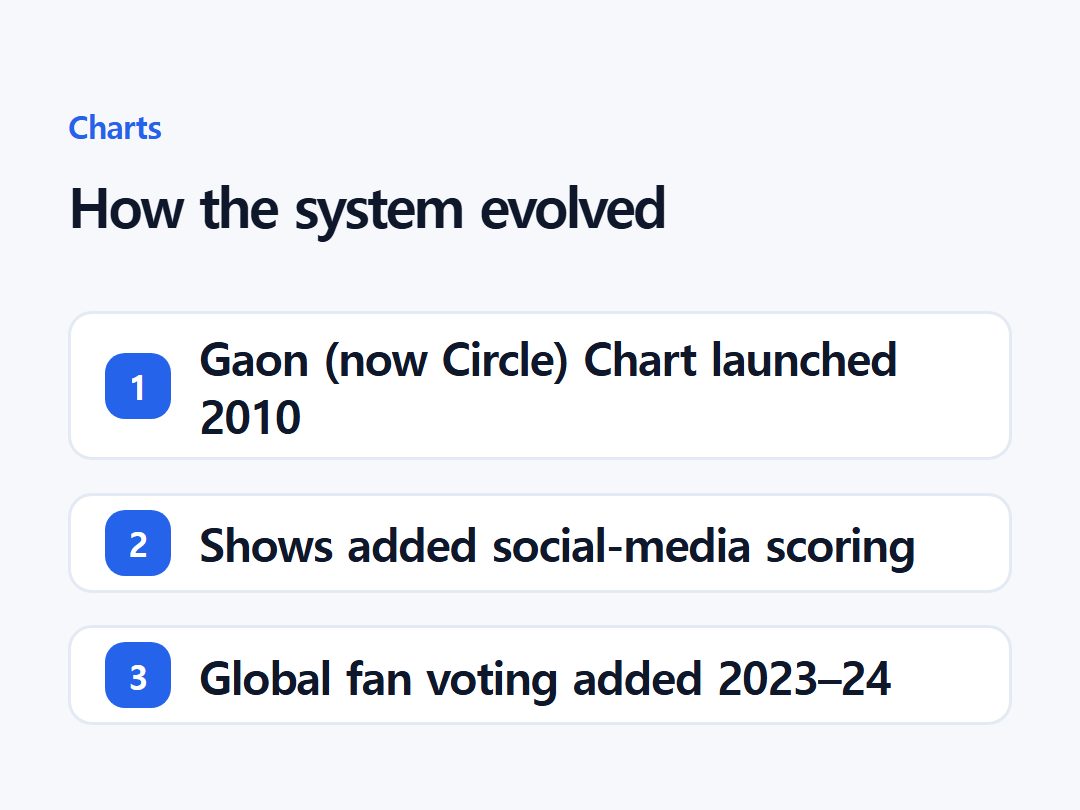
Korea's national aggregate chart followed a similar path on the industry side: the Gaon Chart launched in February 2010 under the Ministry of Culture, Sports and Tourism to give the industry one standardized, cross-platform measure of popularity, and it was rebranded Circle Chart in July 2022 specifically to fold in global K-pop streaming data as the genre's audience internationalized.
Individual shows have kept tweaking their own formulas along a similar arc.
Inkigayo's chart, for instance, has been revised repeatedly since it relaunched in 2013 — dropping broadcast and physical-sales scoring at first, reinstating an on-air score in 2017, adding an album-sales category in 2015, and repeatedly rebalancing digital versus social-media weight as YouTube views became a bigger part of how success is measured.
Music Bank's current 60/20/10/5/5 split dates to February 2022, adopted not long before the Le Sserafim–Lim Young-woong controversy put it under public scrutiny that same May.
Each recalibration has generally moved in the same direction: toward digital streaming as the largest single factor, while keeping broadcast, physical-sales and voting categories that pure streaming charts don't have — the features that make a TV trophy a different measurement than a chart position, by design.
Will these shows ever reveal how they score?
Two things remain unsettled.
First, transparency: broadcasters still won't publish the granular data behind a given week's score — KBS's refusal to name which radio programs count toward its broadcast score in 2022 is the clearest example, and no show has since committed to disclosing full weekly point breakdowns by category.
Second, the shows are still adjusting how much weight to give physical album sales versus overseas streaming, as K-pop's audience keeps shifting further outside Korea.
Inkigayo's October 2024 move to widen its digital-score data beyond domestic platforms suggests other shows may eventually follow with their own global recalibrations, but as of now each broadcaster still runs its own closed formula — which means the gap between a music show trophy and an actual streaming-chart position isn't going away.
How Korea's three biggest shows weigh their scores
| Show | Digital sales/streaming | Broadcast score | Physical albums & voting | Formula last updated |
|---|---|---|---|---|
| Music Bank | 60% | 20% | 10% studio-audience vote; 10% split between physical sales and social media | February 2022 |
| M Countdown | ~50% | Not used; live real-time vote decides top two instead | ~15% physical albums; remainder split among social media reach, global fan pre-voting and the live vote | 2022 |
| Inkigayo | ~50%, now including global streaming | Not specified | ~20% YouTube/social media; remainder not detailed | October 2024 |
Frequently asked
What does it mean when a K-pop song wins on a music show?
It means the song scored highest that week in a broadcaster's own point system, which blends digital sales, physical album sales, broadcast airtime and fan voting — not a real-time streaming chart position like Melon or Circle Chart.
Why did Lim Young-woong lose to Le Sserafim on Music Bank despite better sales?
Lim Young-woong scored zero broadcast points because KBS said his song hadn't aired on any KBS platform that week, letting Le Sserafim's 5,348 broadcast points overcome his lead in streaming and album sales.
What's the difference between a music show win and Melon or Circle Chart?
Melon and Circle Chart track actual streaming and sales data continuously, while a music show's '1위' is a separate weekly formula that also counts broadcast airtime, studio-audience votes and physical album sales.
Sources
Every factual claim above is traceable. We do not translate articles — we gather facts from multiple outlets and write them ourselves.
- Guide To K-Pop Music Show Wins: What You Need To Know — Soompi
- Controversy grows over 'Music Bank' scoring system — The Korea Herald
- List of Music Bank Chart winners (2026) — Wikipedia
- SBS Inkigayo/Chart — NamuWiki
- M Countdown/Chart — NamuWiki
- Circle Digital Chart — Wikipedia
- melon chart — NamuWiki