Ask a Korean speaker to translate nunchi (눈치) into a single English word, and most will pause. "Reading the room" gets close. "Social intelligence" gets close. "Tact" gets close. None of them land exactly, and that gap — not a lack of vocabulary, but a lack of the underlying concept — is the point.
The short version
- Nunchi means silently reading both mood and social hierarchy at once.
- Korean children learn nunchi as a taught skill, not an innate trait.
- Author Euny Hong calls nunchi "a secret weapon of the disadvantaged."
What nunchi actually means
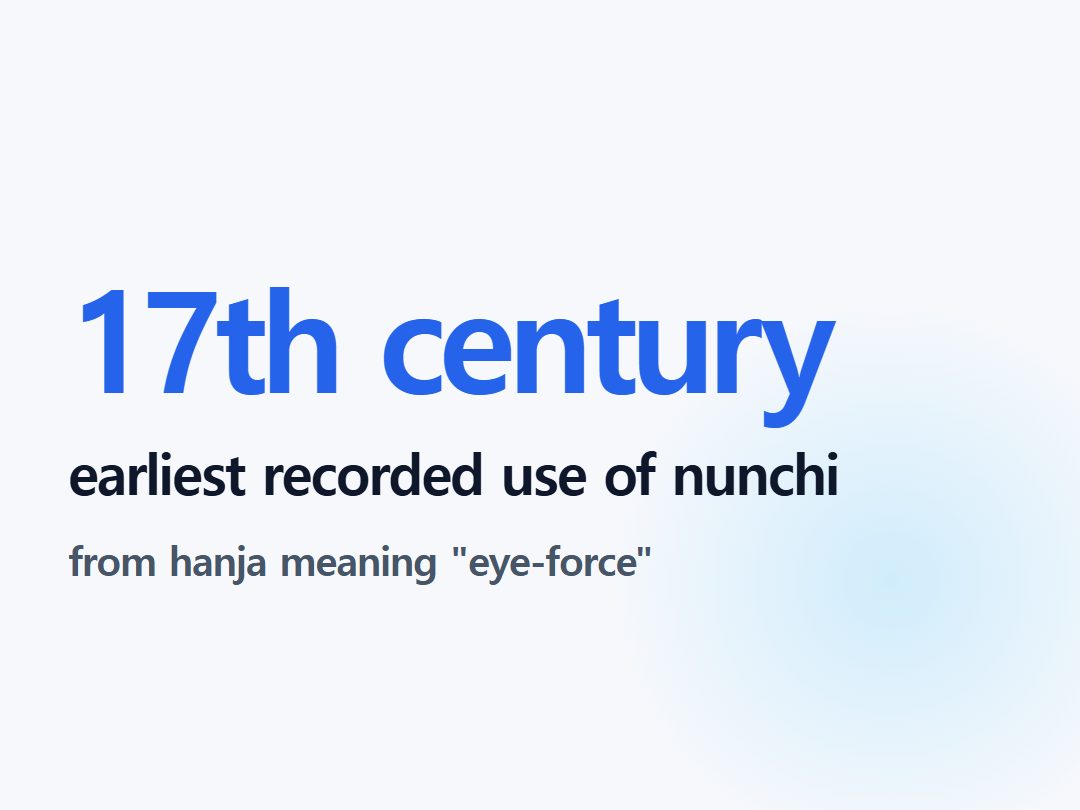
Literally, nunchi breaks down to "eye" (눈, nun) plus a second syllable tracing back to the hanja 眼勢 (Sino-Korean characters historically used to write Korean vocabulary), meaning roughly "eye-force" or "eye-measure." Language reference sites that track the word's history place its earliest recorded use around the 17th century.
The everyday sense that survives today is the ability to silently gauge the mood, intentions, and unspoken expectations of the people around you — and to adjust your own behavior accordingly, without being told what to do.
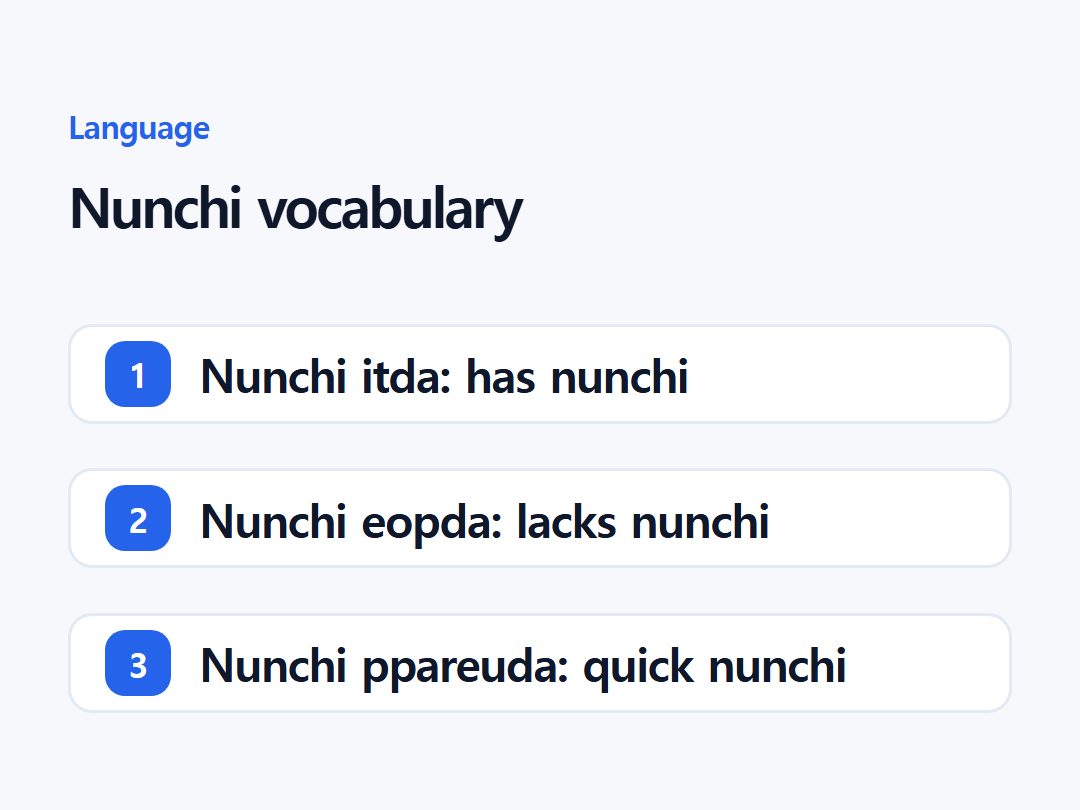
Korean has built an entire mini-vocabulary around it. Nunchi itda (눈치 있다, "to have nunchi") is a genuine compliment. Nunchi eopda (눈치 없다, "to have no nunchi") describes someone who is socially oblivious — the person who keeps talking after everyone else has quietly signaled it's time to go. Nunchi ppareuda (눈치 빠르다) means "quick nunchi": catching on fast, sensing a shift in mood before anyone says a word. Nunchi boda (눈치 보다, literally "to watch someone's nunchi") describes the more anxious cousin of the skill — cautiously monitoring how a superior or a room is reacting before you act. And nunchi chaeda (눈치 채다) simply means to notice, or catch on.
Journalist and author Euny Hong, whose 2019 book The Power of Nunchi: The Korean Secret to Happiness and Success (Penguin Random House) is the most widely cited English-language treatment of the concept, defines it as "the subtle art of gauging other people's thoughts and feelings in order to build trust, harmony, and connection." She adds a line that captures why the word resists translation: "Nunchi means leaving your ego at the door."
Why nunchi means more than reading a room
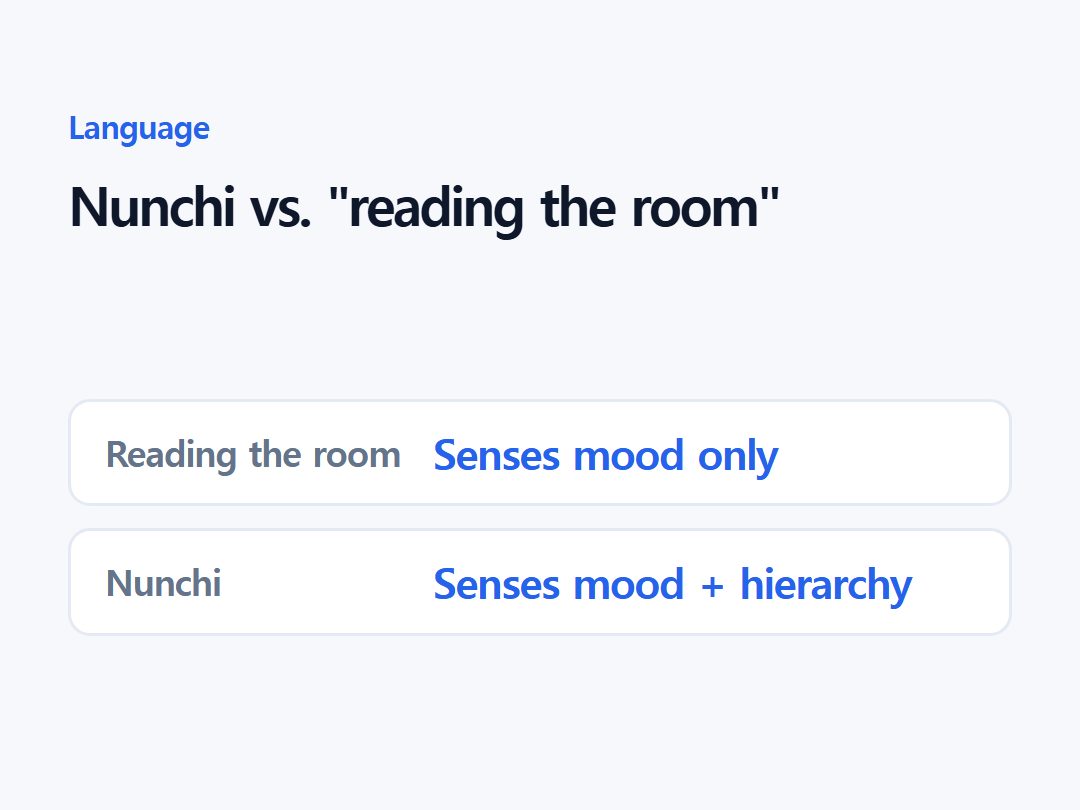
The reason nunchi doesn't map onto "emotional intelligence" or "reading the room" is that those English phrases describe individual perceptiveness — noticing that someone seems upset, or sensing that a meeting has gone quiet. Nunchi does that too, but it is inseparable from something English speakers rarely have to track consciously in the same way: relative social position.
Korean social interaction is structured by age, seniority, and role in a way that shapes speech itself — Korean has multiple levels of formal and informal speech (jondaenmal and banmal) that a speaker must choose correctly based on who they're addressing.
Nunchi is the sense that tells you, instantly and without being told, which register to use, who speaks first, who pours the drink, and when a junior colleague should stop offering opinions in a meeting.
It is less "can you read a mood" and more "can you read a hierarchy and a mood at the same time, and calibrate your own behavior to both." That dual calculation — status plus atmosphere — is what a phrase like "reading the room" leaves out, because reading a room in English-speaking contexts is usually about emotional tone alone, not about where you personally rank within it.
This is also why nunchi is taught, not assumed to be innate.
Hong describes being corrected by her Korean grandmother as a child specifically to instill it — the skill is drilled through repeated small corrections: don't speak before an elder does, notice when to refill someone else's glass before your own runs empty, sense when a guest is ready to leave before they say so.
Multiple explainer sources on the term (Kinfolk, Discover Discomfort, CIEE's study-abroad guides for students in Korea) independently describe the same pattern: nunchi is presented to Korean children less as a personality trait and more as a life skill, closer to table manners than to charisma.
NBC News, reporting on the concept's growing English-language audience, quoted Hong describing nunchi as "a secret weapon of the disadvantaged" — precisely because it requires no money, credentials, or status to practice, only attention.
That framing is part of why the word has traveled: it's being pitched to English readers not as an anthropological curiosity but as a practical skill, the same way "hygge" or "ikigai" crossed into English self-help shelves.
Worth noting, though, that some of Hong's broader historical claims in the book — for instance, tracing nunchi back "5,000 years" or linking it directly to Korea's 20th-century economic rise — have drawn pushback from reviewers as overreach.
The linguistic and behavioral description of nunchi is well documented; the sweeping historical narrative built around it is more contested.
It's also worth being precise about what nunchi is not. It is not simply being perceptive, and it is not shyness or people-pleasing. A person with "quick nunchi" can be assertive — they just choose the right moment and the right framing because they've already read the room and the ranking within it.
The failure mode, nunchi eopda, is treated in Korean social life less as rudeness and more as a kind of social blindness: the person isn't necessarily unkind, they simply aren't tracking signals everyone else is tracking automatically.
From Confucian roots to K-pop's global stage
The concept's roots are usually traced to Confucian social structures that historically organized Korean family and public life around age and rank, where younger or lower-status people were expected to anticipate the needs of elders and superiors rather than wait to be asked directly.
In a culture where directly contradicting or questioning a superior could be seen as disruptive to group harmony, the ability to sense what wasn't being said became a practical necessity rather than an optional social grace.
The word itself has been in continuous use long enough that its hanja origin (眼勢) predates modern Korea, and cognate ideas exist elsewhere in the region without being identical: Discover Discomfort's language explainer notes that Japanese has a comparable phrase, "reading the air" (空気を読む, kuuki wo yomu), and Mandarin uses 眼色 (yanse, "eye color") for a related sense of gauging unspoken cues.
The overlap suggests a broader East Asian pattern of valuing situational, hierarchy-aware perceptiveness — but nunchi's specific vocabulary, its status as an actively taught childhood skill, and its centrality to everyday Korean self-description appear to be distinct enough that translators and linguists have continued to treat it as a standalone term rather than a straightforward equivalent of its neighbors.
What changed nunchi's visibility outside Korea wasn't the word itself — it has been ordinary vocabulary in Korean for centuries — but the wave of English-language interest in Korean culture more broadly.
As K-pop, Korean film, and Korean television reached global audiences, English-language media and publishers began mining Korean for the vocabulary behind the culture, not just the culture's exports.
Hong's book, published in 2019, was part of that wave, arriving alongside other "untranslatable word" self-help titles aimed at English readers.
Will nunchi ever enter English dictionaries?
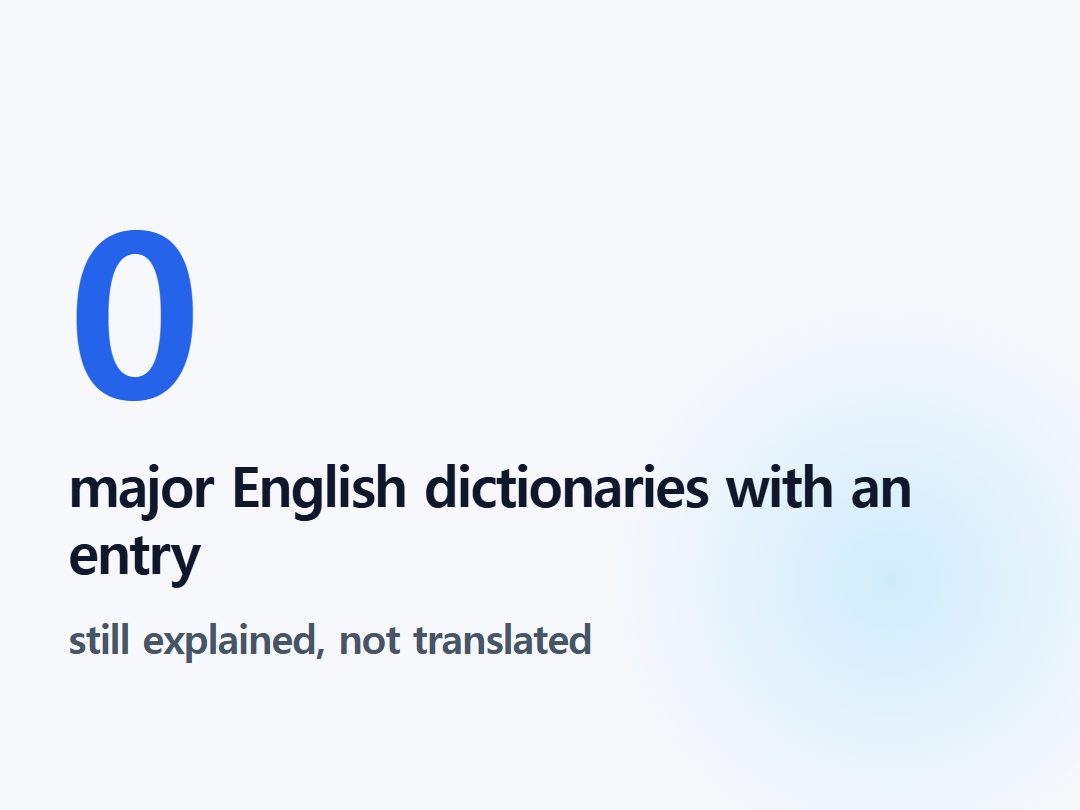
Nunchi hasn't been formally adopted into major English dictionaries the way "hygge" or "kimchi" eventually were, and it remains, for now, a word that requires explanation rather than one readers can be assumed to know.
Whether that changes will likely track the broader trajectory of English-language interest in Korean culture: as more Korean vocabulary enters everyday English usage through K-pop, Korean dramas, and Korean workplace and etiquette guides aimed at foreign audiences, words like nunchi are the most likely candidates to cross over, precisely because they describe something English currently has no efficient way to say.
For now, the safest approach for English speakers encountering the word is the one every source converges on: don't translate it, define it.
Nunchi vocabulary in Korean
| Term | Korean | Meaning |
|---|---|---|
| Nunchi itda | 눈치 있다 | To have nunchi — a genuine compliment for social awareness |
| Nunchi eopda | 눈치 없다 | To have no nunchi — socially oblivious |
| Nunchi ppareuda | 눈치 빠르다 | Quick nunchi — catching on fast, sensing a mood shift early |
| Nunchi boda | 눈치 보다 | To watch someone's nunchi — anxiously monitoring how a superior reacts |
| Nunchi chaeda | 눈치 채다 | To notice or catch on |
Frequently asked
What does nunchi mean in Korean?
Nunchi (눈치) is the ability to silently gauge others' moods, intentions, and unspoken expectations, then adjust your behavior accordingly — combining emotional read with awareness of social hierarchy.
Is nunchi the same as reading the room?
Not quite — "reading the room" in English usually describes emotional tone alone, while nunchi also requires tracking your own relative status and calibrating to both status and mood at once.
Who wrote The Power of Nunchi?
Journalist Euny Hong wrote The Power of Nunchi: The Korean Secret to Happiness and Success, published by Penguin Random House in 2019.
Sources
Every factual claim above is traceable. We do not translate articles — we gather facts from multiple outlets and write them ourselves.
- Word: Nunchi — Kinfolk
- Nunchi in English (눈치) — Explanation and Examples — Discover Discomfort
- The Power of Nunchi by Euny Hong — Penguin Random House
- How to use nunchi, a Korean 'superpower,' to achieve your New Year's resolutions — NBC News
- The Hidden Power of Nunchi (눈치) — CIEE
- K-Book Review: The Power of Nunchi by Euny Hong — Hallyuism