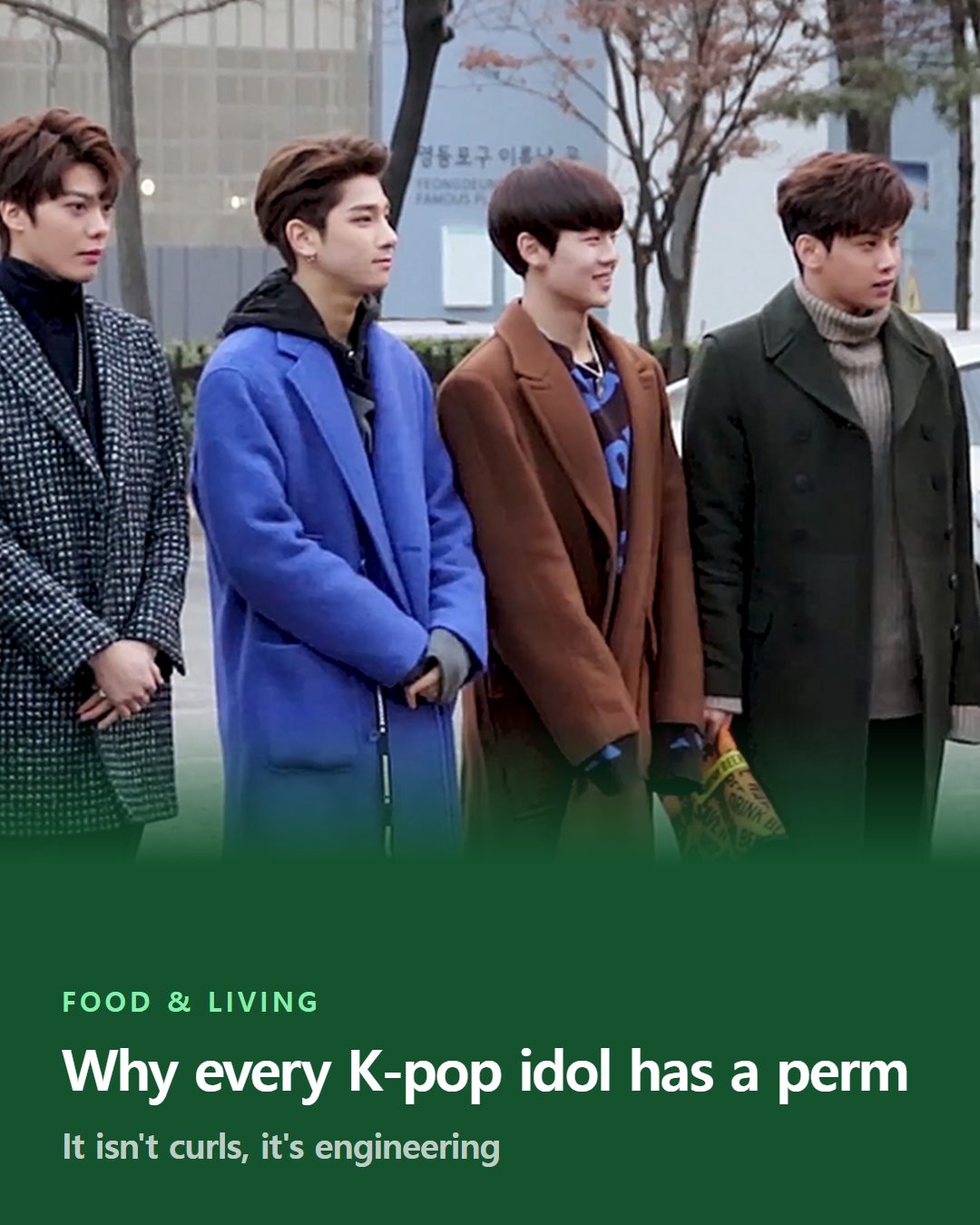
Watch any K-pop group's comeback — the industry term for a group's promotional run around a new single or album — and one detail is easy to scroll past: almost none of the members have flat, straight hair. It moves, catches light, and looks slightly undone even under stage lighting.
The short version
- A Korean perm fixes flared hair after a buzzed two-block haircut, not just curls it.
- Idols redesign their hair every comeback, arriving every few months, not once a year.
- Salons list separate down, side-part, and volume perms because each solves a different problem.
Outside Korea, that look now has its own name on salon menus: the "Korean perm." It shows up on request lists from Singapore to New York, but rarely comes with an explanation of why Korean men treat it as a baseline look rather than an occasional style choice.
The short version: a Korean perm is not mainly about adding curl. It solves a hair-texture problem tied to a specific haircut, and it gets redesigned on a schedule set by the K-pop industry itself. Both of those facts are usually missing from write-ups of the trend.
Neither is really about K-pop as entertainment. One is about hair biology; the other is about how an idol's image gets produced and refreshed on a release calendar most fans outside Korea never see directly.
A perm engineered to not look like a perm
The style most people mean by "Korean perm" is a digital perm: hair wound on heated, temperature-controlled rods and set with a chemical solution, rather than the room-temperature chemical-only process used in a classic cold perm.
The technique traces to Japan and was refined by Korean salons into its current form, according to the South China Morning Post. The result is soft, loose movement that reads as natural texture, not the tight, uniform ringlets associated with 1980s perms.
That distinction matters for how the style reads on camera. A Korean perm is designed to look like hair that simply grew that way — which is exactly the effect idol stylists are paid to produce.
The haircut that made a perm necessary
Much of the demand traces back to one haircut: the two-block, a style with short-buzzed sides and back under longer hair on top. It has been a default men's cut in Korea for over a decade.
East Asian hair is typically thick and straight, and Korean stylists and salon guides note that this texture tends to flare outward rather than lie flat once it is buzzed short at the sides and nape. Wax alone often cannot hold it down for a full day.
A perm is the fix. It is applied not to add curl for its own sake, but to retrain the direction hair grows in — the reason "perm" shows up so often next to "two-block" in Korean styling guides.
This is the part most international coverage skips. A perm on a Korean man is frequently maintenance, not decoration — closer to how someone with cowlicks might get a specific cut, and repeated on the same rough cycle as a haircut rather than saved for a special occasion.
What a perm is actually doing to the hair
Korean stylists distinguish between perms by the specific problem each one solves, not by how curly the result looks. Three jobs come up constantly in Korean styling guides and salon write-ups:
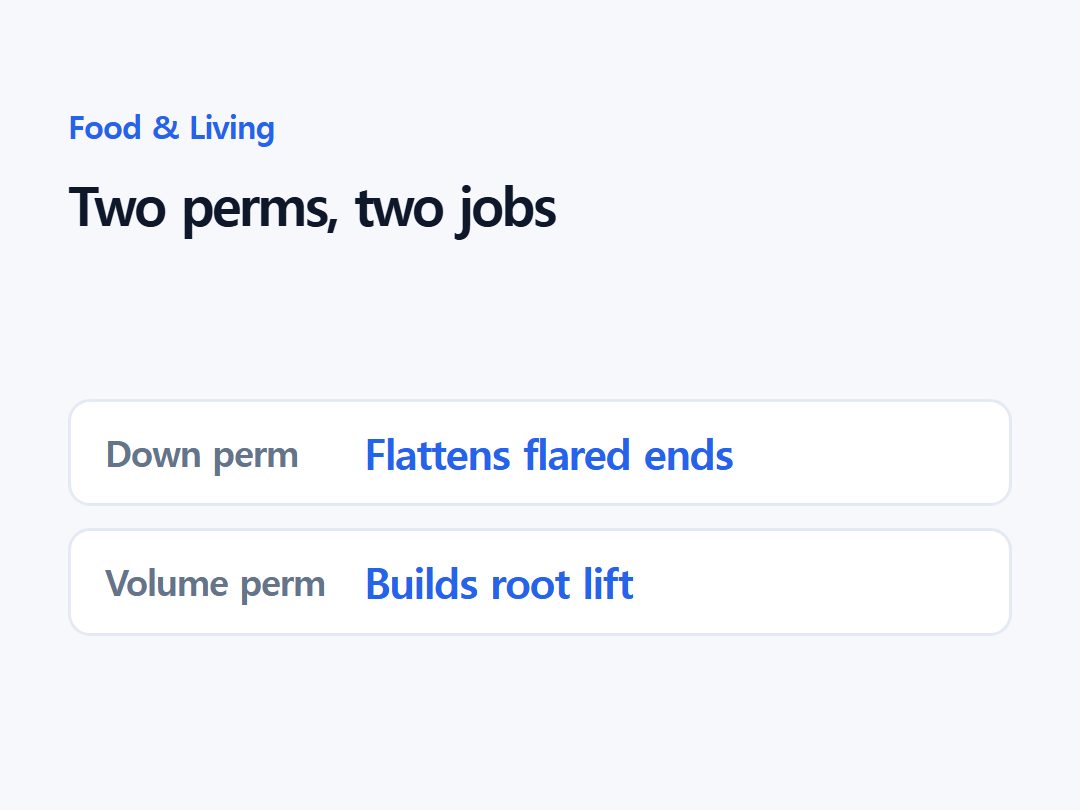
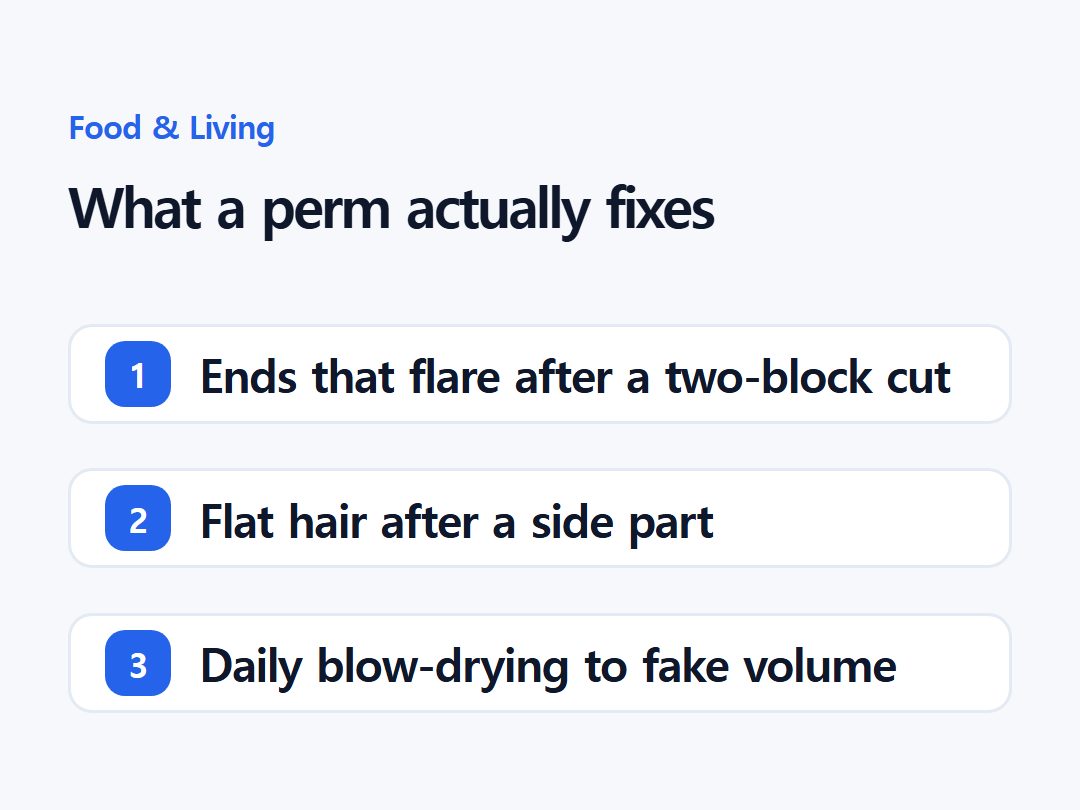
- Flattening ends that flare out after a short two-block cut
- Building root volume so a side part doesn't sit flat against the scalp
- Producing wave texture that holds for months without daily blow-drying
Each problem has its own named perm, which is why Korean salon menus list far more perm types than most international ones.
Down perms flatten; volume perms lift
The two workhorse styles are near opposites in what they do to the hair, even though both are marketed simply as "perm" abroad.
| Perm type | Korean name | What it solves |
|---|---|---|
| Down perm | 다운펌 | Presses flared ends of a short two-block flat |
| Side-part / comma perm | 가르마펌 | Adds root lift so a side part doesn't look pasted down |
| Volume / digital perm | 볼륨펌 | Builds soft, face-framing waves with easy upkeep |
A down perm can look almost invisible in photos, since its entire purpose is to make hair sit still rather than move — which is part of why international viewers often don't register it as a perm at all.
A 2017 K-drama boom pushed it into the mainstream
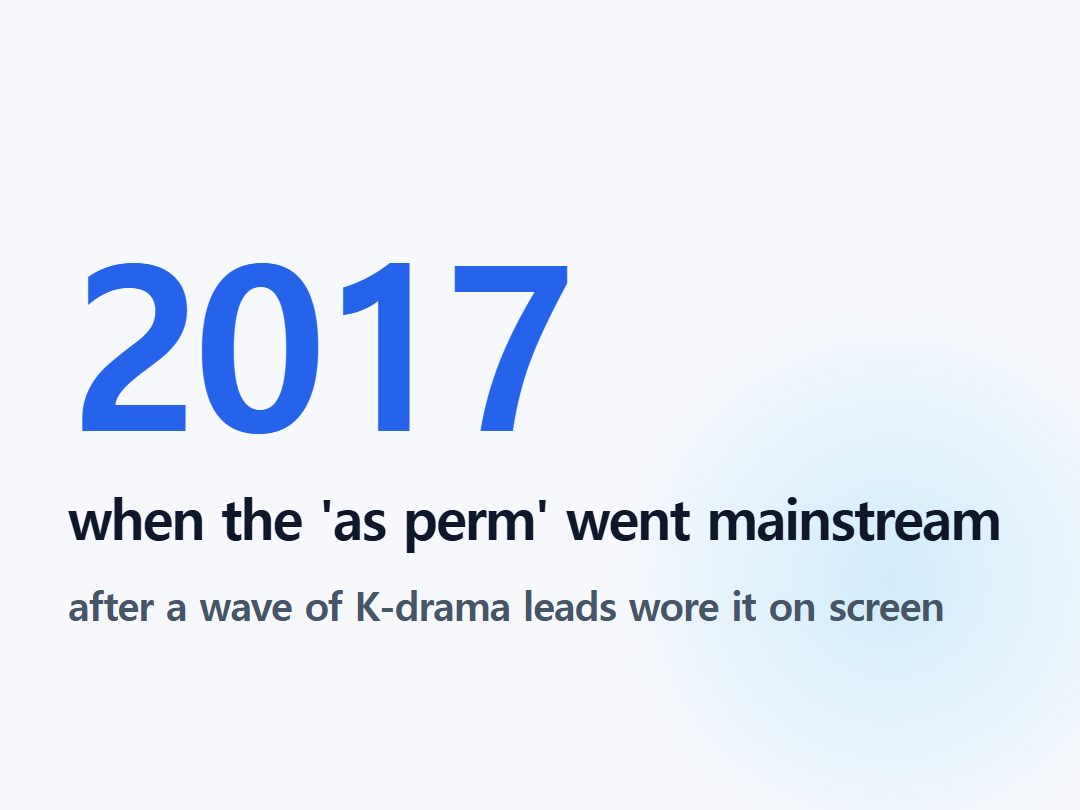
Korean industry coverage traces the current wave to a specific inflection point. According to a 2021 trend report distributed via Newswire, a Korean press-release service, the soft, side-swept "as perm" style gained mass popularity after a wave of K-drama releases starting in 2017, when lead actors and idols began wearing it on screen.
Ordinary men followed. What had been a look associated with a handful of actors became, within a few years, one of the most requested perm styles for men in their 20s and 30s.
Idols get a new hairstyle every comeback, not every year
The other half of the answer is structural. Under Korea's agency system — the model in which entertainment companies manage a trainee or idol's training, image, and schedule — most idols work with dedicated hairstylists supplied or approved by their agency.
Allure Korea interviewed several of these stylists in 2024. One, who has styled the groups ILLIT and NewJeans for more than two years, described handling near-constant schedules and also cutting and coloring hair for a newly debuted boy group as part of the same job.
Because a comeback typically arrives every few months, an idol's hair is redesigned far more often than a Western pop star's signature look, which might last for years. That turnover is what keeps perm styles cycling through the industry rather than settling into one fixed trend.
It also means a single stylist's choices can reach an unusually large audience fast. A perm chosen for one comeback stage is broadcast, screenshotted, and searched by fans within hours, well before it would ever reach that scale through a magazine editorial or red-carpet appearance.
The groups salons currently point to
Ask a stylist outside Korea which idols are driving current requests, and the same names come up. Industry coverage of the trend, including reporting from Fashion Beauty Runway, cites three groups by name:
- ENHYPEN
- SEVENTEEN
- RIIZE
Their members are described as having popularized the soft, wavy look that salons now market simply as a "Korean perm" to non-Korean clients.
The look has left Korea's borders
Salons abroad have started naming the style directly. A 2025 post from Kiri, a salon based in New York City, describes Korean-style perms as one of the styles driving a surge of Korean-hairstyle requests at NYC salons that year, citing shops like 3628 Men Hair Studio and Maison de MI Salon.
On social platforms, hashtags like #digitalperm and #Koreanperm have become their own content category, with tutorial and transformation videos drawing millions of views, per the South China Morning Post's reporting.
What is still unresolved
Some parts of the story resist a clean answer. No English-language or Korean industry source pins down exactly when digital perm technology first reached Korean salons, only that it was adapted from an earlier Japanese technique over an unspecified period.
It is also not possible to credit a single actor or idol with originating any one style — multiple celebrities are named as early adopters of looks like the side-part "comma" perm, with no agreed first mover.
Finally, how much of the comeback-to-comeback hairstyle turnover is driven by agency direction versus a stylist's or member's own preference is not disclosed by companies and varies by group.
Down perm vs. side-part vs. volume perm: what each one solves
| Perm type | Korean name | What it solves |
|---|---|---|
| Down perm | 다운펌 | Presses flared ends of a short two-block flat |
| Side-part / comma perm | 가르마펌 | Adds root lift so a side part doesn't look pasted down |
| Volume / digital perm | 볼륨펌 | Builds soft, face-framing waves with easy upkeep |
Frequently asked
What is a Korean perm?
It usually means a digital perm — hair set on heated rods to create soft, natural-looking waves, a technique adapted from Japan and refined by Korean salons.
Why do Korean men get perms?
The popular two-block haircut buzzes the sides short, and thick, straight Korean hair tends to flare out there; a perm retrains the hair to lie flat rather than just adding curl.
How often do K-pop idols change their hairstyle?
Roughly every comeback, which typically arrives every few months, since agency-supplied stylists redesign an idol's look for each new release cycle.
Sources
Every factual claim above is traceable. We do not translate articles — we gather facts from multiple outlets and write them ourselves.
- What is a digital hair perm? How to replicate K-pop idols' dreamy waves with the treatment — South China Morning Post
- 2021년 남자 헤어스타일 최신 트렌드 '펌' 종류와 '애즈 펌' 셀프 스타일링 공개 — Newswire
- 지금 가장 잘나가는 K-헤어 메이크업 아티스트 5인 — Allure Korea
- Perms for Men are Back: How K-Pop is Defining Men's Hair — Fashion Beauty Runway
- From Seoul to the City: Korean Hairstyle Trends Taking Over NYC Salons in 2025 — Kiri
- Korean Perm for Men: Types, Styles, and What to Expect — Miin Hair & Beauty
- 미용실 가기 전 참고, 올해 남자 헤어스타일 트렌드는? — GQ Korea