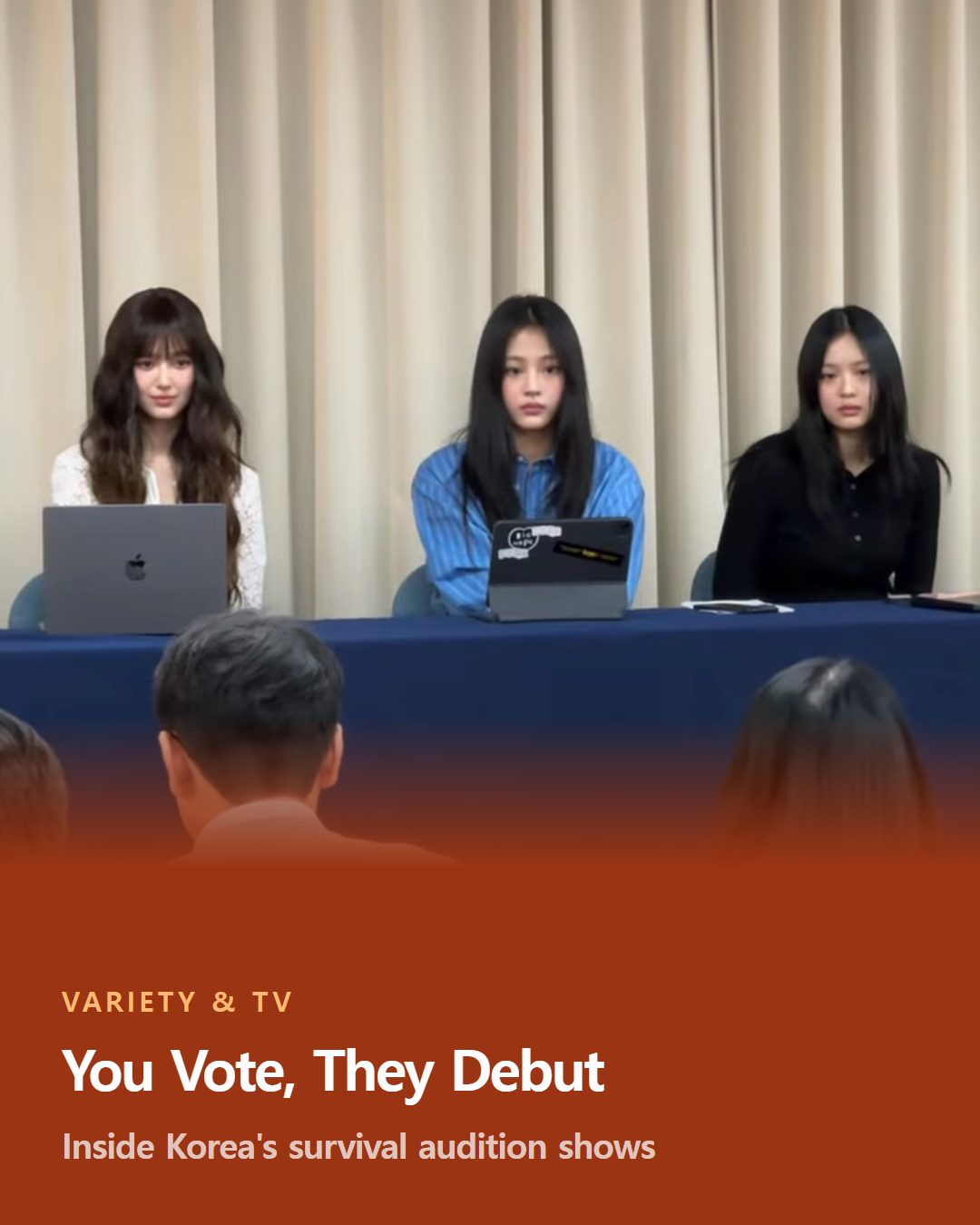
A Korean "survival" audition show looks, on the surface, like any TV talent competition: young performers compete over weeks of episodes, and some go home while others advance. The difference is what viewers are actually doing when they vote.
In shows like Mnet's Produce 101 franchise, Girls Planet 999, and Boys Planet, audience votes do not just pick a winner — they assemble the entire lineup of a new group, line by line, episode by episode, until only the number needed to debut remains. The group that results is not chosen by a record label executive. On paper, it is chosen by the audience.
The short version
- Fans, not agencies, vote to assemble entire K-pop group lineups on survival shows.
- Produce X 101's 2019 vote-rigging scandal led to prison sentences for producers.
- New shows like Boys Planet added outside audits to restore viewer trust.
How do votes decide who debuts in K-pop?
To understand why this matters, it helps to know how K-pop groups are normally formed.
Under what is generally called the agency system, entertainment companies recruit young performers, sign them as trainees, and put them through years of private vocal, dance, and language training before deciding, internally, who debuts and in what group.
Fans typically meet a new group only when the agency is ready to reveal it — teaser photos, a name, a concept, all decided behind closed doors. A survival show inverts that process. It takes the trainee pipeline that used to be invisible and broadcasts it, then hands the final assembly decision to the public.
The mechanism behind this is the branding at the heart of the Produce 101 format: viewers are called "national producers" (국민 프로듀서).
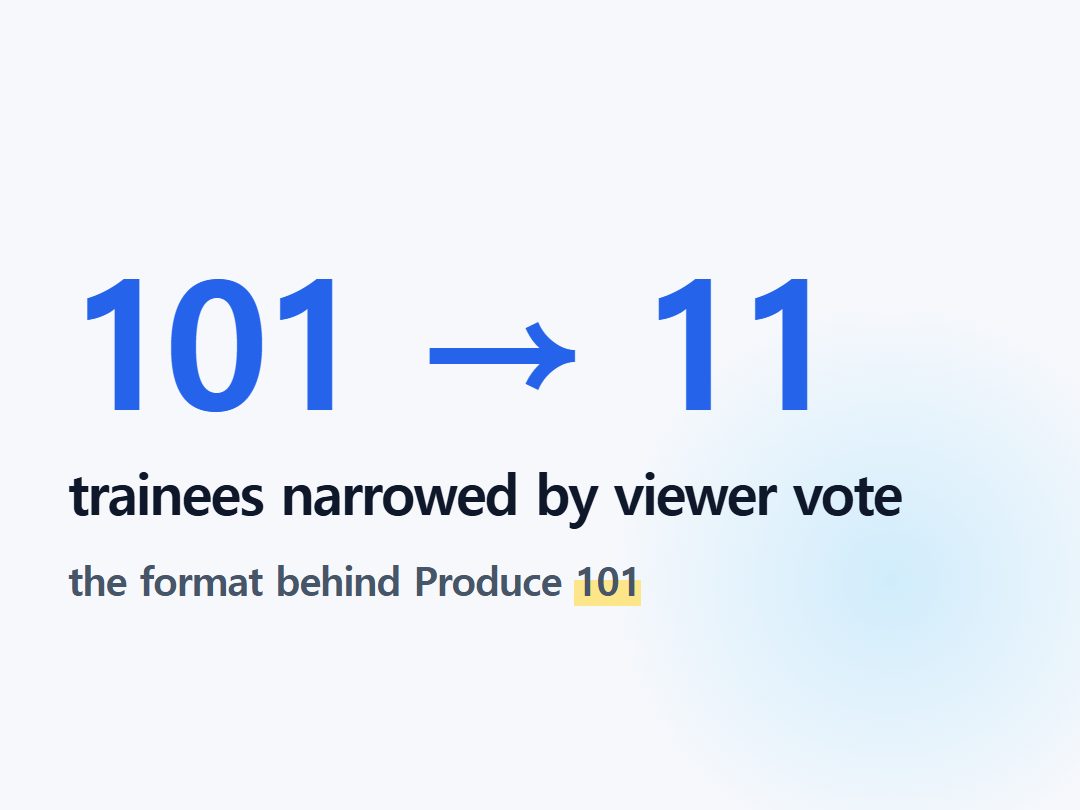
Across four Korean seasons, the show gathered 101 trainees from dozens of different agencies and let the audience vote, through online and live polling, to narrow that number down to a final 11.
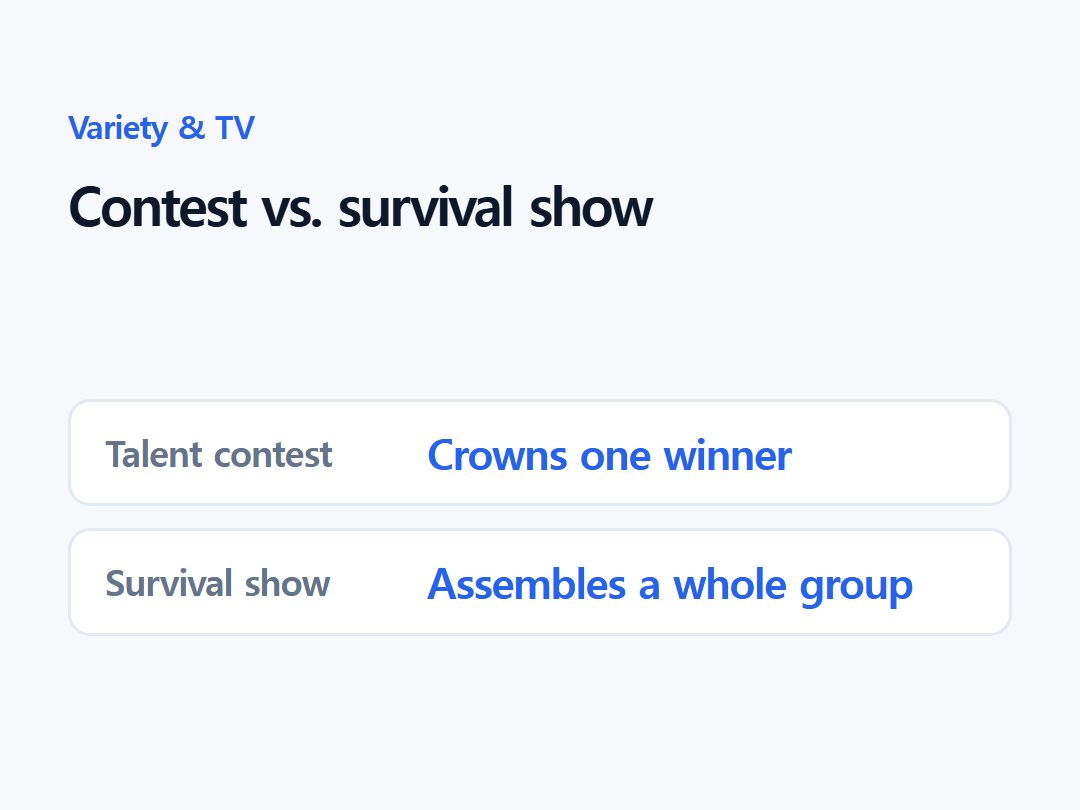
It was not only membership that viewers decided — polling data and viewer input also shaped the group's concept, debut single, and even its name. This is the structural distinction from a Western format like American Idol, where judges hold real authority and the show crowns one winning individual.
A Korean survival show usually has judges or mentors on screen, but they generally do not control who advances; that job belongs to the vote count. And the prize is not a solo record deal — it is membership in a newly formed group built entirely from people who, days earlier, were signed to competing companies.
Because the group that debuts is drawn from trainees at multiple agencies, most of these acts are what the industry calls project groups: temporary units with a fixed activity period written into their contract, after which members typically return to their original agencies or debut independently.
Wanna One, formed from Produce 101 Season 2 in 2017, operated under an 18-month contract before disbanding in January 2019, after which its members went back to labels including NU'EST's agency and others launched solo careers.
I.O.I, the girl group formed from the first season in 2016, disbanded in January 2017, with members returning to groups such as Gugudan, Weki Meki, PRISTIN and WJSN.
Viewers therefore know from the outset that the group they are voting to create has a built-in expiration date — which raises, rather than lowers, the stakes of the vote for many fans.
This participatory design is also why survival shows have become a financial engine for the industry, independent of how many people actually watch the broadcast.
ZEROBASEONE, the group formed from 2023's Boys Planet, debuted after a season that drew television ratings below 1 percent in Korea, yet became an immediate million-selling act on the strength of a fandom that had already formed, and voted, during the show's run.
Industry analysts have pointed to this shift as evidence that a dedicated, paying fanbase now matters more commercially than mainstream broadcast exposure — and a vote-based survival show builds exactly that kind of fanbase before a single official song exists.
What happened in the Produce X 101 scandal?
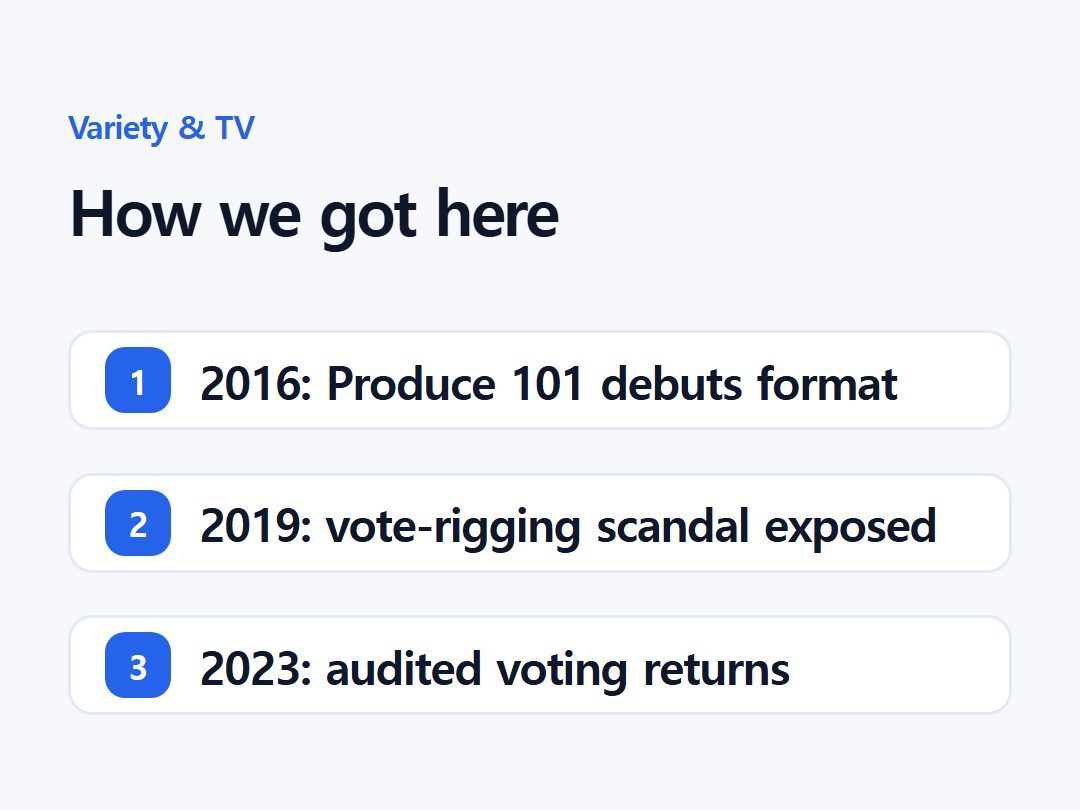
The format traces back to earlier nationwide voting competitions such as Superstar K, but it was CJ E&M's Produce 101, launched by Mnet in 2016, that turned mass audience voting into a group-formation tool rather than a solo-winner contest.
The franchise ran four Korean seasons — Produce 101 (2016), Produce 101 Season 2 (2017), Produce 48 (2018, combining Korean trainees with Japanese idol-scene contestants), and Produce X 101 (2019) — producing the groups I.O.I, Wanna One, IZ*ONE, and X1.
The format's credibility collapsed in 2019. During the final episode of Produce X 101 that July, viewers noticed suspicious numerical patterns in the released vote totals, and 272 viewers filed a lawsuit against Mnet on August 1, 2019, triggering a police investigation.
Producers Ahn Joon-young and Kim Yong-bum were arrested that November, and Ahn later admitted to manipulating the rankings across all four seasons of the franchise. In December 2019, Ahn, Kim, and six entertainment agency representatives were indicted on charges including fraud and obstruction of business.
Ahn was ultimately sentenced to two years in prison and Kim to one year and eight months; on appeal, courts upheld those sentences and extended prison terms to additional agency officials who had previously received only fines.
South Korea's Broadcasting Review Subcommittee separately fined Mnet's parent company, CJ ENM, over the scandal.
As part of the court proceedings, judges disclosed the names of specific trainees who had been wrongfully eliminated — including Starship Entertainment's Koo Jungmo, whose true ranking would have placed him in the debuting lineup for X1 — and Mnet said in the years that followed that it was in discussions to compensate affected trainees, though it has not published a public accounting of the outcome.
X1 disbanded after releasing only one album, and Mnet stepped back from producing new debut-survival shows for several years.
When the format returned with Girls Planet 999 in 2021 and Boys Planet in 2023, producers built in explicit safeguards.
For Boys Planet, which formed the group ZEROBASEONE, Mnet said for the first time an independent outside firm, Samil PwC, would verify the vote count separately from the production team, alongside digital fingerprinting technology intended to block repeat or fraudulent votes.
The show also eliminated the regional vote-weighting used in earlier seasons — previously, Korean and international audiences voted in ways that could be counted unequally — so that, as producers described it, the debut lineup would be decided "100 percent by viewers' votes" on equal footing between domestic and international fans.
New shows test whether the fixes actually work
The reformed, audited version of the format is still being tested season by season. Boys II Planet aired in mid-to-late 2025 and produced an eight-member group, Alpha Drive One, and a related spin-off, Planet C: Home Race, featuring previously eliminated trainees, debuted a separate group called Modyssey in December 2025.
Whether external audits like Samil PwC's are enough to fully restore viewer trust — after a scandal that touched every season of the original franchise — remains an open question among Korean fans, and it is one reason recent shows advertise their verification processes as prominently as their trainees.
It also remains unclear whether Mnet or CJ ENM has completed compensation to the trainees identified by the courts as wrongfully eliminated in 2016–2019, since no public settlement figures have been released.
For international viewers newly discovering the genre, the practical takeaway is this: when a Korean survival show asks for a vote, it is not requesting a favorite — it is asking viewers to help decide, literally, who gets to debut.

Timeline of the 2019 Produce X 101 vote-rigging scandal
| Date | Event |
|---|---|
| July 2019 | Viewers notice suspicious numerical patterns in the final episode's vote totals |
| August 1, 2019 | 272 viewers file a lawsuit against Mnet, triggering a police investigation |
| November 2019 | Producers Ahn Joon-young and Kim Yong-bum are arrested |
| December 2019 | Ahn, Kim, and six agency representatives indicted on fraud and obstruction charges |
| Sentencing (later upheld on appeal) | Ahn: two years in prison; Kim: one year and eight months |
Frequently asked
What is a Korean survival show?
It's a competition where trainees from multiple agencies compete over weeks of episodes, and viewer votes — not a label executive — assemble the entire lineup of a new group.
What happened with the Produce 101 voting scandal?
In 2019, producers were found to have manipulated vote totals across all four Produce 101 seasons; the lead producers were sentenced to prison and several agency officials were indicted or fined.
How long do K-pop project groups from survival shows last?
They have a fixed activity period written into their contract; Wanna One, for example, operated under an 18-month contract before disbanding in January 2019.
Sources
Every factual claim above is traceable. We do not translate articles — we gather facts from multiple outlets and write them ourselves.
- Mnet vote manipulation investigation — Wikipedia
- Court Reveals "Produce 101" Series Contestants Who Were Eliminated Due To Voting Manipulation — Soompi
- K-pop television show producers admit rigging votes — ABC News
- 'Boys Planet' strives to thwart vote-rigging concerns — The Korea Herald
- What makes K-pop audition programs so popular? — The Korea Times
- Mnet Seeks To Compensate Trainees Affected By 'Produce 101' Vote Rigging Scandal — BTimes
- Wanna One — Wikipedia
- Girls Planet 999 — Wikipedia