English-language fan spaces often translate akgae (악개) as simply "toxic fan" or "hater." Korean fandom keeps it as its own word, because an akgae is not an outsider throwing insults at a group. It is someone who still calls themselves a fan — of exactly one member — while working to damage everyone else in that member's group.
The short version
- Akgae means a fan who attacks their own group's other members, not outsiders.
- Unlike an anti, an akgae claims fandom loyalty while attacking from inside.
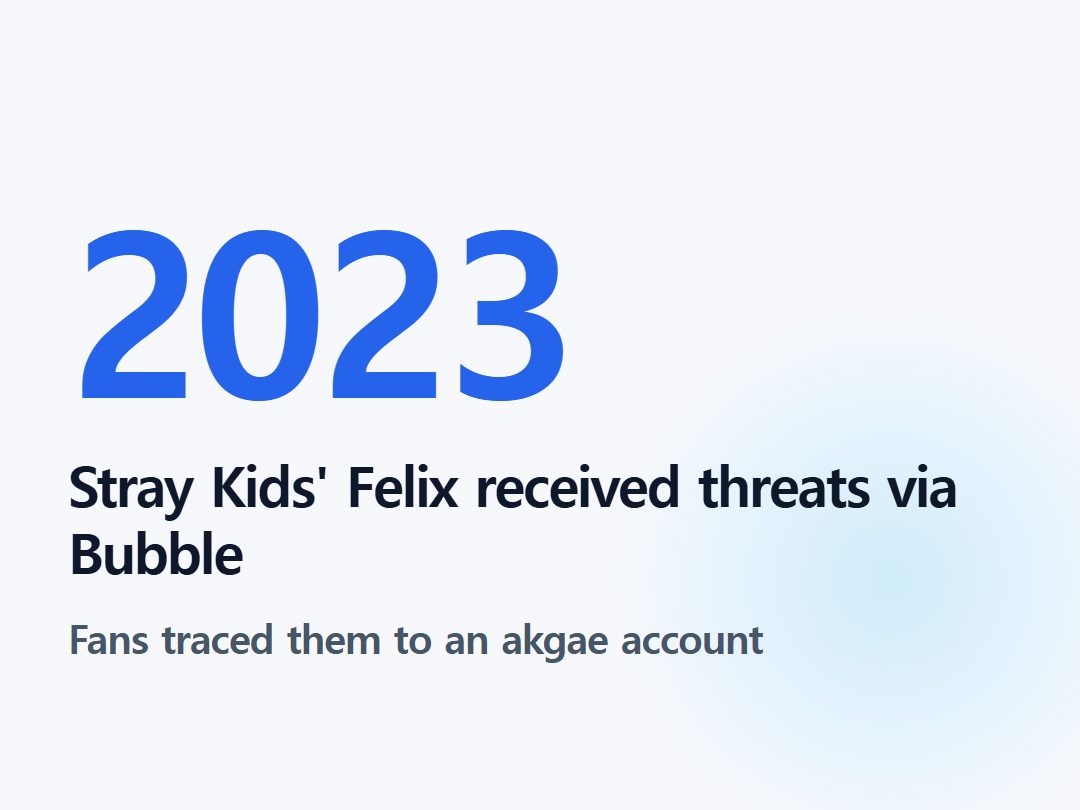
- Fans traced Felix's 2023 Bubble threats to akgae under #ProtectFelix.
The term comes up constantly in group-based K-pop, from boy bands to girl groups to newer virtual acts, precisely because it describes a specific kind of internal betrayal that English fan vocabulary does not have a single word for.
A "malicious individual fan," spelled out
Akgae is short for akseong gaeinpaen (악성개인팬): 악성 (akseong, malicious or malignant) plus 개인팬 (gaeinpaen, individual fan). Strip the first part away and you are left with 개인팬, or solo fan — a fan who focuses on one member of a group without any hostility attached.
Fandom glossaries and fan-culture archives like Fanlore treat 개인팬 and 악개 as clearly separate entries, not two names for the same thing. The malicious version only exists because the plain version already did.
Loving one member only becomes a problem partway through
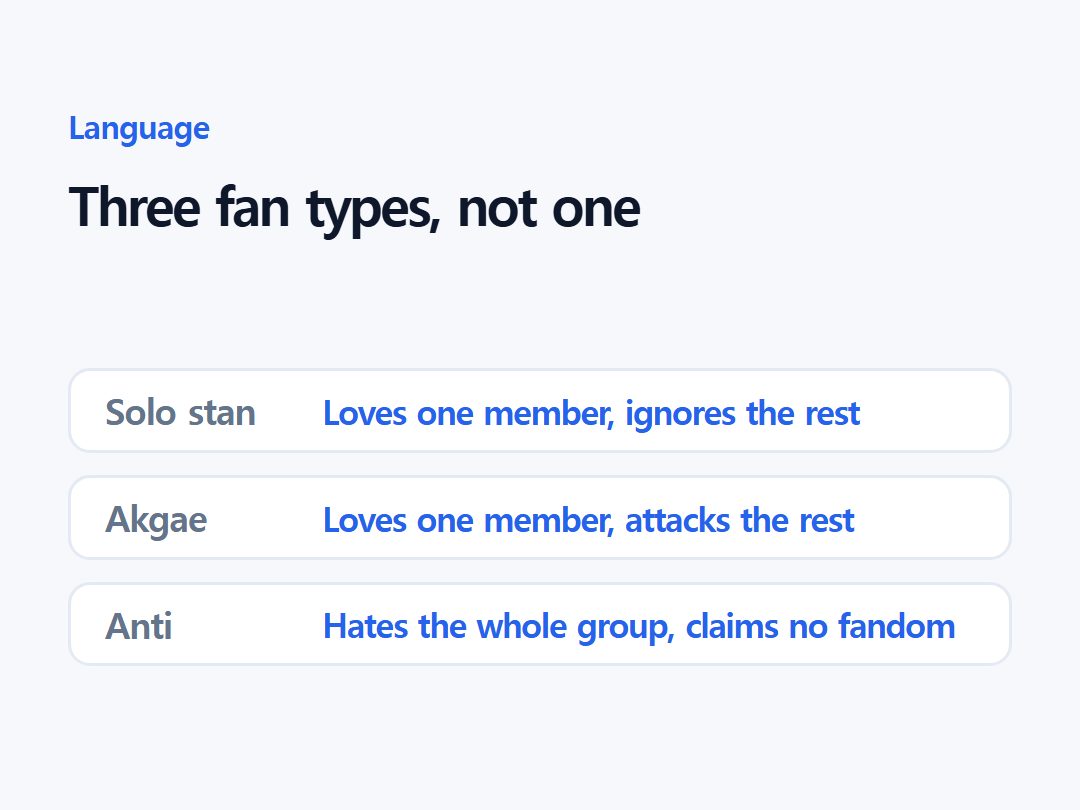
A solo fan — sometimes called a solo stan in English — simply spends their attention and money on one idol. Fan sites, translation accounts, and streaming efforts built around a single member are usually run by solo fans, and Korean fandom generally has no issue with that.
The shift to akgae happens at a specific point: when a fan stops being indifferent to the other members and starts working against them.
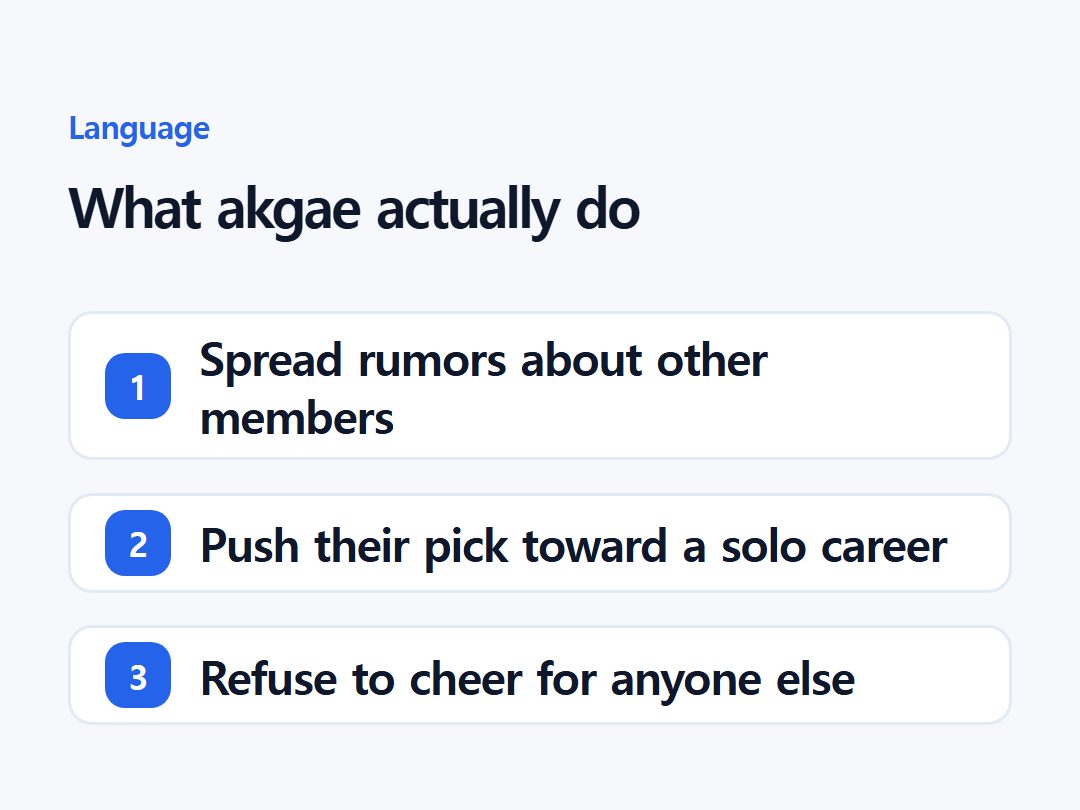
- Spreading rumors that make other members look bad by comparison
- Framing the group as an obstacle holding their favorite back
- Refusing to cheer, vote, or stream for anyone but their pick
- Pushing the narrative that their member should leave for a solo career
None of that is required to simply prefer one member. It is the addition of active harm that fandom vocabulary needed a separate word for.
Why "malicious commenter" is the wrong translation
Korean already has a common word for an anonymous hater: akpeulleo (악플러), literally a "malicious commenter" — someone who posts hostile replies online. It would be the obvious English-friendly stand-in for akgae. Korean fans do not use it that way.
An akpeulleo has no stake in the fandom; they are simply being cruel from outside it. An akgae's harm depends on the fact that they are, or claim to be, inside the fandom — using the credibility of being a fan to attack the group from within, rather than shouting at it from the street.
That is the part international readers usually miss: akgae is a word about position, not just tone. It describes where the attack comes from, not only how nasty it sounds.
An anti attacks the group; an akgae attacks a groupmate
K-pop fandom already has a term for outside hostility: an anti, or anti-fan, someone who dislikes an artist or group entirely and has no claim to fan status. Antis mock, spread negative stories, or organize against a group as a whole, openly and from outside.
An akgae, by contrast, keeps one foot inside the fandom. Fan glossaries describe the practical difference plainly: an anti has no allegiance to the group at all, while an akgae still claims allegiance — just to one member instead of the group as a whole.
Fandoms punish akgae harder than they punish antis
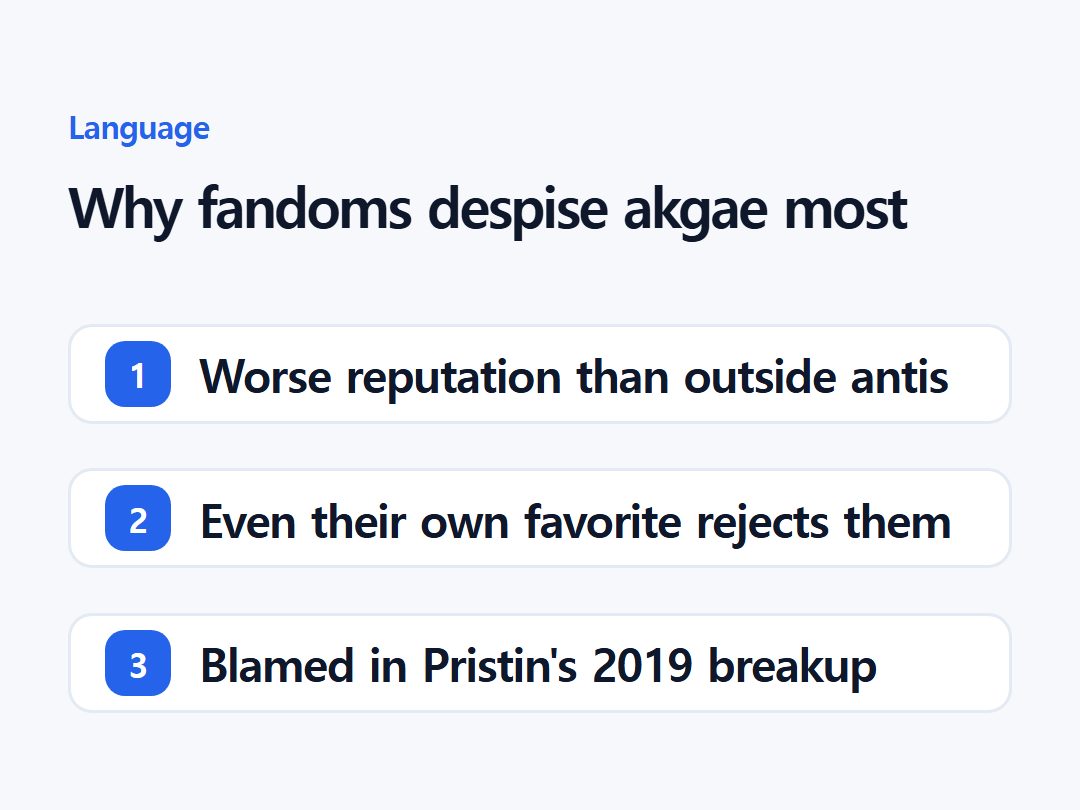
Korean-language fan discussion consistently describes akgae as drawing more contempt inside a fandom than an ordinary anti does. An anti is a known outsider; an akgae is treated as someone who betrayed the group from a position of supposed loyalty.
Fan communities frequently note that even the favored member's own fanbase — and sometimes the idol themselves — does not want that kind of support, because it comes wrapped in harm to bandmates. Being publicly labeled an akgae functions as a form of blacklisting within a fandom, not a badge of devotion.
Korean fan wikis sum this up by calling akgae an "internal anti-fan" — a contradiction in terms that only makes sense once you accept that loyalty to one person and loyalty to a group are not the same allegiance.
Stray Kids' Felix and when the label stopped being just slang
The term is not only theoretical. In 2023, the fandom of Stray Kids' member Felix identified accounts sending him threatening messages through Bubble, a paid app agencies use for direct fan-to-idol messaging, according to reporting picked up by Sportskeeda and allkpop.
Fans traced the messages to individuals reported to be akgae attached to specific members, and organized under the hashtag #ProtectFelix to press JYP Entertainment for a response. The case is cited in fan discussion as an example of how akgae behavior can escalate well past rumor-spreading into direct threats against the members other than their chosen favorite.
Where the imbalance starts: agencies spotlight a face early
Korean commentary on the term traces part of its origin to how groups are formed and promoted. Debut promotion in K-pop routinely gives certain members — a visual center, a main vocalist, a member with breakout variety-show appeal — disproportionately more camera time than others.
Fan-culture writers point to early idol-survival formats, where members were literally ranked and selected on camera, as a template that trained some fans to see a group as a ranked competition rather than a team. The Produce 101 franchise, which built entire temporary groups out of a televised elimination vote, is often cited as the clearest version of that template.
An uneven spotlight does not create akgae on its own, but Korean commentators consistently name it as the condition the behavior grows out of: rank a group publicly, and some fans start treating group membership itself as the thing standing between their favorite and first place.
Pristin and the group fans still argue over
When the ten-member girl group Pristin was abruptly disbanded by Pledis Entertainment in May 2019, with only three members retained by the company, fan anger focused heavily on agency mismanagement, as reported by Newsweek and Malay Mail at the time.
Alongside that anger, Korean fan forums also pointed to years of akgae-driven infighting among fans of individual members as a contributing factor in the group's instability. That is presented in fan discussion as one strand of the story, not an official explanation — Pledis itself never cited fan conduct in its statement — but it is why Pristin is still raised as a cautionary example whenever the term comes up.
What the term still can't settle
There is no fixed line, even among Korean fans, for exactly where solo-fan preference ends and akgae behavior begins. Some fandoms apply the label to anyone who skips voting for other members; others reserve it strictly for people spreading rumors or sending threats.
Agencies also rarely use the word officially, so there is no company statement, ban policy, or legal definition attached to it — enforcement is entirely a matter of fan communities policing themselves. That leaves akgae as a term everyone in a fandom recognizes instantly, but that no two fans will draw the exact same boundary around.
What is settled is the direction of the harm. Whatever the exact threshold, Korean fandom keeps using a word that points inward, at fans, rather than a generic label that could describe any hostile stranger online.
Solo fan vs. anti vs. akgae
| Type | Claims fan status? | Target of hostility | Where the attack comes from |
|---|---|---|---|
| Solo fan (개인팬) | Yes, genuinely | No one — just supports one member | N/A, no hostility involved |
| Anti | No claim to fan status | The entire group | Openly, from outside the fandom |
| Akgae (악개) | Yes, claims loyalty to one member | The other members in that member's group | From within, using fan credibility |
Frequently asked
What does akgae mean in K-pop?
Akgae (악개) is short for akseong gaeinpaen, or 'malicious individual fan' — a fan who claims to support one member while working to damage everyone else in that member's group.
What's the difference between an akgae and an anti?
An anti dislikes a group entirely and attacks it openly from outside with no claim to fan status, while an akgae still claims to be a fan of one member and attacks the group from within.
Is being a solo fan the same thing as being an akgae?
No — a solo fan just focuses their attention and money on one member without hostility toward the rest of the group; it only becomes akgae behavior when that fan starts actively working to damage the other members.
Sources
Every factual claim above is traceable. We do not translate articles — we gather facts from multiple outlets and write them ourselves.
- Akgae — Fanlore
- Solo Fan — Fanlore
- How do K-pop fans become problematic? Meet the akgae fan — Inquirer.net
- Mending Misconceptions 1 – Solo Stans vs Akgaes — underskored
- "#ProtectFelix" — Fans unite behind Stray Kids' idol as akgaes launch hate campaign — Sportskeeda
- "You guys are sick in the head": Fans discover an akgae sending threats to Stray Kids' Felix on Bubble — Sportskeeda
- Stray Kids Fans Rally Under #ProtectFelix, Call on JYP Entertainment to Address Death Threats — allkpop
- Pristin, Pledis Disband Twitter Band — Newsweek
- Fans slam agency after K-pop girl group Pristin disbands after just two years — Malay Mail
- 악개 (Akgae) — Namu Wiki
- 악성 개인팬 (Malicious Individual Fan) — Namu Wiki