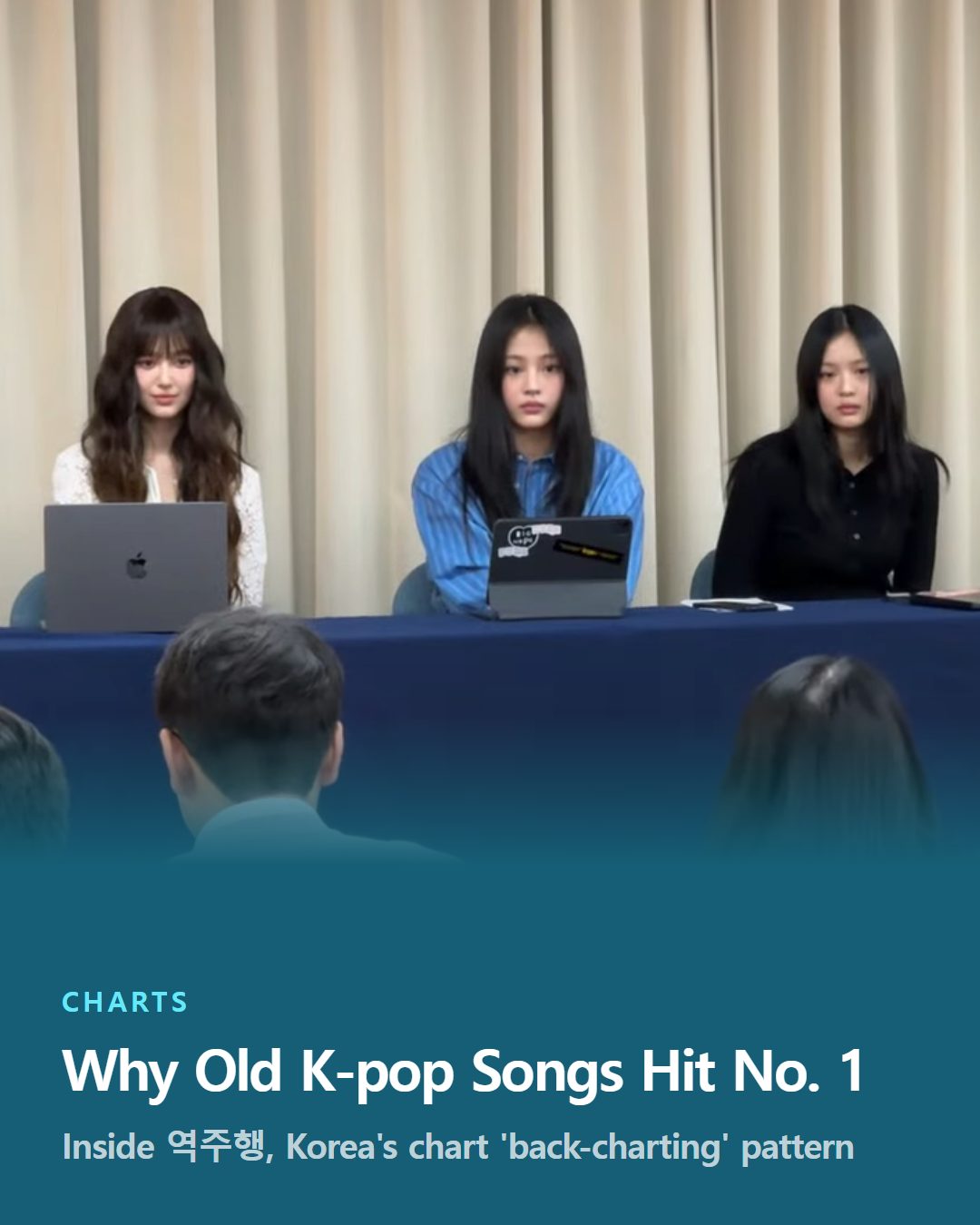
RESCENE's two-year-old single surges to No. 1
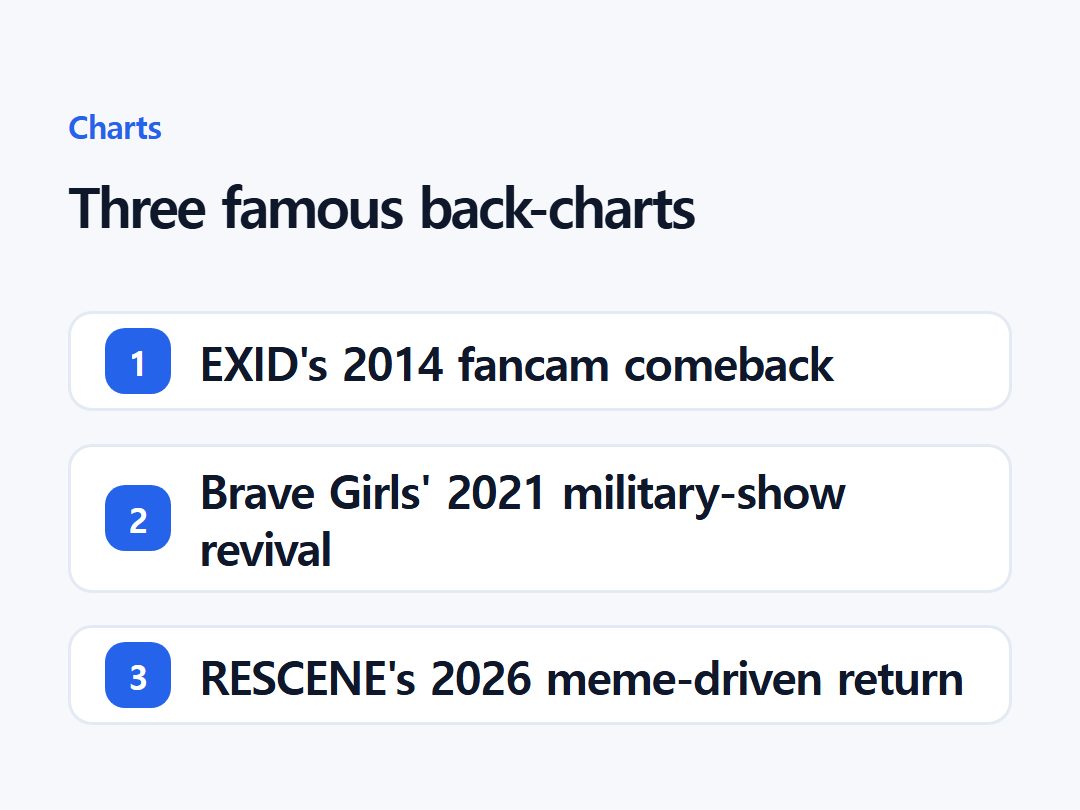
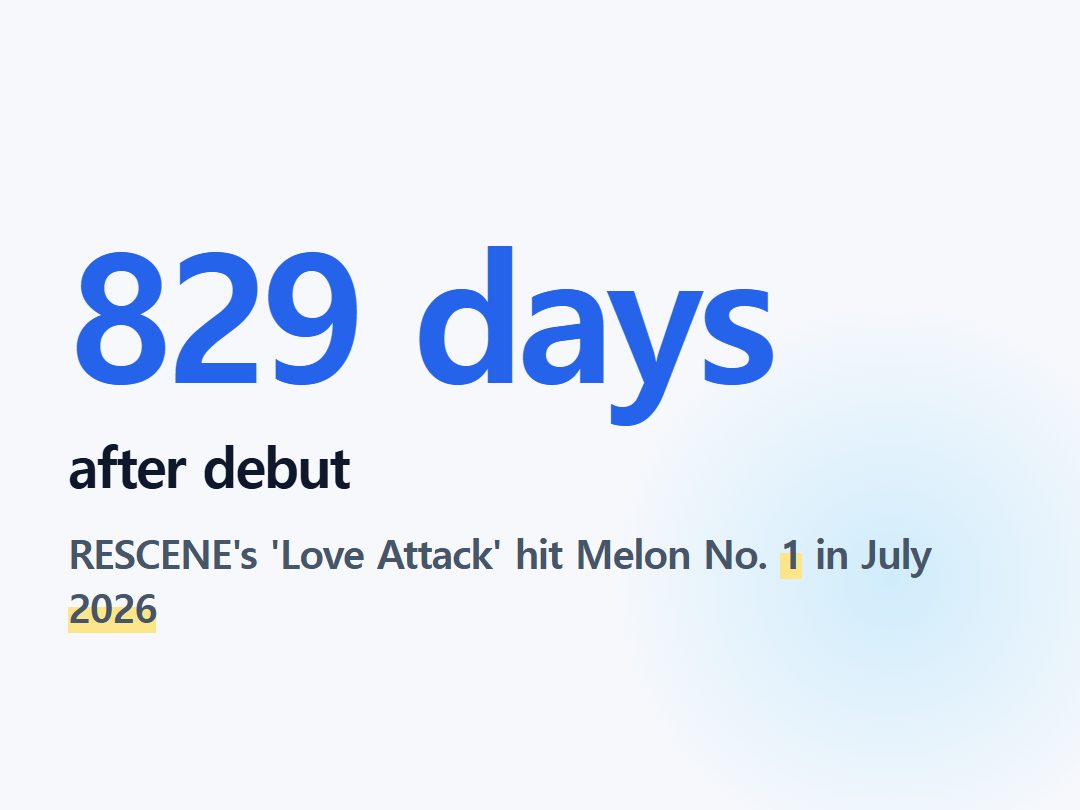
In July 2026, the four-member girl group RESCENE watched their song "Love Attack" reach No. 1 on Melon's TOP100 chart — South Korea's most closely watched music ranking. That would be unremarkable news for most releases, except "Love Attack" came out in August 2024.
It had already fallen out of the Top 100 entirely by the time it clawed its way back to No. 98 in late May 2026, then climbed for six more weeks until it hit No. 1, roughly 829 days after the group's debut. The trigger wasn't a new single or a marketing push.
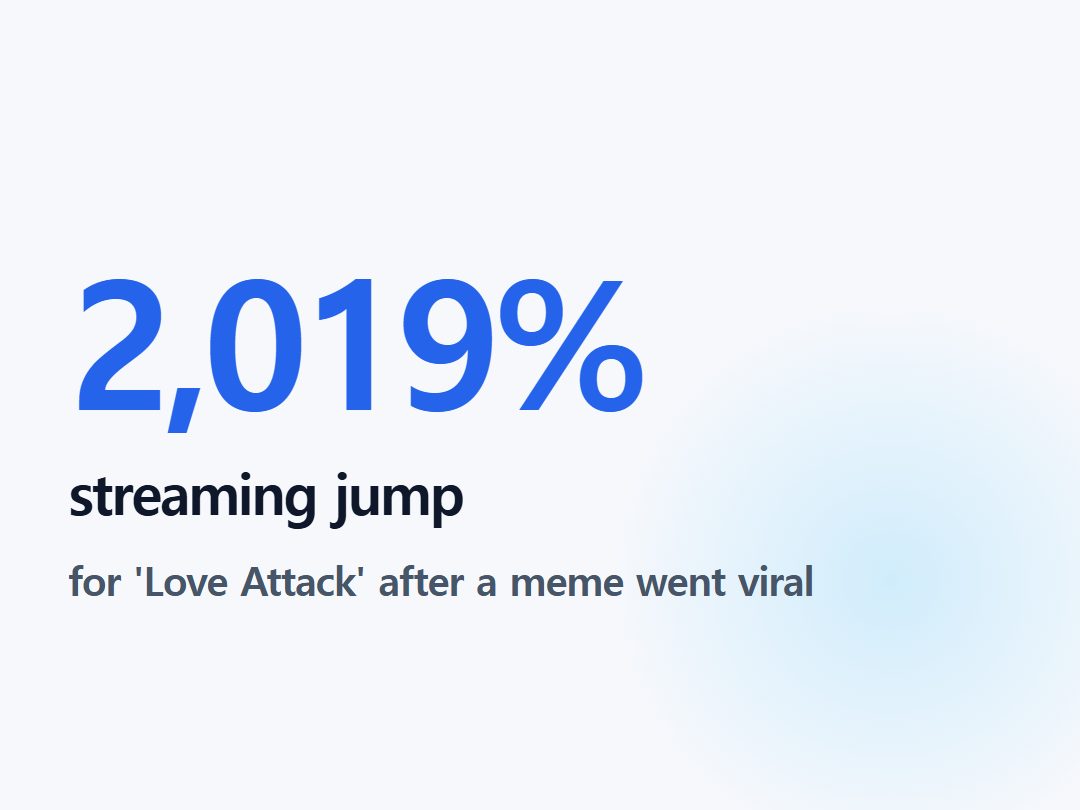
It was a short clip from a member's personal YouTube video — a joke about her hometown dialect that turned into an internet meme — which sent streams of the two-year-old song up more than 2,000 percent.
The short version
- RESCENE's 2024 single hit No. 1 in 2026 via a viral clip.
- Yeokjuhaeng: old K-pop songs re-chart years later through memes or fancams.
- Korea's real-time charts capture such shifts instantly, unlike slower Western charts.
Korean fans have a name for this: 역주행 (yeokjuhaeng), literally "driving in reverse." It describes a song that fails, or barely registers, when it is first released, then climbs the charts long afterward because of a meme, a viral clip, a rediscovery, or word of mouth. It is not a one-off fluke.
It is a recognized, recurring pattern on Korean charts, distinct enough that fans and industry press track and rank the biggest instances of it the way other countries track debut records.
Why do Korea's real-time charts reward old songs?
To an outside observer, the RESCENE case might look like a lucky meme going viral, the kind of thing that happens to obscure songs everywhere. What's harder to see from outside Korea is that back-charting isn't a random accident of the internet — it is something the domestic chart system is specifically built to register, in a way that charts like the U.S. Billboard Hot 100 mostly are not.
Korean chart standing is dominated by domestic streaming platforms, above all Melon, South Korea's largest music service, alongside Genie, Bugs, and FLO.
These feed into the Circle Chart (formerly called the Gaon Chart), the country's official industry-wide ranking body, which compiles weekly, monthly, and yearly totals from streaming and downloads.
Because the domestic listening base is concentrated on a handful of platforms that update daily, a real shift in what ordinary Korean listeners are streaming shows up on the chart almost immediately — not diluted across a slower-moving, more catalog-heavy aggregate the way older or larger markets sometimes are.
A song that was released quietly two years ago can, in principle, out-stream a song released this week, and the chart will reflect that the same day.
This matters for a second reason: charts in Korea aren't just a scoreboard for fans, they are an input into the industry itself. Weekly music programs on Korean television — called music shows — use chart and sales data as part of the scoring formula that decides which act wins that week's trophy.
A song's chart position also shapes whether an agency (the management company that trains, produces, and promotes an idol group) decides to extend a group's promotional schedule, book more media appearances, or greenlight another comeback (the K-pop term for a new single or album release cycle, complete with a new concept, styling, and choreography).
So when a song back-charts, it isn't just a symbolic honor. It can genuinely resurrect a promotional cycle, or a group's career, well after everyone involved assumed that song's moment had passed.
The mechanisms that spark a yeokjuhaeng moment tend to fall into a few repeating categories. One is the fancam — a video shot and edited by a fan to focus on a single performer during a live stage, rather than the full group.
A fancam that captures an especially charismatic performance can circulate independently of the original song's promotional cycle, sometimes years after the fact, and pull new listeners back to the studio track.
Another is exposure through Korea's mandatory military service ecosystem: groups sometimes perform for troops on broadcasts produced for the Ministry of Defense, and compilations of those performances can go viral among a much wider civilian audience than the original telecast ever reached.
A third is straightforward internet meme culture — a joke, a soundbite, or a dance moment clipped out of a music video or livestream and repurposed on short-form platforms, disconnected from any promotional intent at all.
What ties these together is that back-charting is fundamentally community-driven rather than agency-driven. Nobody's marketing team plans for a four-year-old fancam or a two-year-old dialect joke to relaunch a single.
The song has to already be good enough, and available enough on streaming platforms, for a rediscovery to convert into sustained listening. Korean fans read a yeokjuhaeng chart run as a kind of proof: that a song's popularity is closer to organic public taste than the industry's own promotional calendar.
What are K-pop's biggest back-charting success stories?
The pattern has a well-documented lineage. One of the earliest cases widely cited as a defining yeokjuhaeng story is EXID's "Up & Down." The song was released in August 2014 and initially flopped, dropping out of the national Top 100 within a week.
In October that year, a fan uploaded a fancam focused on member Hani during a live stage; the clip spread on YouTube through the fall, and by late December the song had climbed back onto Melon and Bugs' charts, eventually reaching No.
1 on both and topping the Circle Digital Chart in early January 2015 — about four months after release, and roughly five months after EXID's promotional cycle for the song had technically ended.
The group, which had been on the verge of obscurity, went on to win several music show trophies for a song they were no longer actively promoting.
Brave Girls' "Rollin'" is often cited as the most extreme case. The song was originally released in 2017 and went largely unnoticed.
What kept it alive was a string of 72 performances the group gave for South Korean troops on the K-Force Special Show, a program produced by the Ministry of Defense for soldiers on military bases.
Those clips built the group a following inside the military itself — fans jokingly called the phenomenon the "Millboard," a blend of "military" and "Billboard," and Brave Girls became known among enlisted soldiers as the unofficial "president of the military." In February 2021, a YouTuber compiled highlights from those military shows into a single video, which went viral with the general public nearly four years after the song's original release. "Rollin'" then achieved what Korean charts call a "perfect all-kill" — simultaneously topping every major real-time and daily chart at once — and spent five separate weeks at No. 1 on the Circle Digital Chart.
IU's "Hold My Hand," originally a 2011 drama soundtrack song, followed a quieter version of the same arc: a 2019 concert performance of the song was uploaded to YouTube, and by October 2022 that concert video had passed 50 million views, driving a fresh wave of streaming that pushed the decade-old track into Melon's year-end Top 100 for 2022.
The chart infrastructure itself has also evolved in ways that shaped how visible these swings are.
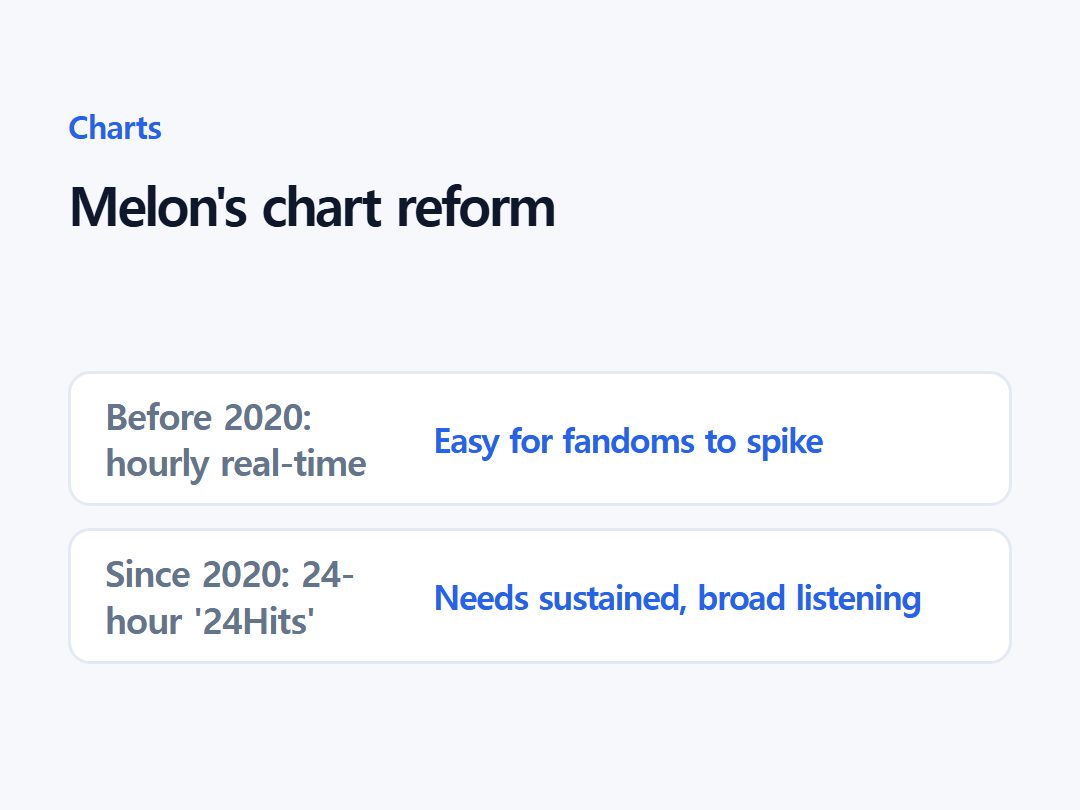
Until 2020, Melon's real-time chart updated hourly, based only on the previous hour's streaming activity — a system that made it easy for coordinated fan campaigns to spike a song into the Top 10 for a short window, even without broad organic popularity, simply by streaming in bursts.
After years of criticism that this rewarded fandom coordination over genuine listening, Melon overhauled the system in July 2020, replacing the hourly real-time chart with "24Hits," a rolling 24-hour measure weighted toward downloads as well as streams, and removed the visible hour-to-hour ranking swings that had made manipulation a spectator sport.
The reform was aimed at fan-driven gaming of new releases, but it also changed the shape of back-charting: a song now needs sustained, broad listening over a full day-cycle to move up, which is arguably a higher bar, but also a more convincing one when a genuine yeokjuhaeng run does happen.
Why back-charting can't be planned in advance
RESCENE's case suggests the phenomenon hasn't gone away under the reformed chart system — if anything, short-form video platforms have added a new, faster trigger to the older list of fancams and military broadcasts. What remains unresolved is how repeatable this is for any individual act.
Agencies cannot manufacture a back-charting run the way they can schedule a comeback; it depends on a pre-existing song being strong enough to survive rediscovery, and on a viral moment that no marketing plan can reliably produce.
For now, yeokjuhaeng remains something Korean fans watch for rather than something the industry can plan around — which is precisely why, when it happens, Korean outlets treat it as its own kind of chart story, separate from a normal release week.
Notable yeokjuhaeng (back-charting) cases in K-pop
| Song | Original Release | Trigger | Chart Result |
|---|---|---|---|
| EXID – "Up & Down" | August 2014 | Fan-shot fancam of member Hani went viral in October 2014 | No. 1 on Melon and Bugs; topped Circle Digital Chart by January 2015 |
| Brave Girls – "Rollin'" | 2017 | 2021 YouTube compilation of 72 military-show performances went viral | Perfect all-kill; 5 weeks at No. 1 on Circle Digital Chart |
| IU – "Hold My Hand" | 2011 | 2019 concert clip passed 50 million YouTube views by Oct 2022 | Entered Melon's year-end Top 100 for 2022 |
| RESCENE – "Love Attack" | August 2024 | Viral dialect-joke clip from a member's YouTube video | No. 1 on Melon TOP100 in July 2026, ~829 days after debut |
Frequently asked
What does yeokjuhaeng mean?
Yeokjuhaeng (역주행) is Korean for "driving in reverse" — a song that flops or barely registers on release, then climbs the charts long afterward because of a meme, viral clip, or rediscovery.
Why did RESCENE's 'Love Attack' hit No. 1 two years after release?
A viral clip from a member's YouTube video about her hometown dialect became a meme and sent streams of the two-year-old song up more than 2,000 percent, pushing it from No. 98 to No. 1 on Melon's TOP100.
What is the most extreme yeokjuhaeng case in K-pop history?
Brave Girls' "Rollin'" is often cited as the most extreme case: a 2021 YouTube compilation of the group's military-show performances went viral nearly four years after the 2017 release, and the song achieved a perfect all-kill with five weeks at No. 1 on the Circle Digital Chart.
Sources
Every factual claim above is traceable. We do not translate articles — we gather facts from multiple outlets and write them ourselves.
- 6 K-Pop Songs That Entered The Charts Long After Their Release — Soompi
- Up & Down (EXID song) — Wikipedia
- EXID's 'Up & Down' hits #1 on Melon's real-time charts! — allkpop
- Rollin' (Brave Girls song) — Wikipedia
- A primer on how a viral YouTube video revived K-pop act Brave Girls — The Brag / Tone Deaf
- Rescene hits #1 on Melon TOP100 with 'Love Attack', members react with tearful live stream — allkpop
- Melon names Rescene the standout act of 2026's first half for a two-year-old song powered by a meme — Korea JoongAng Daily
- Update: Melon Makes Major Changes To Chart System — Soompi
- How Do Korean Music Charts Influence the K-pop Industry? — MyKobsession