Saturday Night Live Korea is not a dubbed rerun of the American show.
It runs on a formal format license from NBCUniversal — the same licensing arrangement that lets Lorne Michaels serve as an executive producer on SNL adaptations abroad — but almost everything downstream of that license has been rebuilt for Korean broadcast law, Korean libel rules, and a comedy ecosystem built around K-pop idols rather than stand-up comedians.
The short version
- NBC says South Korea is the only country with a lasting SNL adaptation abroad.
- The show stopped airing live once it moved to Coupang Play in 2021.
- SNL Korea dropped Weekend Update in 2014, replacing it with a talk show.
A licensed format, not a copy
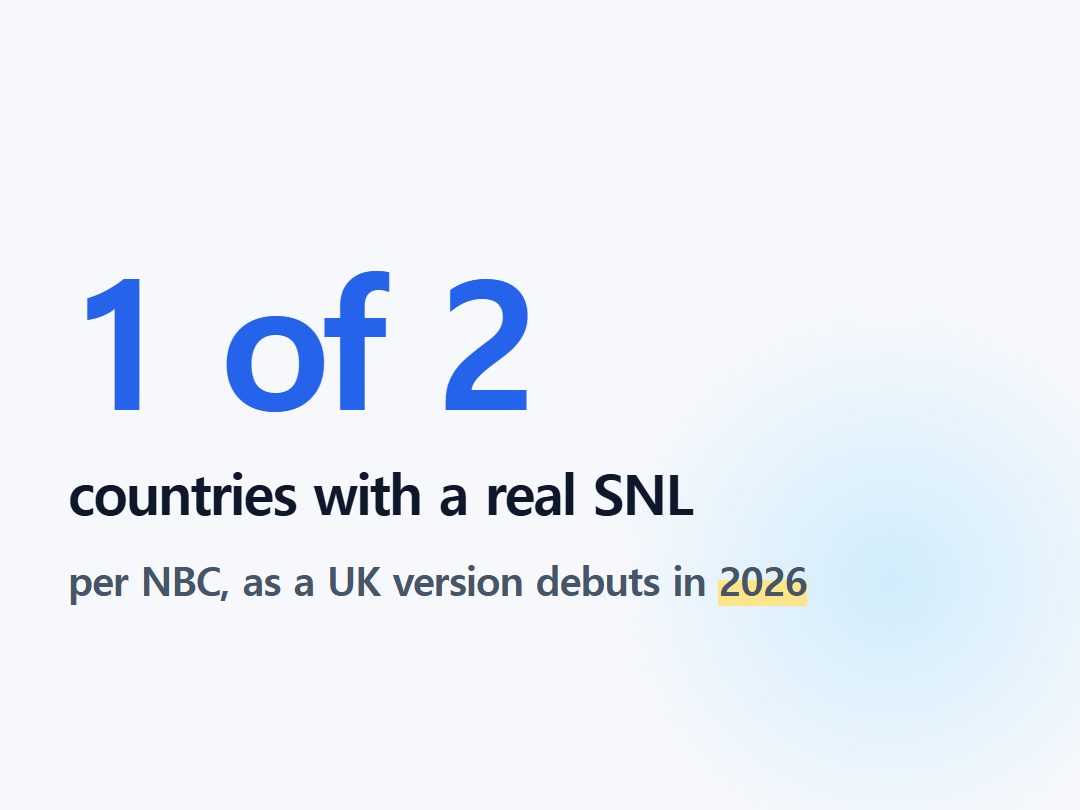
SNL Korea premiered on the cable channel tvN on December 3, 2011, and it is still airing. According to NBC, South Korea is the only other country with a genuine, ongoing SNL of its own — attempts to launch local versions in France, Italy, and Japan did not last.
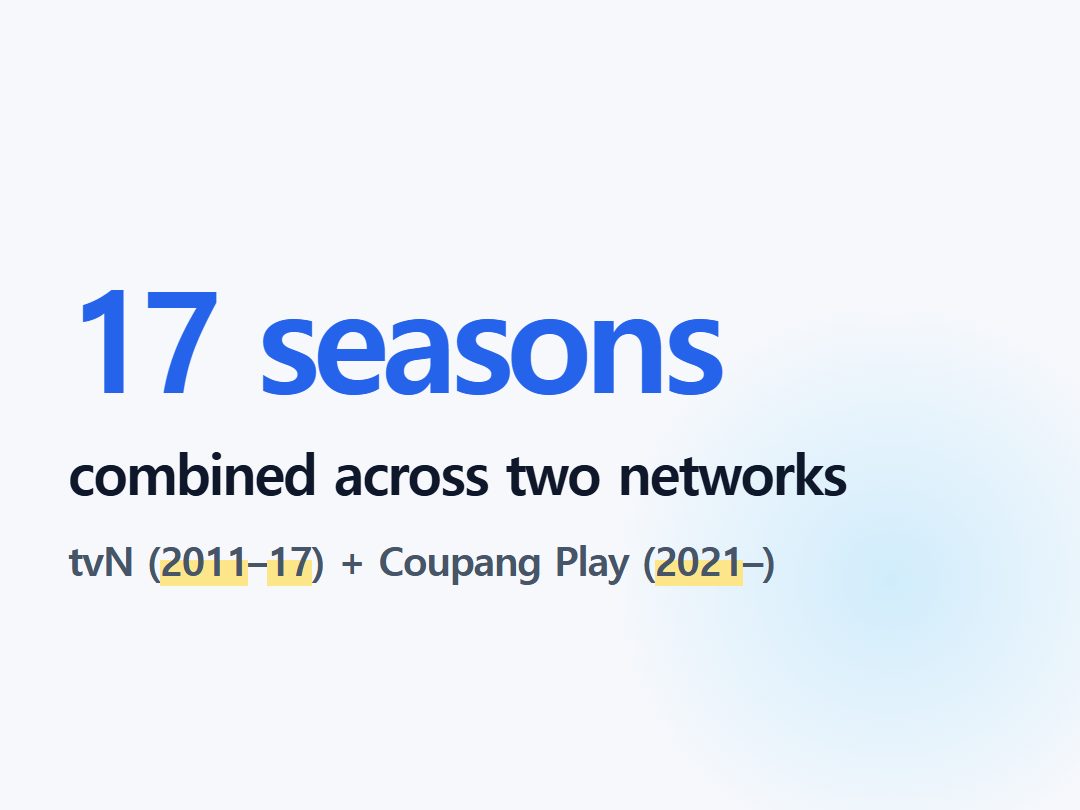
That claim resurfaced in 2025 when NBC announced a UK version of SNL for 2026, with Korea cited as the format's one lasting success story outside the United States. Combined across its original cable run and its streaming reboot, the Korean show has now aired 17 seasons.
Why the "live" in SNL doesn't apply anymore
The name Saturday Night Live describes something the Korean version can no longer do. During its tvN years, the show broadcast live at 10:50 p.m. on Saturdays, just like its American parent.
That ended when the show moved to the streaming service Coupang Play in 2021. Korean law requires video content to pass either a pre-broadcast review by the Korea Media Rating Board or a post-broadcast review by the Korea Communications Standards Commission — and streaming platforms fall into neither category cleanly.
To satisfy the post-broadcast rule, finished episodes are quietly aired once overnight on a small satellite DMB channel or cable outlet before going up on Coupang Play. The workaround means every Korean episode is fully recorded and edited well before most viewers ever see it — the opposite of the improvisational, error-prone energy that live broadcast gives the American show.
A content rating that keeps swinging between 15 and 19
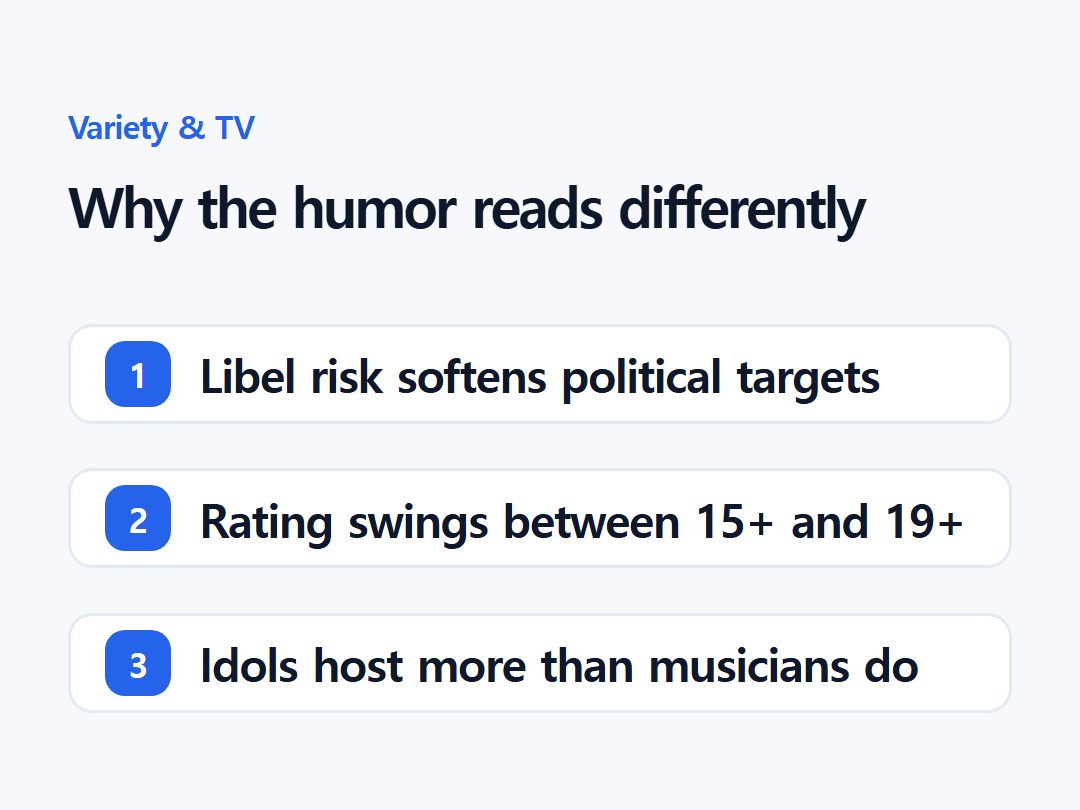
Korean broadcast content carries an age rating, and SNL Korea's rating has moved back and forth for over a decade. In 2014, the show shifted from a 19+ to a 15+ rating to reach an earlier, broader Saturday timeslot — trading some of its raunchier material and political bite for higher ratings.
The 19+ label has since returned, and it has not settled the debate. A 2025 sketch featuring actress Moon Chae Won drew criticism for sexual content that critics said was ineffective at the 19+ rating alone, since clips routinely circulate on platforms with no age gate at all.
Parliament played by puppets, not pundits
American SNL satirizes politicians through direct impersonation — a cast member playing a president at a podium. Korean political satire has often taken a more indirect route.
The 2012 sketch series "Yeouido Teletubbies" recast National Assembly members and that year's presidential candidates as the children's characters, mapping party colors onto Teletubby costumes during South Korea's 18th presidential election.
It was popular enough to run across two seasons before ending when its director departed. A single narrator, voice actor Gu Ja-hyung, read each episode in the same soft, storybook tone as the children's show it was mocking, letting the mismatch between voice and subject do the joke's work.
By the 2022 presidential race, the show had moved back to direct impersonation: cast members Kwon Hyuk-soo and Kim Min-kyo played candidates Lee Jae-myung and Yoon Suk-yeol, mimicking their speech patterns and mannerisms in sketches that drew over a million views.
The soundbite that outlived the campaign
In October 2021, presidential candidate Yoon Suk-yeol appeared on an SNL Korea segment and was asked whether he would let the show satirize him freely if elected. His answer — that free political satire is "not something to help with, it's SNL's right" — became a widely quoted line.
After he took office, the same clip was repeatedly cited in political debate whenever a satirical sketch drew controversy, including a 2024 skit depicting presidential security staff physically silencing a cast member mid-performance. Opposition lawmakers have invoked the 2021 quote directly when criticizing how satire involving the president has since been received.
Weekend Update moved to the end, then vanished
The American Weekend Update segment has run continuously since 1975, always slotted after the first musical performance. The Korean version never followed that placement, running it near the very end of the episode instead, just before the goodnights.
Then, in its fifth season in 2014, SNL Korea dropped Weekend Update entirely and replaced it with a musician-hosted mini talk show. The American original has never gone a season without its news-desk segment.
Hosts who are also the musical guest
The American show keeps a clean line between a comedic host and a separate musical guest. SNL Korea blurred that line for its first four tvN seasons, billing K-pop acts as combined host-and-performer for the same episode.
- Super Junior, SHINee, and 2AM hosted and performed songs in the same appearance
- Wonder Girls, TWICE, and Red Velvet followed the same combined format
- Red Velvet's Wendy went further, joining the cast for an entire reboot season
Wendy's dual role created a specific kind of meta-comedy unavailable to the American show: her own sketch characters played superfans of Red Velvet, the group she actually belongs to. From season 5 onward, the show separated the roles again, moving closer to the American structure.
The Korean cast has also worked with international guests who never appear on the American show's stage, including actress Chloë Grace Moretz performing sketches in Korean, and English-speaking guests such as Tom Hiddleston, Jason Mraz, and Miranda Kerr working through the crew's translation on set.
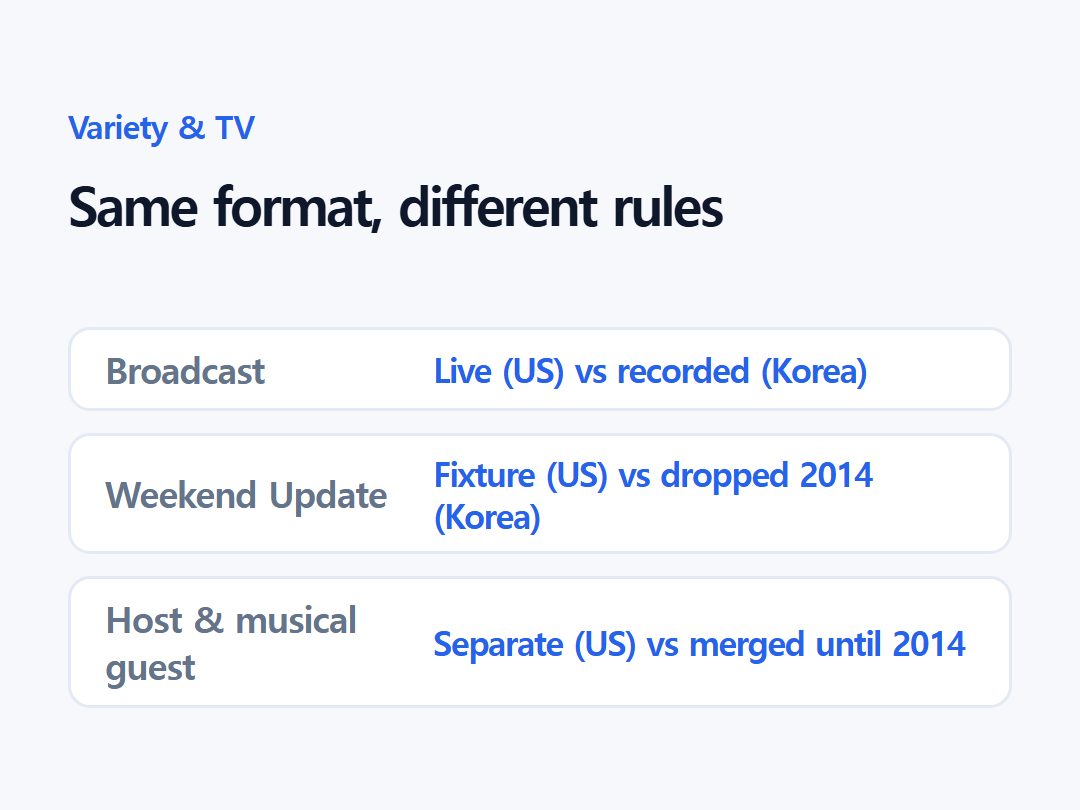
| Element | American SNL | SNL Korea |
|---|---|---|
| Broadcast | Live, weekly | Fully recorded since 2021 |
| Weekend Update | Continuous fixture since 1975 | Repositioned, then dropped in 2014 |
| Host / musical guest | Always separate roles | Combined through season 4, then split |
Digital shorts, borrowed a second time
The American show popularized the pre-taped "digital short" in the mid-2000s, cutting away from the live studio to filmed sketches that a live set could not stage. SNL Korea adopted the same device early in its run, using shorts for anything too elaborate for a Saturday-night studio floor.
Once the entire show became fully recorded in 2021, that distinction mostly disappeared. A studio sketch and a digital short are now produced under identical conditions and released together as one packaged episode, rather than as a mix of live and pre-taped segments the way the American version still runs it.
From cable Saturdays to a streaming original
SNL Korea ran nine seasons on tvN before announcing a full end on Facebook in May 2018. Its NBC rights lapsed in 2020, and reruns disappeared from tvN's own site along with them.
Coupang Play revived it in September 2021 as the streaming service's first original entertainment title, bringing back lead producer Ahn Sang-hwi and much of the original creative team. The most recent run, season 8 of the reboot, aired ten weekly episodes from March 28 to May 30, 2026, hosted by a rotating lineup that included Tak Jae-hoon, Han Ga-in, and Uhm Ji-won.
What the format still hasn't settled
Critics inside Korea have increasingly argued that the show's political satire has softened, aiming more often at celebrities and office workers than at sitting politicians — a shift some commentators trace to caution around defamation risk rather than any change in law.
The overnight-broadcast workaround that lets the show avoid full pre-review also remains a legal patch rather than a settled arrangement, meaning a future update to Korea's streaming content rules could force the format to change again. Whether SNL Korea drifts back toward its noisier, more live-feeling tvN era, or further away from it, is still an open question the show itself has not answered.
SNL Korea timeline
| Year | What happened |
|---|---|
| 2011 | Premieres on tvN, December 3 |
| 2012 | "Yeouido Teletubbies" recasts politicians as Teletubbies for the presidential election |
| 2014 | Rating drops from 19+ to 15+; Weekend Update dropped for a talk-show format |
| 2018 | tvN run ends after nine seasons, announced on Facebook |
| 2020 | NBC rights lapse; reruns pulled from tvN's site |
| 2021 | Coupang Play revives the show as its first original entertainment title; broadcast becomes fully recorded |
| 2026 | Reboot season 8 airs March 28-May 30 |
Frequently asked
Is SNL Korea live?
No. Since moving to Coupang Play in 2021, episodes are fully recorded and edited, then aired once overnight on a small satellite or cable channel to satisfy Korean review rules before streaming.
How many seasons does SNL Korea have?
SNL Korea has aired 17 seasons combined across its original tvN run and its Coupang Play streaming reboot.
Why did SNL Korea end on tvN?
SNL Korea ran nine seasons on tvN before announcing a full end on Facebook in May 2018, and its NBC rights lapsed in 2020 before Coupang Play revived the show in September 2021.
Sources
Every factual claim above is traceable. We do not translate articles — we gather facts from multiple outlets and write them ourselves.
- 'SNL Korea' Revived As Original Series At Coupang Play — Variety
- Saturday Night Live Korea — Wikipedia
- "SNL Korea" Improves Viewer Ratings with a Shift from 19+ to 15+ Content — Soompi
- SNL Korea, Defanged by Censorship, Stumbles with Sexual Humor — Seoulbeats
- "Too dirty": Moon Chae Won's SNL Korea skit draws backlash for "overboard" sexual references — allkpop
- SNL crosses the pond — Axios
- 쿠팡플레이 코미디 쇼 'SNL 코리아' 시즌 8, 3월 28일(토) 저녁 8시 공개 확정 — Coupang Newsroom
- SNL, 윤 정권 '입틀막' 패러디…"풍자는 권리" — NoCutNews
- 정치풍자 권리를 강조했던 윤석열 대통령 후보 시절 발언 소환 — Media Today