
On Korean television right now, some of the most-watched programs feature almost no competition, no elimination, and no plot twist. A comedian does her laundry. A retired soccer player shops for furniture. A father tries to get his toddler down for a nap while a hidden camera in the playhouse tent films the whole thing.
This is Korea's 'observational variety' (관찰 예능, gwanchal yeneung) genre: footage of a celebrity's ordinary daily life, filmed documentary-style, edited together with a studio panel reacting to it in real time.
The short version
- Korean observational shows film real celebrities' ordinary daily life, unscripted, no competition.
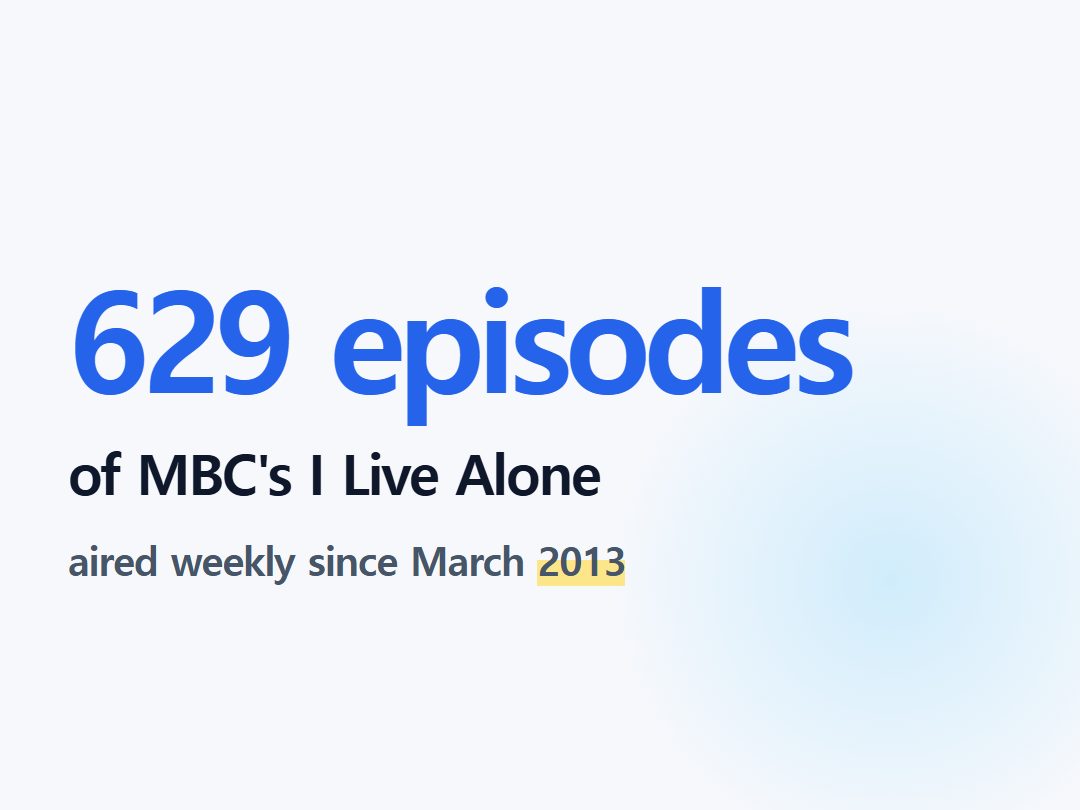
- I Live Alone has aired since March 2013, reaching roughly 629 episodes.
- Producer Na Young-seok's low-conflict format reshaped Korean variety TV after 2013.
MBC's I Live Alone, which follows single celebrities through their solo routines, has aired weekly since March 2013 and has reached roughly 629 episodes.
It ranked first in Gallup Korea's monthly survey of Koreans' favorite TV programs in June 2024, and has placed third or higher in that survey on a near-continuous basis for years.
KBS2's The Return of Superman, which observes celebrity fathers caring for their children alone for 48 hours, has run since November 2013 and remains one of the network's flagship Sunday programs.
Neither show has a game, a mission, or a script in the way most reality television outside Korea does — and that absence is the entire point.
Why does Korean reality TV skip the drama?
For international viewers raised on Survivor, The Real Housewives, or Love Island, 'reality TV' usually means manufactured conflict: strangers thrown together, forced to compete, edited to maximize drama. Korean observational variety runs on the opposite logic, and understanding that difference explains why the genre has become the backbone of Korean entertainment television rather than a niche format.
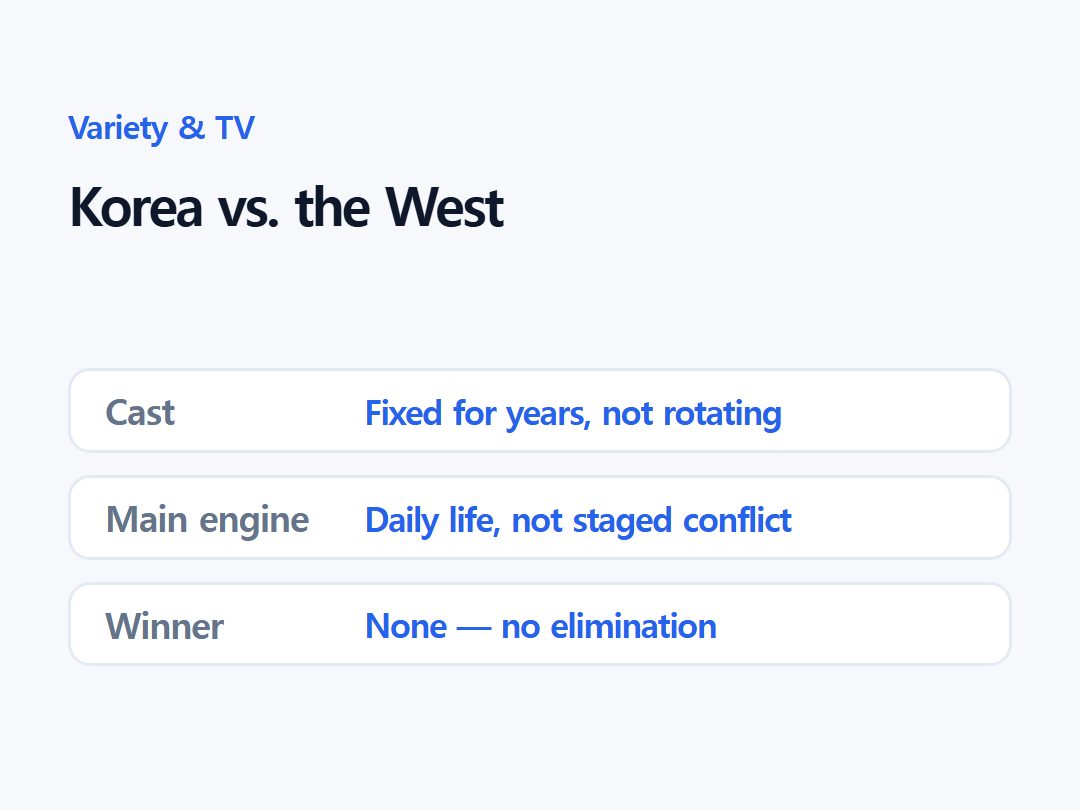
The first structural difference is the cast. Western reality formats like MasterChef or The Amazing Race typically reset with a new group of contestants every season, and the appeal is finding out who wins.
Korean observational shows instead keep a small, fixed cast — sometimes for a decade or more — and the appeal is watching familiar people go about familiar lives. I Live Alone's cast is nicknamed the 'Rainbow Club'; The Return of Superman has rotated fathers over the years but keeps the same premise running continuously. There is no season finale and no winner, because there is nothing to win.
The second difference is what counts as content. Rather than staging a competition, producers place fixed cameras in a celebrity's actual home — in tents, in playhouses, in kitchen corners — and let ordinary tasks (cooking, grocery shopping, folding laundry, playing with a child) become the footage.
A narrator and, separately, a studio panel of hosts and guest commentators watch the same footage the audience is watching and react to it, explaining context and adding jokes.
Korean media scholars who study the genre describe this narrator-and-panel structure as the 'observer,' arguing it is what actually distinguishes one observational show from another, since the raw format — a hidden camera following a celebrity — is otherwise identical across programs.
The observer figure also does something else: it softens the voyeurism inherent in watching someone's unguarded home life, turning it into a shared, commented-on experience rather than a one-way stare.
The third difference is tone. Academic analysis of the genre notes that Korean observational shows lean into 'family,' domestic routine, and gentle curiosity rather than scandal, humiliation, or strategic betrayal — the engines of much Western reality programming.
A South Korean industry commentator interviewed by CJ ENM's own newsroom has described the shift in similar terms: audiences increasingly value programs that read as authentic over ones that are visibly staged, and observational shows benefit because there is comparatively little for producers to fabricate.
That same low-conflict, home-based format also happens to make product placement easy — a coffee machine or a snack brand can appear naturally in someone's kitchen — which is one reason Korean broadcasters and cable channels adopted the format so aggressively once it started drawing ratings.
None of this means Korean observational shows are unscripted in an absolute sense. Cast and crew typically know the outline of a segment or the identity of a guest in advance, and editing shapes a narrative the way it does anywhere.
But the negotiated, structured spontaneity of a show like Running Man — where cast members improvise within a set premise — is still a different exercise from restaging someone's entire daily life for the cameras, which is closer to what observational variety asks of its subjects.
How Korean TV traded stunts for stillness
Variety programming has been part of Korean broadcasting since its earliest days: when Korea's television networks launched in the 1960s, general variety shows such as Show Show Show were among their first offerings, and studio-based comedy, music, and talk formats dominated for decades afterward.
Through the 1990s and early 2000s, Korean entertainment TV leaned heavily on talk-show and game-show hybrids built around verbal sparring between comedians and guests.
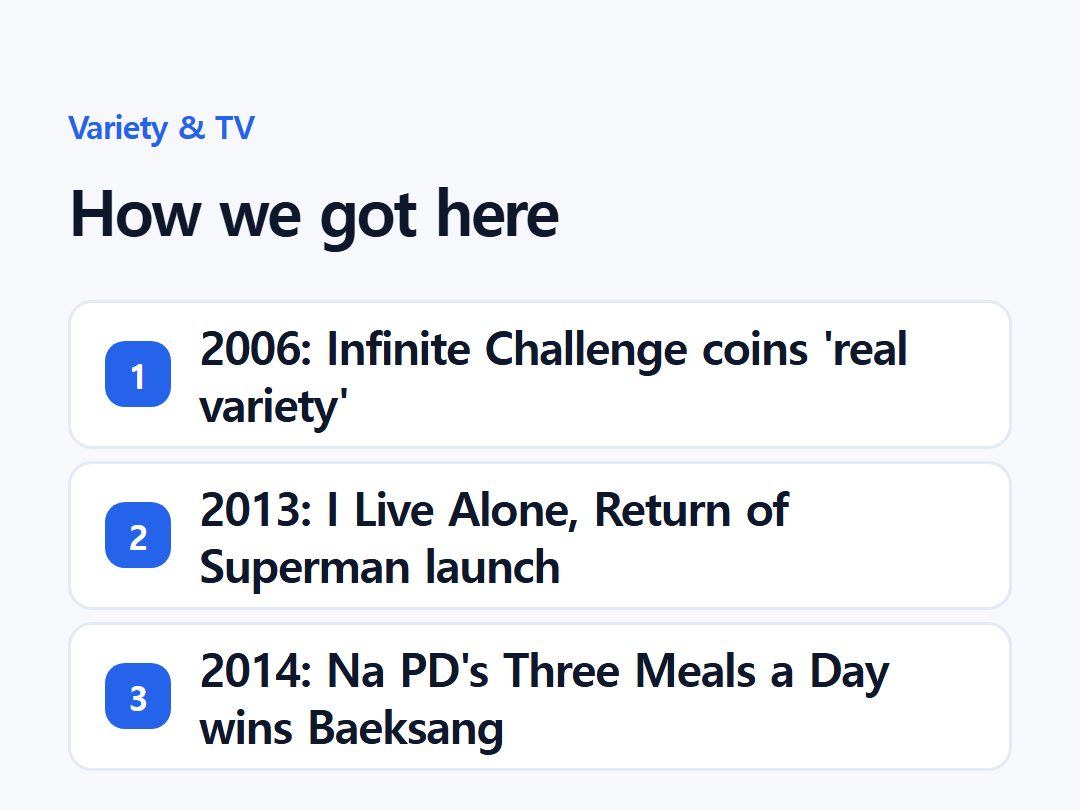
The genre's modern turn began on July 8, 2006, when an episode of MBC's Infinite Challenge is widely credited with coining the term 'real variety' — unscripted, physical, stunt-driven entertainment built around a fixed comedic cast rather than rotating contestants. Infinite Challenge ran for 13 years and effectively set the template Korean variety TV would follow for the next decade: a small, consistent ensemble taking on challenges and missions together.
By the mid-2010s, that 'real variety' wave had started to lose steam, and Korean broadcasters looked for a lower-key alternative. Two shows launched within months of each other in 2013 supplied it.
MBC's I Live Alone began as a Lunar New Year pilot in February 2013 and became a weekly series that March, inviting viewers into celebrities' apartments instead of sending them on missions.
KBS2's The Return of Superman, which premiered as a holiday special that September before joining the regular Sunday lineup in November, applied the same idea to parenting, filming celebrity fathers with hidden cameras as they cared for their kids alone.
The genre's most influential push, however, came from producer Na Young-seok, who had built his career at KBS directing the real-variety hit 2 Days & 1 Night starting in 2007.
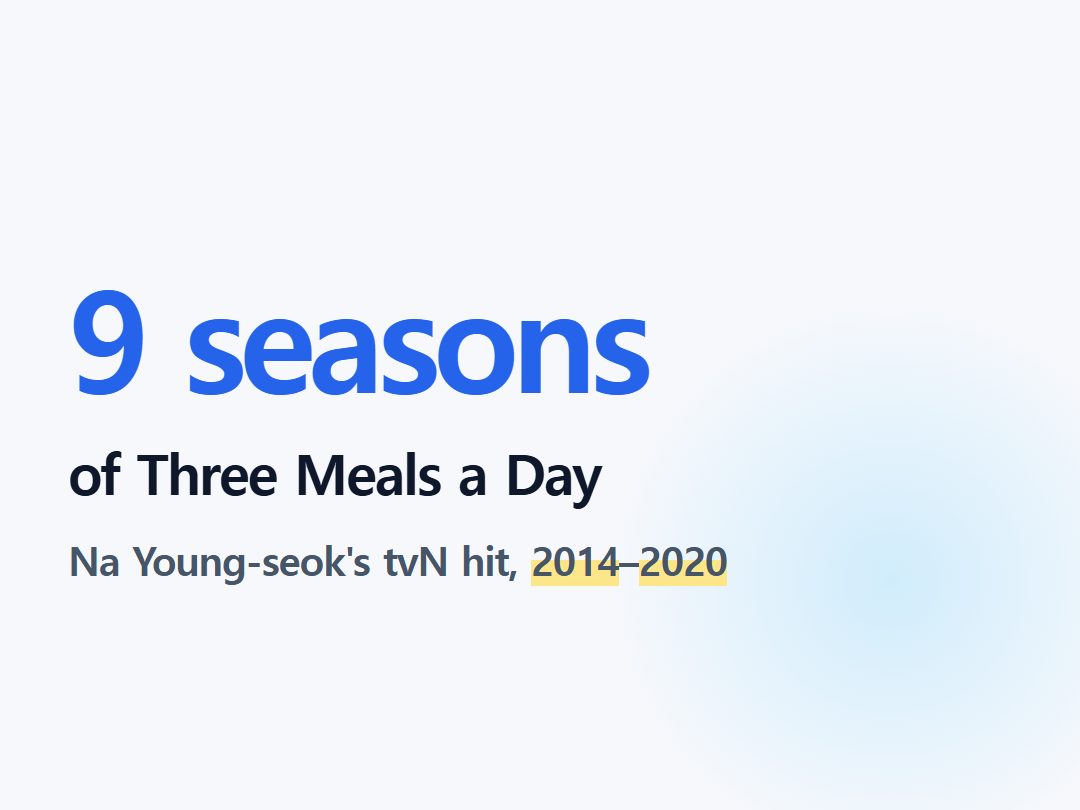
When Na left KBS in December 2012 and joined the cable network tvN, he began developing a slower, quieter style of observation: Three Meals a Day, which ran for nine seasons and 106 episodes between 2014 and 2020, simply followed a small cast preparing meals from scratch in a remote village, with almost no competitive element at all.
The show won Na the Best Variety Show award at the 2014 Baeksang Arts Awards — Korea's leading entertainment and film awards — and the following year he became the first variety-show producer ever to win the Baeksang Grand Prize, the ceremony's top overall honor.
His success on a cable channel, historically the underdog to Korea's terrestrial networks, signaled to the whole industry that observational formats could out-perform bigger-budget real variety.
Broadcasters across the board followed, and by the late 2010s observational variety — along with adjacent formats like 'meokbang' (eating broadcasts, where a host eats on camera while chatting with viewers) and parenting shows — had become the industry's default mode rather than an experiment.
Can I Live Alone survive losing its stars?
Observational variety's greatest strength is also its structural weakness: because the format has no plot, its entire appeal rests on whether audiences still like the specific people on screen.
Unlike a competition show, which can refresh itself with a new season and new contestants, an observational show can only swap out cast members one at a time when someone's popularity fades or a controversy hits — and that patchwork approach can eventually make a long-running show feel stale.
I Live Alone is currently a live test case for exactly that risk. The show entered a period of public scrutiny after a controversy involving longtime cast member Park Na-rae, and lost two of its most recognizable members — Park Na-rae and SHINee's Key — in quick succession.
The production team responded in January 2026 by reshuffling the cast and publicly committing to a 'back to basics' approach, betting that a familiar format can survive a change of faces.
Whether that reset restores the show's ratings, or whether it signals the format's first real sign of fatigue after more than a decade, is still an open question.
More broadly, the genre's low-drama, family-safe formula is now being adapted into other spaces, including observational-style dating shows such as Channel A's Heart Signal, which built its 2017 comeback on filming non-celebrity contestants' unscripted daily interactions rather than the heavily produced blind-date formats that preceded it.
As Korean broadcasters compete with streaming platforms and shorter web-variety content, whether the fixed-cast, hidden-camera format that has anchored Korean prime time for over a decade can keep pace — or needs its next reinvention — is the question producers are now facing.
Key milestones in Korean observational variety
| Year | Show / Figure | Milestone |
|---|---|---|
| 2006 | Infinite Challenge | Coins the term 'real variety' |
| 2013 | I Live Alone / The Return of Superman | Observational variety format launches |
| 2014 | Three Meals a Day | Wins Best Variety Show at the Baeksang Arts Awards |
| 2015 | Na Young-seok | First variety-show producer to win the Baeksang Grand Prize |
| 2017 | Heart Signal | Applies observational style to dating shows |
Frequently asked
What is Korean observational variety TV?
It's a genre (관찰 예능) that films celebrities' ordinary daily lives documentary-style, with a studio panel reacting in real time, instead of staging competitions or scripted conflict.
How many episodes has I Live Alone aired?
I Live Alone has aired weekly since March 2013 and has reached roughly 629 episodes, ranking first in Gallup Korea's survey as recently as June 2024.
Why did I Live Alone lose cast members in 2026?
The show lost longtime members Park Na-rae and SHINee's Key after a controversy involving Park Na-rae, prompting a January 2026 cast reshuffle and a 'back to basics' approach.
Sources
Every factual claim above is traceable. We do not translate articles — we gather facts from multiple outlets and write them ourselves.
- I Live Alone (TV program) — Wikipedia
- MBC's 'I Live Alone' makes a fresh start following Park Na-rae and Key's exit — allkpop
- Struggling 'I Live Alone' seeks to win back viewers by returning to basics — The Korea Times
- The Return of Superman (South Korean TV program) — Wikipedia
- 관찰 예능의 장르화 과정과 스토리텔링 연구—관찰자의 역할을 중심으로 — Korea Citation Index (academic journal, 대중서사연구)
- [BEHIND TALK] Why Are They Rising? The Success Trends of Today's Popular K-Variety Shows — CJ ENM Newsroom
- Na Young-seok — NamuWiki
- Three Meals a Day — Wikipedia
- A match made in heaven: The evolution of Korean reality dating shows that struck a global chord — Korea JoongAng Daily