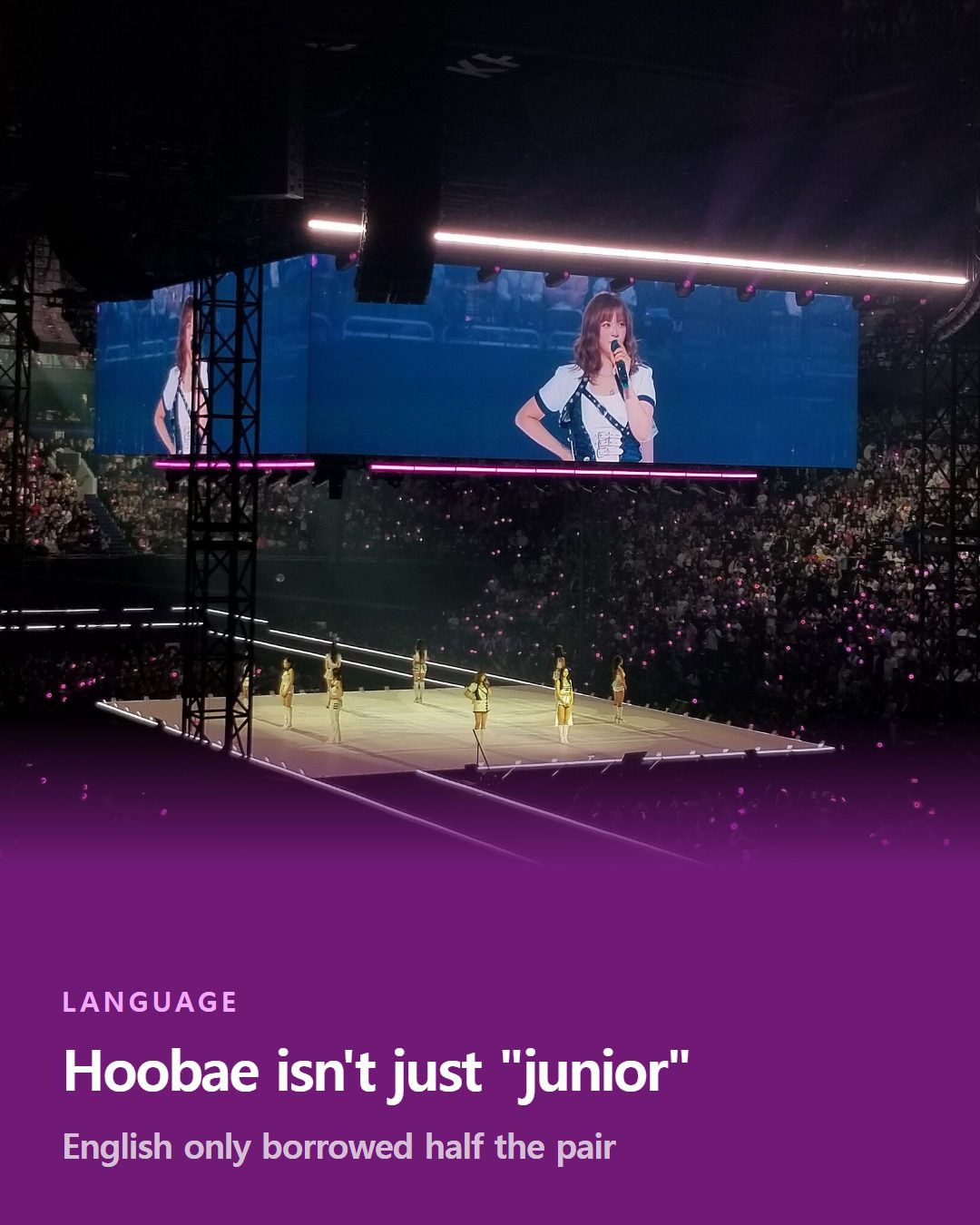
International fans who watch Korean variety shows or idol interviews quickly notice two words repeated constantly: sunbae (선배, senior) and hoobae (후배, junior). Subtitles usually translate both as simply "senior" or "junior," which hides the part that actually matters: this is not about who is older. It is about who arrived first.
The short version
- Sunbae/hoobae ranks by entry order, not age, unlike oppa or hyung.
- In K-pop, debut date decides seniority, not birthday.
- Kkondae and gapjil now call out sunbae who skip the mentoring half.
What do sunbae and hoobae actually mean?
Sunbae and hoobae are relational titles used in any setting with a fixed entry order — a school, a university club, a company, a sports team, or a K-pop group's debut. Whoever entered that setting earlier is the sunbae; whoever entered later is the hoobae.
The terms are gender-neutral, unlike family-style words such as oppa or hyung, and they apply the moment two people share an institution, even if they have never spoken before.
The relationship carries real obligations on both sides. A hoobae is expected to speak to a sunbae in jondaetmal — the formal, honorific register of Korean speech used with people of higher status — until the sunbae explicitly invites more casual speech.
A sunbae, in turn, is culturally expected to look out for hoobae: giving advice, sometimes covering a meal, and easing them into the group.
In interviews, idols routinely address more senior artists as "sunbaenim," adding the honorific suffix -nim, and Korean broadcasters treat getting this wrong as a real breach of manners, not a minor slip.
In stricter settings such as university clubs or sports teams, the deference can be more visible still — a hoobae may be expected to greet a sunbae first and let them order first at a group meal, while a good sunbae is expected to pick up the bill in return.
Why debut order outranks birth year in K-pop
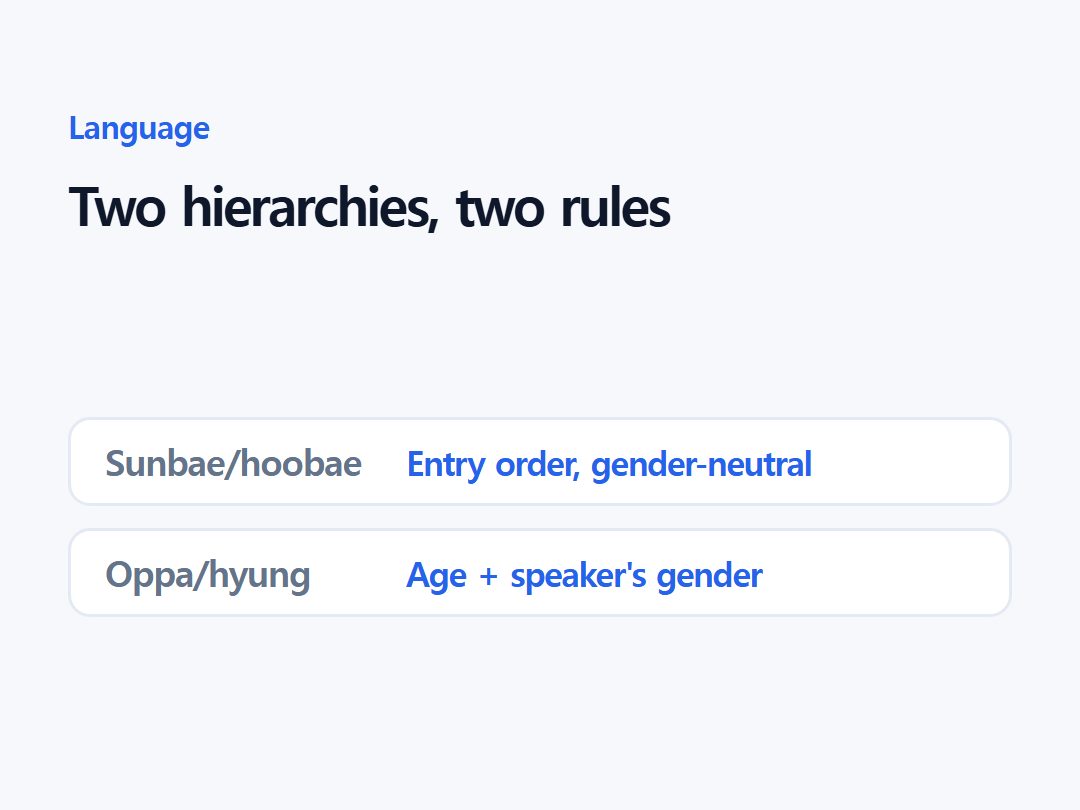
The reason this trips up international readers is that Korean already has a well-known set of age-based terms — oppa (오빠), hyung (형), noona (누나), and unnie (언니) — and it is easy to assume sunbae/hoobae is just a more formal version of the same idea. It is not.
Oppa and hyung are chosen by two variables: the age of the person you're addressing, and your own gender. A woman calls an older male friend oppa; a man calls the same person hyung. These words are personal and typically require an existing relationship — Koreans don't casually call strangers oppa on the street.
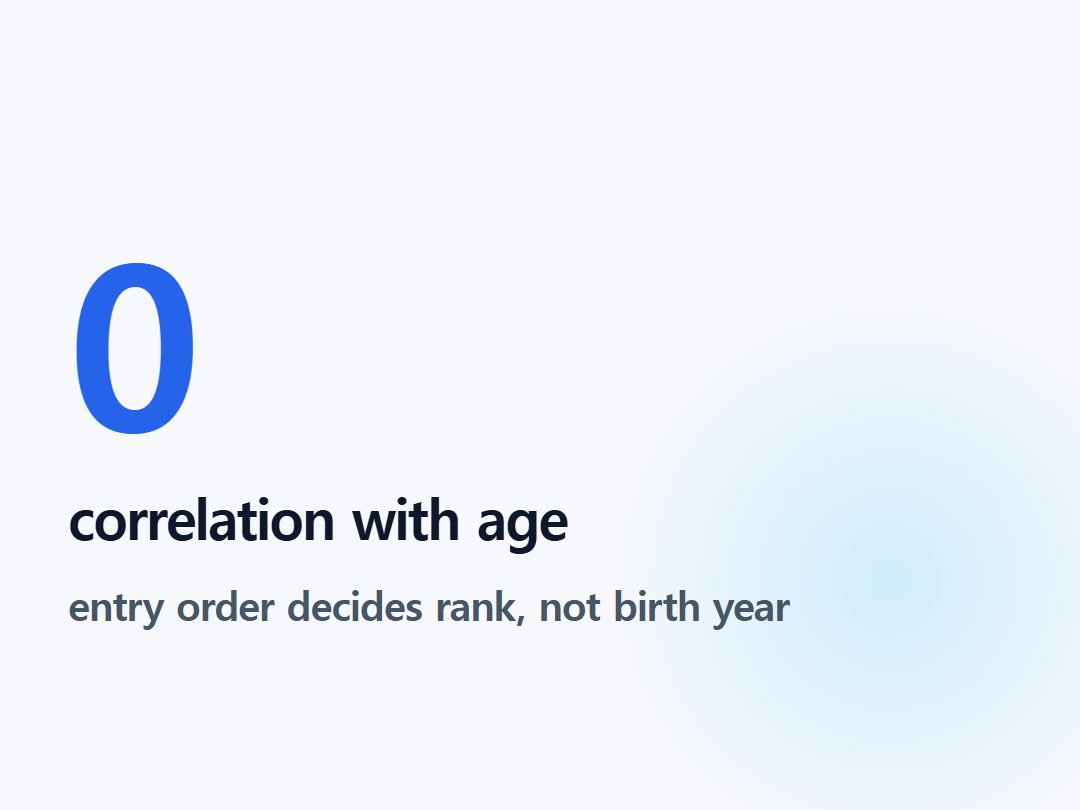
Sunbae and hoobae run on a completely different axis: entry order into a shared institution, full stop. Age and gender are irrelevant.
This produces situations that look paradoxical to outsiders but are unremarkable to Koreans: a 25-year-old who joined a company two years ago outranks a 30-year-old who started last month. A student who is technically younger but tested into university a year earlier is sunbae to an older classmate.
In K-pop specifically, seniority is fixed by debut date, not birth date — and idols track this closely. When BTS's Jungkook briefly addressed the group DAY6 as "sunbaenim" during a livestream, fans immediately corrected him online, since BTS debuted in 2013 and DAY6 in 2015, making the seniority run the other way.
In a similar case, GOT7's Jaebeom is technically senior to BTS despite GOT7 debuting after BTS, because Jaebeom's earlier group JJ Project predates BTS's 2013 debut.
Even outside Korea, the framing gets applied: when Stray Kids' Felix referred to Taylor Swift as "sunbaenim" in a livestream, Korean fans understood it as him extending industry-seniority etiquette to a globally senior artist, not as an age comment — Felix is more than a decade younger than Swift, but the word he chose signals professional rank, not birth year.
This distinction also explains a detail that confuses newcomers to Korean workplace culture: two systems of hierarchy run simultaneously and can conflict. A company's org chart and its unwritten sunbae/hoobae order don't always match a person's age, and Koreans are expected to navigate both without visible friction.
This layered hierarchy is reinforced early: most Korean men complete around 18–21 months of mandatory military service, an institution built almost entirely around rank by arrival date and time served rather than age, which is often cited as reinforcing the same instinct — deference to whoever has simply been somewhere longer — before they ever enter a company or, for idols, a label's trainee system.
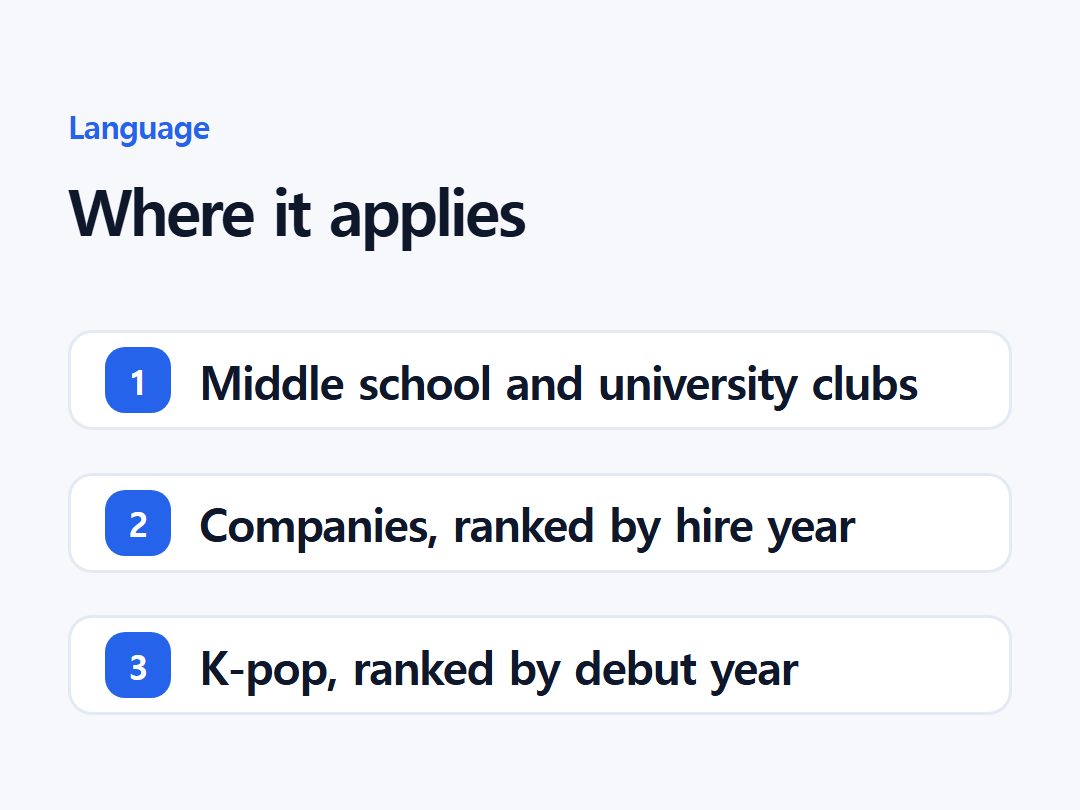
Where sunbae-hoobae hierarchy actually came from
Sunbae-hoobae culture is most visibly rooted in school life. It typically isn't used in elementary school, where children default to age-and-gender terms like oppa, hyung, unnie, and noona instead.
The vocabulary shifts in middle school and especially high school, when students join sports teams, music clubs, or student councils that are explicitly organized by entry year — and it becomes fully normalized in university, where club culture around class-year hierarchy can be strict, with hoobae expected to defer to sunbae in seating, speech, and social obligations at group gatherings.
From there, the same logic transferred naturally into two institutions that shape Korean adult life: the corporate workplace and, in entertainment, the trainee-and-debut system.
Companies are organized around joining year (입사, ipsa) much the way schools are organized around entry class, and new hires inherit the same jondaetmal-and-deference expectations toward colleagues who joined earlier, regardless of age gap.
K-pop agencies imported the identical structure for trainees and debuted artists, which is why seniority in the industry is calculated in debut years, and why rookie groups are trained to bow to and formally address groups that came before them, even labelmates from the same agency.
The precise historical origin of the custom is debated among Korean-language writers themselves.
Some trace its more rigid, ritualized form to the Japanese colonial period (1910–1945), when Japanese-style school hierarchies were introduced into the Korean education system; others connect the underlying instinct to older Confucian ideas about order and status that predate colonial rule.
There isn't a single settled account, but there is agreement on the outcome: by the postwar decades, entry-order hierarchy was firmly embedded in Korean schools, companies, and, later, the entertainment industry.

Why are Koreans criticizing bad sunbae now?
The system is not static. Younger Koreans have increasingly begun naming and criticizing its failure modes in public discourse.
Two terms capture this: kkondae (꼰대), a mocking label for an older or senior figure who demands deference and obedience without offering real mentorship in return, and gapjil (갑질), the broader term for abuse of a superior position — a concept serious enough that it has prompted workplace-conduct legislation in Korea.
The criticism circulating among younger workers and fans is not aimed at scrapping sunbae/hoobae itself, but at holding sunbae accountable for the mentorship half of the bargain that is supposed to come with the authority — a sunbae who takes the deference and the free meals without offering guidance is now far more likely to be called out publicly than quietly tolerated, including inside idol fandoms, where fans have started scrutinizing whether senior artists actually mentor newer groups or simply collect the bows.
For international audiences, the practical effect worth watching is in idol interviews and variety shows: a group's on-camera formality toward another group is rarely about age and almost always signals debut order, so the honorific someone chooses — sunbaenim versus a casual name — is a small but reliable clue to how the industry itself ranks its own artists.
How the two hierarchies actually differ
| Oppa / Hyung / Noona / Unnie | Sunbae / Hoobae | |
|---|---|---|
| Based on | Age of the person addressed, plus your own gender | Entry order into a shared school, team, or company |
| Requires an existing relationship | Yes — typically used with people you know | No — applies the moment two people share an institution |
| Example | A woman calls an older male friend oppa | A 25-year-old with 2 years' tenure outranks a 30-year-old who just started |
Frequently asked
What's the difference between sunbae/hoobae and oppa/hyung?
Oppa and hyung depend on the other person's age and your own gender, while sunbae and hoobae depend only on who joined a school, team, or company first.
Is sunbae/hoobae status based on age in Korea?
No, it runs on entry order into a shared institution, so a younger person who joined earlier can outrank an older newcomer.
Why do K-pop idols call other groups sunbaenim?
Because K-pop seniority is fixed by debut date rather than birth date, so idols use sunbaenim to show respect to groups that debuted earlier, even if those members are younger.
Sources
Every factual claim above is traceable. We do not translate articles — we gather facts from multiple outlets and write them ourselves.
- How the Terms "Sunbae" and "Hoobae" Work in the K-Pop Industry — Soompi
- Don't Call Someone Sunbae (선배) Before Reading This! — Linguasia
- "Stayswifties won again": Fans go berserk as Stray Kids' Felix calls Taylor Swift 'sunbaenim' during his recent live — Sportskeeda
- What is the difference and correct use of sunbae, hoobae, oppa and dongseng? — HiNative
- What is the difference between sunbae and hubae? — Talkpal