
Family Outing premiered on SBS on June 15, 2008. Each week a rotating cast — called the "Family" — traveled to a real household somewhere in Korea, moved in for two days and one night, and did chores and games set by the actual homeowners, who were away on vacation.
The short version
- Family Outing (SBS, 2008) proved Korea's reality-variety format could succeed on a second network.
- It ended in 2010 at its ratings peak, once the original cast scattered.
- Running Man took its Sunday slot in 2010 and became a global hit.
The show ran until February 2010, was rebooted with an entirely new cast that same year, and folded within five months. On paper, that is a modest three-year run. Its real significance is what it proved: that an unscripted-format show built around ordinary people's real homes could be a hit on a second network, not just the one that invented the idea.
In Korea this style of programming is called reality variety, or 리얼 버라이어티 — shows where celebrities react to genuinely unscripted situations rather than performing rehearsed comedy sketches on a studio set. Family Outing is remembered as one of the three programs that made that format a fixture of Korean broadcasting, years before today's more common observational shows took over.

A cast assembled to look like an actual family
The original lineup was Yoo Jae-suk, Yoon Jong-shin, Lee Hyo-ri, Kim Soo-ro, Big Bang's Daesung, Park Ye-jin, Lee Chun-hee, and Park Si-yeon, later joined by Kim Jong-kook and Park Hae-jin as members left or were written out.
Casting mattered because the premise depended on chemistry that looked involuntary. The Family had to bicker, cook, and fail at chores as if they actually lived together — closer to a documentary crew's footage than a scripted comedy sketch.
Before this, Korean variety mostly stayed in a studio
Korean entertainment shows through the 1990s and early 2000s were largely studio formats: hosts and guests seated on a set, playing games with a live audience. Family Outing moved the cameras into a stranger's kitchen and left them there for two straight days.
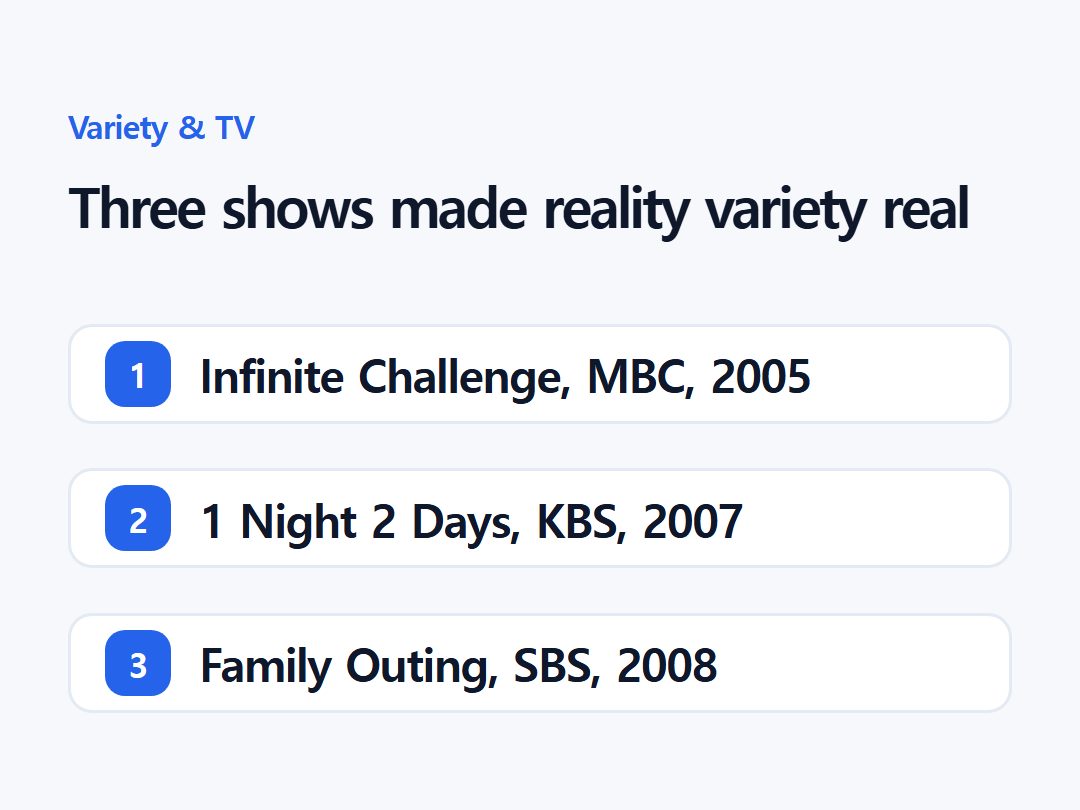
That shift had already started elsewhere. MBC's Infinite Challenge, which began in 2005 under the title Reckless Challenge, is widely credited as Korea's first true reality-variety program — a show billed on unscripted situations rather than staged sketches. KBS's 1 Night 2 Days followed in 2007 with a similar travel-based format.
Reality variety only became a genre once a second network copied it
One hit show can be a fluke of casting or timing. Family Outing mattered because it showed the format traveled: SBS, a different broadcaster with a different production culture, ran the same basic idea and drew some of the highest ratings on Korean Sunday television.
Korean television critics now refer to Infinite Challenge, 1 Night 2 Days, and Family Outing together as the three shows that established terrestrial reality variety as a durable category, not a one-network experiment.
That three-way validation mattered because it was a format working across MBC, KBS, and SBS at once. It is what let networks treat reality variety as a genre worth building new shows around, rather than a single broadcaster's gimmick.
- Infinite Challenge (MBC, 2005) — the format's originator
- 1 Night 2 Days (KBS, 2007) — the travel-based version
- Family Outing (SBS, 2008) — proved the format could move networks
The 'reality' label started its own controversy
Reality-variety shows in this era still relied on tight outlines: producers set locations, tasks, and rough beats, then let cast members improvise inside them. Viewers and press at the time openly debated how much of Family Outing was actually spontaneous.
By mid-2009, entertainment outlets were reporting that the show's ratings had softened partly because of ongoing arguments over how real its reality really was. The controversy did not sink the show, but it shows the genre's core tension from the start: audiences wanted a documentary, producers needed a broadcast-ready story.
A joint Grand Prize signaled the format had arrived
At the SBS Entertainment Awards on December 30, 2009, Yoo Jae-suk and Lee Hyo-ri jointly won the daesang — the ceremony's top prize, equivalent to a network's top honor for its own stars. Family Outing also won Best Teamwork that night.
It was Yoo Jae-suk's second daesang that year, after one from a rival network's awards weeks earlier. The win also made Lee Hyo-ri one of only two entertainers in Korean television history to hold a Grand Prize in both music and entertainment categories.
A network naming a reality-variety cast its top entertainers, ahead of scripted comedy and studio talk shows, told the rest of the industry the genre was no longer a novelty act.
Why season one ended right at its ratings peak
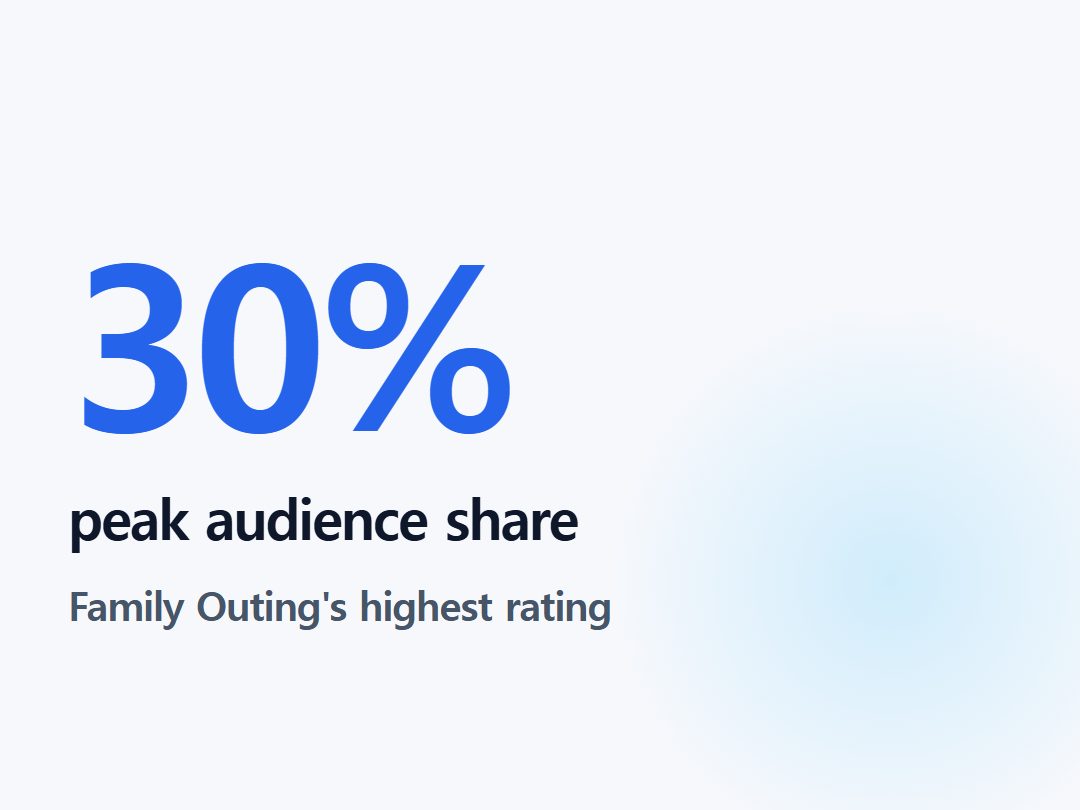
Family Outing's best recorded rating was around 30% of the viewing audience — a figure few Korean shows reach today. It did not end because viewers left. It ended because the cast did.
By late 2009, members were juggling solo acting and music schedules that made the twice-weekly overnight shoots harder to sustain. Yoo Jae-suk and Park Si-yeon's departures were announced in November 2009, and by the January 11, 2010 recording, the entire original Family had filmed its last episode together.
A new cast, a new crew, and a five-month cancellation
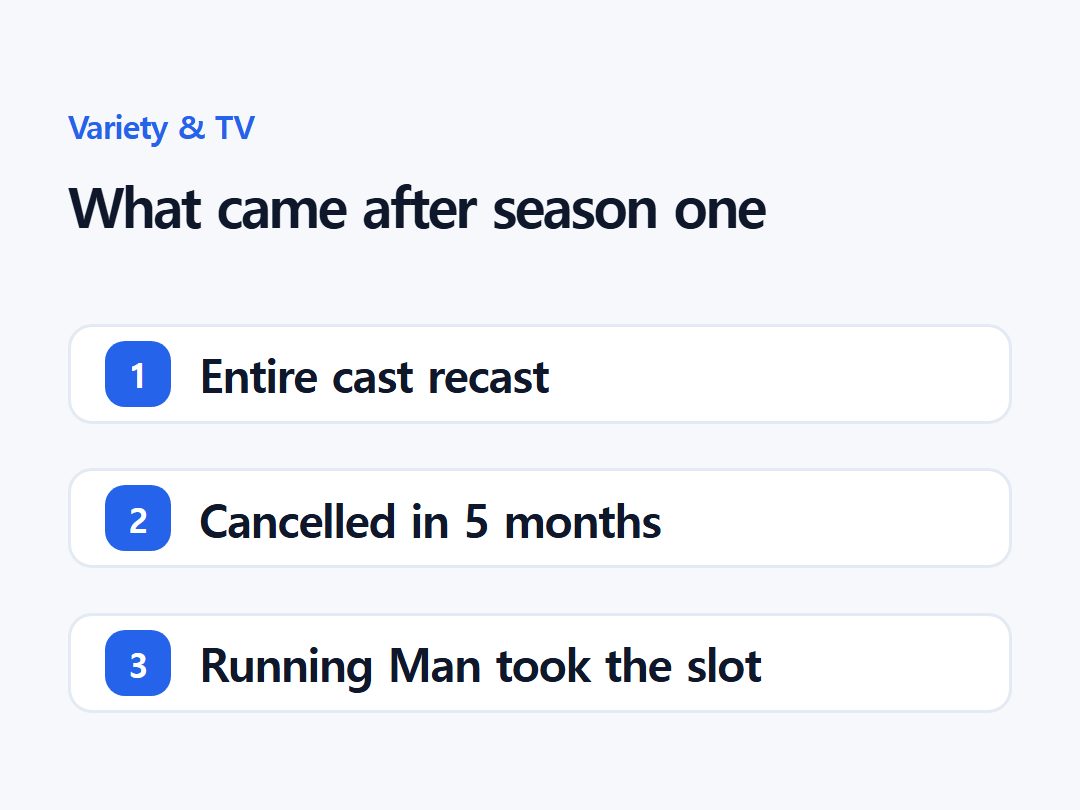
SBS relaunched the show three weeks later as Family Outing 2, with a completely different cast — including Yoona and Taecyeon of the K-pop groups Girls' Generation and 2PM — and a new production team using a similar format.
It lasted five months. Industry commentary at the time pointed to a missing center: Yoo Jae-suk's role as the group's de facto host had organized the original show's chaos into something broadcastable, and no replacement cast filled that function the same way.
Running Man opened in the exact slot Family Outing vacated
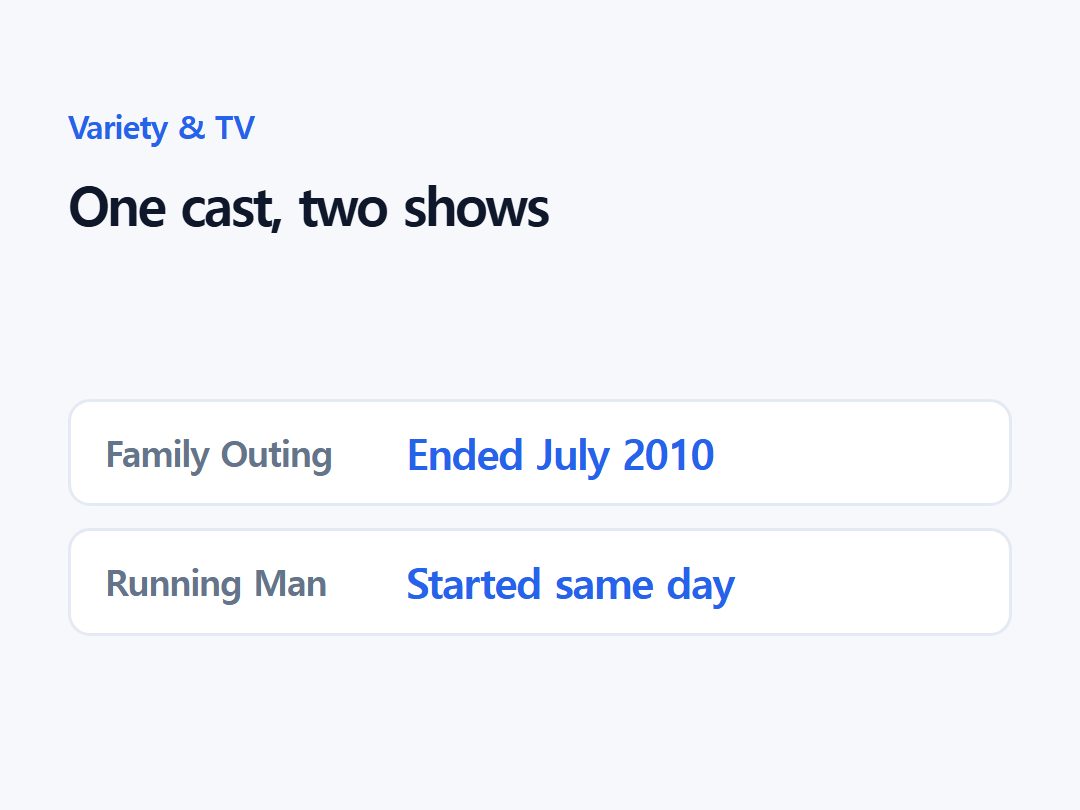
Family Outing 2's final episode aired July 11, 2010. Running Man's first episode aired the same day, in the same Sunday timeslot, on the same network — reuniting Yoo Jae-suk and Kim Jong-kook from the original Family Outing cast.
Running Man would go on to outlast every reality-variety show that came before it, eventually becoming one of Korea's most internationally exported entertainment formats. That lineage is direct: the cast, the network relationship, and the basic idea of celebrities completing tasks on camera all trace back through Family Outing.
What eventually replaced the format, and why
Reality variety's constructed missions — tasks, games, a house to clean — gradually lost ground in the early 2010s to a different approach: observational variety, where cameras simply follow a celebrity's ordinary day and a studio panel reacts to the footage afterward, with far less staged competition.
MBC's I Live Alone premiered in March 2013, and KBS2's The Return of Superman followed that September. Both are still airing after more than a decade — longer than any single reality-variety show from Family Outing's generation managed.
The shift was less a rejection of Family Outing's genre than an admission that scripted spontaneity had a shelf life. Audiences eventually wanted to watch celebrities do nothing in particular, rather than complete a task convincingly on cue.
What is still debated about the format's legacy
Korean entertainment writers still disagree on how much credit Family Outing deserves versus Infinite Challenge, which came first and is more often called the genre's true originator. What is not disputed is that Family Outing was the proof of concept that let a second and third network commit resources to the same idea.
Whether any single show can be called reality variety's inventor remains an open argument among Korean critics — one this piece does not try to settle, since the three shows' production teams have never agreed on it publicly either.
The three shows that established reality variety as a genre
| Show | Network | Year | Role |
|---|---|---|---|
| Infinite Challenge | MBC | 2005 | Format's originator |
| 1 Night 2 Days | KBS | 2007 | Travel-based version |
| Family Outing | SBS | 2008 | Proved the format could move networks |
Frequently asked
When did Family Outing air?
It premiered on SBS on June 15, 2008, and ran until February 2010, when the original cast left the show.
Why did Family Outing end?
Cast members like Yoo Jae-suk and Park Si-yeon left in late 2009 for solo acting and music work, not because ratings dropped — its best rating was around 30% right before it ended.
What show replaced Family Outing on SBS?
SBS tried a recast Family Outing 2, but it was canceled after five months; Running Man then premiered in the same Sunday timeslot on July 11, 2010.
Sources
Every factual claim above is traceable. We do not translate articles — we gather facts from multiple outlets and write them ourselves.
- Family Outing — Wikipedia
- Family Outing 2 — Wikipedia
- List of Family Outing episodes — Wikipedia
- Infinite Challenge — Wikipedia
- List of Running Man episodes (2010) — Wikipedia
- Yoo Jae-suk, Lee Hyori share grand prize at SBS Entertainment Awards — HanCinema
- Reasons for Family Outing rating decline — allkpop
- Yoo Jae Suk and Lee Hyori to leave Family Outing — allkpop
- I Live Alone (TV program) — Wikipedia
- The Return of Superman (South Korean TV program) — Wikipedia