A pale, silent figure in a black suit and a wide black hat steps into a hospital room, an apartment, a chicken restaurant. No one else in the scene notices him. Someone is about to die.
The short version
- The saja escorts souls to judgment court — he never causes the death himself.
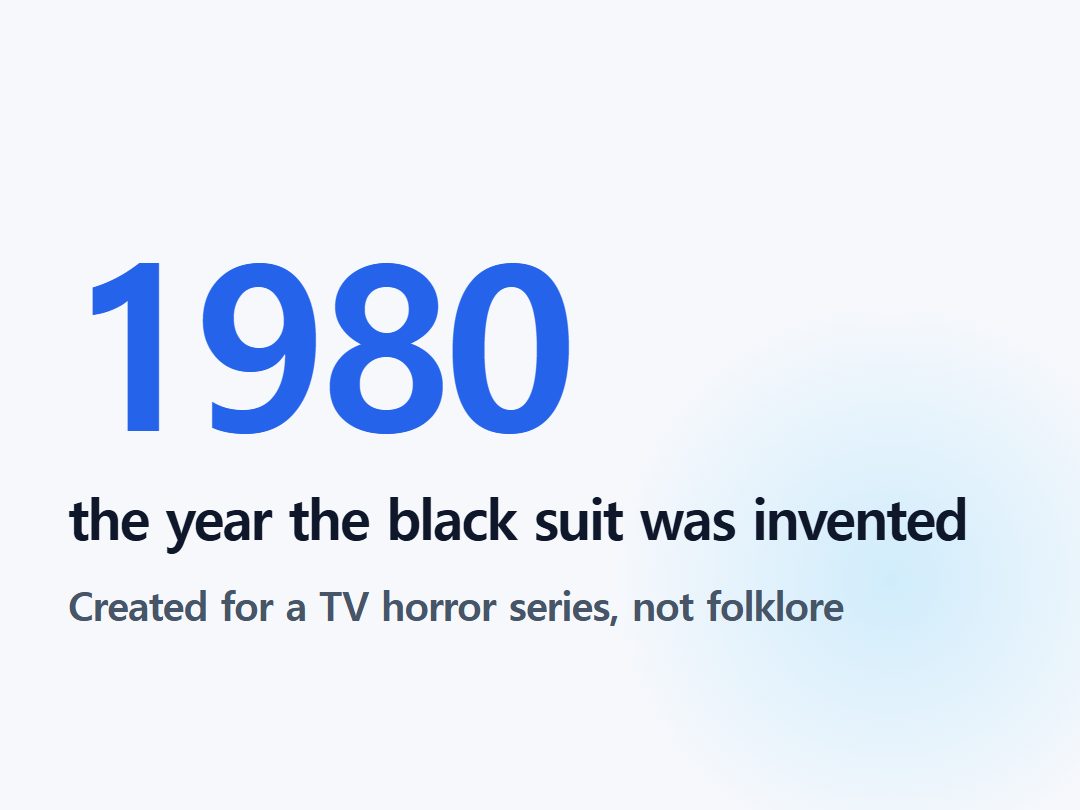
- The black-suit, white-face look was invented for TV in 1980, not ancient folklore.
- KPop Demon Hunters built its Saja Boys on this folklore and won a 2026 Oscar.
International viewers run into this character constantly — in Goblin, in Hotel del Luna, in Along with the Gods, and most recently in the Oscar-winning animated film KPop Demon Hunters. In Korean he is 저승사자 (jeoseung saja), literally "messenger of the afterlife." Korean viewers know exactly what they're looking at. International viewers usually don't.
A bureaucrat of death, not a killer
The saja doesn't decide who dies, and he doesn't cause death himself. His job starts only after someone's allotted time has already run out: he is dispatched to escort the soul to the underworld court of King Yeomra, the judge of the dead in Korean folk belief.
This bureaucratic framing comes from a blend of Buddhist and Taoist afterlife ideas absorbed into Korean folk religion, where the underworld runs like a court system, complete with judges, ledgers, and paperwork.
This is the detail most international readers miss. Western grim reaper imagery — a skeleton with a scythe — treats death itself as the killer. The Korean saja works more like a civil servant carrying out a court order, checking a name off a list and following a schedule.

The black suit is a 1980 invention, not ancient folklore
The saja's signature look — black hanbok, a wide black hat, a chalk-white face, black lips — feels ancient. It isn't. It was designed for television in 1980.
Director Choi Sang-sik created the image for an episode of the horror anthology Jeonseol-ui Gohyang ("Tales of the Hometown"), which aired June 3, 1980. He later said no standardized reaper "character" existed before that; he simply decided death should be colored black.
Choi has since said, with some regret, that Korean television had no concept of intellectual property at the time — meaning he never held rights to a design the entire industry now uses for free.
Before black: painted scrolls in red and white
Late Joseon-dynasty paintings of the underworld show a different reaper — sometimes dressed in red robes, sometimes white, styled like a solemn court official rather than a phantom. Folklore writer Kwak Jae-sik has noted that Korea had almost no fixed visual for the role before the Joseon period.
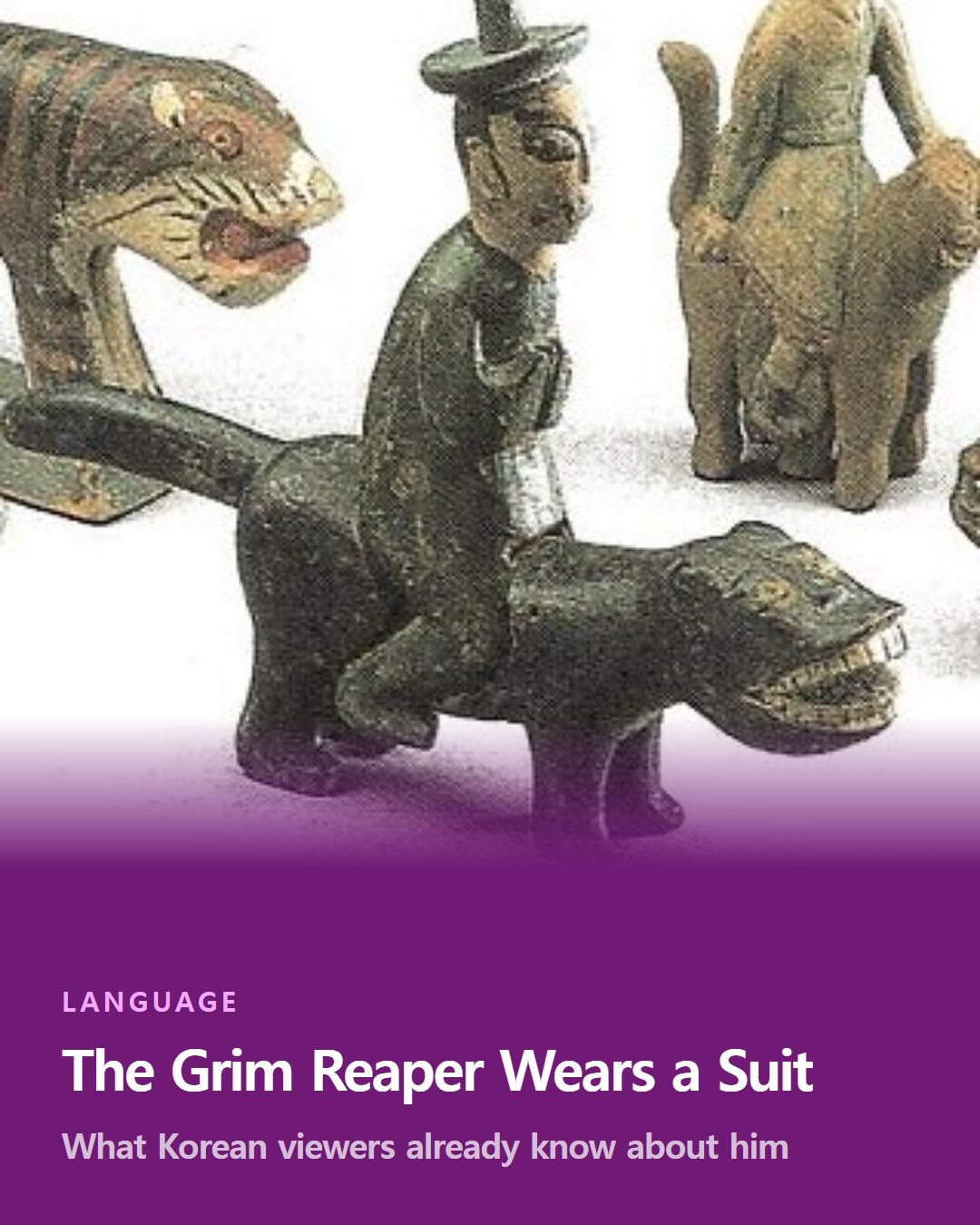
One piece of the modern image does predate 1980, however: wooden funeral figurines called kkokdu, some carved in dark robes resembling today's reaper, appeared in 19th- and 20th-century funeral processions.

Why the hat carries more authority than the color
The wide black hat — a gat — isn't decoration. It comes from the heungnip, the formal black hat worn by Joseon-dynasty government officials. Put a gat on the reaper, and a Korean viewer instantly reads him as a ranked bureaucrat acting under royal authority, not a wandering ghost.
That single prop does the same work a badge does in a Western procedural: it establishes jurisdiction, not menace.
Three reapers, one bowl of rice, at every funeral
Korean shamanist funeral custom didn't picture one reaper working alone — it pictured three, arriving as a group. Some regions prepared a specific offering called saja-bap, "reaper's rice," meant to keep the escorts well-disposed toward the soul they were taking.
- Three bowls of rice, one for each reaper
- Three pairs of straw shoes, for the road ahead
- Coins left out, on the folk belief that even death's officials could be bribed
A fuller version of this spread, called saja-sang, could add drink and extra food to the rice and shoes — the same instinct behind a funeral altar today, just aimed at the escort instead of the deceased.
The custom has faded from most modern funerals, but the number three still surfaces whenever a film or drama wants to signal it's drawing on older folk belief rather than the 1980 television image.
Goblin put the reaper in a double-breasted suit
The 2016–2017 tvN drama Goblin (released internationally as Guardian: The Lonely and Great God) reset the visual template a second time. Lee Dong-wook played Wang Yeo, a grim reaper who traded the black hanbok and gat for a fedora and a double-breasted suit, while keeping the pale, unreadable composure of the older look.
Lee reportedly had to convince screenwriter Kim Eun-sook to cast him, after she initially felt he didn't match her mental image of the role. The gamble worked: Goblin became one of the highest-rated dramas in Korean cable television history, and Wang Yeo's tailored, melancholic reaper became the reference point nearly every "modern saja" has followed since.
The reaper multiplies across Korean screens
Once Goblin proved the character could carry romance and comedy as well as horror, the saja turned into a recurring figure across Korean film and television, with each version adjusting the formula.
- Along with the Gods: The Two Worlds (2017) and its 2018 sequel returned to the traditional count of three, played by Ha Jung-woo, Ju Ji-hoon, and Kim Hyang-gi, guiding souls through seven trials over 49 days
- Hotel del Luna (2019) folded reaper mythology into a hotel that serves only ghosts
- Death's Game (2023) cast a young woman in the role instead of a man in black, using the premise to force its protagonist through repeated deaths
None of these versions has the reaper kill anyone on screen — a rule the underlying folklore insists on, and one every title above keeps intact.
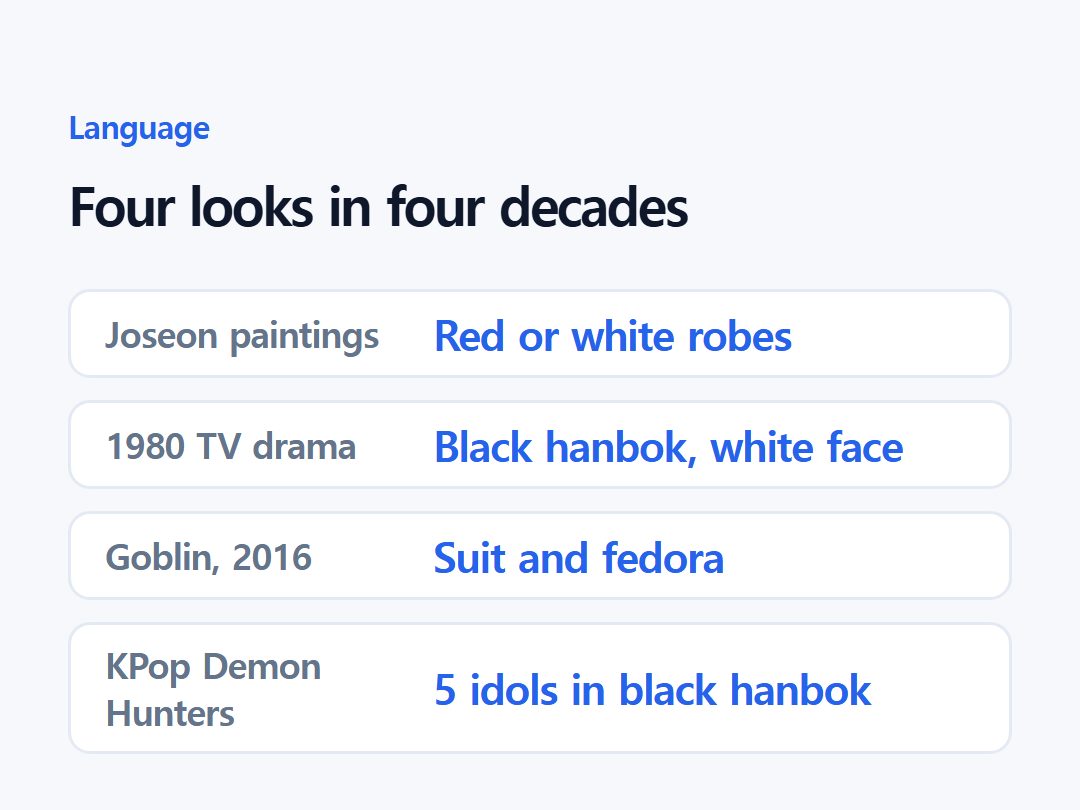
Four looks in four decades, at a glance
| Era or work | What the reaper looks like |
|---|---|
| Joseon-era paintings | Red or white robes, court-official styling |
| 1980, Legend of the Hometown | Black hanbok, white face, black lips |
| 2016, Goblin | Double-breasted suit and fedora, no gat |
| 2025, KPop Demon Hunters | Five-member idol group in black hanbok and gat |
How five K-pop idols turned him into an Oscar winner
Netflix's animated film KPop Demon Hunters (2025) built its villains, the "Saja Boys," directly on jeoseung saja iconography — black hanbok, tall gat, and all — for the group's reveal performance of the song "Your Idol." Co-director Chris Appelhans has confirmed the design was drawn straight from the folklore figure.
Co-director Maggie Kang has said she grew up "hearing stories about the grim reapers of Korea — the black hat guys," and wanted to bring that childhood image into animation. The film became Netflix's most-watched animated original ever, and in March 2026 it won the Academy Award for Best Animated Feature, with its song "Golden" also winning Best Original Song.
The film uses five Saja Boys rather than the traditional three, or the single figure common in most K-dramas — a reminder that every version of this character is a remix, not a copy of one fixed original.
What's still unresolved
There is no single authoritative version of the saja to measure adaptations against, because the "traditional" image is itself a 1980 television invention layered onto older, looser folk beliefs. How much of the black-robe look existed in Korean funeral objects before Choi Sang-sik's design — and how much he invented outright — remains debated among Korean folklore writers.
Folklore is also inconsistent about whether the saja can be reasoned with. Some old tales describe humans successfully bribing or tricking a reaper into delaying a death, which sits oddly against the modern "incorruptible bureaucrat" framing most dramas prefer.
It's also unclear whether Choi has ever sought formal credit or compensation for originating an image the entire industry now uses for free; available interviews describe his frustration, not a legal claim.
What is settled is simpler. Whenever an international viewer sees a calm, silent figure in black step into a Korean drama, that figure is doing a specific, culturally coded job — checking a name off a list, not hunting a victim.
Four looks in four decades
| Era or work | What the reaper looks like |
|---|---|
| Joseon-era paintings | Red or white robes, court-official styling |
| 1980, Legend of the Hometown | Black hanbok, white face, black lips |
| 2016, Goblin | Double-breasted suit and fedora, no gat |
| 2025, KPop Demon Hunters | Five-member idol group in black hanbok and gat |
Frequently asked
Who is the Saja in Korean dramas?
The saja (저승사자) is Korea's grim reaper figure — a bureaucrat who escorts souls to the underworld court of King Yeomra rather than killing anyone himself.
Why does the Korean grim reaper wear a black suit?
The black hanbok, wide gat hat, and white face were designed by director Choi Sang-sik for a 1980 TV horror anthology episode, not inherited from ancient folklore.
Is the Saja Boys look in KPop Demon Hunters based on real folklore?
Yes — co-director Chris Appelhans confirmed the group's black hanbok and gat design was drawn directly from traditional jeoseung saja iconography.
Sources
Every factual claim above is traceable. We do not translate articles — we gather facts from multiple outlets and write them ourselves.
- '검은 도포+갓' 저승사자 연출 원조 최상식 PD "한국형 죽음의 이미지 고심…저작권 아쉬워" — Segye Ilbo
- Guardian: The Lonely and Great God — Wikipedia
- Lee Dong Wook Almost Didn't Make It As The Grim Reaper In tvN's "Goblin" — Soompi
- Along with the Gods: The Two Worlds — Wikipedia
- Hotel del Luna — Wikipedia
- What you need to know about Saja Boys, Korea's grim reapers in K-pop form — The Korea Herald
- KPop Demon Hunters: Breakthrough of the Year 2025 — TIME
- 'KPop Demon Hunters' Wins Best Animated Feature Film at 2026 Oscars — Billboard
- Jeoseung Saja: The Korean Grim Reaper and Death Guide — Mythlok