Open a random episode of Running Man, 2 Days & 1 Night, or King of Mask Singer, and the running time will usually fall somewhere between 90 and 120 minutes, sometimes longer. Open an episode of Survivor or The Bachelor and it will wrap inside a 44-minute network hour, commercials included.
This is not a difference in ambition or budget. It comes down to two structural facts that most international viewers never see: how each country regulates advertising inside a broadcast, and how each industry actually gets paid for a program.
The short version
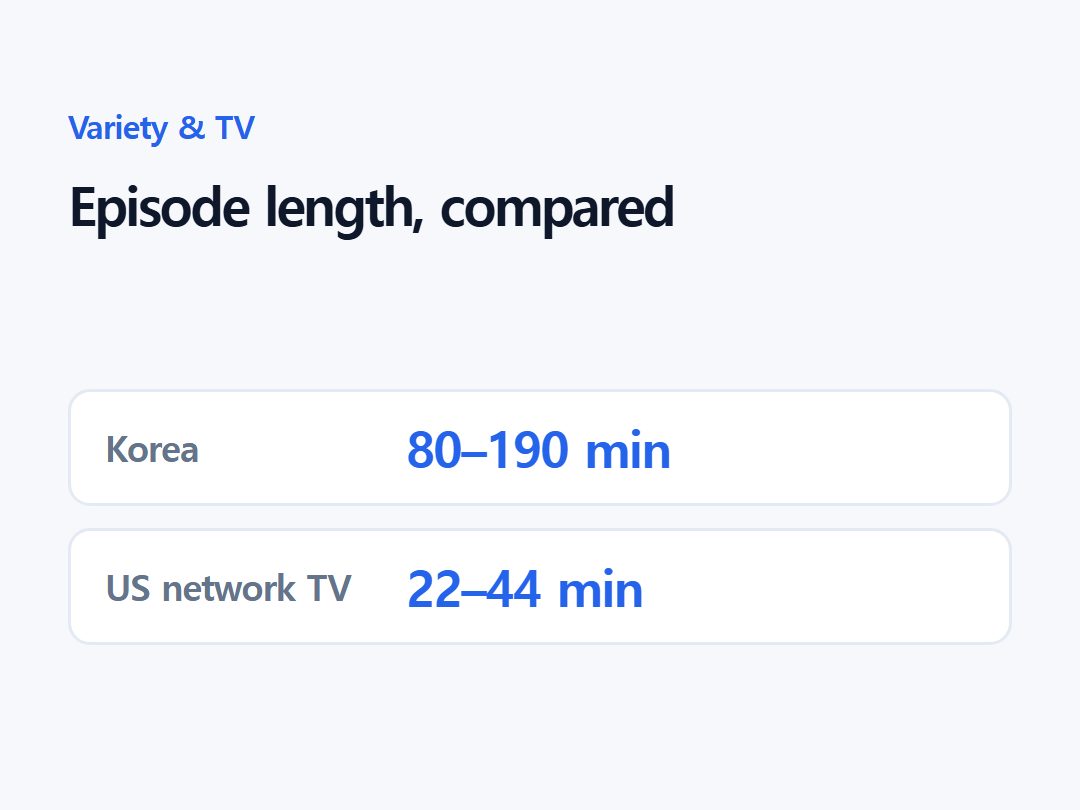
- Korean variety episodes run 80–190 minutes; US shows fit a 44-minute hour.
- Korea only legalized mid-roll ads in 2021, but longer shows unlock more breaks.
- Product placement, legal since 2010, now drives much of variety show budgets.

How much longer Korean episodes actually run
Korean terrestrial variety shows — unscripted entertainment programs built around a fixed cast, games, and celebrity guests, roughly equivalent to American reality or game-show formats — have long run far past the 22-to-44-minute slot familiar to American network television.
Wikipedia's own production data illustrates the range: MBC's long-running Sunday franchise Sunday Night has run as long as 175 minutes including its ad breaks, SBS's Good Sunday block ran around 190 minutes at its peak, and even a comparatively tighter show like Running Man currently airs at roughly 80 to 95 minutes an episode, according to SBS's own program page and Wikipedia's episode records.
By contrast, an hour-long American network broadcast — reality or scripted — typically contains only about 42 to 44 minutes of actual program content, with the rest sold as commercial time in fixed blocks.
Unscripted competition shows such as Survivor or The Voice tend to run even tighter, often closer to 40 minutes of content per hour, because producers build cliffhangers around scheduled ad breaks rather than stretching the show itself.
The gap is not accidental. It traces back to a broadcasting rule Korea only reversed in 2021, and to an advertising economy that rewards a longer program with more inventory to sell.
Two financial reasons networks keep episodes long
For 48 years, Korean law banned terrestrial broadcasters from inserting commercials in the middle of a single program. The ban dated to a 1973 revision of the Broadcasting Act, aimed at protecting program integrity.
It meant a Korean network could sell ads before and after a show, but not during it — a much smaller inventory than American networks, which have never had a federal cap on adult-program ad time.
The U.S. Federal Communications Commission regulates commercial minutes only for children's programming (10.5 minutes per hour on weekends, 12 on weekdays); general-audience programming has been left to the market since deregulation in the early 1980s.
Korean broadcasters found a legal workaround. If a single program was split into a labeled "Part 1" and "Part 2," the commercial break between them counted as being between two programs, not inside one — technically legal.
Industry insiders called this practice PCM (Premium Commercial Message), or more plainly, split-part scheduling. KBS's weekend variety block Happy Sunday, which bundled 1 Night 2 Days and Superman Returns into one franchise, used exactly this method, as did long-running shows like Immortal Songs and Happy Together.
The workaround rewarded length: the longer and more segmented a show was, the more of these ad-break junctions it could legally create.
A single variety show franchise stitching together two or three hour-long "corners" under one title was, in effect, a way to multiply ad slots without technically breaking the mid-roll ban.
Regulators tried to legalize standard mid-roll advertising in 2018 but backed off after public pushback, since audiences associated the practice with the drama and variety split-format flaws already commonplace.
It finally passed in July 2021, when Korea's broadcasting regulator allowed official mid-program commercials for the first time since 1973.
But rather than shrinking programs, the new rule preserved the incentive for length: under the resulting schedule, a 90-to-120-minute program is legally allowed three mid-roll ad breaks, and a 120-to-150-minute program is allowed four. Every additional half hour of runtime unlocks another ad break. A show that runs long simply has more legal ad inventory to sell than one that doesn't.
Layered on top of that is a second revenue stream American reality TV barely uses in the same way: product placement, known in Korea as PPL.
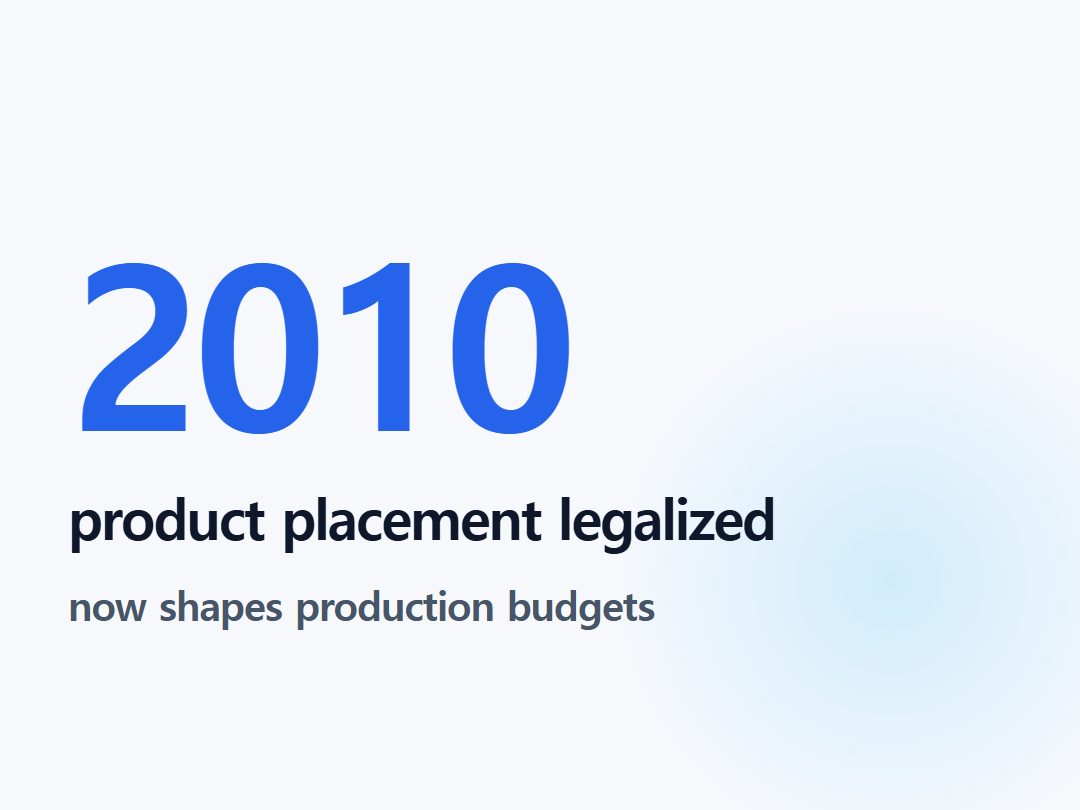
Indirect advertising inside entertainment and drama programming was only legalized in January 2010, under conditions capping it at 5% of total runtime, a quarter of the screen, and 30 seconds per brand per appearance, according to Korea Development Institute's public economic-education materials.
What began as a modest concept — brands lending props to a drama set instead of paying for real advertising — grew into a market. By the mid-2020s, PPL revenue had become central enough to Korean production economics that trade coverage describes it as determining much of a show's production budget outright.
A longer variety episode with more segments — a road trip, a cooking challenge, a studio game — simply has more physical space to feature sponsored products naturally than a tightly cut 40-minute American reality format does.
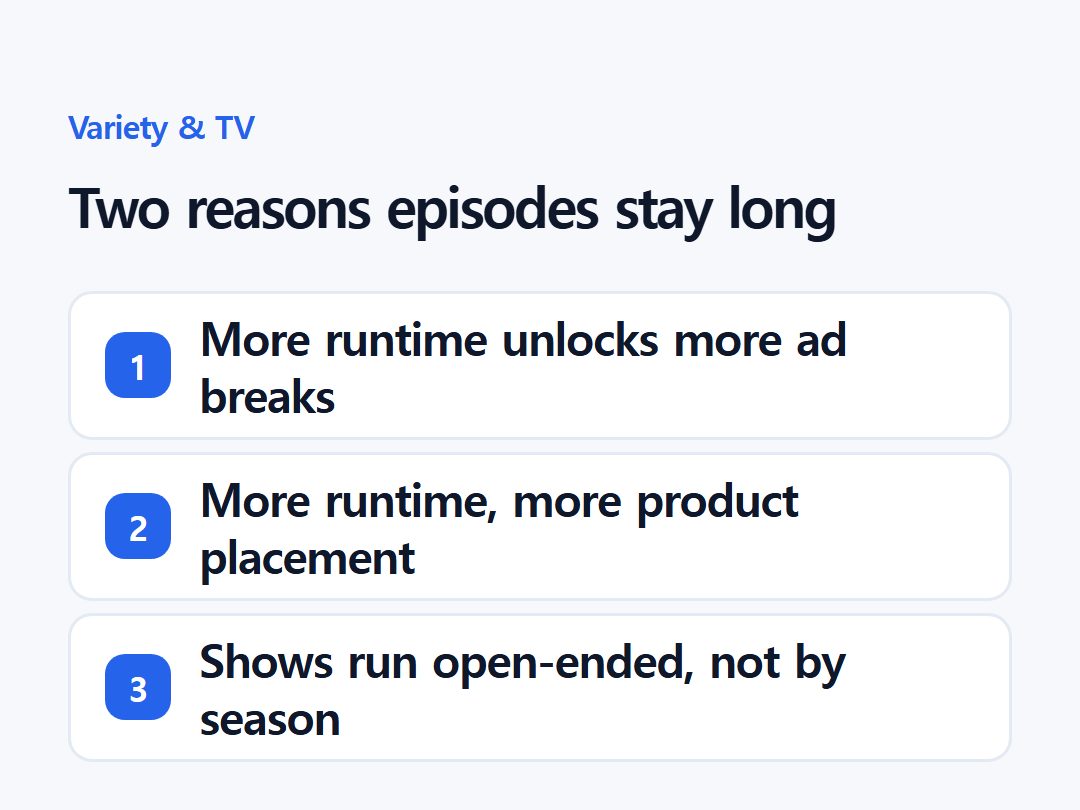
Put together, Korean broadcasters have two separate financial reasons to keep an episode long: more runtime legally unlocks more mid-roll ad breaks, and more runtime creates more surface area for paid product placement.
American networks, operating under a system with no comparable regulatory link between program length and ad allowance, have no equivalent incentive — their ad load is instead shaped by decades of fixed 30-and-60-minute slot scheduling inherited from the radio era and from syndication economics, where reruns need a uniform, predictable length to fit into any station's daily schedule.
| Factor | South Korea | United States |
|---|---|---|
| Mid-roll ad cap | Tied to runtime: more minutes unlock more legal ad breaks | No federal cap for adult programming |
| Product placement | Legal since 2010; core budget source by the 2020s | Allowed but not runtime-linked in the same regulatory way |
| Typical episode | 80–190 minutes | 22–44 minutes of content |
| Program model | Open-ended weekly run, sometimes 500+ episodes | Fixed season order |
From talk shows to today's marathon format
Korean variety television went through several distinct eras before arriving at today's marathon format. In the 1990s, the dominant genres were talk shows and so-called "public-interest" entertainment — programs built around charitable or social themes rather than pure competition.
The early-to-mid 2000s shifted toward studio-based formats. The turning point came in the mid-to-late 2000s with the rise of "real-variety" shows — unscripted programs following a fixed cast through games and challenges with minimal script.
MBC's Infinite Challenge, which launched in 2005, and KBS's 1 Night 2 Days, which launched in 2007, established the format that still defines Korean variety today, and both grew into some of the longest-running entertainment programs in Korean television history.
That same period is when the split-part scheduling workaround took hold, letting weekend variety blocks bundle multiple hour-long segments under one franchise name to maximize legal ad placement. The 2010 legalization of product placement added a second incentive layer on top of that.
Both practices reinforced a production culture built around long, segmented, sponsor-friendly episodes — one that had already taken root by the time official mid-roll advertising was finally legalized in 2021, so the shift in law changed the technical mechanism for inserting ads but did not undo the underlying incentive to keep episodes long.
Will Korean variety shows get shorter?
The Korean industry itself is now testing shorter formats, driven less by regulation than by streaming competition.
Netflix rolled out a slate of daily unscripted shows in a shorter format in 2025, and Disney+ followed in August 2025 with five "midform" Korean variety shows running around 30 minutes each — explicitly positioned as a bridge between the traditional 90-minute-plus broadcast format and short-form social video.
Whether long-running terrestrial staples like Running Man, now well past its tenth anniversary and still airing in the 80-to-95-minute range, adapt their length to compete with streaming, or continue serving an older, loyalty-driven weekend audience that grew up with the marathon format, remains the open question for the format's next decade.
Why episodes run longer in Korea than the US
| Factor | South Korea | United States |
|---|---|---|
| Mid-roll ad cap | Tied to runtime: more minutes unlock more legal ad breaks | No federal cap for adult programming |
| Product placement | Legal since 2010; core budget source by the 2020s | Allowed but not runtime-linked in the same regulatory way |
| Typical episode | 80–190 minutes | 22–44 minutes of content |
| Program model | Open-ended weekly run, sometimes 500+ episodes | Fixed season order |
Frequently asked
Why are Korean variety shows so long?
Korean law ties legal mid-roll ad breaks to runtime, and longer episodes also give product placement more room, so length itself pays for itself.
How long is an episode of Running Man?
Running Man currently airs at roughly 80 to 95 minutes per episode, according to SBS's program page and Wikipedia's episode records.
When did Korea allow commercials in the middle of a show?
Korea's broadcasting regulator legalized official mid-program commercials in July 2021, ending a ban that had been in place since a 1973 law.
Sources
Every factual claim above is traceable. We do not translate articles — we gather facts from multiple outlets and write them ourselves.
- 지상파 중간광고 48년만에 허용한다…이르면 6월 시행 — Nongmin Shinmun
- 지상파 중간광고 허용, 무엇이 달라졌나 [SW시선] — Sportsworld
- 지상파, 중간광고 허용 3년만 재추진 "만시지탄" — PD Journal
- 간접광고(PPL) — KDI Economic Information & Education Center
- Regulations on children's television programming in the United States — Wikipedia
- Running Man (TV program) — Wikipedia
- Sunday Night (South Korean TV program) — Wikipedia
- Good Sunday — Wikipedia
- Disney+ bets on midform variety shows — The Korea Herald
- Running Man hits 15 but still sprinting strong as Korea's variety king — Malay Mail