King Sejong invented Hangeul, Korea's native alphabet, in the 1440s to give ordinary people a writing system they could learn quickly. Chinese characters, already in use in Korea for centuries, required years of study that most people never got.
The short version
- Hangeul launched in the 1440s but took five hundred years to dominate writing.
- South Korea flip-flopped on hanja bans five times between 1968 and 2005.
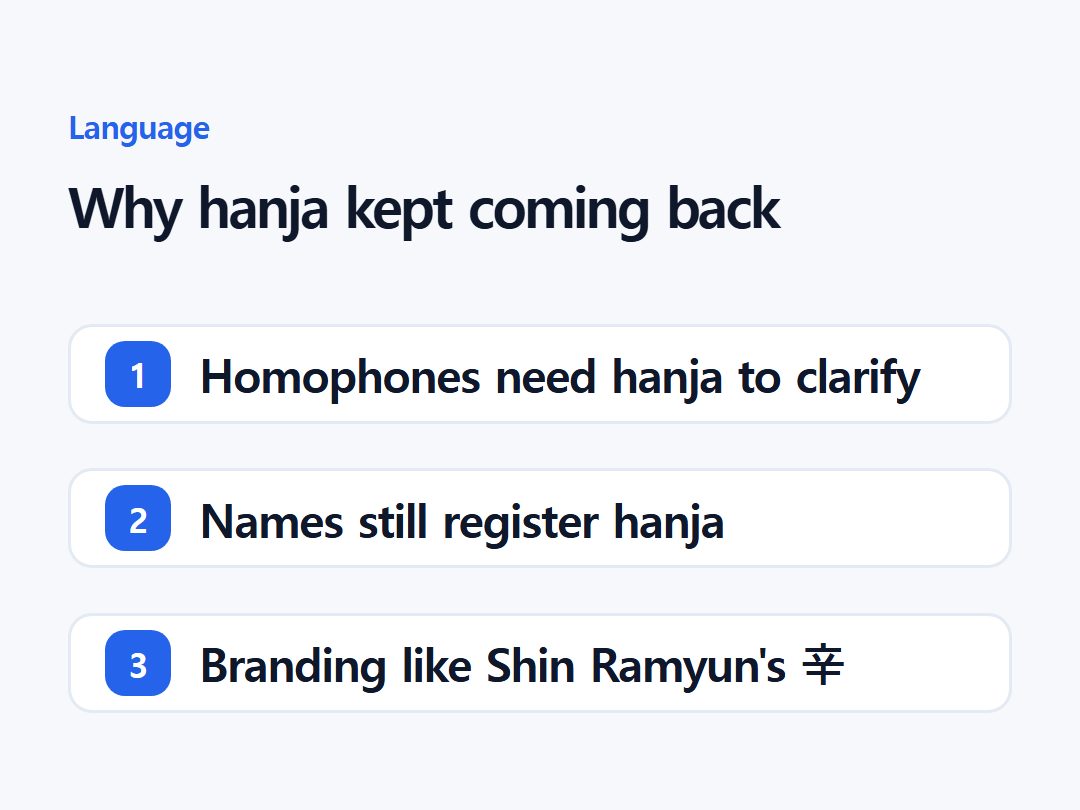
- Sino-Korean homophones like 의사 still need hanja to avoid confusion.
Hangeul still didn't replace Chinese characters for another five hundred years. Korean law, newspapers, and textbooks kept using hanja — the Korean term for Chinese characters — well into the twentieth century, and it only fully left daily writing in the 1990s.
The reasons the delay lasted so long, and why hanja still shows up on ramyeon packaging and ID paperwork today, come down to elite politics, colonial history, and a linguistic problem Hangeul alone can't fix.
A king invented an alphabet to fix a literacy problem
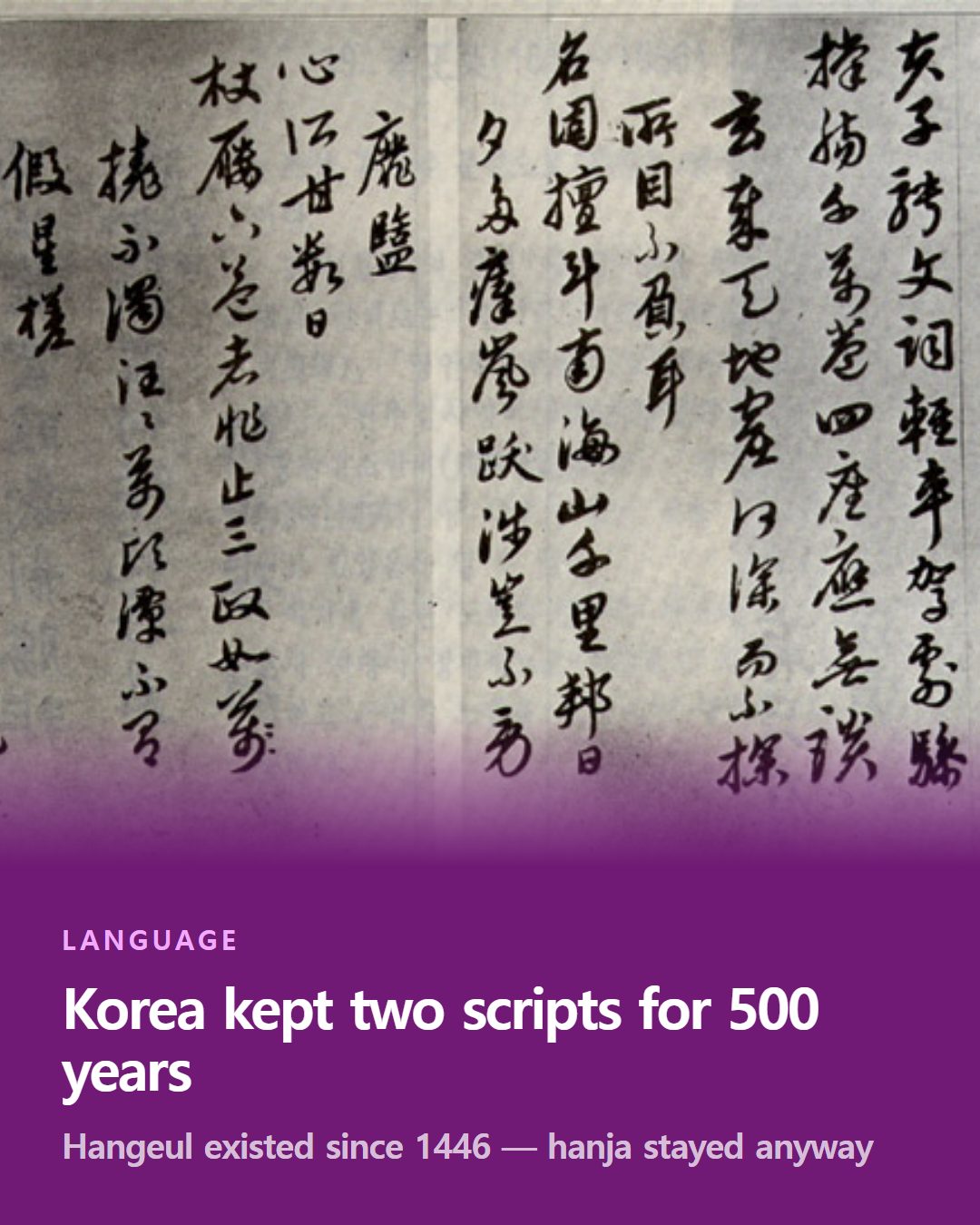
Before Hangeul, Korea had no writing system of its own. Educated Koreans wrote in hanmun, Classical Chinese, borrowed along with China's writing system more than two thousand years earlier.
Chinese and Korean share almost no grammar — Chinese doesn't mark the verb endings and particles Korean depends on. Scribes built workarounds instead: systems called Idu, Hyangchal, and Gugyeol used Chinese characters to spell out Korean sounds and grammar.
None of it was simple. Reading and writing hanja took years of study, which kept literacy confined largely to the yangban, Korea's hereditary scholar-official class. Sejong said as much in his preface to the new alphabet: ordinary people had things to say but no way to write them down.
Scholars called the new alphabet an act of barbarism
Sejong's own court pushed back almost immediately. In February 1444, a group of Confucian officials led by Choe Manri, a senior scholar at the Hall of Worthies — Sejong's royal research institute — filed a formal memorial opposing Hangeul.
The objection wasn't really about linguistics. Choe argued that inventing an independent script broke with China, the civilization Joseon modeled itself on, and that only "barbarians" invented their own alphabets. Wider literacy also threatened the yangban's monopoly on written knowledge, a pillar of their social status.
Sejong dismissed Choe from his post, then reinstated him a day later. Choe resigned anyway and died the following year. Hangeul survived the fight, but the elite kept writing almost entirely in Chinese for the next four and a half centuries.
The exam that ran the country stayed in Chinese
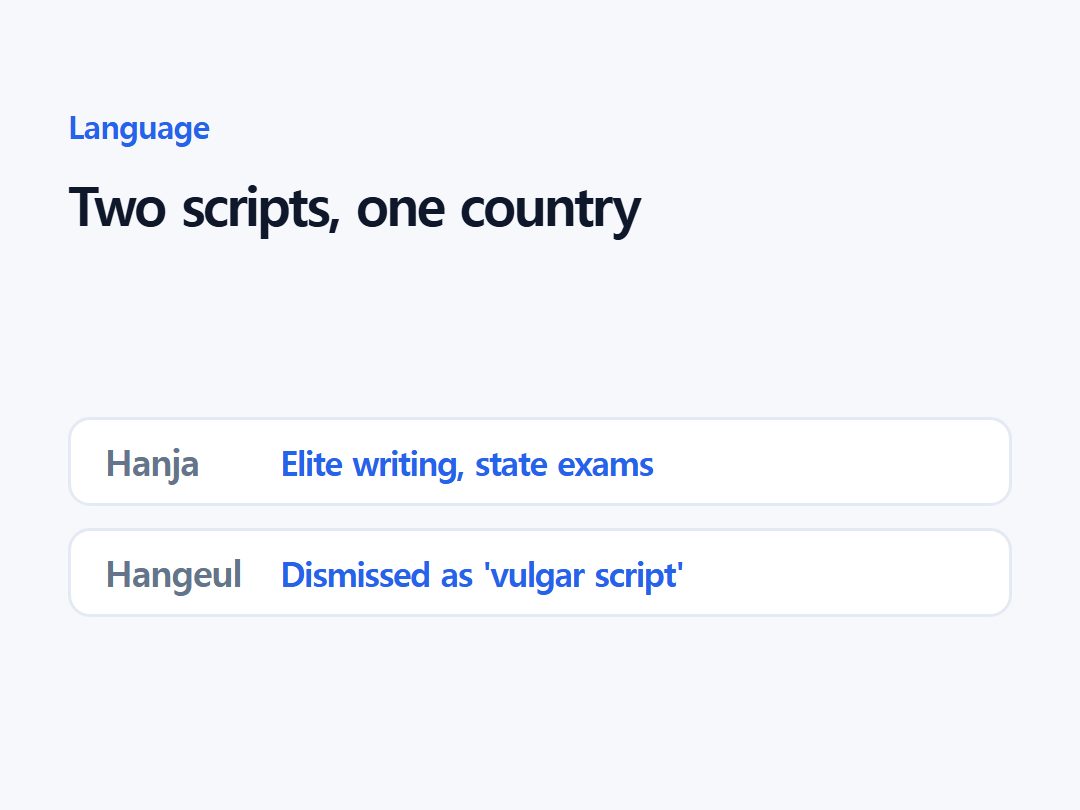
For centuries after 1446, Hangeul was dismissed by the elite as eonmun, "vulgar script," linked to women and commoners rather than serious scholarship. The gwageo, Korea's civil-service exam and the only route into government office, was conducted entirely in Classical Chinese.
Any man with career ambitions had to master hanja regardless of whether Hangeul existed. Government records, histories, and formal literature stayed in hanmun through the end of the Joseon dynasty — Hangeul circulated mainly in personal letters, novels, and religious texts, genres the elite didn't rank as "real" writing.
A royal decree put Hangeul into law for the first time
The balance shifted in November 1894, when King Gojong ordered that Korea's legal codes be written primarily in Hangeul, with hanmun kept only as a reference translation — part of a wider set of modernizing edicts historians call the Gabo Reforms.
The decree didn't eliminate Chinese characters. It created gukhanmun honyong, "mixed script": hanja for word roots, mostly nouns borrowed from Chinese, and Hangeul for Korean grammatical endings and particles. This hybrid became the default for newspapers, textbooks, and official documents for most of the twentieth century.
Colonial rule turned Hangeul into a resistance symbol
Japan's 1910 annexation of Korea complicated the picture. Hanja use in Korean print initially intensified — Japanese also used Chinese characters, so colonial administrators had little reason to object to their presence.
But as Japan's assimilation policies escalated, eventually banning Korean-language instruction in schools by the late 1930s, Hangeul stopped being just a writing system and became something to defend. Scholars who standardized Hangeul grammar during this period were prosecuted by colonial authorities for it.
By the time Korea was liberated in 1945, writing in Hangeul carried the weight of national identity, not just a simpler design.
North Korea erased hanja; South Korea reversed course five times
The two Koreas split sharply on what to do next. North Korea moved fast — hanja was phased out of schools and publishing by the end of the 1940s, and Chinese characters have not appeared in ordinary North Korean print since.
South Korea's path was far less linear:
- 1968 — President Park Chung Hee announced a five-year plan to eliminate hanja from public life, banning it from textbooks, schools, and the military.
- 1972 — Public backlash forced a partial reversal; hanja returned to schools as an elective, though standard textbooks stayed hangul-only.
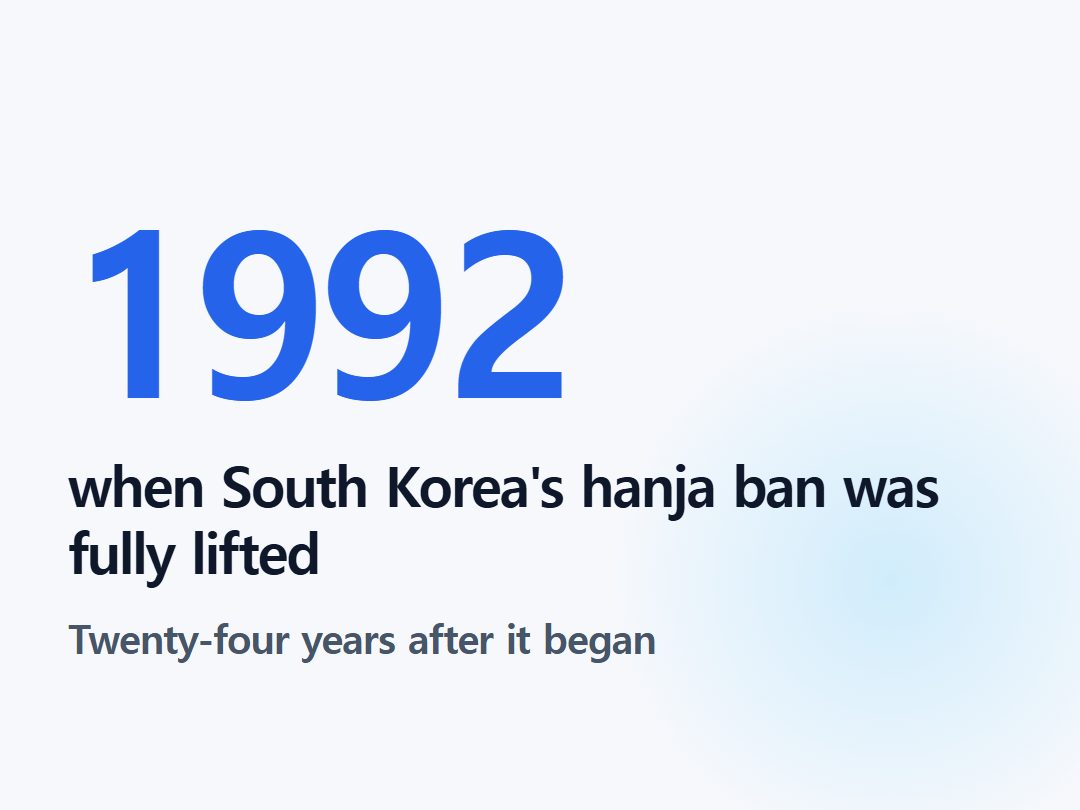
- 1992 — President Kim Young-sam's government formally lifted the ban that had shaped classrooms for over two decades.
- 1999 — President Kim Dae-jung's administration reversed direction again, adding hanja to road signs and reintroducing hanmun as a school elective.
- 2005 — The older Hangul Exclusivity law was formally repealed, closing out decades of on-and-off legislation.
Each shift reflected a different government's answer to the same unresolved question: is Hangeul-only writing modernization, or is losing hanja literacy an actual cultural loss?
Why one Hangeul spelling can mean three unrelated words
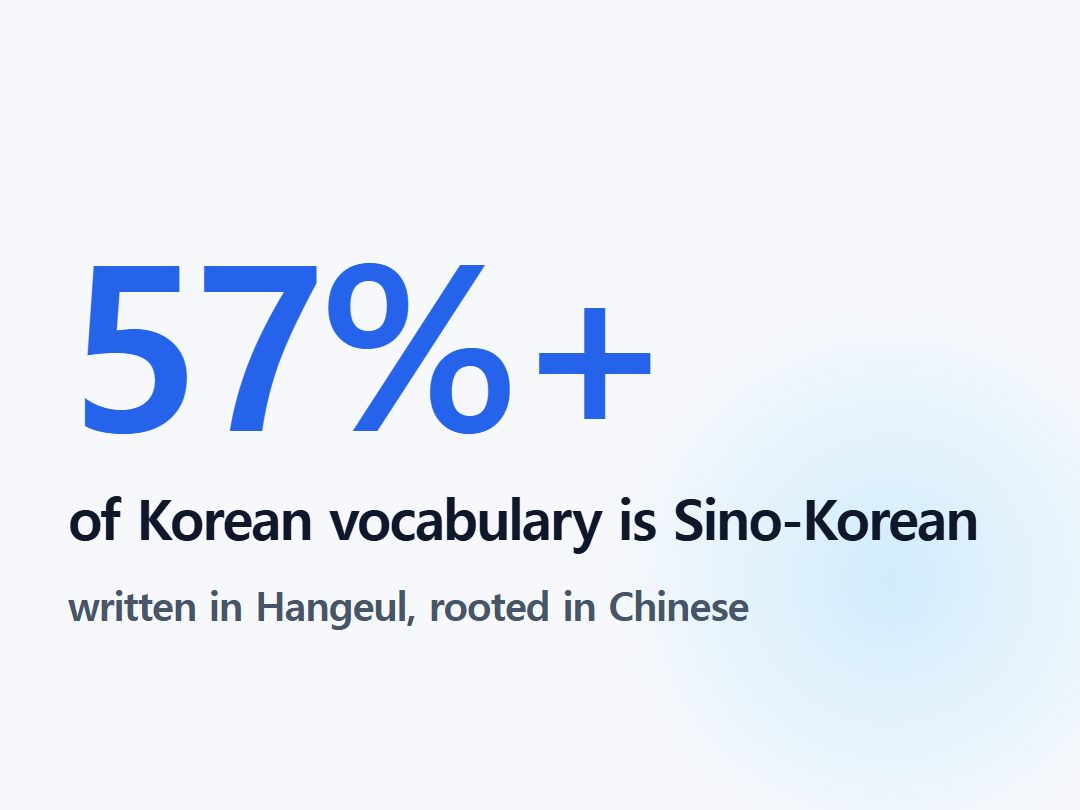
Here is the problem hanja bans never fully solved. Somewhere between 57 and 70 percent of Korean vocabulary is Sino-Korean — words borrowed from Chinese centuries ago, now spelled in Hangeul but still built from Chinese character roots.
Chinese is tonal; Korean isn't. When Sino-Korean words lost their original tones, large numbers of them collapsed into identical Hangeul spellings. Roughly 35 percent of the Sino-Korean words in Korea's standard dictionary are homophones with at least one other Sino-Korean word.
The textbook example is 의사 (uisa), which written in Hangeul alone could mean "doctor" (醫師), "intention" (意思), or "patriot" (義士), depending entirely on which Chinese characters it's built from. Context usually resolves the ambiguity, but not always — which is why hanja never fully disappeared from Korean writing.
Where Chinese characters still survive in Korea today
Hanja now shows up in narrow, specific places rather than everyday text:
- Legal, medical, and academic documents, where hanja in parentheses clarifies which homophone is meant.
- Personal names — Korean names are formally registered with matching hanja, chosen from a government-approved list, under a framework the Supreme Court set up in 1991.
- Branding, most visibly the character 辛 ("spicy") on Shin Ramyun packaging.
- Newspaper headlines, where hanja abbreviations save space — 韓 for Korea, 美 for the United States.
A national hanja proficiency test, introduced in 2001, is still taken by students today — mostly to strengthen a résumé rather than out of daily necessity.
What's still unresolved
Korea never settled the debate Choe Manri started in 1444. All elementary schools in Seoul began offering hanja classes again in 2013, but there is still no national consensus on whether hanja belongs in mandatory curricula.
The bigger, quieter cost is generational. Koreans educated after the hanja bans of the 1970s and 1980s often struggle to read hanja-heavy documents their own grandparents wrote. Whether that's an acceptable trade for a simpler alphabet, or a literacy gap worth closing, still depends on who in Korea you ask.
South Korea's five reversals on hanja policy
| Year | Action |
|---|---|
| 1968 | Park Chung Hee announced a five-year plan to eliminate hanja from public life |
| 1972 | Public backlash forced a partial reversal; hanja returned to schools as an elective |
| 1992 | Kim Young-sam's government formally lifted the hanja ban |
| 1999 | Kim Dae-jung's administration reversed again, adding hanja to road signs and hanmun electives |
| 2005 | The Hangul Exclusivity law was formally repealed |
Frequently asked
Why didn't Hangeul replace Chinese characters right after it was invented?
The Confucian elite saw Hangeul as a threat to their monopoly on literacy, and the civil-service exam stayed in Classical Chinese for centuries, so career-minded men still had to learn hanja.
Does North Korea still use Chinese characters?
No — North Korea phased hanja out of schools and publishing by the end of the 1940s, and it hasn't appeared in ordinary print since.
Why do Koreans still use hanja if they write in Hangeul?
Roughly 57 to 70 percent of Korean vocabulary is Sino-Korean, and losing the original Chinese tones left about 35 percent of those words as identical Hangeul homophones, so hanja in parentheses is sometimes needed to tell them apart.
Sources
Every factual claim above is traceable. We do not translate articles — we gather facts from multiple outlets and write them ourselves.
- History of Hangul — Wikipedia
- Debate on the use of Korean mixed script — Wikipedia
- Choe Manri — Wikipedia
- Ch'oe Manli, anti-Hangul Confucian scholar — Language Log
- Ch'oe Malli's Opposition to the Korean Alphabet — Columbia University Asia for Educators
- Kugyŏl — Wikipedia
- Sino-Korean vocabulary — Wikipedia
- Hanja — Wikipedia