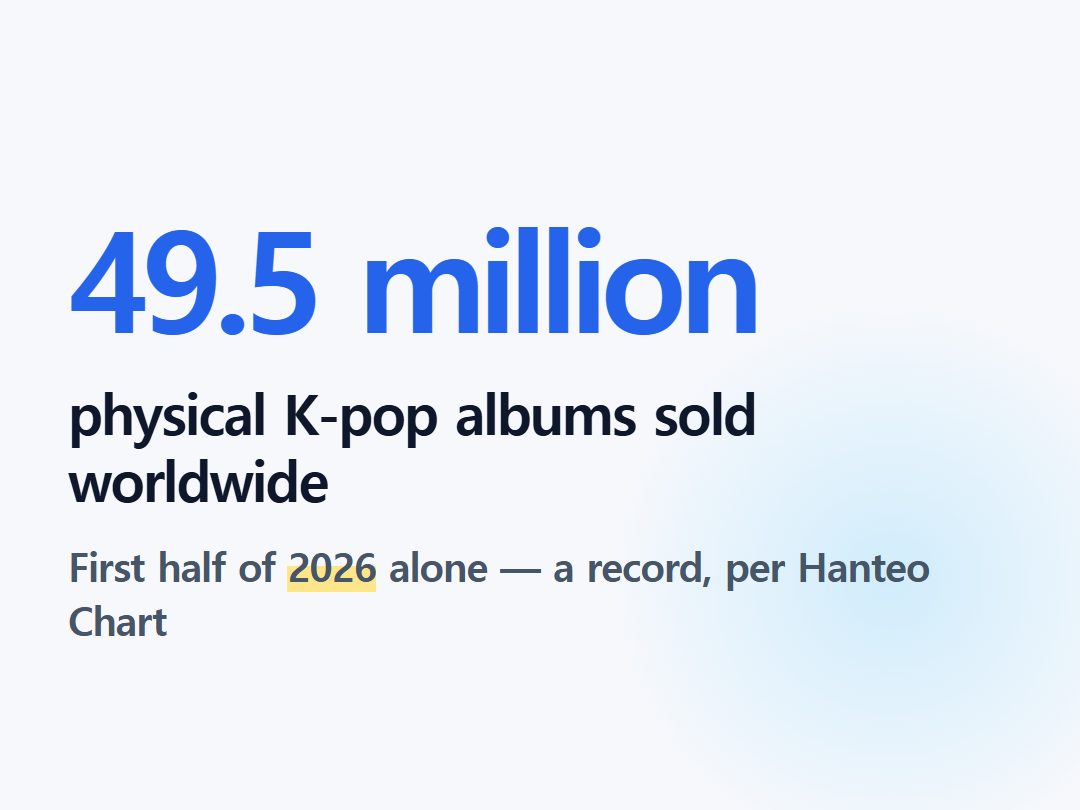
In the first half of 2026, fans worldwide bought 49.5 million physical K-pop albums, a record for any six-month period, according to the Hanteo Chart, a South Korean sales-tracking platform. Fourteen different acts sold more than a million copies of a single release in its first week alone.
Yet several of those same acts do not rank nearly as high on global streaming charts. The gap is not a mystery or a sign of inflated numbers — it is a predictable result of how K-pop albums are designed to be bought, not just heard.
The short version
- K-pop albums sold a record 49.5 million copies in early 2026.
- Random photocards push fans to buy multiple copies of the same album.
- Sales charts count purchases, not listeners, unlike streaming numbers.
Record sales worldwide, still trailing on streaming
Hanteo Chart, which compiles real-time purchase data from roughly 5,000 retailers around the world, reported on July 8, 2026 that global fans bought 49.5 million physical albums between January and June — a 23.4 percent jump from the 40.1 million sold in the same period a year earlier, and enough to beat the previous record of 46.2 million set in the first half of 2023.
BTS's return with the full-length album "Arirang" contributed heavily, selling an estimated 4.16 million copies in its first week, but Hanteo emphasized that the record was not carried by one or two groups.
Fourteen separate acts — including BLACKPINK, Ateez, Tomorrow X Together, Enhypen, and newer groups such as Riize, BoyNextDoor, and TWS — each cleared a million first-week copies, together accounting for 22.6 million units.
This physical dominance shows up internationally, too. In the International Federation of the Phonographic Industry's (IFPI) Global Album Sales chart for 2025, seven of the top ten best-selling albums worldwide were by K-pop artists, and nine of the top ten came from Asia overall.
On IFPI's separate measures of global streaming activity, Western pop acts still lead by a wide margin. The same artists can top a sales chart and sit well behind other acts on a streaming chart, because the two charts are counting fundamentally different things.
Why do fans buy the same album twice?
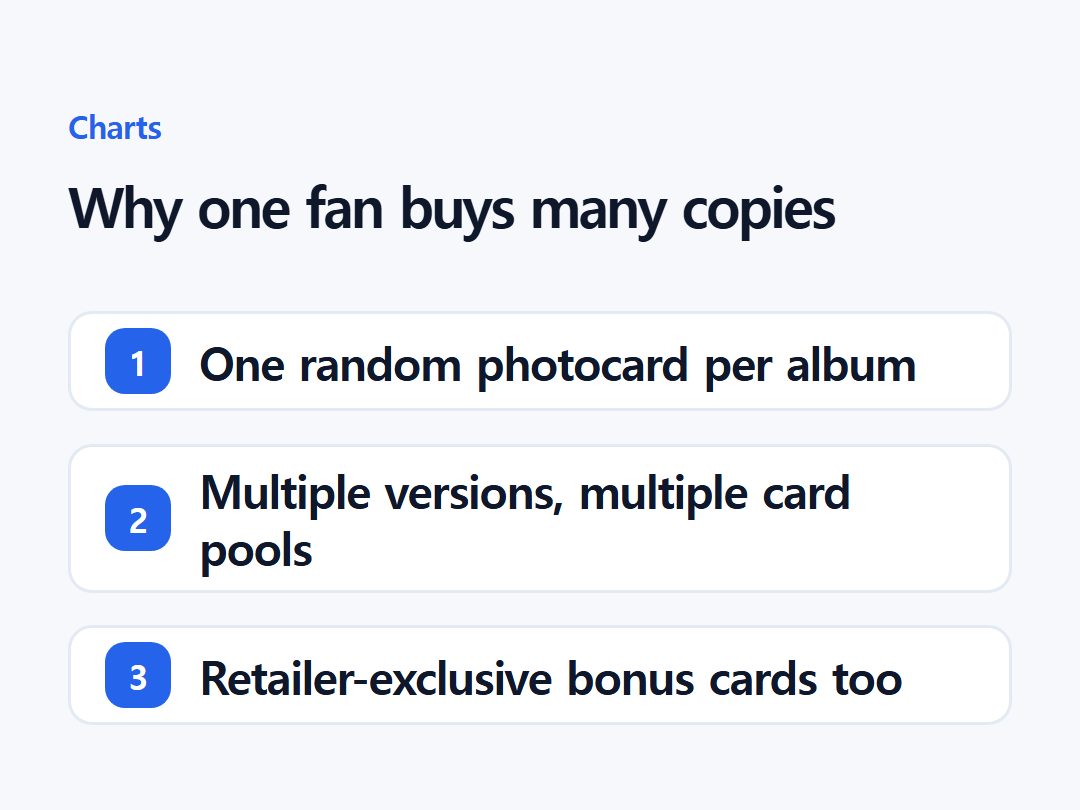
The gap exists because a large share of K-pop album purchases are not made to be listened to. They are made to be opened. Most K-pop releases include a random photocard — a small, glossy card, roughly the size of a playing card, printed with a photo of one member of the group.
A given album version usually contains one card drawn randomly from a set that can include every member, sometimes in multiple poses or outfits. A fan who wants the specific member and pose they like has no way to choose it at checkout; they only find out which card they received after opening the package.
This randomness is the engine of the entire system. If a member has four possible photocards in circulation and each album yields only one random card, a fan chasing a specific one may need to buy several copies of the exact same album just to improve their odds.
Agencies compound this by releasing an album in multiple physical "versions" — different cover art, different packaging, different bundled items — each with its own separate photocard pool, plus additional "pre-order benefit" cards that vary by which retailer a fan orders from.
A fan trying to collect a full set may end up ordering the same release from several different stores. Some releases push this further than others: TWICE's 2024 EP "Strategy" was issued in eighteen distinct versions, and Illit's 2025 mini-album "Bomb" came in ten.
Multiplied across a fandom of hundreds of thousands, this is how a single release can generate millions of individual transactions from a fraction as many listeners.
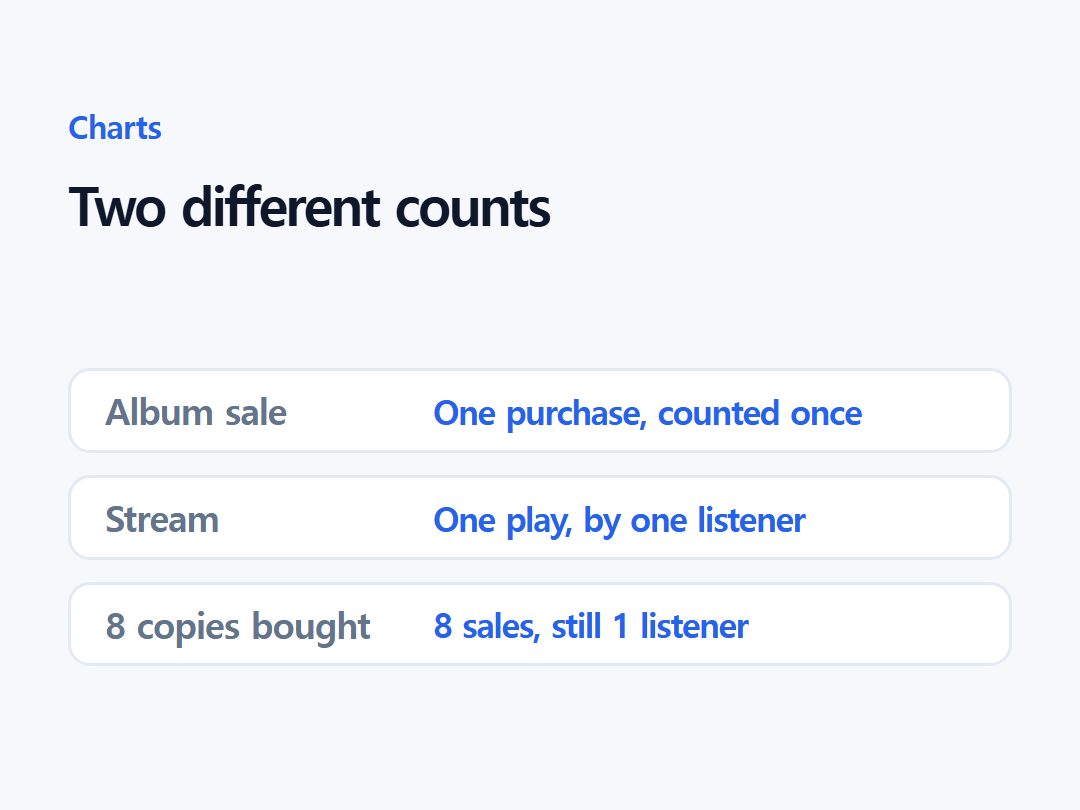
That distinction — transactions versus listeners — is the core of the puzzle. A streaming count measures how many times a song was played, aggregated across however many people did the playing. A physical album sale measures a single purchase, full stop.
A fan who buys eight copies of the same album to chase a photocard registers as eight sales and is still one person listening to one copy of the music, likely on a phone rather than a CD player at all.
Surveys of South Korean listening habits consistently show that streaming through smartphones and platforms is the dominant way people actually hear music; the CD itself is frequently secondary to what comes inside the packaging.
There is also a direct financial incentive built into how K-pop tracks and rewards success.
First-week album totals, tallied publicly by Hanteo Chart and by its rival Circle Chart (the rebranded, globally-oriented successor to the long-running Gaon Chart), feed into music-show wins, year-end awards, and an agency's own internal metrics for whether a comeback succeeded.
Because these charts count units sold rather than people who bought them, multiplying purchases per fan is a legitimate and heavily used strategy for improving a group's chart position — distinct from, and not dependent on, how often the music is streamed afterward.
The scale of this has drawn regulatory scrutiny in South Korea.
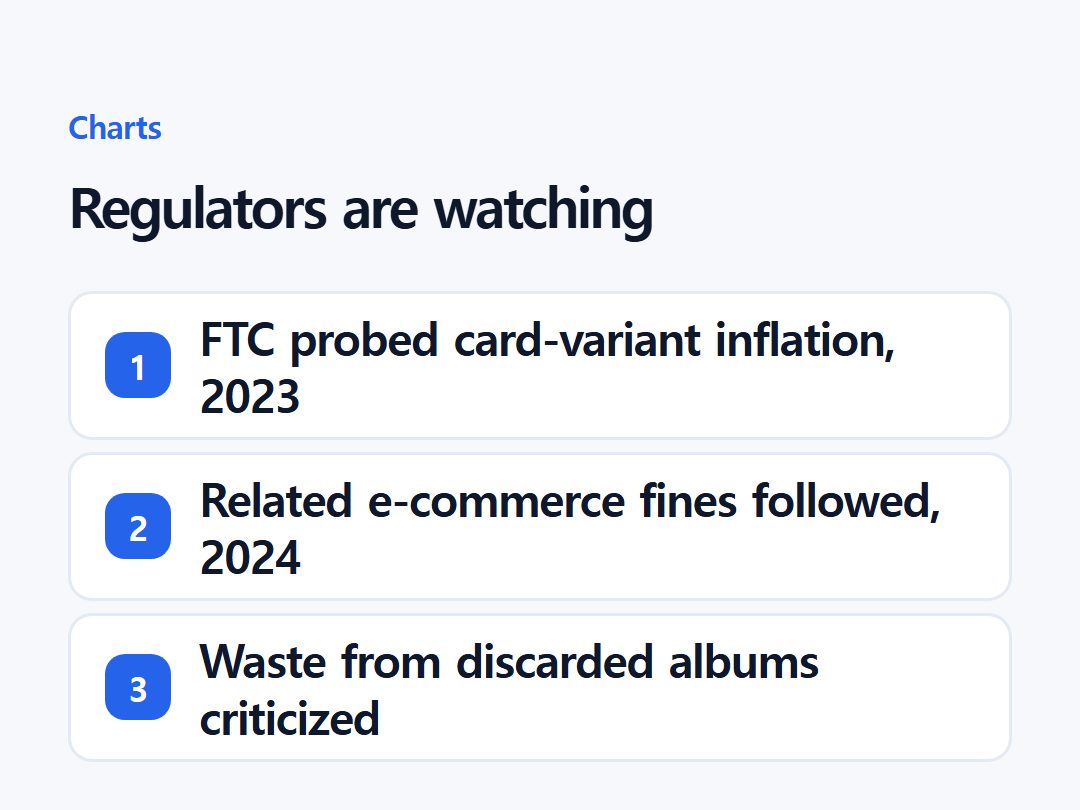
In August 2023, the Korea Fair Trade Commission opened on-site investigations into SM Entertainment, JYP Entertainment, YG Entertainment, and HYBE, examining whether agencies deliberately inflated the number of photocard variants to pressure fans into repeat purchases — with critics pointing to releases like NCT's, which have shipped with close to fifty distinct photocard types for a single album.
That inquiry into the card system itself has not produced a public penalty.
A related but separate 2024 investigation into the same four agencies' online stores did conclude with fines, after regulators found the companies imposed refund policies — such as requiring unboxing videos as proof before a refund on a defective or missing item — that violated consumer protection law.
The practice has also produced a visible waste problem: fans who only want the card, not the packaging or CD, have periodically left boxes of unwrapped albums as trash in stairwells and parking lots, a phenomenon Korean media refer to as "album kkang," literally "album gutting."
How photocards and repackages became the norm
Neither piece of the system — the photocard or the multi-version release — is new; both were refined gradually and only converged into today's scale over roughly fifteen years.
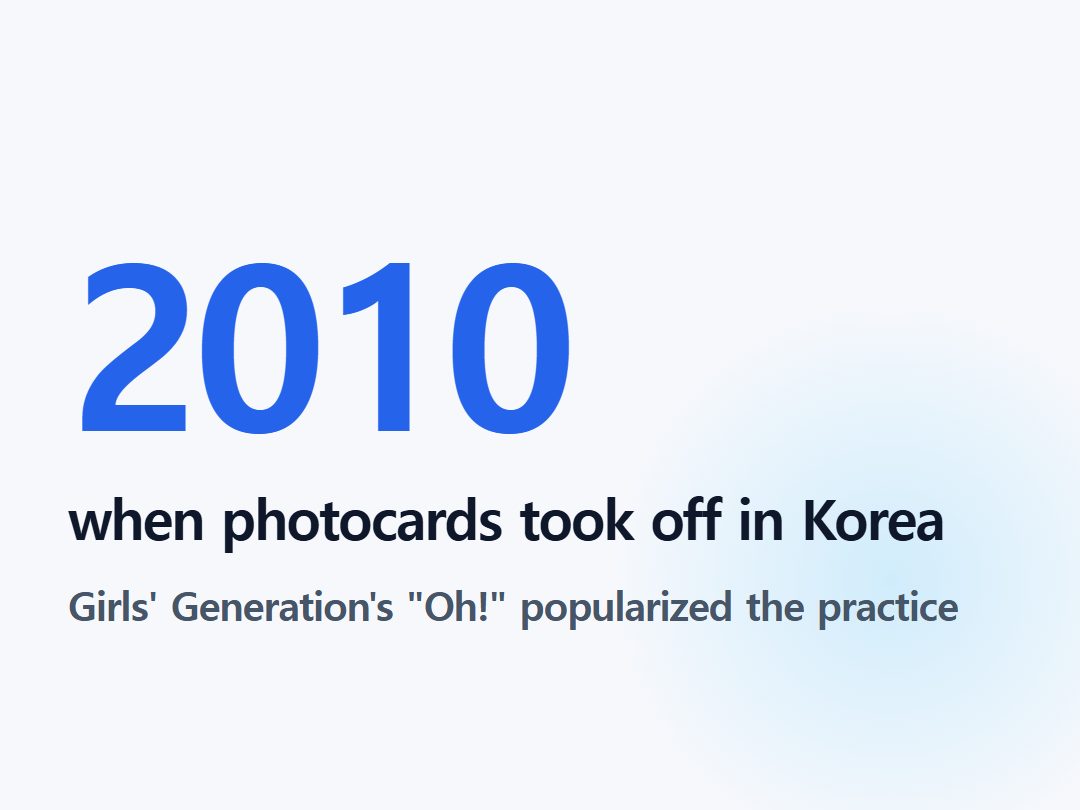
Photocards as an idol-marketing tool trace back to the late 2000s, with SM Entertainment's TVXQ including one in a 2007 Japanese release, but the practice is widely credited with taking hold domestically after Girls' Generation's 2010 album "Oh!" bundled cards with the release.
That album, helped by the pull of the collectible, became the best-selling record of the year on the Gaon Album Chart (Circle Chart's predecessor), outselling even the combined totals of the year's other major comeback and its repackage edition — an early demonstration to the industry that splitting a release into more purchasable pieces could move more units than a single strong single ever would.
The other half of the model, the "repackage" album, followed a similar logic: labels had already learned by the late 2000s that reissuing an album with one or two new tracks and new packaging, months after the original release, could generate a second wave of sales from fans who considered it a distinct product.
Once agencies combined that instinct with the random photocard, they had a template: release the same core music across several physical editions, each with its own collectible pool, and let fans' desire to complete a set do the rest.
The chart system evolved alongside the practice.
Gaon Chart, the industry-backed data provider used by broadcasters for decades, rebranded as Circle Chart in July 2022 and began publishing its own weekly first-week sales figures for the first time, a metric that had previously only been available through its competitor, Hanteo.
The two charts still measure sales differently — Hanteo counts confirmed sales to individual customers in real time, while Circle Chart's figures are built from broader retail and distributor shipment data — but both are now used by major music shows and award ceremonies to judge comeback performance, cementing first-week unit totals as one of the industry's most closely watched success metrics.
Will regulators ever crack down on photocards?
Whether this model is sustainable is genuinely unresolved.
The Fair Trade Commission's 2023 inquiry into photocard variant inflation has not been publicly closed with findings, and it remains unclear whether regulators will treat the random-card system itself as an unfair sales practice rather than simply policing agencies' refund and e-commerce policies, as the 2024 fines did.
Environmental criticism of discarded, unopened albums has grown loud enough that some agencies have begun offering "photocard-only" purchase options or QR-code digital albums that skip physical packaging altogether, though these have not displaced traditional multi-version releases.
There are also early signs that younger South Korean fans are shifting toward digital-first consumption, which could eventually narrow the gap between sales charts and streaming charts from the domestic side.
For now, though, Hanteo's mid-2026 numbers point the other way — toward a physical market still growing broadly across the industry rather than shrinking, which means the disconnect between how many albums a group sells and how many people are actually streaming them is likely to persist.
Hanteo Chart vs. Circle Chart
| Chart | How it counts sales | Weekly first-week reporting since |
|---|---|---|
| Hanteo Chart | Confirmed sales to individual customers, in real time, from roughly 5,000 retailers | Long-running industry standard |
| Circle Chart (formerly Gaon Chart) | Broader retail and distributor shipment data | July 2022 |
Frequently asked
Why do K-pop albums sell millions but stream much less?
Album sales count individual purchases, and fans often buy many copies of the same release chasing random photocards, while streaming counts actual listens by however many people are playing the song.
What is a K-pop photocard and why does it matter for sales?
It's a small, randomly-inserted card featuring one group member; since fans can't choose which one they get, many buy multiple copies of the same album to collect a specific card, inflating first-week sales totals.
What is 'album kkang'?
It's a Korean term, literally 'album gutting,' for fans discarding the CD and packaging after removing only the photocard, leaving unwrapped albums as trash in stairwells and parking lots.
Sources
Every factual claim above is traceable. We do not translate articles — we gather facts from multiple outlets and write them ourselves.
- K-pop album sales hit record 49.5 million in first half of 2026, Hanteo says — Korea JoongAng Daily
- GLOBAL MUSIC REPORT 2026: Global recorded music revenues grow 6.4% as record companies drive innovation — IFPI
- Korean and Japanese artists dominate IFPI album-sales chart — Music Ally
- Why K-Pop Fans Are Buying, Trading, and Selling Photos of Their Idols — Vice
- Fair Trade Commission Investigates Major Entertainment Companies Over Random Photo Card Sales Scheme to Boost Album Revenue — allkpop
- HYBE, YG, SM and JYP Entertainment reportedly fined by South Korea's Fair Trade Commission for strict purchase policies — NME
- Gaon Announces Rebrand From Domestic Chart To Global "Circle Chart" — Soompi
- K-pop 101: Hanteo chart vs. Gaon chart — Sportskeeda
- BTS, Enhypen, K-pop Fans Fuel Surge in Physical Album Sales — Rolling Stone