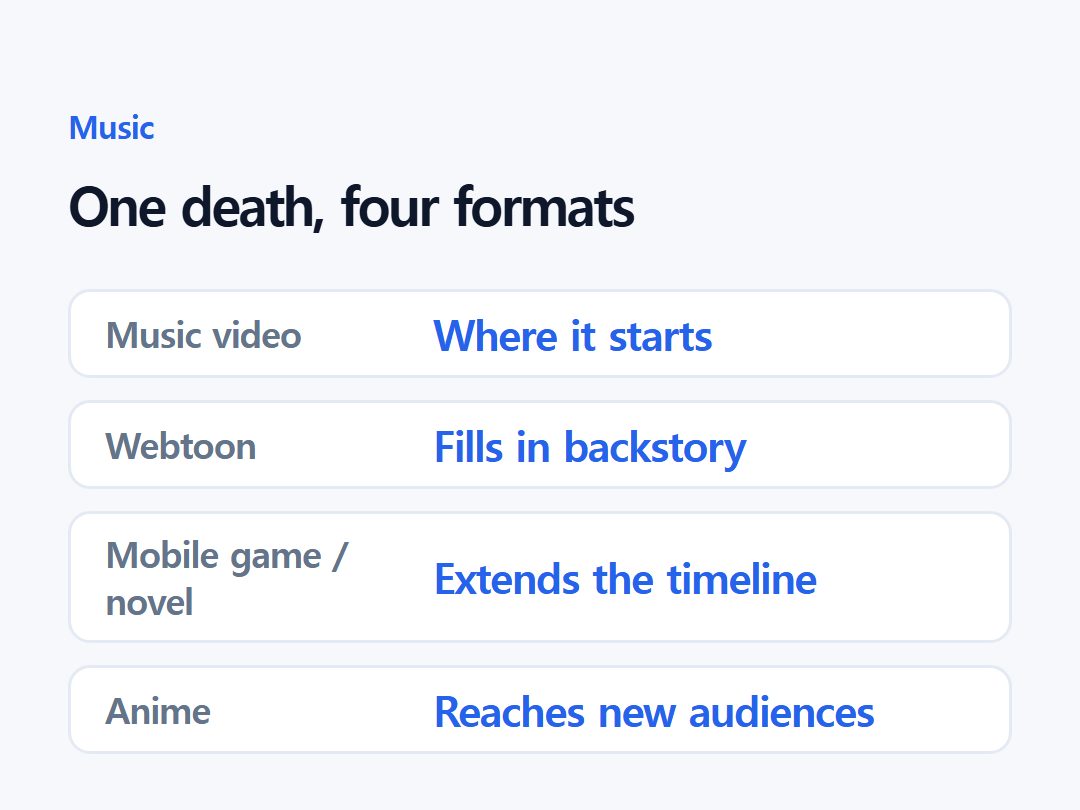
A member appears to die in a K-pop music video, then shows up again in the next one, then in a linked webtoon, then years later in a mobile game or an anime. This has happened across EXO, BTS, ENHYPEN, TXT, and aespa's catalogs. It is not a writer running out of ideas — it is a release schedule.
The short version
- EXO, BTS, and ENHYPEN never officially confirm which member's on-screen death is real.
- Unresolved deaths give agencies a hook for years of future comebacks.
- ENHYPEN's webtoon death is becoming a Crunchyroll anime premiering January 2026.
EXO started the pattern in 2012 with a Tree of Life story
EXO's mythology began with the music video for "Mama" in 2012, which introduced twelve members as guardians of a cosmic "Tree of Life" split into two hidden halves after an evil force called the Red Force tried to consume it.
The story resurfaced across nearly a decade of releases. In "Lucky One" (2016), members appear experimented on in a lab; in "Power" (2017), an eclipse restores a member's lost ability; in "Obsession" (2019), the group fights literal doppelgängers called X-EXO, each battle built around a member's individually assigned power such as fire, wind, or light.
"Obsession" ends with both sides appearing to destroy each other in the same choreography, closing on a shot of the fictional world half on fire and half untouched. **No follow-up release has stated which side, if either, survived.**
BTS turned two 2015 videos into a mystery fans are still solving
BTS's "I Need U" and "Run," both released in 2015, launched what fans call the HYYH universe, named after the Hwayangyeonhwa ("The Most Beautiful Moment in Life") album series. The videos show members in car accidents, fights, and near-drownings, cut together out of chronological order.
Neither video states who lives or dies. Years of fan analysis — comparing camera angles, missing members in a group photo, a scene of falling playing cards — produced competing theories about which member's death anchors the story, none of them confirmed by the band's label.
One widely circulated reading pairs the two videos as cause and effect: a fight shown in "Run" is read as the reason a member is later shown alone at night in "I Need U," shortly before the scene many fans interpret as fatal.
A competing reading argues the whole sequence is symbolic rather than literal, standing in for the strain of growing up rather than any member's actual death. HYBE has not endorsed either interpretation.
The company has never said who actually died
This is the detail international readers usually miss: **Big Hit (now HYBE) has never released an official explanation of the HYYH story.** The ambiguity is not a gap the company forgot to fill — it is the product.
The same pattern holds at EXO's label, SM Entertainment. "Obsession" ends on a deliberately unresolved image, half the world on fire and half not, with no press statement clarifying whether any member's arc concluded.
Why it matters: an unfinished plot is a production schedule
Korean fans already treat these deaths as the start of a story, not the end of one. International viewers who watch a single video in isolation often read it as a dark one-off concept, missing that it is chapter one of a plan the agency intends to keep extending.
Industry reporting on this shift describes labels now treating idol groups as long-term intellectual property rather than single-era acts, with narrative arcs built to scale up or down depending on how fans respond. That reporting also notes agencies now regularly bring on novelists and screenwriters specifically to design these multi-year arcs.
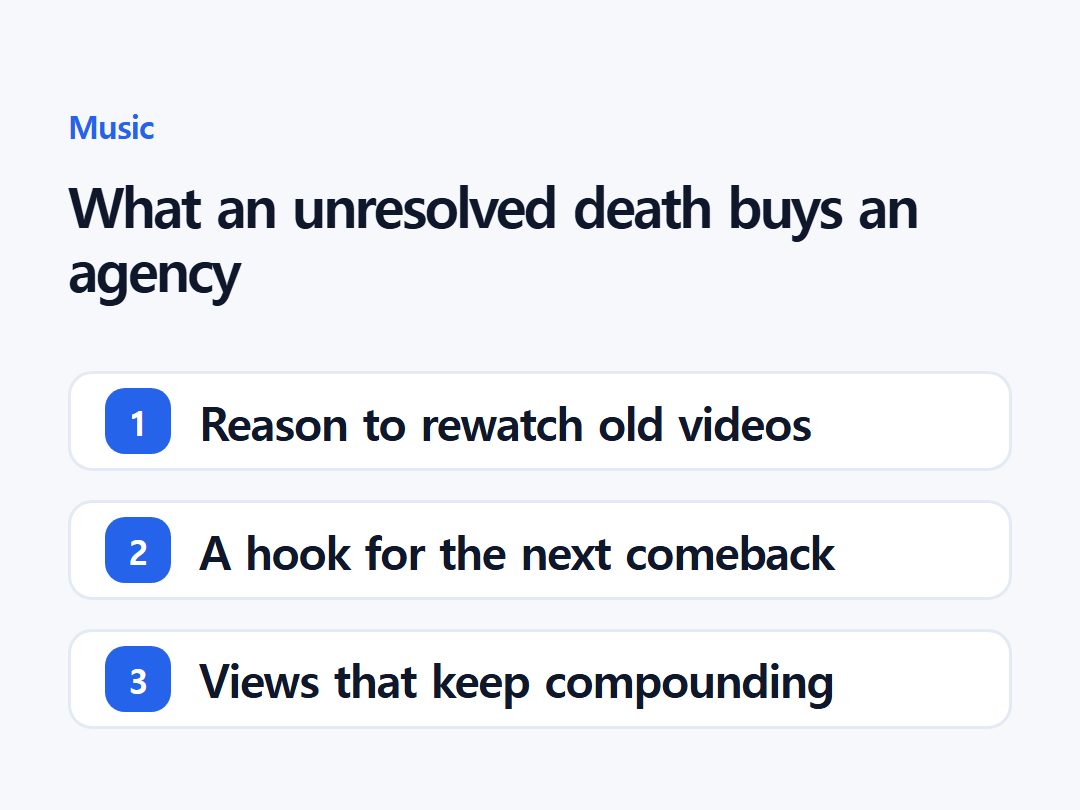
An unresolved death does three things a resolved one cannot:
- Gives fans a reason to rewatch old videos before every comeback
- Creates a hook the next album cycle can pay off or complicate
- Turns a single music video into content that keeps generating views for years
A "comeback," in K-pop terms, is not a return from hiatus — it is the standard term for any new single or album release, and groups typically have two or three a year. A death left open between comebacks gives each one a built-in question to answer.
This is not unique to EXO and BTS. aespa's videos run through a parallel digital world called Kwangya, guided by a fictional AI character; ATEEZ built an arc around a time-bending object called the Cromer; TXT has its own linked webtoon extending its members' story. **The pattern repeats because it works, not because one company invented it.**
Fans do marketing work the agency does not pay for
The theorizing itself has commercial value. Frame-by-frame breakdown videos, dedicated wikis, and long theory threads routinely outlast the running time of the music video they analyze, and they keep circulating on platforms the agency does not have to buy ads on.
None of this requires the company to say anything. **Silence keeps every theory alive at once**, which keeps more people arguing, rewatching, and posting than a single confirmed answer ever would.
ENHYPEN shows how far the system has scaled
ENHYPEN's "Dark Moon: The Blood Altar," a vampire-themed webtoon co-created with HYBE, launched in 2022 and folded a character death directly into its plot: a character named Selen dies partway through the series before reincarnating generations later.
That webtoon is now becoming a television anime, set to premiere on Crunchyroll in January 2026 — meaning a single group's fictional universe has expanded from music video, to webtoon, to a separate animated production spanning several years and formats.
HYBE has since built prequels and spin-offs around the same fictional world, and extended the format to another of its acts, the Japanese boy band &Team, in a linked spin-off series. **One character death in a webtoon chapter became the seed for a release calendar stretching years past the original comeback.**
SM links several different groups through one shared universe
SM Entertainment runs a parallel version of this called the SM Culture Universe, which connects aespa, EXO, NCT, and SHINee through a shared fictional setting called Kwangya. A plot beat introduced through one group's video can echo into another's release the following year.
This means a death or disappearance is no longer contained to one group's discography — it can become a shared reference point across a label's entire roster, multiplying how many separate fandoms have a reason to track it.
How we got here: from one prologue to an industry template
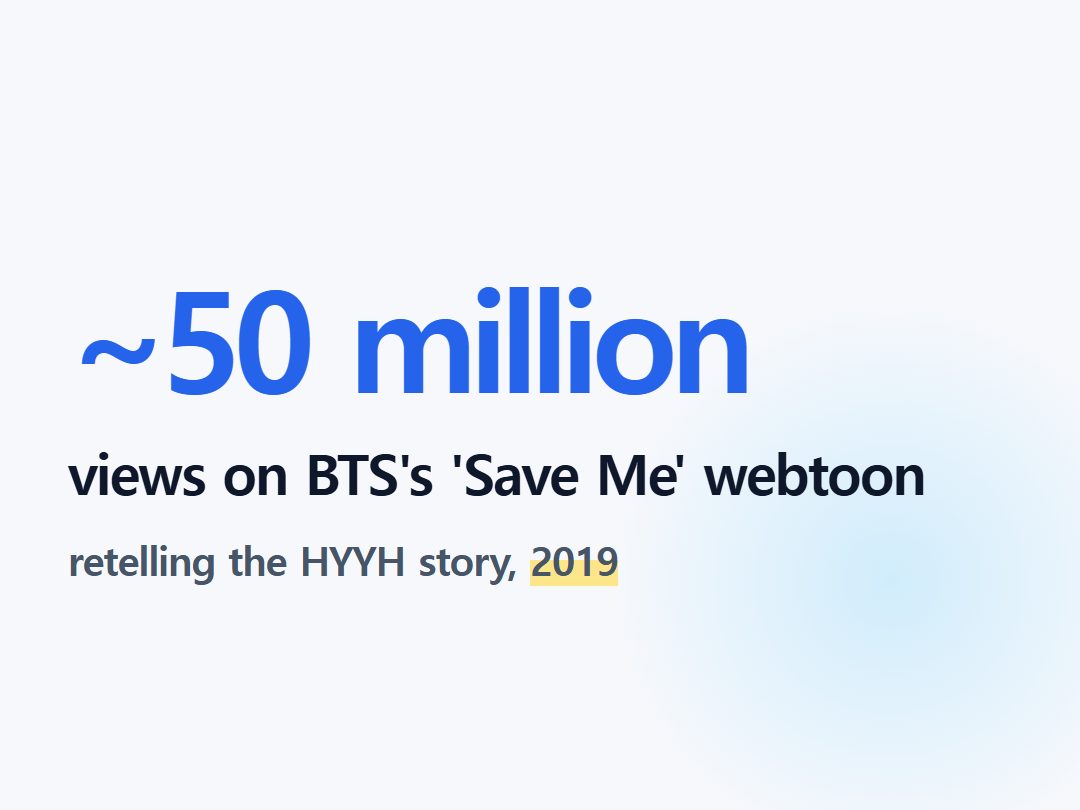
The timeline runs in a fairly straight line. EXO's 2012 mythology proved a mystery arc could survive years of unrelated comeback concepts. BTS then expanded that idea past music videos entirely with the 2019 webtoon "Save Me," which retold the HYYH story and reportedly drew around 50 million views on the Line Webtoon platform before its run ended.
By the time ENHYPEN debuted in 2020, aligning a webtoon and later an anime with album cycles was no longer experimental — it was close to standard practice for a major-label debut act.
HYBE had already tested the model once more in between, with a separate 2021 webtoon, "7Fates: Chakho," that recast BTS members as original characters in an unrelated story. Each step added a new format without requiring the last one to reach a conclusion first.
What is still unresolved
The HYYH storyline has never received an official close from HYBE, and fan theories about which member died first still conflict with each other a decade later. EXO's "Obsession" ending remains similarly unexplained by SM.
The newer universes are unresolved by necessity rather than choice: ENHYPEN's anime is only beginning in 2026, and SM's Kwangya-linked storylines are still adding chapters with each new comeback across four different groups.
Do the companies ever confirm what fans theorize?
Rarely, and almost never with a direct yes-or-no answer about a specific member's fate. Agencies tend to let the ambiguity stand, since a confirmed ending closes the story fans have spent years building content around — and an open one does not.
K-pop fictional universes at a glance
| Group | Fictional Universe | Started | Format | Current Status |
|---|---|---|---|---|
| EXO | Tree of Life / "Obsession" | 2012 | Music videos | Ending still unexplained by SM |
| BTS | HYYH | 2015 | Music videos + "Save Me" webtoon (2019) | Never officially explained by HYBE |
| ENHYPEN | Dark Moon: The Blood Altar | 2022 | Webtoon → TV anime | Anime premieres on Crunchyroll, Jan 2026 |
| aespa, EXO, NCT, SHINee | SM Culture Universe (Kwangya) | Ongoing | Shared universe across 4 groups | Still adding chapters each comeback |
Frequently asked
Did anyone actually die in BTS's 'I Need U' or 'Run'?
HYBE has never confirmed who dies or survives in the HYYH storyline, and fan theories about it still conflict a decade later.
What happened at the end of EXO's 'Obsession' music video?
It ends with both sides seemingly destroying each other and a world half on fire, half untouched, but SM has never clarified the outcome.
When does the ENHYPEN anime come out?
The 'Dark Moon: The Blood Altar' anime, based on ENHYPEN's webtoon, is set to premiere on Crunchyroll in January 2026.
Sources
Every factual claim above is traceable. We do not translate articles — we gather facts from multiple outlets and write them ourselves.
- How K-pop turned lore into a production system — The Korea Times
- The Lore of the Idol: How K-pop Uses Complex Mythology to Build Fan Loyalty — Martin Cid Magazine
- 'Obsession' is an Entrancing Evolution for Exo — Seoulbeats
- Dark Moon: The Blood Altar TV Anime Reveals Cast, Staff, January 2026 Debut — Anime News Network
- Save Me (webtoon) — Wikipedia
- I Need U (BTS song) — Wikipedia
- Dark Moon: The Blood Altar — Wikipedia