Every few months, an international fan base learns for the first time that a favorite K-pop idol or actor is about to disappear from public life for close to two years. The reaction is often confusion: why would a company let its biggest star vanish at the height of his career?
The answer is that no company, and no star, gets to decide. Military service in South Korea is a legal duty written into the constitution, and fame does not create an exception to it.
The short version
- South Korea requires nearly all men to serve 18-21 months before turning 28.
- Fame grants no exemption; all seven BTS members completed service by 2025.
- The 2020 'BTS law' only delayed enlistment to 30 — it didn't cancel it.

Did every member of BTS finish their service?
South Korea requires almost every able-bodied male citizen to complete mandatory military service, typically between 18 and 21 months depending on the branch, once he turns 18 and before he turns 28. This applies to K-pop idols, actors, and other entertainers exactly as it applies to office workers, students, and farmers. There is no general celebrity exemption.
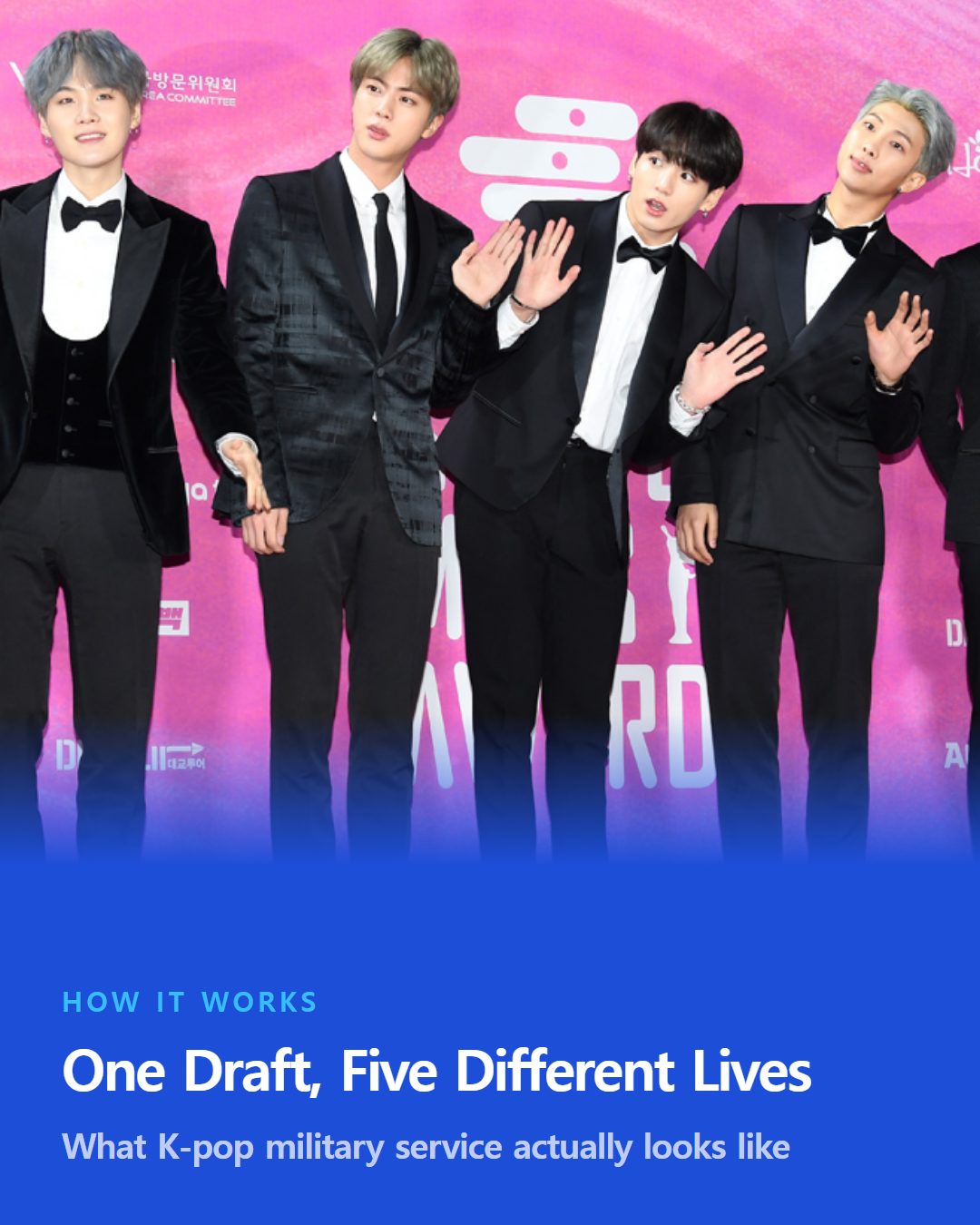
The clearest recent example is BTS. All seven members enlisted between December 2022 and December 2023 and completed their service by June 2025. Jin was the first to enlist, on December 13, 2022, and the first to be discharged, on June 11, 2024. J-Hope followed in April 2023.
RM, Jimin, V, and Jungkook enlisted together in December 2023 and were discharged in June 2025.
Suga, who had a pre-existing shoulder injury, fulfilled his duty as a “social service agent,” an alternative form of service for men who do not meet the fitness standard for combat duty, and finished in June 2025 as well. None of them received an exemption.
What they did receive, years earlier, was a temporary right to delay enlistment, which is a different thing entirely.
Why can't idols buy their way out of service?
The most common misunderstanding among international fans is that Korean celebrities either dodge military service through fame and money, or that a special law lets them skip it. Neither is true, and the distinction matters because it reflects a legal principle Korean audiences take for granted but that has no real equivalent in most countries with professional or volunteer militaries.
Article 39 of the South Korean constitution states that all citizens have a duty of national defense, and the Military Service Act translates that into a concrete obligation for men: register at 18, undergo a physical fitness classification, and serve.
This is not framed as a career interruption to be managed by an agency’s public relations team. It is a legal obligation enforced by the state, with criminal penalties for evasion.
A celebrity who tries to avoid it is not seen as making a savvy business decision; he is seen as breaking the law and, in the court of Korean public opinion, betraying a basic civic duty shared by every other man his age.
This is also why the one real legislative change aimed at K-pop stars was narrow and, even then, controversial.
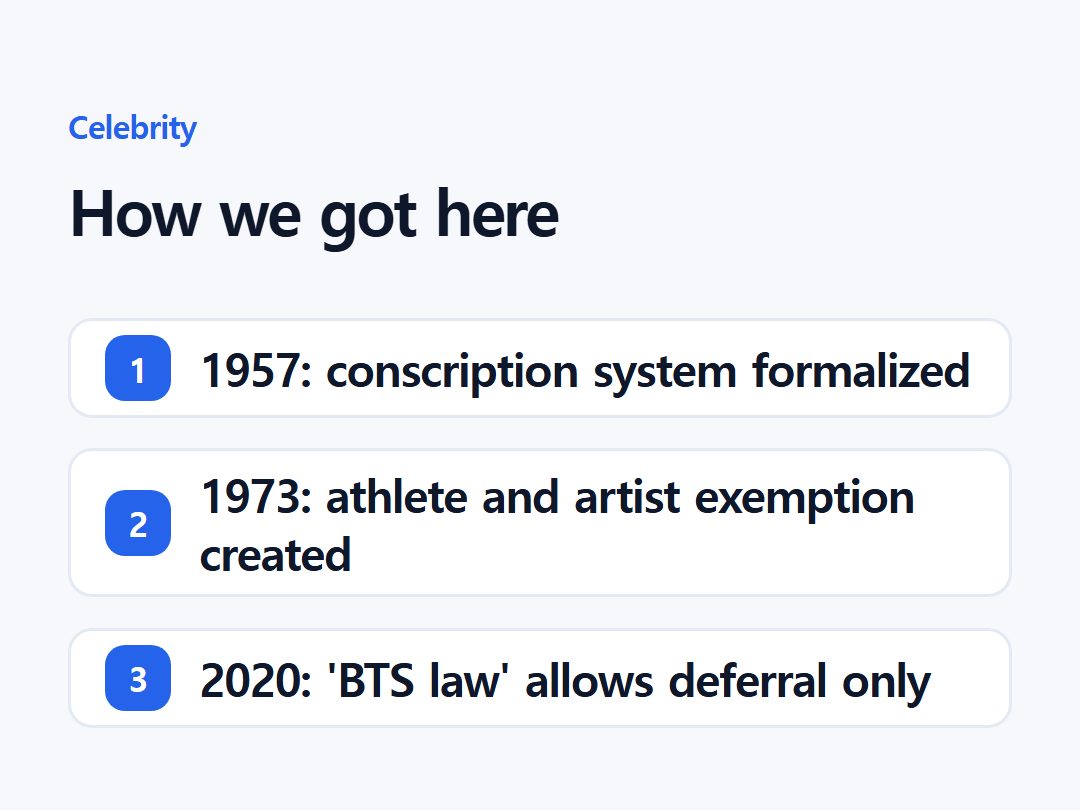
In December 2020, as BTS became the first Korean act to top the Billboard Hot 100, the National Assembly amended the Military Service Act to let popular musicians who had received the Order of Cultural Merit — a state honor BTS was given in 2018 — postpone enlistment from age 28 to age 30.
This provision, widely nicknamed the “BTS law,” did not exempt anyone from service. It only delayed when the clock started.
The Defense Ministry said at the time that it would apply the criteria as strictly as possible, precisely because lawmakers were worried the change would look like preferential treatment for the famous.
In the end, BTS did not even use the deferral to its full extent; members began enlisting well before turning 30, and Jin publicly said he would report for duty whenever called.
What makes this distinction sharper is that South Korea does have a genuine exemption system, and pop musicians and actors are pointedly left out of it.
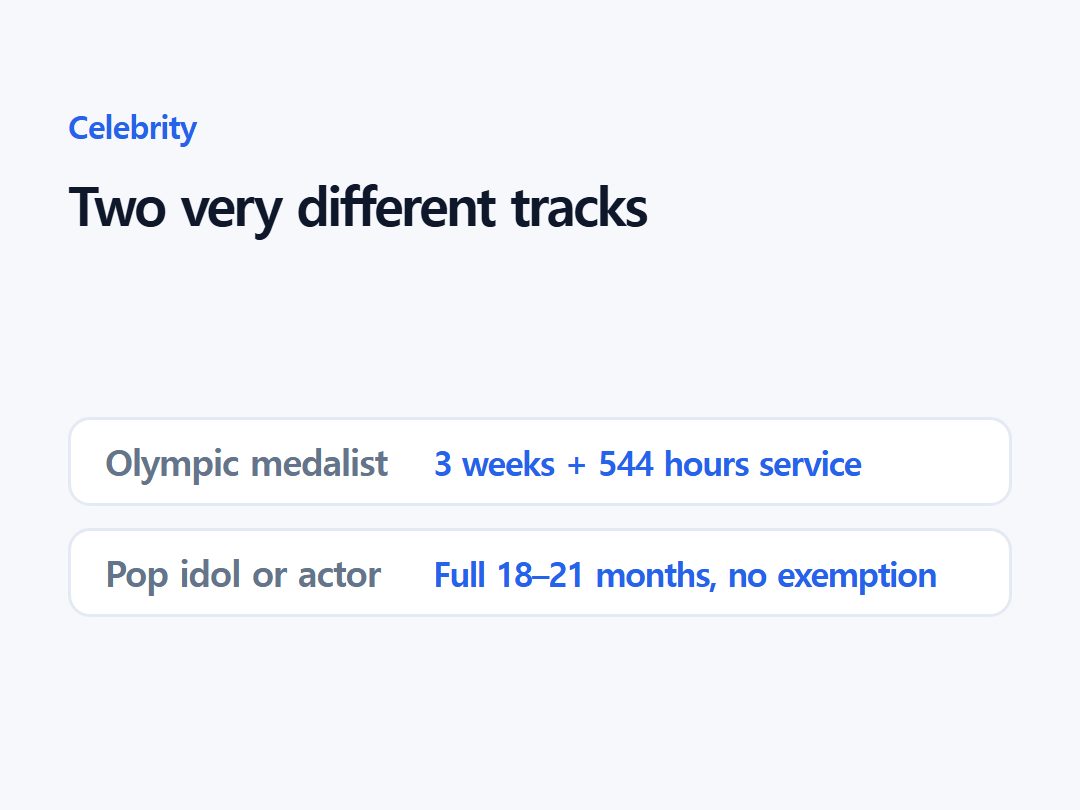
Since 1973, the Military Service Act has allowed elite athletes who win an Olympic medal of any color or gold at the Asian Games, along with classical musicians and dancers who place in specific competitions, to fulfill their obligation with three weeks of basic training and 544 hours of alternative service rather than up to two years in uniform.
Soccer star Son Heung-min and Olympic medalists have used this route.
Esports player Lee “Faker” Sang-hyeok became eligible for it after winning gold at the 2023 Asian Games, which triggered public debate over why a professional gamer could be exempted while BTS, despite generating billions of dollars in economic impact and repeated Billboard No. 1s, could not.
That debate is still unresolved, and it illustrates the underlying principle: exemptions in South Korea are narrowly defined by law, tied to specific, auditable achievements like medals, not to general fame or commercial success.
A pop star does not qualify no matter how successful he is, because the law was never written to let him.
The consequences of trying to sidestep the system, rather than simply serving late or through the alternative-service track, are also instructive for readers used to celebrities managing scandals through statements and time.
In 2010, rapper MC Mong was investigated for deliberately having healthy teeth extracted to fail his physical fitness exam; he was never convicted of a crime after a lengthy legal process, but the accusation alone effectively ended his mainstream career.
Singer Yoo Seung-jun, a major star in the late 1990s, left Korea in January 2002 shortly before his enlistment date and became a naturalized United States citizen, which released him from the obligation under Korean law.
The government responded by barring him from entering the country, a ban that has now lasted more than two decades despite South Korea’s Supreme Court twice ruling in his favor on narrow procedural grounds.
In May 2026, the Justice Ministry announced it would write a permanent entry ban for military service evaders directly into the Immigration Act, explicitly citing Yoo’s case as the reason the law needed to close remaining loopholes.
Justice Minister Jung Sung-ho described giving up citizenship to avoid service and later seeking to return as “antisocial conduct” that could fairly be called unpatriotic.
That is the register in which Korean institutions discuss this issue: not as image management, but as a question of civic obligation and, when violated, national betrayal.
From Korean War duty to today's narrow exemptions
South Korea’s conscription system dates to the Military Service Act of 1949 and was formalized into its modern shape in 1957, in the years following the Korean War, which ended in an armistice rather than a peace treaty.
The two Koreas remain technically at war, and mandatory conscription has been maintained since as a direct response to the ongoing military presence of North Korea along the border.
This context is central to why the obligation is treated as non-negotiable: it is framed domestically as a matter of national survival, not a bureaucratic formality.
The narrow exemption track for elite athletes and classical artists was introduced in 1973 under South Korea’s then-authoritarian government, which wanted to link international sporting and artistic success to national prestige.
That system has persisted largely unchanged for half a century, even as the entertainment industry it excludes — K-pop in particular — became one of the country’s largest cultural exports.
As BTS’s global success accelerated through the late 2010s, lawmakers faced growing public pressure to address the mismatch, which led directly to the 2020 deferral amendment.
Separately, South Korea’s Constitutional Court and Supreme Court ruled in 2018 that the country’s long-standing refusal to offer any alternative to conscientious objectors, most of whom were Jehovah’s Witnesses imprisoned for refusing service on religious grounds, was unconstitutional.
That led to a 36-month alternative service program in correctional facilities starting in January 2020, roughly twice the length of standard military service, which the Constitutional Court upheld again in 2024.
Together, these cases show a system that has bent in specific, legally defined ways, but has consistently refused to create a broad, discretionary path around service for anyone, famous or not.

The fairness debate stays open, service goes on
The fairness debate the “BTS law” opened has not closed. A government task force reviewed the athlete and artist exemption system again in 2024, and polling has shown majority public support for tightening rather than expanding it, but no legislative changes have followed.
Meanwhile, the ordinary rhythm continues: idols who enlisted in 2024, including NCT’s Jaehyun and Seventeen’s Jeonghan, are scheduled for discharge in 2026, and others will enlist as they approach 28.
The Justice Ministry’s move to formally codify the entry ban on evaders, prompted by the Steve Yoo case, is also still working through the legislative process.
None of this points toward Korean celebrities gaining an easier path through military service; if anything, the direction of policy has been to close remaining gaps rather than open new ones.
South Korea's military service tracks
| Track | Requirement | Who qualifies |
|---|---|---|
| Standard service | 18 to 21 months active duty, age 18-28 | Nearly all able-bodied men |
| "BTS law" deferral (2020) | Enlistment postponed to age 30; service still required | Order of Cultural Merit recipients |
| Elite exemption (since 1973) | 3 weeks basic training + 544 hours alternative service | Olympic/Asian Games medalists, top classical musicians and dancers |
| Conscientious objector service (since 2020) | 36 months alternative service in correctional facilities | Recognized religious/conscientious objectors |
Frequently asked
Do K-pop idols get out of Korean military service?
No. There is no general celebrity exemption, and nearly every able-bodied South Korean man, idol or not, must serve between 18 and 21 months before he turns 28.
What is the 'BTS law'?
A December 2020 amendment letting musicians who received the Order of Cultural Merit, like BTS, postpone enlistment from age 28 to age 30. It delayed their service, it did not exempt them from it.
Why can athletes like Son Heung-min skip military service but BTS can't?
Since 1973, South Korean law has let Olympic and Asian Games medalists and certain classical musicians and dancers substitute three weeks of training plus 544 hours of alternative service. Pop musicians and actors were never written into that exemption, no matter how successful.
Sources
Every factual claim above is traceable. We do not translate articles — we gather facts from multiple outlets and write them ourselves.
- Why Do Korean Males Have to Serve in the Military? — LegalClarity
- Defense Ministry revises law to allow BTS members to defer military service until age 30 — Korea JoongAng Daily
- BTS stars Jimin, V, Jung Kook and RM to enlist in South Korean military — NBC News
- BTS' Jungkook and Jimin Discharged from Korean Military After RM and V — Rolling Stone
- BTS serves, but Olympic medalists exempt: Military exemptions under review — The Korea Times
- Gov't to codify entry ban on military service evaders, cite singer Steve Yoo's case — Korea JoongAng Daily
- S Korea passes law allowing BTS stars to defer military service — Al Jazeera