Open two different articles about the same Korean drama episode and you will sometimes find two different rating percentages for the exact same broadcast. Neither outlet is wrong. Both numbers come from the same ratings agency, and both are real.
The confusion comes from a detail that rarely makes it into English-language recaps: Korea's television ratings service publishes more than one figure for every episode, broken down by region, and reporters do not always specify which one they are citing.
The short version
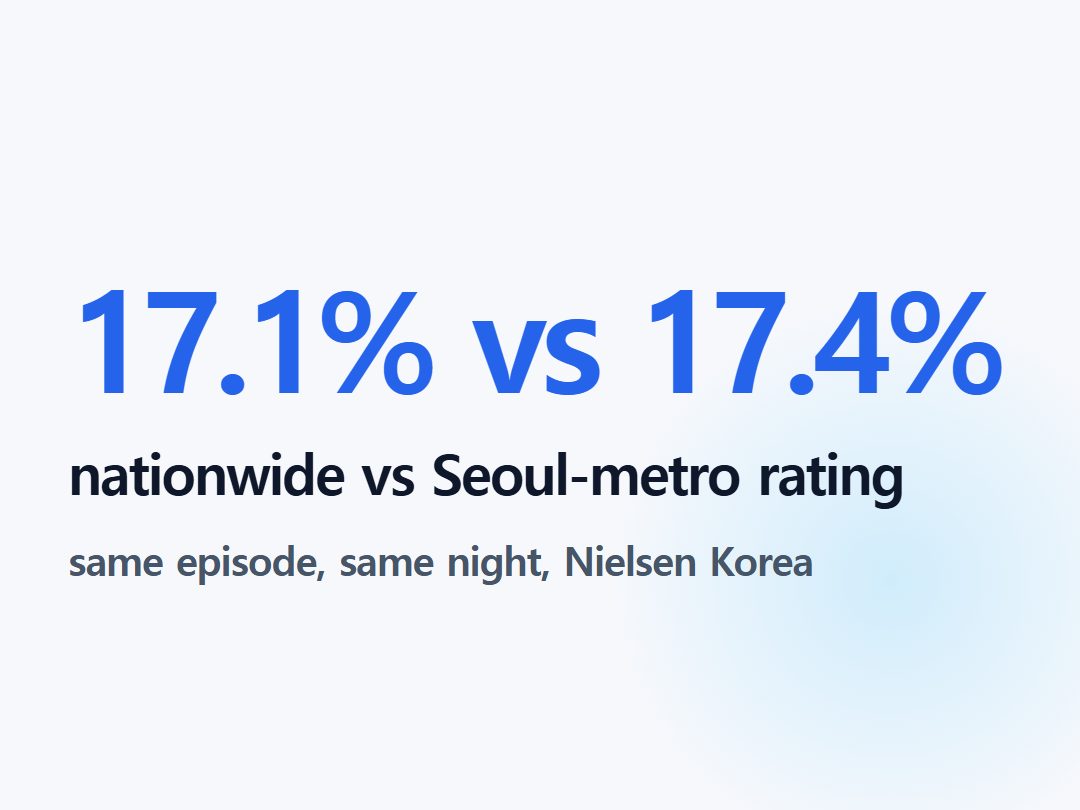
- tvN's finale scored 17.1% nationwide but 17.4% in Seoul — both are correct.
- Nielsen Korea also splits every rating into household and individual figures.
- Rival firm TNMS shut down in 2024, leaving Nielsen Korea the only provider.
The finale that scored 17.1% and 17.4%
Take a recent, well-documented example. When tvN's period drama Bon Appétit, Your Majesty aired its finale on September 28, 2025, Nielsen Korea — the country's television ratings agency, formerly known as AGB Nielsen — reported that the episode averaged a 17.1 percent rating nationwide, peaking at 19.4 percent.
The same episode was also reported at 17.4 percent in the Seoul metropolitan area, peaking at 20 percent, according to Nielsen Korea data cited by The Korea Times. Both figures describe the identical hour of television.
They are simply drawn from two different survey populations that Nielsen Korea tracks and publishes separately, and international outlets translating or summarizing Korean entertainment news sometimes pick up only one of the two without noting which.
This is not a one-off glitch or a rare data error. It is the normal, everyday output of how Korean TV ratings are measured, and it shows up in nearly every ratings story a Korean entertainment outlet publishes.
What's the difference between nationwide and Seoul ratings?
Nielsen Korea measures viewership using people meters — small devices attached to television sets in a panel of sample households that log what is being watched in real time.
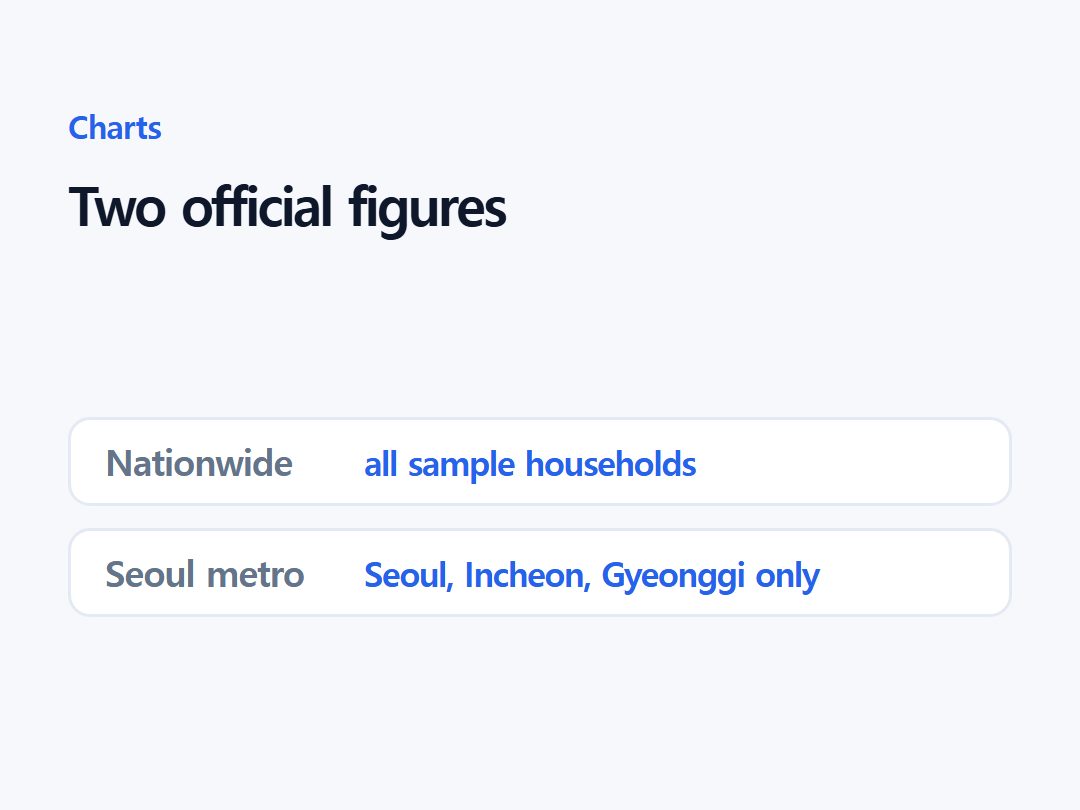
From that panel, Nielsen Korea calculates two separate headline figures for terrestrial and cable programming: a nationwide rating, drawn from households across the country, and a Seoul metropolitan area rating, drawn only from the subset of households in Seoul, Incheon, and Gyeonggi Province — the capital region that surrounds the city.
Nielsen Korea's own public ratings site lets users toggle between a label reading 전국 (nationwide) and one reading 수도권 (Seoul metropolitan area) for the same broadcast date, because both are standard, official outputs of the same survey, not a nationwide number and some unofficial local estimate.
The two figures diverge because Seoul's media market behaves differently from the rest of the country.
The capital region holds roughly half of South Korea's population and has long been treated by broadcasters and advertisers as the more commercially significant audience, since ad rates and buyer interest have historically concentrated there.
A drama can post a higher rating in Seoul than nationwide, or vice versa, depending on its genre and audience — sageuk historical dramas and daily soaps tend to skew differently by region than trendy contemporary dramas aimed at younger, urban viewers.
Because both numbers are legitimate, a broadcaster's press release, a fan account, or a headline writer can choose whichever figure best supports the story they want to tell — a record nationwide rating versus the highest-ever rating in the capital — without technically citing a false number.
For an international reader unfamiliar with the system, two different percentages attached to the same episode can look like sloppy reporting. It usually is not; it is two accurate answers to two different questions.
A second, related axis compounds the confusion: Nielsen Korea also separates household ratings from individual ratings. A household rating estimates the share of TV-owning households tuned to a program; an individual rating, which Nielsen Korea has published since 2017, estimates the share of individual viewers instead.
These are not interchangeable, since a household rating cannot distinguish one person watching from a family of four watching, and articles do not always specify which of the two they are quoting either — meaning a single episode can technically be described with four different official numbers: nationwide household, nationwide individual, Seoul-metro household, and Seoul-metro individual.
There is a third source of divergence that international readers may run into in older articles, though it is now largely historical.
For much of the 2000s and 2010s, Korea had two competing ratings companies operating in parallel — Nielsen Korea and a rival firm called TNMS (Total National Multimedia Statistics) — and their numbers for the same broadcast sometimes differed even within the same region.
Industry reporting from Edaily traced part of that gap to differences in how each company weighted its panel by age: TNMS allocated a larger share of its sample to viewers in their 20s to 40s than Nielsen did, and the two firms disagreed publicly over which weighting method was more accurate.
That inter-agency gap is a separate phenomenon from the nationwide-versus-Seoul split described above, but it fed the same general impression among casual readers that Korean ratings numbers are inconsistent.
It is worth naming here mainly so readers do not conflate it with the geographic split, which is the more common source of two-numbers confusion today.
How Nielsen Korea outlasted its only rival
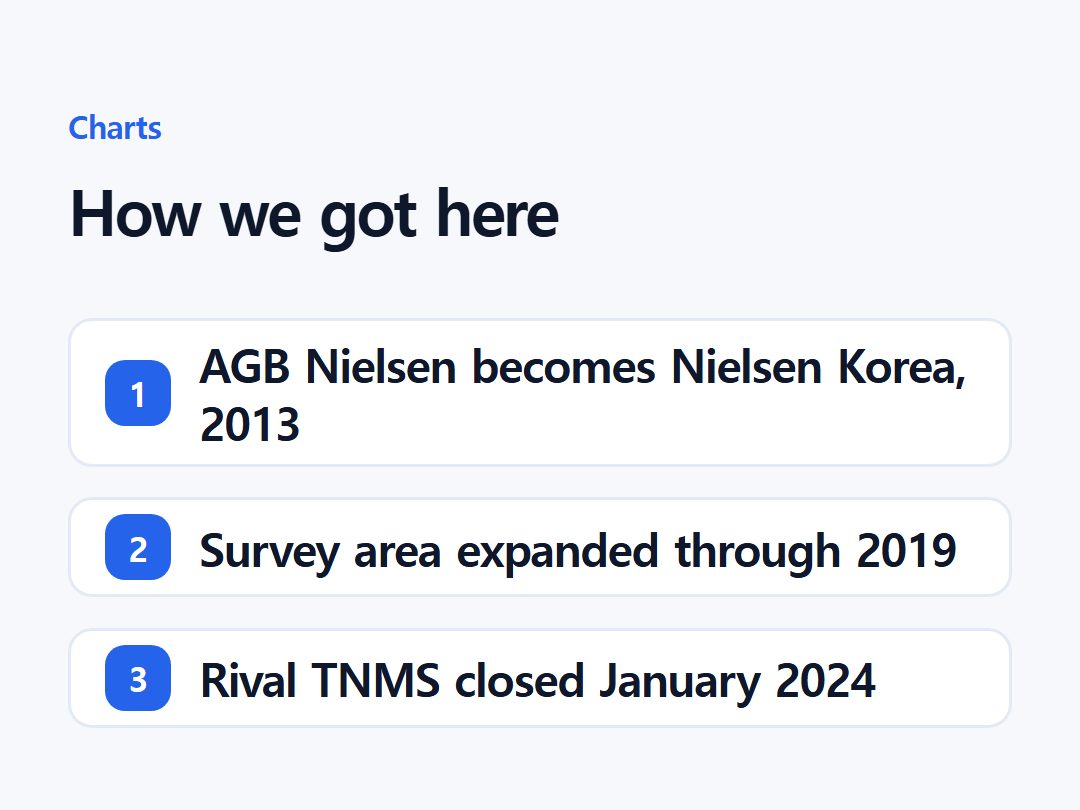
Korea's television ratings industry traces back to AGB Nielsen Media Research, which merged with Nielsen's local operation and rebranded as Nielsen Korea in 2013, according to Nielsen Korea's own corporate history.
Over the following years, the survey's geographic coverage expanded gradually — starting concentrated in Seoul, then adding the five other major metropolitan cities, then mid-size cities, until the panel covered all cable broadcast regions nationwide by 2019.
That expansion is part of why the nationwide/Seoul-metro split still matters: the nationwide figure represents a genuinely larger and more recently built-out sample than the Seoul number, which has existed in something close to its current form for longer.
For nearly two decades, Nielsen Korea operated alongside a rival, TNMS, founded in 1998 by a former Korea Broadcast Advertising Corporation executive.
Having two independent commercial ratings providers was itself unusual — most countries maintain only a single official ratings body — and the two firms' numbers diverging by fractions of a percentage point on ordinary broadcasts, and sometimes producing different top-10 rankings for variety shows, was a recurring point of industry friction, including a defamation lawsuit AGB Nielsen filed against TNMS in 2010 over accusations of manipulated data. TNMS ceased operations on January 1, 2024, leaving Nielsen Korea as the country's sole commercial television ratings provider.
That closure ended one layer of the two-different-numbers problem — the inter-agency gap — but it did not touch the other layer, since Nielsen Korea itself continues to publish separate nationwide and Seoul-metro figures, and separate household and individual figures, for every broadcast.
Netflix ratings measure something completely different
The ratings landscape keeps getting more layered rather than simpler.
Streaming has added a third kind of number to the conversation that is not directly comparable to either of Nielsen Korea's figures: Netflix's public rankings measure total hours viewed divided by runtime, not the percentage of households or individuals watching at a given time, so a drama's Netflix No.
1 ranking and its Nielsen Korea household rating are answering fundamentally different questions, even when both get called a show's ratings in casual conversation, as industry explainers have noted.
There is also a live debate inside Korea's broadcasting industry over whether a household-panel methodology built for the linear-TV era still captures how people actually watch television now that streaming and mobile viewing account for a growing share of audience attention — a criticism that has surfaced in Korean media-industry coverage questioning how much longer broadcast fortunes should be decided by a measurement system largely unchanged for decades.
No regulatory or methodological overhaul has been announced.
For now, the nationwide/Seoul-metro split remains the standard way Korean broadcasters and outlets report a drama's performance, and the practical takeaway for international readers is simple: when a Korean ratings figure appears without a region attached, it is worth checking which one is being quoted before treating it as the definitive number for that episode.
Korea's TV ratings industry timeline
| Year | Event |
|---|---|
| 1998 | TNMS founded by a former Korea Broadcast Advertising Corporation executive |
| 2010 | AGB Nielsen files a defamation lawsuit against TNMS over data-manipulation accusations |
| 2013 | AGB Nielsen merges with Nielsen's local operation and rebrands as Nielsen Korea |
| 2017 | Nielsen Korea begins publishing individual ratings alongside household ratings |
| 2019 | Nielsen Korea's panel expands to cover all cable broadcast regions nationwide |
| 2024 | TNMS ceases operations, leaving Nielsen Korea as the sole ratings provider |
Frequently asked
Why do Korean drama ratings show different numbers in different articles?
Nielsen Korea publishes separate nationwide and Seoul metropolitan area ratings for the same episode, and outlets often cite only one without specifying which.
What is the difference between nationwide and Seoul-metro ratings in Korea?
The nationwide rating is drawn from households across the country, while the Seoul-metro rating covers only Seoul, Incheon, and Gyeonggi Province, the capital region.
Is TNMS still used for Korean TV ratings?
No, TNMS ceased operations on January 1, 2024, leaving Nielsen Korea as South Korea's sole commercial television ratings provider.
Sources
Every factual claim above is traceable. We do not translate articles — we gather facts from multiple outlets and write them ourselves.
- AGB 닐슨 미디어리서치 시청률 순위 (nationwide/Seoul metro toggle) — Nielsen Korea
- 'Bon Appetit, Your Majesty' ends with record ratings, confirming Lim Yoon-a's star power — The Korea Times
- K-drama ratings explained: what the Korean numbers actually measure — Seoul Current
- 한국 일일드라마 시청률표 읽는 법: 닐슨코리아 기준 확인 — TVJIP
- 시청률 (population base and regional survey differences) — Namu Wiki
- TNMS (closure January 1, 2024) — Namu Wiki
- TV 시청률의 비밀..닐슨과 TNMS 0.7%나 벌어지는 이유는? — Edaily
- 닐슨코리아 (merger history and company background) — Wikipedia (Korean)