Watch enough Korean variety television — 예능 (yeneung), the umbrella term for unscripted entertainment shows — and a pattern jumps out. Someone off-camera keeps talking.
A voice interrupts a game to explain a rule, negotiate a penalty, or just heckle a cast member, and the camera sometimes swings around to show the person doing it: the PD, short for producer-director.
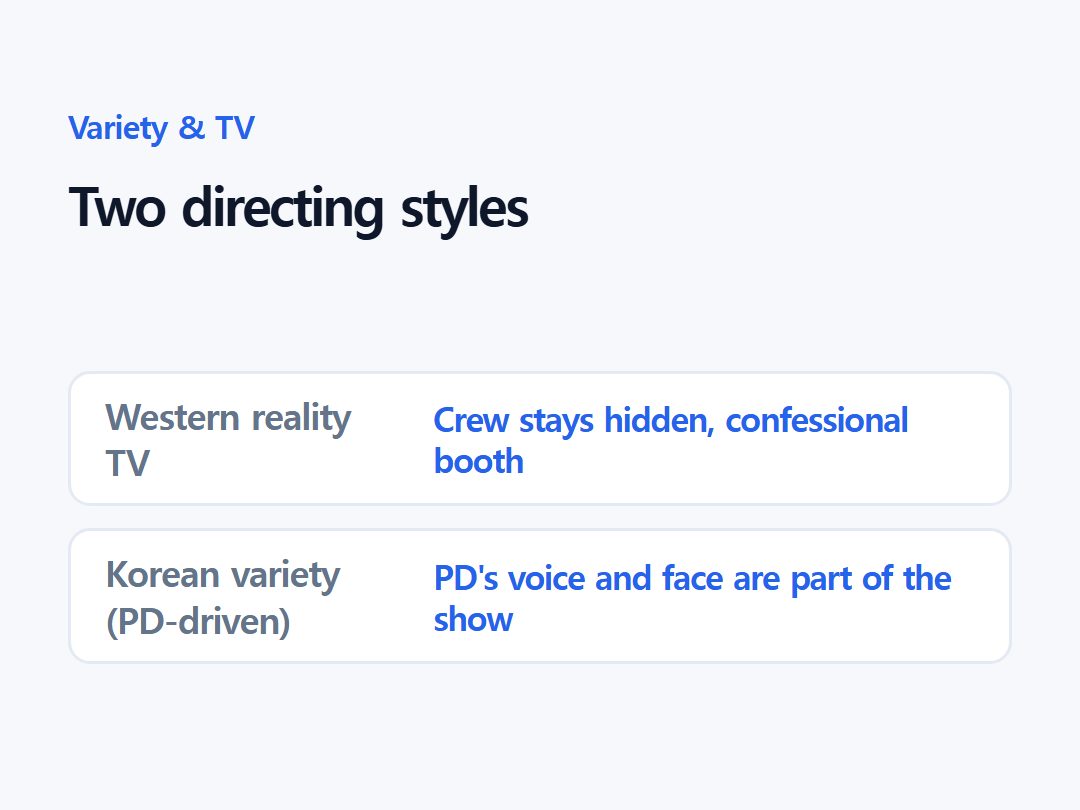
In Western reality TV, the production team stays invisible by convention — heard, if at all, only as a disembodied question in a "confessional" interview. In Korean variety shows, the PD is frequently a visible, audible, named participant in the show itself. This is not a glitch or a budget shortcut.
It is a deliberate, decades-old directing style, and understanding it changes how an international viewer reads almost every Korean variety show.
The short version
- Korean variety PDs often appear on camera, unlike hidden Western reality-TV crews.
- Infinite Challenge (2006) started sarcastic subtitles; 2 Days & 1 Night (2007) added on-camera PDs.
- The Korean PD role combines director, showrunner, and producer into one visible author.
Two different techniques, often mistaken as one
Two things are doing the work here, and they're often confused as one.
The first is on-screen text: Korean variety editors layer in dense captions, reaction graphics, and sound-effect text throughout an episode — a technique producers describe as functioning like "an extra narrator, adding layers of humor or emotion to make sure no one misses the point," as one seven-year variety-industry producer put it to The Korea Herald in February 2025.
The second, and the one this piece is about, is the PD's literal voice and physical presence.
On shows like KBS's 2 Days & 1 Night and its spin-off New Journey to the West, director Na Young-seok — known to viewers simply as "Na PD" — regularly steps into frame to hand out missions, argue with cast members over rules, or get roasted by them, to the point that recap sites and fan wikis describe him as functioning like an unofficial extra cast member rather than someone behind the camera.
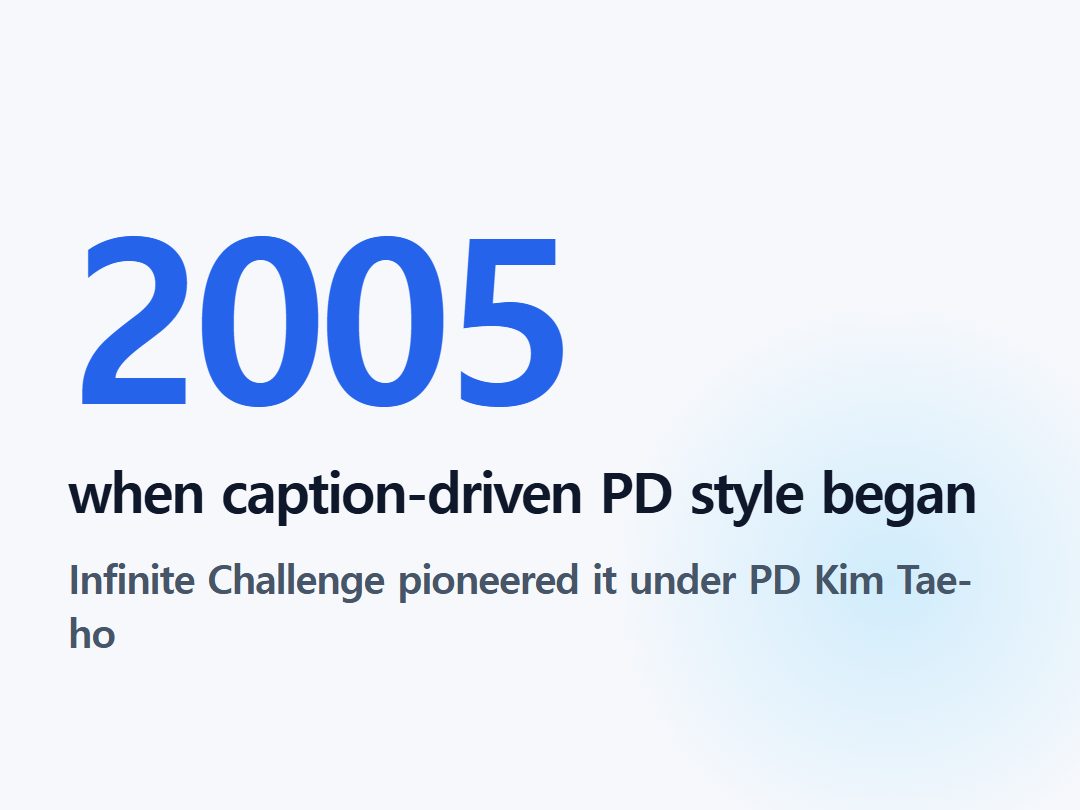
On MBC's long-running Infinite Challenge, director Kim Tae-ho took the opposite physical approach — he mostly stayed off-screen — but pioneered a text-based version of the same idea: sarcastic, personality-driven subtitles that let the production's point of view intrude directly into the frame, a style that was unusual enough in the mid-2000s to be considered an innovation at the time.
Other shows go further still: MBC's Omniscient Interfering View builds its entire format around outside commentary, with a studio panel watching footage supplied by celebrities' managers and interrupting constantly to critique what they see.
Why is the PD visible instead of hidden?
For an international audience raised on the Western reality-TV convention of the invisible crew — no boom mics in shot, no crew voices, producers only heard as a muffled question in a diary-room interview — a PD stepping into frame to bicker with a cast member can look like a production mistake, or like the show's illusion breaking. It isn't. It reflects a different premise about what the audience is being sold.
The PD is not hidden — the PD is an author, and often a character
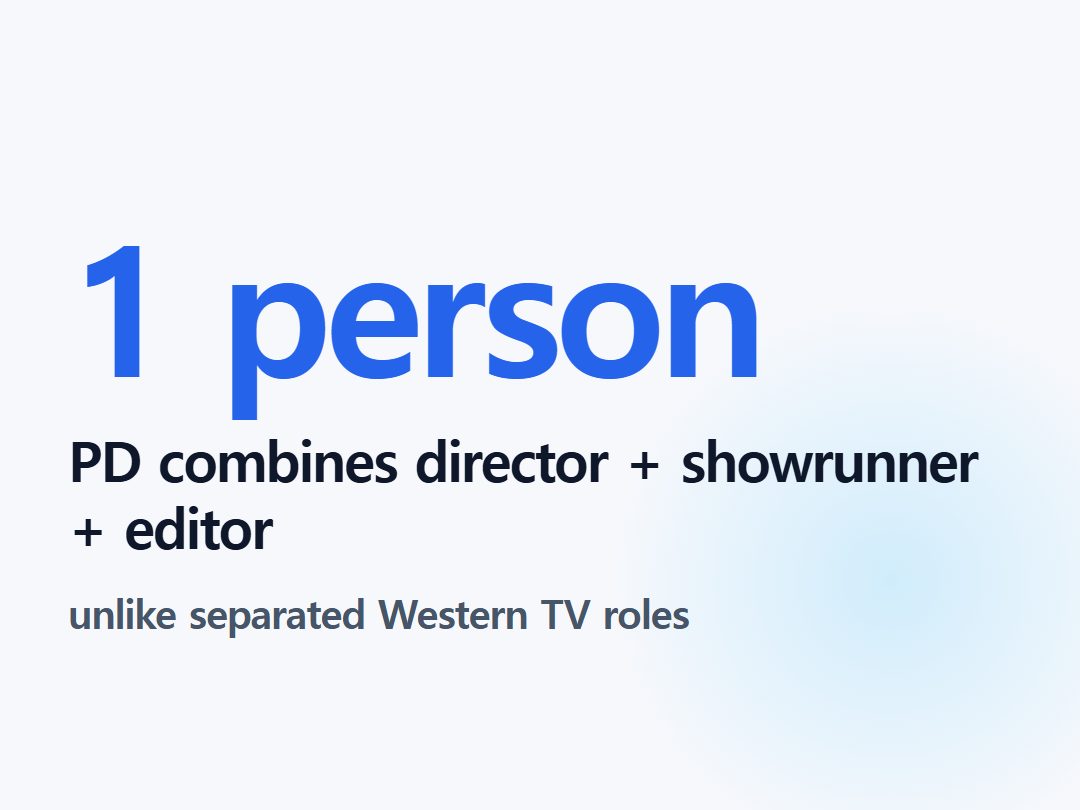
In Korean broadcasting, the term PD covers a role that Western television usually splits across several job titles — director, showrunner, and executive producer combined into one person, who is typically involved in planning the concept, casting, filming, editing, and even the title of a show.
Because so much creative authorship sits with one identifiable person, Korean variety television has developed a genuine "star PD" culture: individual directors like Na Young-seok and Kim Tae-ho became public figures with their own recognizable voice, humor, and reputations, sought out by networks and cast members by name.
Letting that person's voice and presence into the show isn't an accident of production; it is closer to a director signing their own work, and audiences already know whose show they are watching before the opening title even runs.
Subtitles as a second narrator
The caption style reinforces the same idea from a different angle. Rather than simply repeating dialogue for clarity, Korean variety captions actively interpret a scene — flagging a joke, exaggerating a reaction, or supplying a line of commentary the editing team wants the audience to have.
A Korea National Open University professor interviewed by The Korea Herald described this as reflecting a broader preference: Korean productions lean into heavily edited, editorially guided storytelling, in contrast to a Western taste for entertainment that feels organic and left open to the viewer's own interpretation.
The visible PD and the busy caption track are, in that sense, two expressions of the same house style — production commentary is treated as content, not as something to be hidden.
It replaces, rather than imitates, the confessional booth
Western reality formats typically extract cast reactions afterward, in an isolated "diary room" interview, then cut that commentary back into the footage.
Korean productions more often build the commentary into the scene itself in real time — the PD asks the question, sets the penalty, or reacts out loud while the cameras are already rolling on the cast's response, rather than pulling them aside for a separate, stylistically distinct interview later.
The result is a show where the boundary between "the content" and "the people making the content" is treated as much thinner, and often as a source of chemistry and comedy in its own right — the rapport between a cast and their PD becomes something viewers watch for.
How the on-camera PD trend actually started
The heavy-caption style has roots outside Korea: producers have said the technique was originally adapted from Japanese variety television, which also used on-screen text extensively, before Korean shows developed their own version of it through the 2000s.
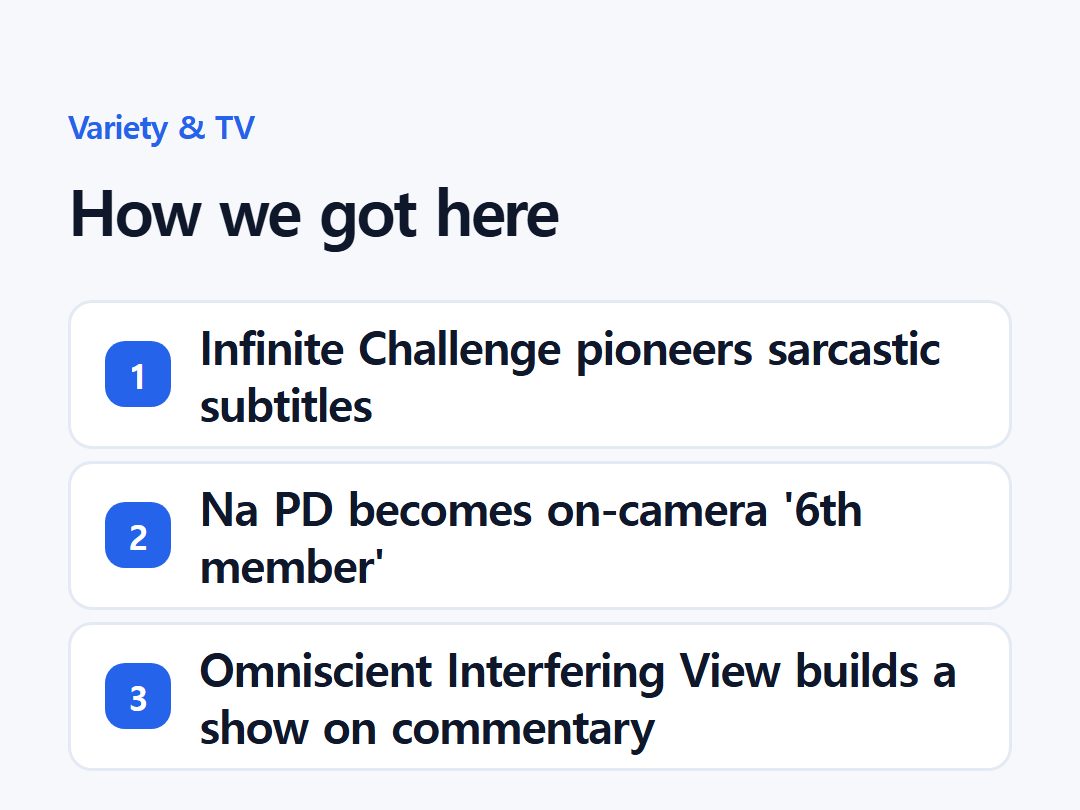
The turning point most often cited for Korean variety specifically is Infinite Challenge, which began as a segment in 2005 and became a standalone MBC show in 2006 under Kim Tae-ho; its cynical, personality-driven subtitles were widely credited as a first for Korean television at the time, and the style has since become close to a default across the genre.
A parallel but distinct shift came from Na Young-seok on KBS's 2 Days & 1 Night, which premiered in 2007: rather than intervening mainly through text, Na PD put himself physically and vocally into the show, negotiating with cast members over challenges and penalties on camera to the point that recap culture began describing him as an unofficial extra member of the cast.
That on-camera PD role became even more central on his later show New Journey to the West, which grew directly out of the earlier cast wanting to recreate the loose, improvised feel of the original show — with Na PD's voice functioning almost as a narrator-participant throughout. By 2018, the format had evolved again with Omniscient Interfering View, which stopped treating outside commentary as an occasional interruption and instead built a whole show around it, using celebrities' own managers as the source of footage and a studio panel to supply the running commentary in place of a single PD's voice.
Is the visible-PD style here to stay?
The convention is not static.
Some of the most-watched recent Korean variety shows, including I Live Alone and Three Meals a Day, deliberately dial back visible production intervention in favor of a quieter, more observational feel, with staff limited mostly to occasional voices or brief appearances rather than the fuller on-camera role Na PD plays elsewhere.
That points to an open question rather than a settled rule: how much visible authorship a Korean variety show uses is itself a stylistic choice a production makes show by show, not a fixed national format.
There is also a long-running domestic debate, dating back at least to criticism of shows like Running Man in the early 2010s, about where planned "rundown" structure and prepared missions end and a scene's spontaneity begins — visible PD involvement makes that question more visible to the audience than it would be if the same planning happened invisibly, off camera.
As Korean formats are increasingly licensed, remade, or produced directly for global streaming audiences, it remains to be seen how much of the visible-PD convention survives translation, or whether international versions default back toward the hidden-crew model most global audiences already expect.
How the visible-PD style developed, show by show
| Year | Show | PD | What changed |
|---|---|---|---|
| 2005–2006 | Infinite Challenge | Kim Tae-ho | Stayed off-screen but pioneered sarcastic, personality-driven subtitles |
| 2007 | 2 Days & 1 Night | Na Young-seok ("Na PD") | Stepped on camera to negotiate rules and penalties with cast |
| Later | New Journey to the West | Na Young-seok | On-camera role deepened into a narrator-participant |
| 2018 | Omniscient Interfering View | Studio panel | Built the whole format around outside commentary, not just one PD |
Frequently asked
Why do PDs appear on camera in Korean variety shows?
The PD role combines director, showrunner, and producer in one person, so letting that person's voice into the show functions like a director signing their own work, and Korean TV has built a 'star PD' culture around figures like Na Young-seok and Kim Tae-ho.
Who is Na PD?
Na PD is director Na Young-seok, known for 2 Days & 1 Night and New Journey to the West, where he steps into frame to hand out missions and argue with the cast over rules, to the point recap sites describe him as an unofficial extra cast member.
What show started the sarcastic subtitle style in Korean variety TV?
Infinite Challenge, which began as a segment in 2005 and became a standalone MBC show in 2006 under Kim Tae-ho, pioneered the sarcastic, personality-driven subtitles now common across the genre.
Sources
Every factual claim above is traceable. We do not translate articles — we gather facts from multiple outlets and write them ourselves.
- Why Korean variety shows are so text-heavy -- and why it works — The Korea Herald
- Kim Tae-ho (PD) — Namuwiki
- Na Young-seok / directing features — Namuwiki
- 2 Days & 1 Night — Wikipedia
- New Journey to the West — Wikipedia
- Infinite Challenge — Wikipedia
- Omniscient Interfering View — Wikipedia
- How Scripting is Ruining Running Man — Seoulbeats