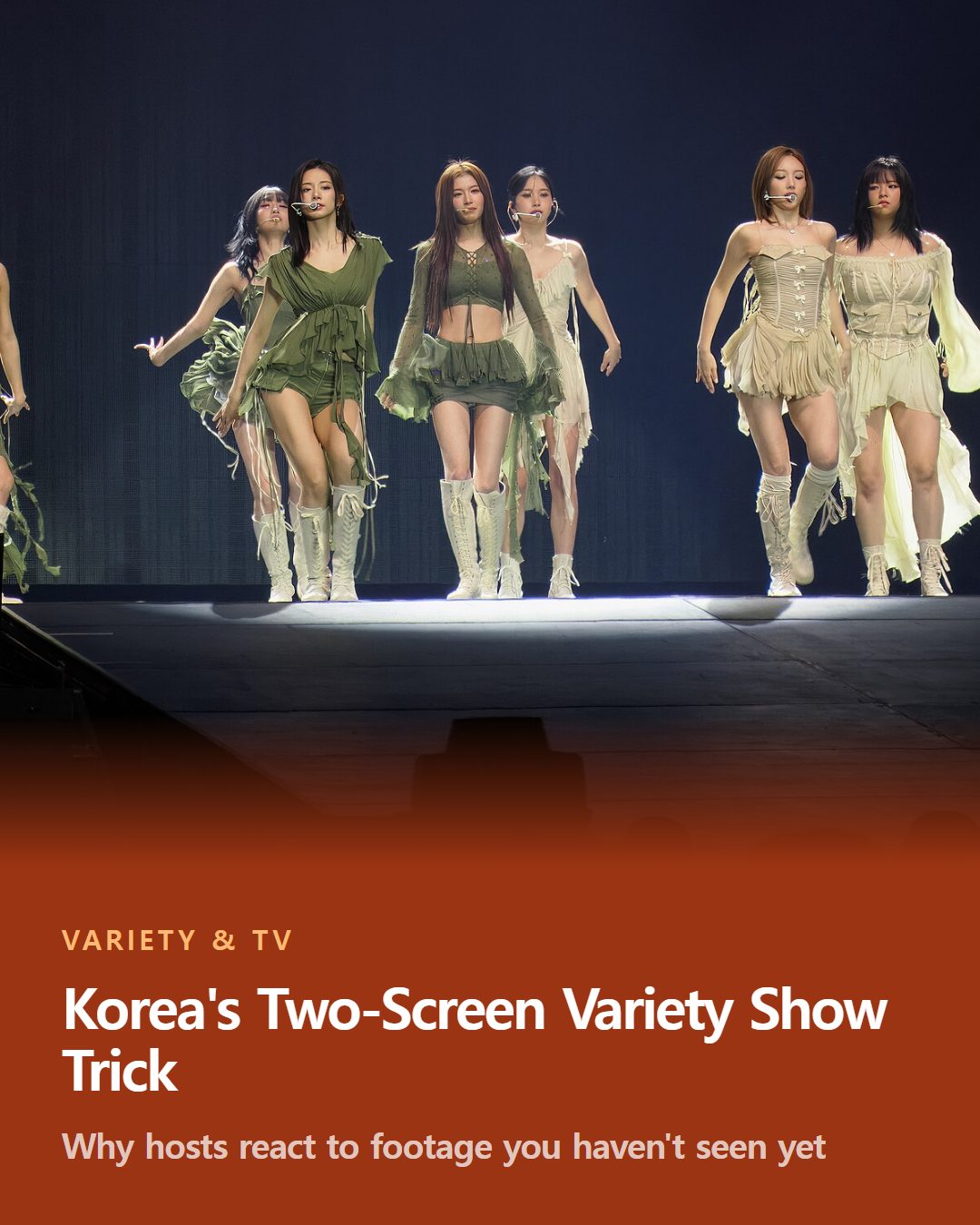
Turn on almost any long-running Korean variety show — MBC's I Live Alone, Omniscient Interfering View, or SBS's parenting show The Return of Superman — and the format repeats itself. A panel of hosts sits in a studio. A large screen plays footage that was filmed days, sometimes weeks, earlier.
The hosts watch it for what is presented as the first time, laughing, gasping, and cracking jokes as it plays, and their commentary is cut back into the same episode. Only once the taped segment ends does the studio conversation catch up to what the home audience just watched.
The short version
- Korean variety shows air taped footage, then film hosts reacting to it later.
- This 'VCR' format lets producers cast anyone, not just skilled on-camera talkers.
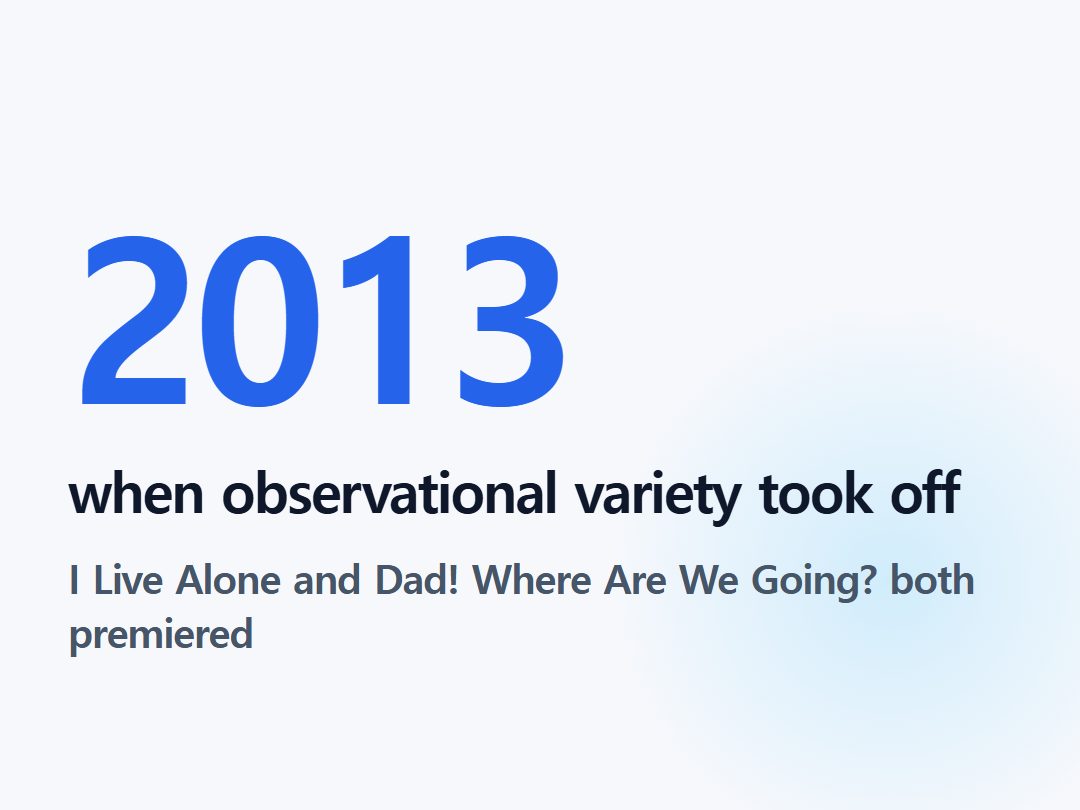
- I Live Alone and Dad! Where Are We Going? popularized it in 2013.
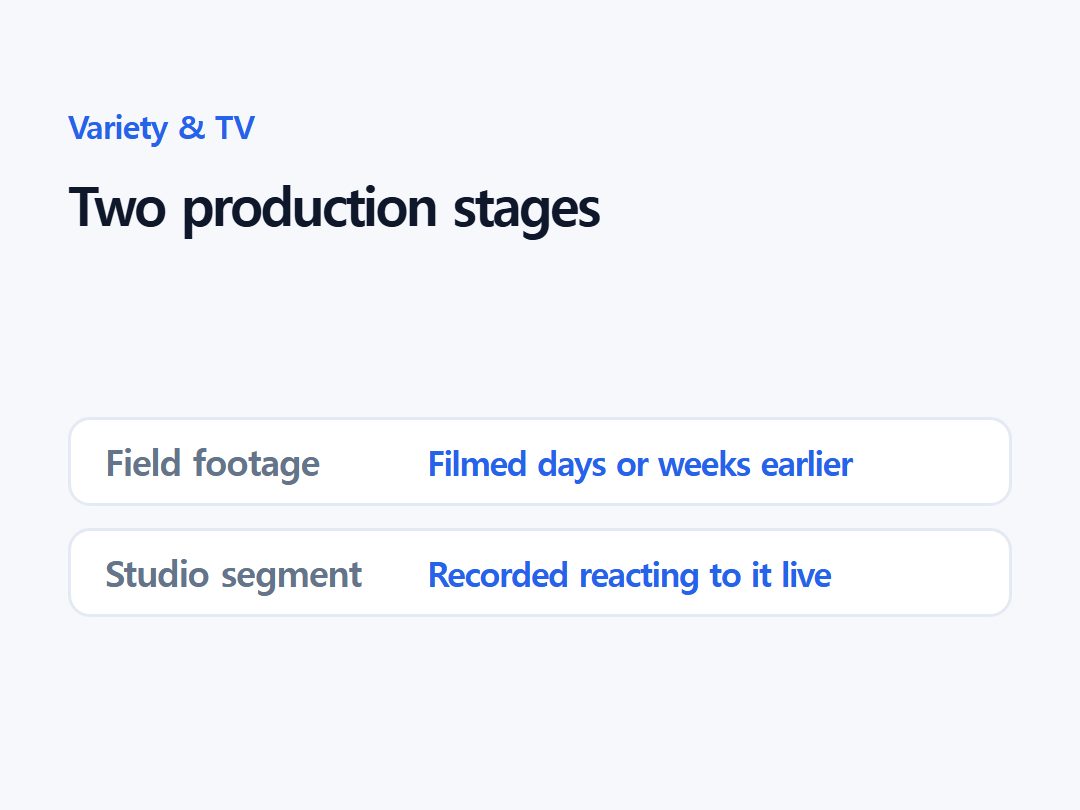
In Korean broadcasting, that pre-shot package has a name: a VCR, industry shorthand borrowed from "video cassette recorder" for any prepared video segment played mid-show. What looks like one continuous program is really two productions stitched together — field footage recorded first, and a studio reaction recorded second.
Two productions, one broadcast
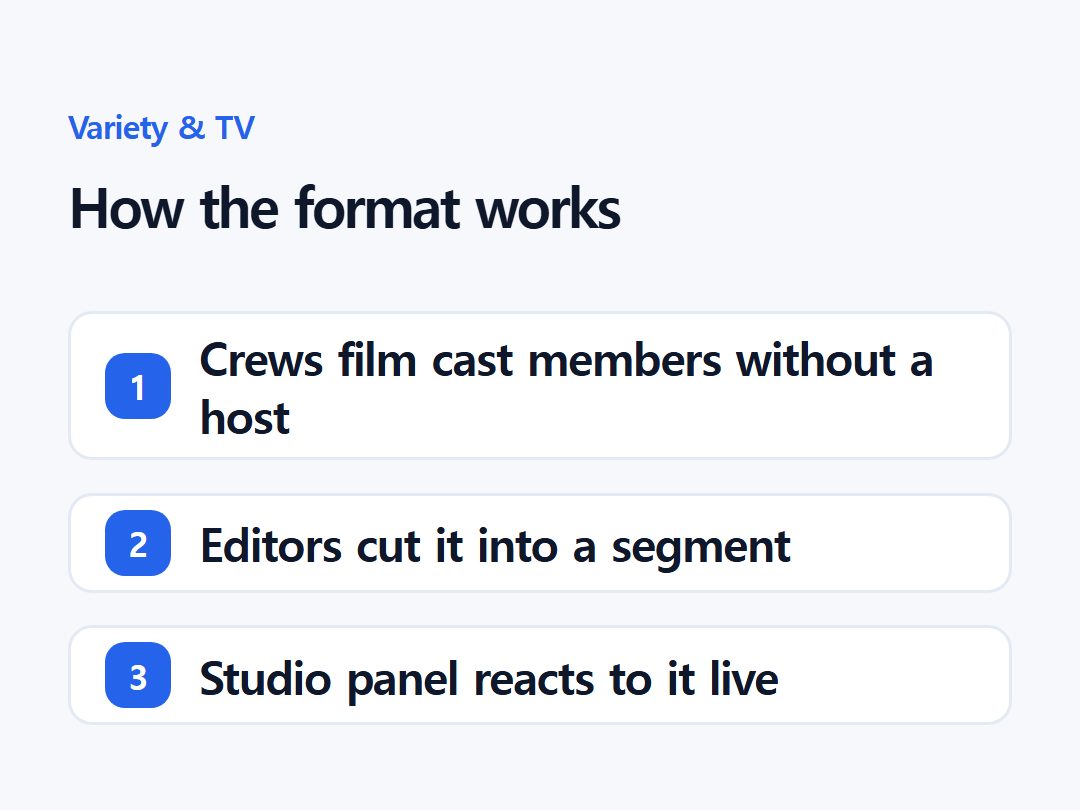
The workflow behind this is fairly consistent across shows. A separate crew films a cast member going about an ordinary day — cooking, running errands, meeting friends — often with multiple fixed cameras and no interviewer prompting them, closer to a documentary shoot than a talk-show taping.
Producers and writers edit that raw footage into a segment built around a few strong moments.
Only then is it screened for the studio cast, who watch it together with a live audience and react in the moment, with their reactions layered underneath thick on-screen captions, sound effects, and freeze-frames during post-production.
Omniscient Interfering View, which has aired on MBC since 2018, pushes the structure furthest: much of its footage is sourced from cast members' own managers, and a fixed studio panel — including a behavioral psychologist as a recurring guest — watches and analyzes it on air. I Live Alone, MBC's observational show about celebrities living alone since 2013, uses the same two-stage build every week: a day in a cast member's life, then a studio segment where regular panelists react to and discuss it.
Why do hosts react to footage instead of live?
To a viewer used to Western reality TV or late-night talk shows, this can look like an odd, roundabout way to make television — why not just let the cast react live, on camera, as things happen? The answer is that separating filming from reacting solves several problems at once, and understanding why explains a habit that runs through most of Korean variety programming, not just one show.
First, it lets producers cast almost anyone. Because the field footage doesn't require its subject to perform comedy or banter for a camera crew, a show can feature an athlete, a webtoon artist, a chef, or a first-time guest with no on-camera experience — people who could never carry a live studio segment on wit alone.
The entertainment value gets added afterward, by professional hosts reacting to the footage, so the subject of the footage only has to live their life normally in front of a camera.
Second, the reactions are, within the limits of a produced TV show, closer to genuine than a scripted bit would be. The panel is seeing the footage for close to the first time, alongside the studio audience, so surprise, laughter, or a wince land as unrehearsed.
Korean variety production leans on a "writer-centered system" in which staff writers design a show's flow, game rules, and pacing — even so-called unscripted formats are shaped by a director and writing team — but the reaction segment is one of the few moments where genuine, unplanned response is the actual product being filmed.
Third, the format functions as a kind of communal viewing experience built into the broadcast itself.
Korean variety shows are known for extremely dense on-screen captions — text that doesn't just repeat dialogue but reacts, jokes, and editorializes on behalf of the audience, according to reporting by The Korea Herald on the genre's caption-heavy editing style.
A studio panel watching and reacting to footage serves a similar function at a larger scale: it gives viewers at home a stand-in audience whose laughter and shock cue how a moment is meant to land, creating what one analysis described as a synchronized, shared emotional experience between the show and its viewers, rather than leaving the audience to interpret events alone.
That cushioning effect matters most in shows with emotional weight.
On parenting programs where a child psychologist reviews footage of a struggling family, or on shows that touch on a cast member's private difficulties, the studio panel's job is partly to soften a moment that raw footage alone might make too heavy — joking gently, offering sympathy, or redirecting the tone before it airs.
The two-stage structure gives producers a second pass at managing tone that a single continuous shoot would not allow.
From 2005's missions to 2013's observational shift
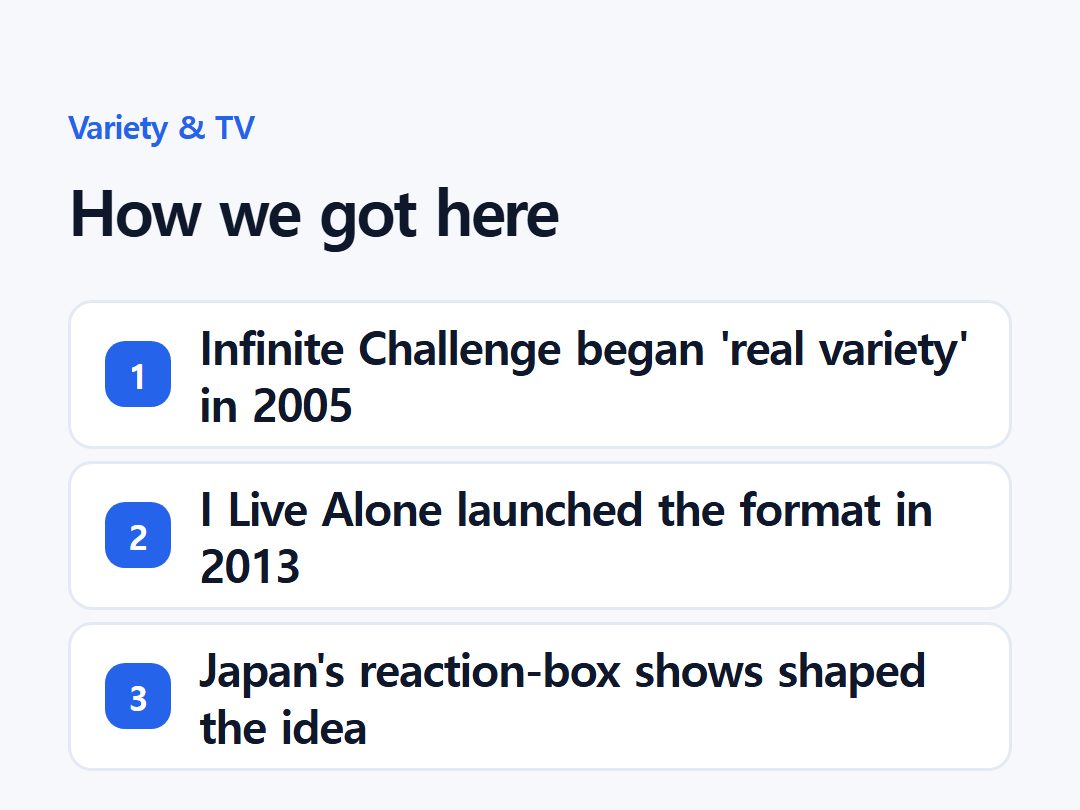
Korean variety television dates back to the 1960s, but the format familiar to international viewers today traces more directly to a shift in the mid-2000s. Infinite Challenge, which premiered on MBC in 2005, is widely credited with establishing "real variety" (리얼 버라이어티) — a hybrid genre positioned between scripted comedy sketches and pure documentary, built around outdoor missions and challenges rather than a fixed studio set.
It influenced a wave of shows, including Running Man and 2 Days & 1 Night, that followed a similar loosely structured, unscripted-feeling model.
The specific VCR-plus-studio-reaction structure became dominant a few years later, during what Korean industry commentary calls the rise of "observational variety" (관찰 예능). Two shows that premiered within months of each other in early 2013 — Dad!
Where Are We Going? and I Live Alone, both on MBC — moved the genre away from staged missions and toward filming cast members' ordinary lives, then bringing that footage into a studio for commentary.
Both were ratings hits, and the format they popularized became, over the following decade, one of the default templates for Korean variety production, extending into parenting shows, dating shows, and workplace-observation formats.
The underlying idea of a studio audience reacting to a screen also has an older regional lineage.
Japanese television developed a related device decades earlier: the "waipu," a small inset box in the corner of the screen showing a celebrity's face reacting to footage playing on the main screen, a format that traces back to a 1981 Fuji Television program and has been compared to a laugh track for American sitcoms.
Korean variety took a related instinct — showing an audience its own reaction as part of the entertainment — and expanded it from a small corner box into a full studio segment with its own dedicated camera time, its own jokes, and its own place in the episode's runtime.
Are the studio reactions staged or genuine?
The format is not without periodic scrutiny.
Because the studio reaction is recorded separately from the field footage, questions occasionally surface about how much of what looks spontaneous is genuinely unplanned versus loosely engineered by producers to hit certain beats — a tension that flared in 2010 when viewers spotted a timeline inconsistency in an episode of Running Man, which producer Jo Hyo-jin later acknowledged involved footage captured out of the order it appeared to show.
Moments like that are rare, but they underline that "observational" is a production style, not a guarantee of unfiltered reality.
The structure is also spreading beyond broadcast television. Streaming services, including Netflix's Korean-produced dating shows, have adopted versions of the same two-stage build — pre-recorded footage of participants, watched and analyzed afterward by an in-studio panel of observers.
As more of these shows reach international audiences who are unfamiliar with the convention, the two-stage structure that Korean viewers take for granted may keep catching first-time viewers off guard, at least until it becomes as recognizable abroad as the single-camera sitcom or the confessional-booth reality format already are.
How a VCR segment gets made
| Stage | What happens |
|---|---|
| 1. Field shoot | A separate crew films the cast member's ordinary day with fixed cameras and no interviewer |
| 2. Edit | Producers and writers cut the raw footage into a segment built around a few strong moments |
| 3. Studio screening | The studio cast watches it with a live audience and reacts in the moment |
| 4. Post-production | Reactions are layered in under captions, sound effects, and freeze-frames |
Frequently asked
What does VCR mean on Korean variety shows?
It's industry shorthand for a pre-recorded video segment, usually footage of a cast member's ordinary day, that gets played in the studio for hosts to react to as if seeing it for the first time.
Why do Korean variety show hosts react to footage instead of talking live?
Separating filming from reacting lets producers cast people with no on-camera comedy skills, keeps the panel's reactions closer to genuine surprise, and gives producers a second chance to soften emotionally heavy moments before airing.
Which shows started the VCR-and-studio-reaction format?
I Live Alone and Dad! Where Are We Going?, both launched on MBC in early 2013, popularized the two-stage structure that later became a default template across Korean variety TV.
Sources
Every factual claim above is traceable. We do not translate articles — we gather facts from multiple outlets and write them ourselves.
- I Live Alone (TV program) — Wikipedia
- Omniscient Interfering View — Wikipedia
- Dad! Where Are We Going? — Wikipedia
- Korean variety show — Wikipedia
- Why Korean variety shows are so text-heavy -- and why it works — The Korea Herald
- Boxed Geinōjin: Those annoying TV "Waipu" — The Japan Times (Alice Gordenker column)
- What Are Korean Variety Shows? A Guide to Finding Your Next Good Watch — Vice