
Turn on almost any Korean variety show — a loosely scripted, half-improvised comedy program built around games, missions and celebrity guests — and the stakes rarely involve money. On Running Man, losing a mission can mean a name tag ripped off your back and a face-first plunge into freezing water.
On Weekly Idol, losing a dance-off usually means a forehead flick from a groupmate. On 2 Days 1 Night, losing a round of rock-paper-scissors has meant sleeping outdoors in winter. Winners, by contrast, typically get nothing more tangible than bragging rights and the next segment's head start.
The short version
- Losers get punishments; winners get bragging rights, not cash, on Korean variety shows.
- South Korean broadcast rules discourage cash prizes that resemble gambling incentives.
- Netflix's Physical: 100 broke tradition, paying real winners 300 million won.
This is not incidental. It is the default design of the genre, and it has held for more than two decades, from X-Man in 2003 through Infinite Challenge in the mid-2000s to Running Man today.
For international viewers used to game shows built around cash jackpots, the near-total absence of prize money — and the presence of physical or humiliation-based penalties instead — can look strange, even unnecessarily harsh.
The reasons behind it sit at the intersection of Korean broadcast regulation, television economics, and a specific cultural line around what counts as real embarrassment versus performed embarrassment.
Why don't Korean shows just pay cash?
A regulation most viewers never see
South Korean broadcasters are not free to hand out escalating cash prizes however they like.
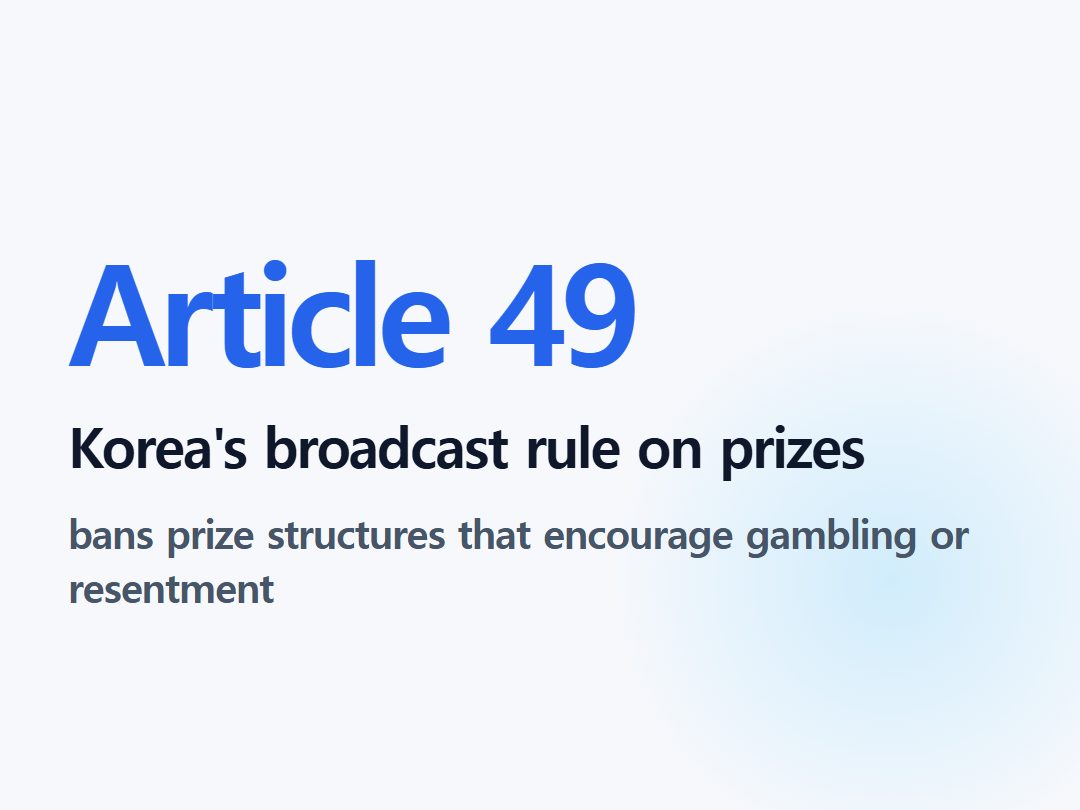
The Korea Communications Standards Commission's Broadcasting Review Regulations state, under the article governing prizes and awards, that a broadcast \"must not encourage gambling-like tendencies or feelings of relative deprivation\" through the scale or method of prizes given to performers, studio audiences or viewers, and that programs introducing prizes must not turn them into advertising for the prize itself.
The rule was written with quiz shows and call-in contests in mind, but it shapes the whole industry's instincts: a format built around growing cash rewards risks regulatory review, while a format built around jokes, dares and mild physical penalties does not.
Producers did not need an outright ban on prize money to avoid leaning on it — punishment simply carried none of the same legal or reputational risk that a large payout did.
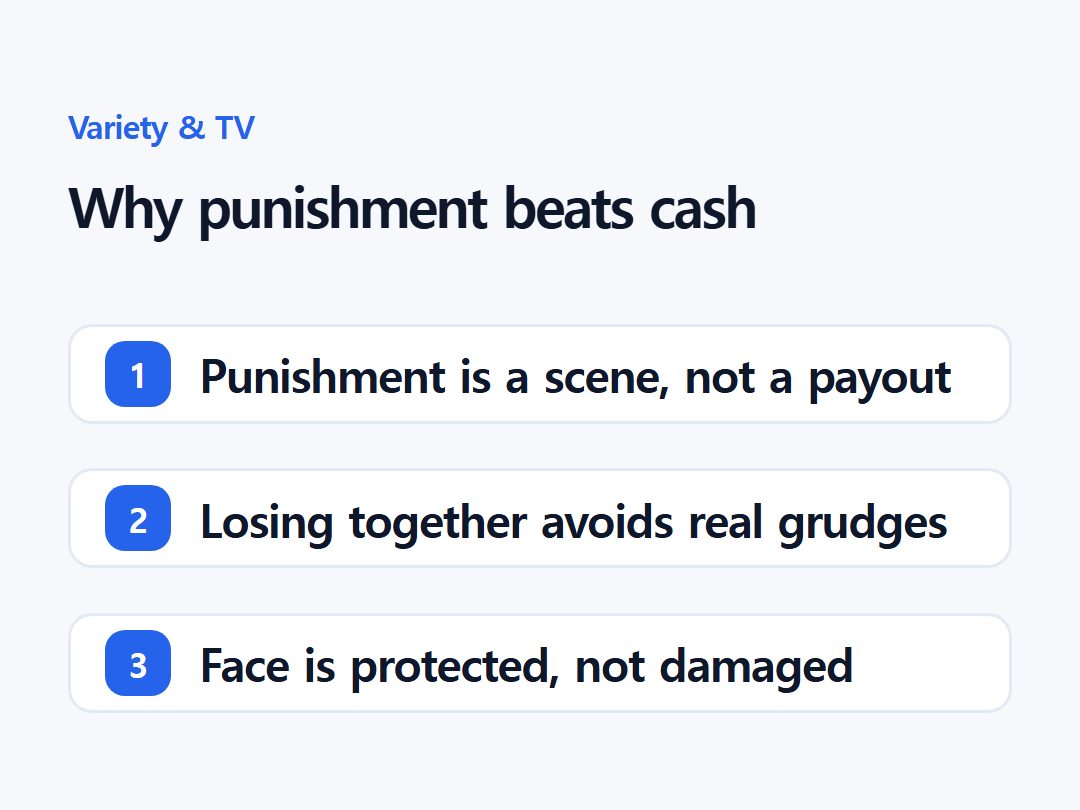
Punishment is content; a prize check is not
There is also a straightforward production logic. A cash prize is something a winner receives, usually off camera, and it does not generate an image.
A punishment — cold noodles smeared on a face, a forfeit that requires singing an old trot song in a wig, a dunk into an ice bath — is a scene, with a build-up, a reaction shot and a punchline.
In a television economy that increasingly survives on short clips re-uploaded to YouTube and social media, a twenty-second punishment moment is far more shareable than a transfer of money.
Producers openly design games around what the losing side will have to do, not around what the winning side will receive, because the losing moment is what gets watched, replayed and subtitled by fan channels overseas.
It is also why hosts and guests play these games with real effort rather than going through the motions: the fear of on-camera embarrassment is a stronger motivator, second by second, than a prize that pays out later and privately.
Losing together, not losing alone
Because most punishments are collective — an entire losing team eats the spiciest dish, or the whole cast watches one member get flicked — they function less like real consequences and more like shared performance.
Cast members on long-running ensemble shows are often required, contractually and creatively, to keep appearing together for years, so producers need a stakes system that does not create real winners and losers with real grudges.
A forehead flick from a fellow K-pop idol group member, or a shouting match in a Mafia-style deduction game, doubles as proof of how comfortable the cast already is with one another.
Korean television routinely marks the distinction with language: a comedic penalty is a beolchik (벌칙), while an actual disciplinary consequence is a cheobeol (처벌) — a different word entirely.
Viewers are cued, before the segment even starts, to read what follows as affectionate teasing between people who trust each other, not as genuine humiliation.
A controlled loss of face
That framing matters in a culture where public standing and dignity — chemyeon (체면), often translated as \"face\" — carry real social weight. A punishment segment that actually damaged someone's chemyeon would backfire with audiences rather than entertain them.
So producers work inside tight limits: the person being punished is nearly always in on the joke, the penalty is contained to a single scene, and it is undone by the next segment.
The format lets a celebrity look silly in a way that reads as \"good sport\" rather than \"loser,\" which is a safer kind of public exposure than actually losing money or status on camera in front of millions of viewers.
How X-Man and Infinite Challenge started the format
The format has an identifiable lineage.
SBS's X-Man, which ran from 2003 to 2007, was one of the first major hit shows built around forfeits and hidden-identity deduction games rather than a cash jackpot, and it helped launch the careers of hosts including Yoo Jae-suk and Kim Jong-kook, who would go on to define the genre for the next two decades.
MBC's Infinite Challenge, which began in 2005 and is widely credited as Korea's first \"real-variety\" show, formalized the punishment segment in mid-2006, when cast members who arrived late to filming or lost recurring games — such as the word-reversal segment \"Ah-Ha\" — were physically penalized on camera as part of the format itself, not as an afterthought to a competition.
That show's mix of unscripted mishaps and slapstick forfeits became the direct template for SBS's Running Man, which premiered in July 2010 and turned the losing team's punishment — cold water, flour, forced physical stunts, the now-signature name-tag-ripping finale — into the show's closing centerpiece.
KBS's long-running 2 Days 1 Night applied the same logic to an outdoor travel format, while idol-focused programs such as Weekly Idol borrowed it at a smaller, weekly scale, turning the forehead flick into a recurring gag across nearly every episode.
Many of the specific penalty games — flicking, forfeits decided by the traditional paper-tile game ddakji — draw on playground and drinking-game traditions that predate television entirely, which is part of why they read as familiar, low-stakes fun to Korean audiences rather than as an imported game-show mechanic.
By the 2010s, punishment-over-prize had become the default assumption for the entire genre, not a quirk of any single program.
Will streaming money end Korea's punishment format?
The model is not universal, and its limits are becoming more visible as Korean shows move onto global streaming platforms with international-scale budgets.
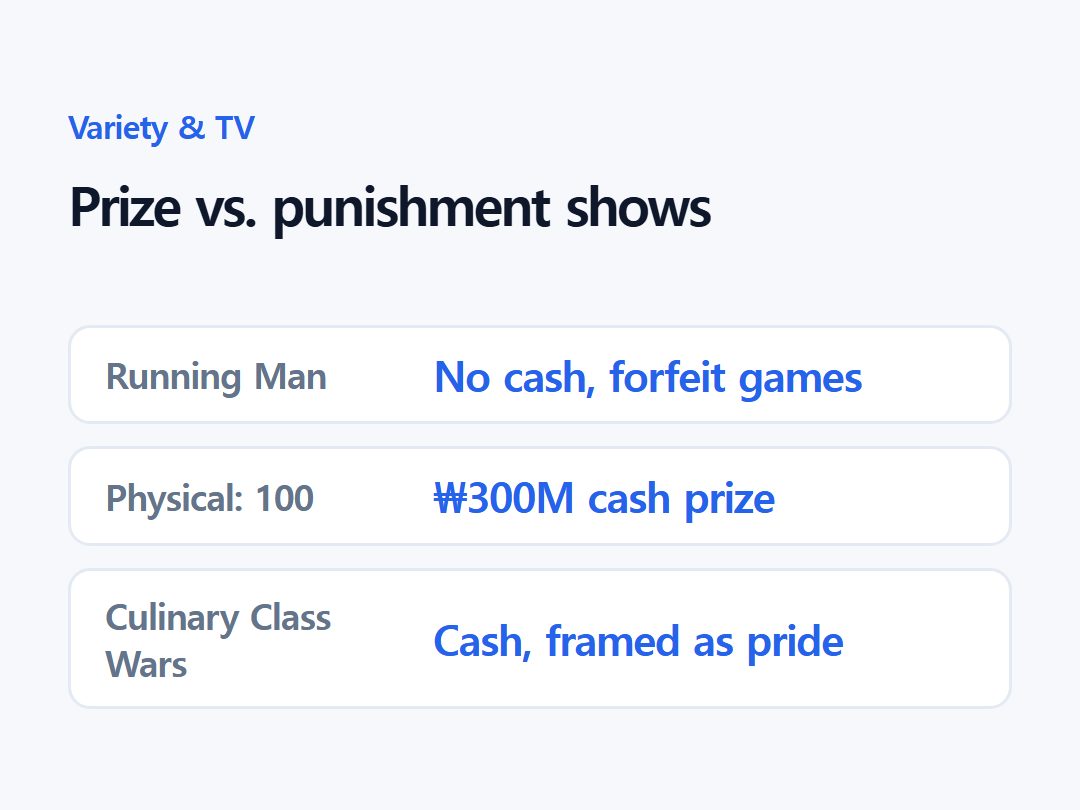
Netflix's Physical: 100 (2023) paid its overall winner a 300 million won cash prize — roughly $230,000 at the time — and its 2024 sequel kept the same figure. Culinary Class Wars, also on Netflix, put up 300 million won in prize money but built its narrative explicitly around chefs competing for professional recognition rather than the payout, with the production framing the contest as one for \"pride, not cash\" even as a real check was on the table.
Whether Korean variety television keeps its punishment-first tradition as streaming budgets enter the picture, or gradually drifts toward the cash-prize model more familiar to Western audiences, is still unresolved — and it will likely be decided less by cultural preference than by which format performs better with a global audience that is watching Korean shows outside the domestic broadcast rules that shaped them in the first place.

Punishment-based broadcast shows vs. Netflix's cash-prize format
| Show | Platform | Year | Prize model |
|---|---|---|---|
| Running Man / Infinite Challenge / X-Man | Broadcast TV (SBS/MBC) | 2003–present | No cash prize; losers get a punishment (beolchik) |
| Physical: 100 | Netflix | 2023 | 300 million won (~$230,000) cash prize |
| Physical: 100 (season 2) | Netflix | 2024 | Same 300 million won prize |
| Culinary Class Wars | Netflix | 2024 | 300 million won prize, framed as "pride, not cash" |
Frequently asked
Why don't Korean variety shows give cash prizes?
South Korean broadcast regulations discourage large cash prizes that could look like gambling, so producers use physical or humiliation-based punishments (beolchik, 벌칙) for losers instead.
What is a beolchik in Korean variety shows?
A beolchik (벌칙) is a comedic, on-camera penalty for losing a game, like a forehead flick or an ice-water dunk, as opposed to a cheobeol (처벌), which is a real disciplinary consequence.
Do any Korean shows pay cash prizes?
Yes — Netflix's Physical: 100 paid its 2023 and 2024 winners 300 million won (roughly $230,000), and Culinary Class Wars offered the same prize amount.
Sources
Every factual claim above is traceable. We do not translate articles — we gather facts from multiple outlets and write them ourselves.
- Korean variety show — Wikipedia
- Running Man (TV program) — Wikipedia
- Infinite Challenge — Wikipedia
- X-Man (game show) — Wikipedia
- Ddakji — Wikipedia
- Culinary Class Wars — Wikipedia
- 방송심의에 관한 규정 (Broadcasting Review Regulations) — Korea Communications Standards Commission / National Law Information Center
- 'Culinary Class Wars': Behind-The-Scenes Details On The Netflix Show — Forbes
- Who is Woo Jin-yong? Meet the Physical 100 winner as he takes home 300 million KRW cash prize — Sportskeeda
- From Spectator to Player: Brain Teasers in Variety Television — Morning Calm (Korean Air)
- Don't Panic at the Penalty: 3 Variety Show Words to Survive Korean Games — Daily Hangul