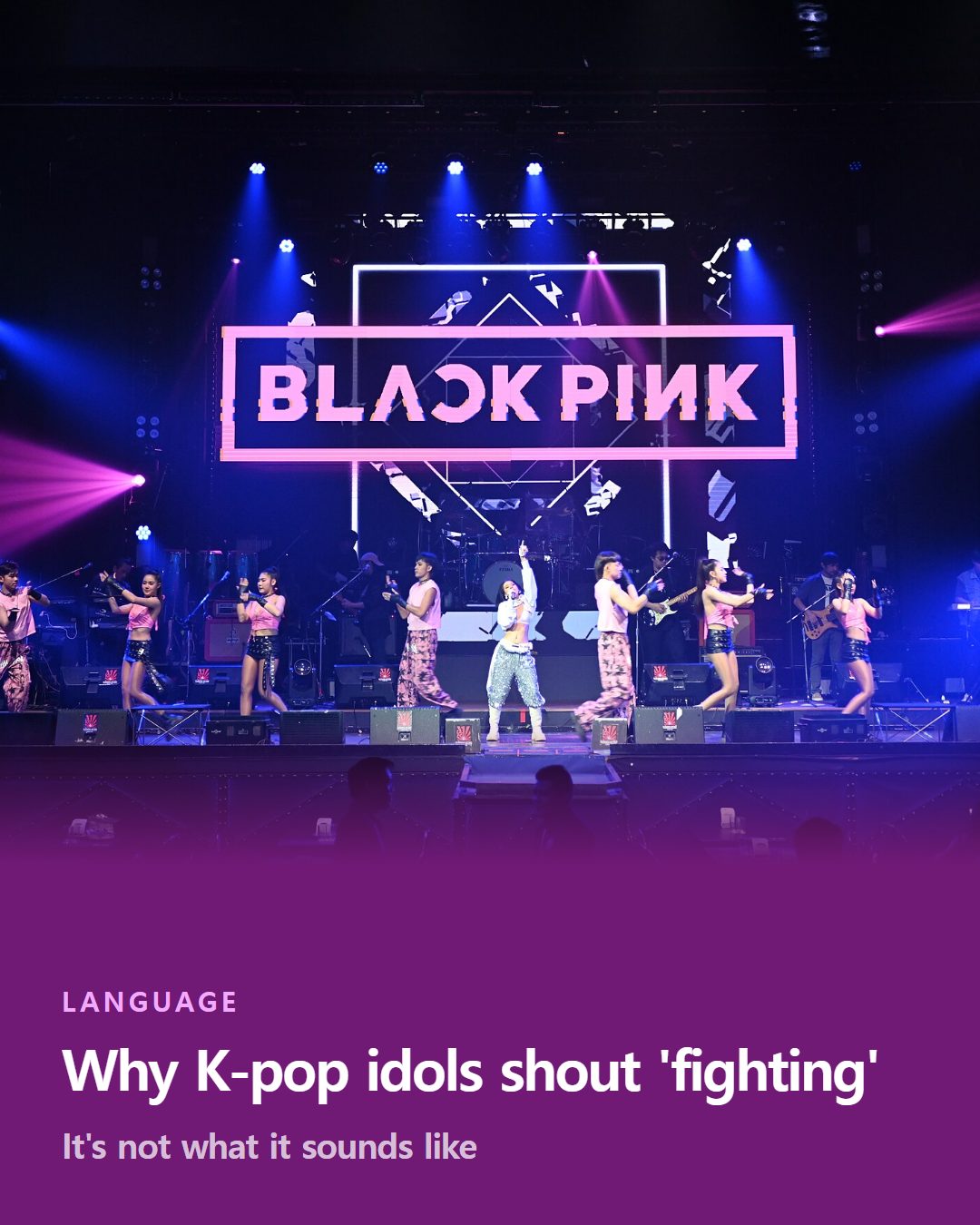
K-pop idols huddle before almost every stage. On a count, they shout one word together: fighting.
The short version
- "Fighting!" isn't a threat — it means "you've got this" in Korean.
- Korean has no /f/ sound, so the word became 화이팅 or 파이팅.
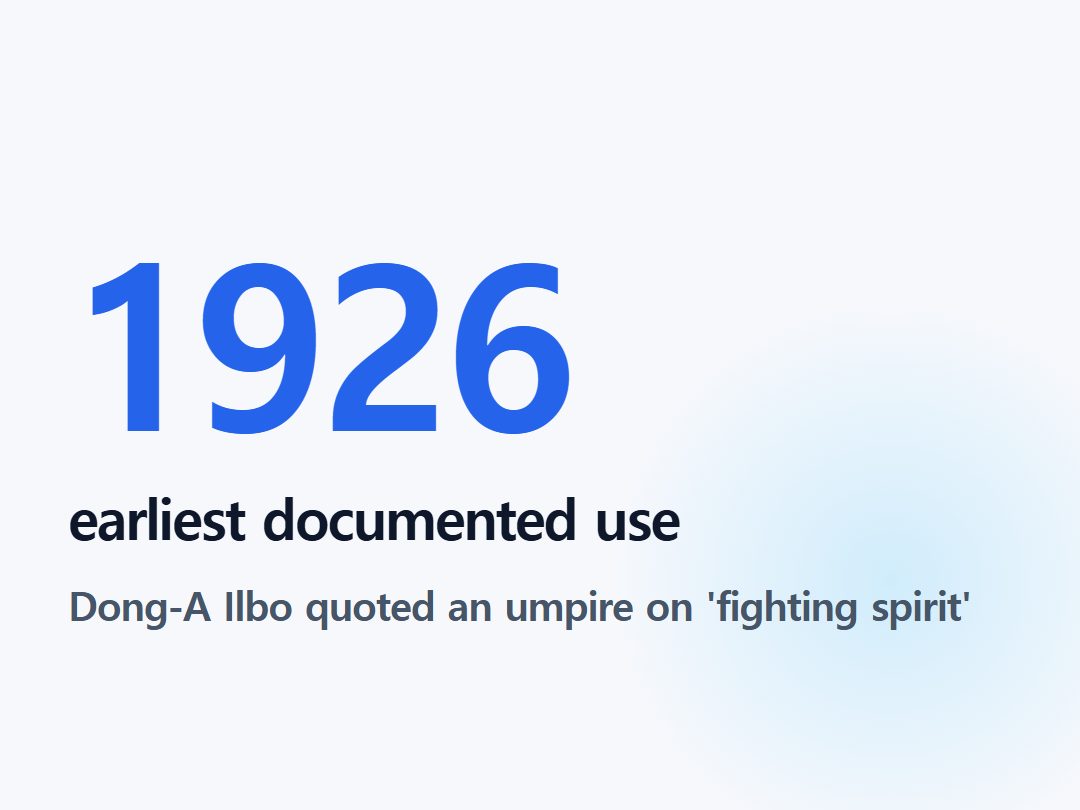
- A 1926 newspaper already used "fighting spirit," decades before the 2002 World Cup boom.
To an English speaker, that sounds like a threat. In Korean it means the opposite — something closer to "you've got this." The gap between what the word says and what it means is the whole story.
A ritual before every stage, not just a fan chant
Watch enough K-pop content and the pattern repeats: members circle up backstage, someone counts to three, and the group shouts "fighting!" before walking out. Fans return the favor, chanting a member's name followed by the word from the crowd.
The word isn't limited to music. Koreans use it constantly outside entertainment too.
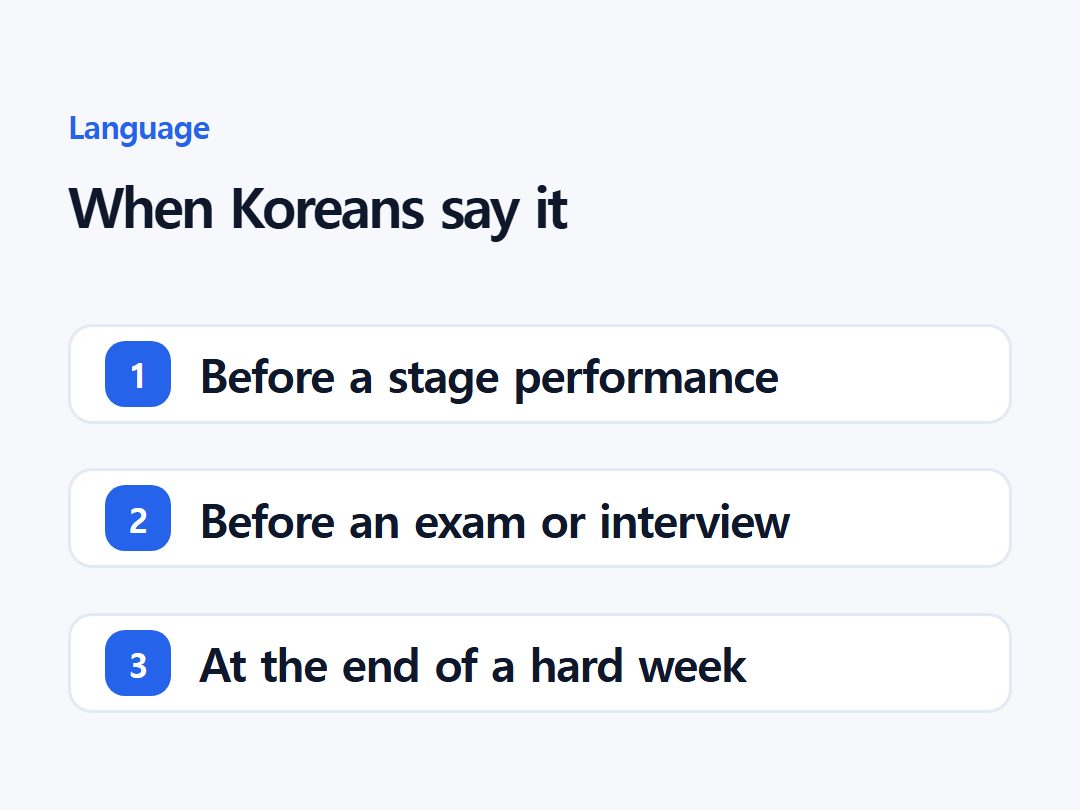
- Before a stage performance, as a group huddle chant
- Before a job interview or exam, as a send-off
- At the end of a hard week, in place of "good luck"
It functions as a stand-in for "good luck," "keep going," and "you can do it" all at once — a single word doing the work of several English phrases.
The word travels with idols off stage too. It shows up scrawled on hand-made fan banners, printed on lightsticks, and typed into fancam comment sections — always aimed the same way, pushing someone forward rather than describing a fight they're in.
Korean has no "f" sound, which explains the odd spelling
The word is borrowed from English "fighting," but Korean doesn't have an /f/ phoneme, so the sound gets replaced with either /h/ or /p/. That produces two competing spellings: 화이팅 (hwaiting) and 파이팅 (paiting).
Language authorities favor 파이팅 (paiting) as the closer match to English pronunciation, and it's the only form listed in the Standard Korean Language Dictionary. Everyday speech ignores that ruling — "hwaiting" is what most Koreans actually say out loud.
The Japanese-loanword theory most Koreans grew up believing
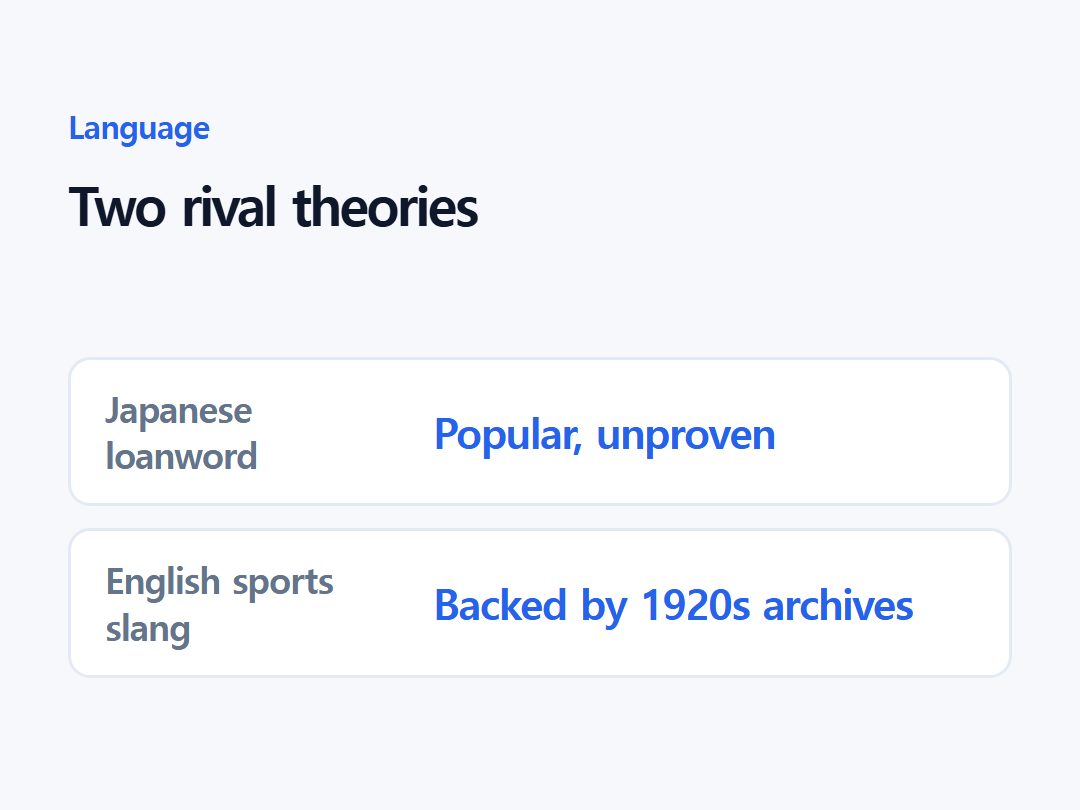
For decades, the standard explanation was that the word traveled from Japanese. Japanese had already borrowed English "fight" as ファイト (faito), and the theory holds that Korean picked up the term — and its unusual pronunciation — through Japanese, likely during or after Japan's 1910–1945 colonial rule of Korea.
The theory gets circumstantial support from a pattern: Korean historically used ㅎ (the "h" sound) to approximate English /f/ in other borrowed words too, such as "fine" (화인), "fantasy" (환타지), and the convenience-store chain Family Mart (훼미리마트). Japanese does something similar with its own "h"-based sounds. But similarity isn't proof, and the two languages could have landed on the same workaround independently.
That's the weak point of the Japanese theory: it explains the sound, but a shared sound doesn't prove a shared route. Two languages missing the same phoneme will often improvise the same fix without ever borrowing from one another.
Newspaper archives push the origin back to 1926
Digging into digitized newspaper archives, Korean-language researcher and blogger known online as "Ask a Korean" found an earlier, English-first paper trail than the Japanese theory suggests. A Dong-A Ilbo article from September 5, 1926 quoted a baseball umpire complaining that certain teams lacked "fighting spirit" — written out in Korean script as 파이팅 스피리트.
Through the early twentieth century, Korean sportswriters kept reaching for that same English phrase to describe a team's drive or competitive energy. That points to a direct route from English sports journalism into Korean, with no Japanese detour required.
The word loses its second half by the 1960s
The two-word phrase didn't stay intact. A September 1962 Kyunghyang Shinmun article about a soccer match used "fighting" alone, already stripped of "spirit," to describe the intensity of play. By the early 1960s, Koreans were also using the shortened word as a standalone cheer.
That timeline matters: it predates the word's biggest modern boost by four decades. Whatever pushed "fighting" into mainstream slang, it was already circulating as sports shorthand well before anyone chanted it at a World Cup match.
A phone company's World Cup slogan sealed it for good
South Korea's run to the semifinals at the 2002 World Cup, which it co-hosted with Japan, gave the word a national stage it never had before. Mobile carrier KTF ran an ad campaign built around the slogan "Korea Team Fighting!" — a line that doubled as free advertising for the company's own initials.
The campaign rode the country's biggest sporting moment in a generation, plastered across a sea of matching red T-shirts in the streets. "Fighting" went from a familiar sports phrase to a word every Korean, regardless of age, associated with collective cheering.
The government tried to replace it with 'aja' — and lost
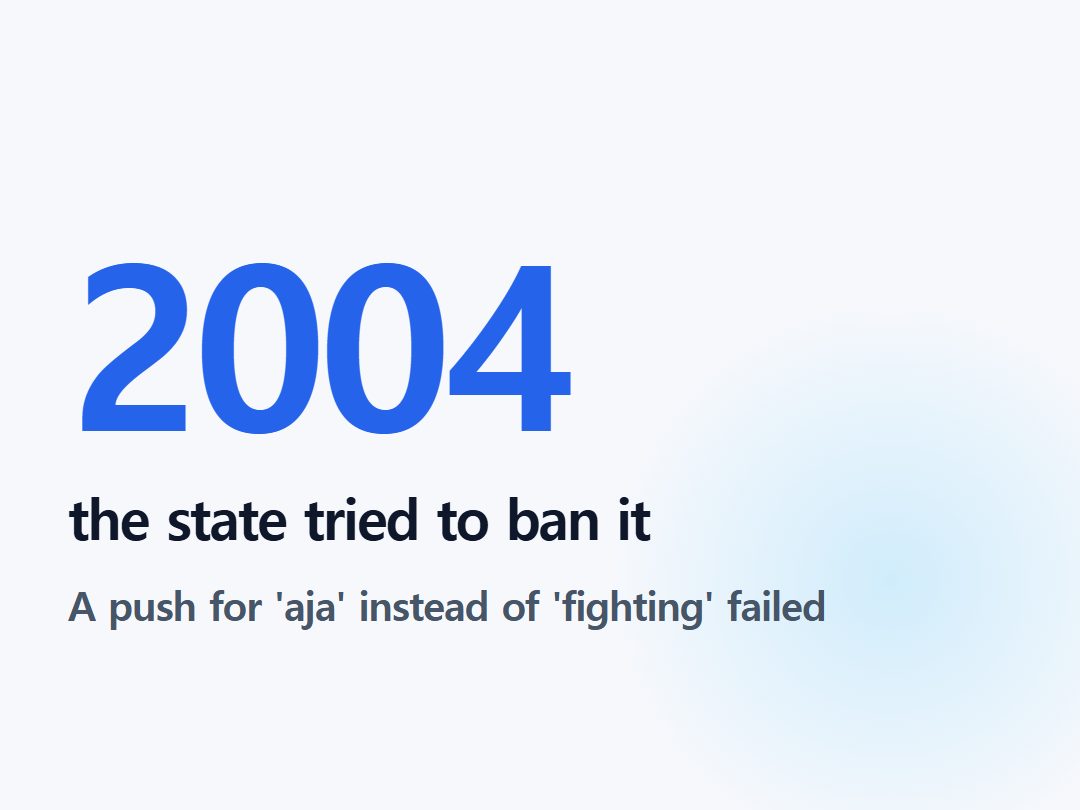
Not everyone welcomed the word's staying power. In 2004, the National Institute of Korean Language — the state body that oversees standard usage — campaigned to replace "fighting" with a native alternative, "아자" (aja), arguing a made-up English borrowing didn't belong in formal Korean.
The push went nowhere. Two decades later, "fighting" remains one of the most common words in casual Korean speech, while "aja" survives mostly as a companion chant said alongside it — "아자 아자, 화이팅!" — rather than as its replacement.
What idols mean by it, versus what the English word implies
None of this history depends on the theories agreeing, because the modern meaning is settled regardless of origin. When an idol shouts "fighting!" into a fancam microphone or writes it on a handwritten sign, it carries no trace of physical conflict.
Linguists describe this kind of shift as translanguaging — a borrowed word takes on a new function once it crosses into another language, detached from its original sense. English "fighting" describes an ongoing struggle with an uncertain outcome. Korean "fighting" is unconditional encouragement, closer to a cheer than a description.
Why the word still trips up English-speaking fans
International fans encountering the word for the first time often assume idols are announcing an actual fight, or using it sarcastically. English-language K-pop guides and language blogs field this exact question often enough that it's become a recurring genre of explainer post.
The confusion runs one direction only, and that's the source of the trouble. Because "fighting" reads as plain English, it doesn't carry the same signal as an obviously foreign word like daebak or maknae — nothing marks it as needing translation, so English speakers try to parse it as English and land on the wrong meaning.
Fan-run glossary posts and K-pop explainer sites now treat the question as a recurring beginner topic, answered again for each new wave of fans discovering the genre. The word rarely gets defined once and forgotten — it gets rediscovered constantly.
Which origin story is actually true remains unresolved
No academic body has definitively ruled on how "fighting" entered Korean. Three explanations still circulate, and the evidence doesn't fully rule any of them out.
- Direct borrowing from English sports journalism, via the phrase "fighting spirit"
- A loanword route through Japanese, following Japan's own "fight" pronunciation
- A Korean War-era account of American soldiers goading feuding local merchants
The archival record favors the English-journalism route, since it's backed by dated newspaper citations the other theories lack. What's confirmed either way is the spread: sports usage by the 1920s–60s, a standalone cheer by the 1960s, and full mainstream saturation after the 2002 World Cup — the deeper origin is likely to stay a matter of competing theories rather than settled fact.
Timeline: how 'fighting' entered Korean
| Year | Event |
|---|---|
| 1926 | Dong-A Ilbo quotes a baseball umpire using "fighting spirit" (파이팅 스피리트) |
| 1962 | Kyunghyang Shinmun drops "spirit," uses standalone "fighting" for a soccer match |
| 2002 | KTF's World Cup slogan "Korea Team Fighting!" pushes the word into the mainstream |
| 2004 | National Institute of Korean Language tries to replace it with "아자" (aja) — fails |
Frequently asked
What does 'fighting' mean in Korean?
It's an all-purpose cheer of encouragement, standing in for "good luck," "keep going," and "you can do it" — it carries no sense of physical conflict.
Why do Koreans spell it 'hwaiting' instead of 'fighting'?
Korean has no /f/ sound, so the borrowed word comes out as 화이팅 (hwaiting) or 파이팅 (paiting); paiting is the official dictionary form, but hwaiting is what most people actually say.
Did 'fighting' come from Japanese?
It's unresolved — the long-standing theory says it passed through Japanese "faito," but a 1926 Dong-A Ilbo article using "fighting spirit" points to a possible direct borrowing from English sports journalism instead.
Sources
Every factual claim above is traceable. We do not translate articles — we gather facts from multiple outlets and write them ourselves.
- Them Fighting Koreans — Ask a Korean!
- Why South Koreans Say 'Hwaiting!' — NextShark
- fighting, int. meanings, etymology and more — Oxford English Dictionary
- 파이팅 (paiting) — Wiktionary
- Why Do Koreans Say Fighting? What It Means In Hangul? EXPLAINED — My Korean Addiction