Watch enough Korean dramas or variety shows and a pattern emerges: a diner calls a middle-aged restaurant worker "imo" (이모, literally "maternal aunt"), a passer-by hails an older man as "ajeossi," and two people who met five minutes ago are already calling each other "oppa" and "eonni," or "older brother" and "older sister." None of these people are related.
In Korean, that is completely ordinary — and understanding why says more about how the language actually works than any single subtitle can.
The short version
- Korean has no all-purpose word for 'you,' so kinship terms fill the gap.
- 55.9% of women report being called 'ajumma' unprofessionally, versus 12.4% of men.
- Oppa entered the Oxford English Dictionary in 2021 as slang for an attractive Korean man.
Why doesn't Korean have a word for 'you'?
Korean does not have a comfortable, all-purpose word for "you" that an adult can use freely with a stranger or a social superior.
Addressing someone directly by name is also restricted in most situations — it is generally reserved for people younger than you or clearly beneath you in status, a pattern rooted in a Confucian-influenced social order in which, as one linguistic analysis of the practice puts it, age and hierarchy shape who is allowed to speak to whom, and how.
That leaves a practical gap: what do you actually call the server bringing your food, or the man blocking the escalator, without sounding either too formal or too rude?
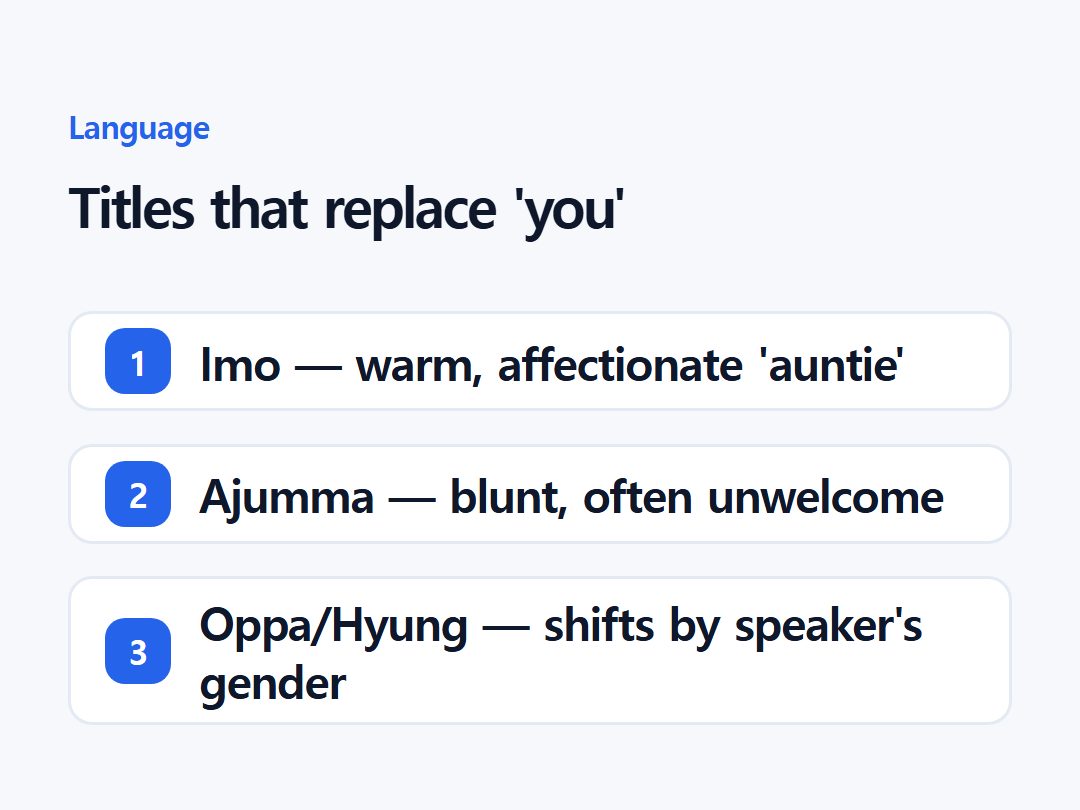
Korean fills that gap with kinship terms repurposed as address terms — a pattern linguists call fictive kinship. Instead of reaching for a pronoun, speakers reach for a family label that roughly fits the other person's age and how close the speaker feels to them:
- 이모 (imo) — literally "maternal aunt," used warmly for older women in casual restaurants, market stalls, and cafés.
- 아줌마 (ajumma) and 아저씨 (ajeossi) — more generic, distant terms for a middle-aged woman or man; unlike imo, they carry no real family meaning at all.
- 할머니 (halmeoni) and 할아버지 (harabeoji) — "grandmother" and "grandfather," used for the elderly.
- 오빠/형 (oppa/hyung) and 언니/누나 (eonni/noona) — "older brother" and "older sister," used between people close in age. Which word applies depends on the speaker's own gender: a woman calls an older man oppa, while a man calls that same older man hyung.
These are not nicknames. They function as the second-person pronoun Korean never fully developed — a substitute for "you" that simultaneously signals the other person's approximate age, their gender, and how close the speaker considers the relationship to be.
Why the wrong term can offend, not charm
This is the detail that trips up international viewers most often: kinship terms in Korean are not a quirky translation choice. They are doing real social work, and getting them wrong — or misreading them — means misreading entire scenes.
First, they establish warmth on contact.
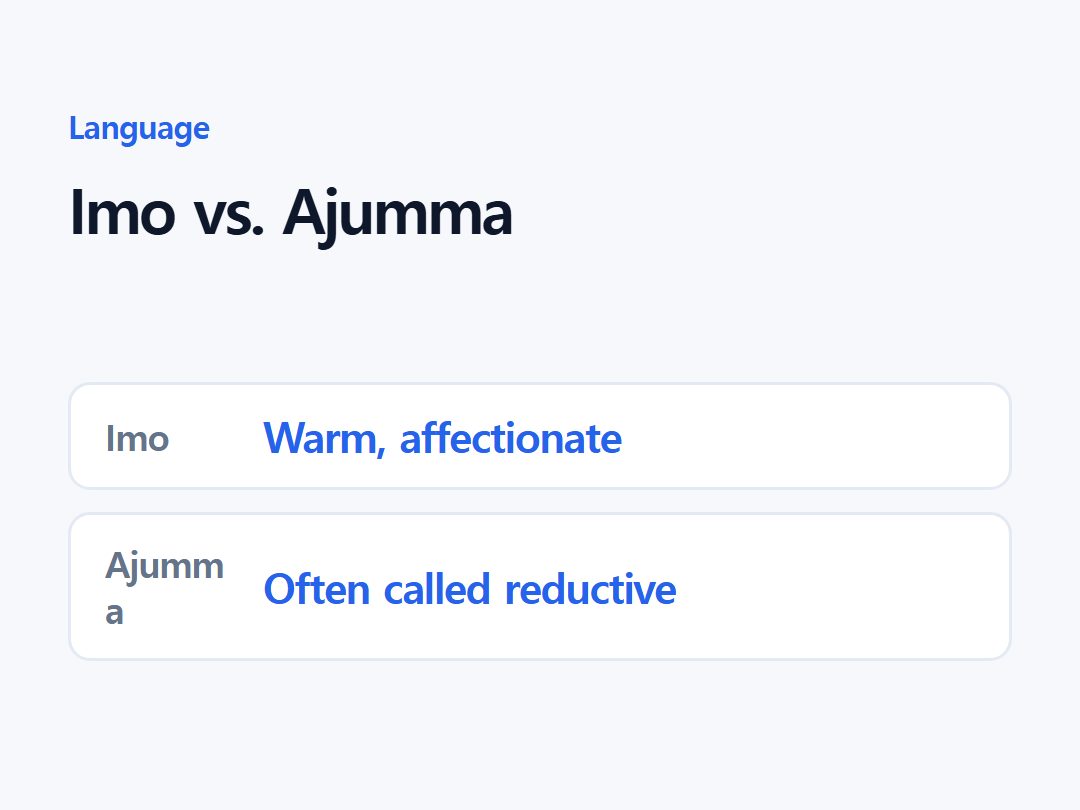
Calling a stranger imo instead of a colder, more generic term frames the interaction as something closer to family, inviting the kind of informal goodwill Koreans often describe as jeong — an emotional closeness built through small, repeated gestures rather than declared outright.
A customer who greets a restaurant worker as imo is signaling that this is a relationship, not just a transaction, even though the two have likely never met before.
Second, the same mechanism cuts the other way. Because these terms simultaneously mark age, gender, and assumed intimacy, the wrong one — or one imposed on someone against their wishes — can feel reductive rather than warm. Ajumma is the clearest case.
It technically just describes a married, middle-aged woman, but it has accumulated stereotypes over time — permed hair, loud behavior, pushiness on public transit — to the point that many women reject the label outright, regardless of whether it technically applies to them.
Korea University linguist Shin Ji-young has described an address term as "essentially a verbal confession of how I perceive the other person," which is exactly why the choice carries weight far beyond simple politeness.
A September 2023 workplace survey found that 55.9% of women reported being called "ajumma" or "agassi" — a term for a young, unmarried woman that has separately picked up unwanted connotations — in ways they considered unprofessional, compared with 12.4% of men who reported comparable treatment.
Third, the same word can shift meaning depending on who says it and to whom.
Oppa — literally "older brother," for a woman to use toward an older man — is also how Korean women address boyfriends, which is why the word entered the Oxford English Dictionary in 2021, defined there as "an attractive South Korean man, especially a famous or popular actor or singer." The identical term can be a mark of respect toward a senior colleague, an endearment toward a partner, or — as North Korean leader Kim Jong-un reportedly decided when he moved to ban the word — foreign-coded slang unwelcome in official use.
For an international viewer, the practical takeaway is that choosing a term of address in Korean is a live social calculation every time someone speaks to a stranger: not an afterthought, but a running judgment about age, status, gender, and closeness, made in real time and audible in a single word.
How did 'ajumma' turn into an insult?
Kinship-based address has deep roots in Korea's Confucian-influenced social hierarchy, in which relative age and status shape how people are permitted to speak to one another. Over recent decades, though, the specific vocabulary has shifted.
Formal titles such as a full name plus the honorific suffix -ssi, once treated as a safe, neutral default, have gradually lost ground to pseudo-kinship terms — oppa for a boyfriend, imo for a babysitter or restaurant worker — spreading kinship logic into corners of daily life that have nothing to do with actual family.
Ajumma's trajectory shows how these terms can curdle over time.
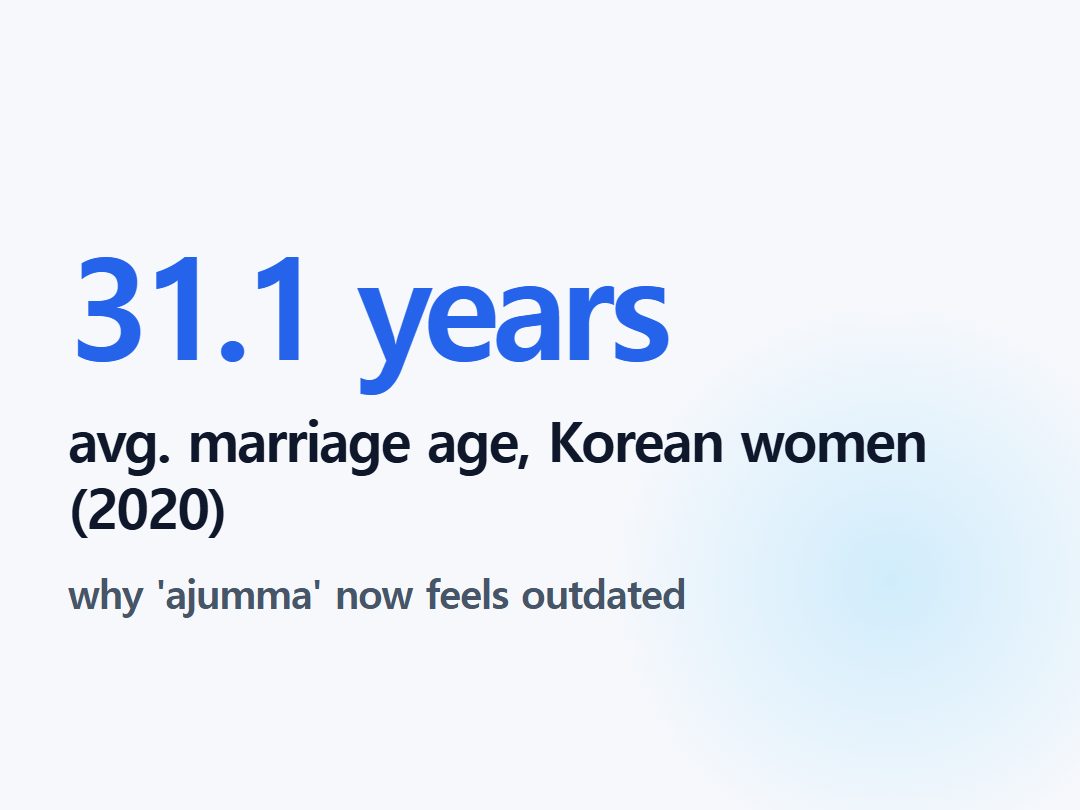
Until the 1990s, the word mapped reasonably well onto reality: Korean women commonly married in their mid-twenties, so "ajumma" simply meant "a married woman of a certain age." That mapping has broken down as the country's marriage age has climbed; Statistics Korea data cited by the Korea Herald put the average marriage age for Korean women at 31.1 by 2020.
A term built around a 1990s life stage now lands, more often than not, on women a decade or more younger than the stereotype it evokes — a large part of why it increasingly reads as an insult rather than a neutral description.
That shift has had concrete consequences.
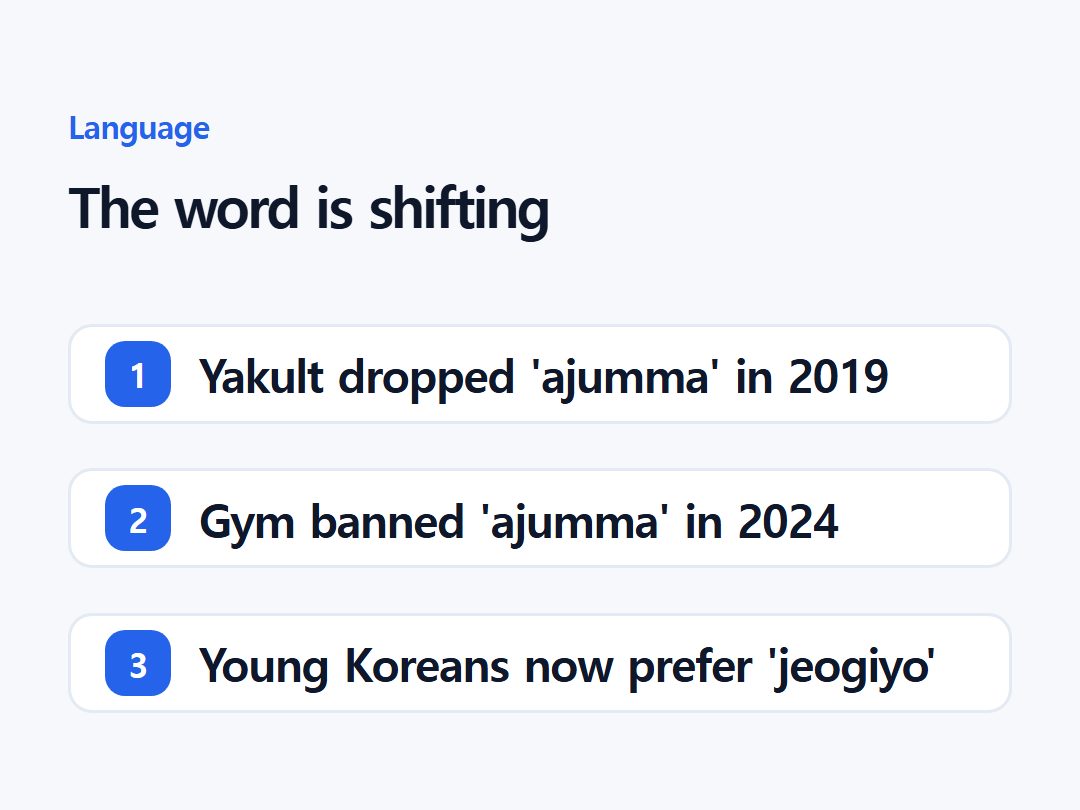
In 2019, Korea Yakult renamed its door-to-door sales staff — long known informally as "Yakult ajumma" — to "Fresh Managers." A cleaning contractor for the Daegu Metro similarly retitled its "cheongso ajumma" (cleaning ajumma) workers as hwangyeongsa, or "environment managers." Courts have treated the word as a serious provocation in specific cases, too: reporting by Korea JoongAng Daily described a 12-month prison sentence handed to a woman who threw a bottle at someone who had called her ajumma, and a separate case in which being addressed that way preceded a knife attack on a subway train.
From 'no ajumma zones' to plain 'excuse me'
The tension between warm kinship terms and loaded ones like ajumma is still playing out in Korean public life. In 2024, a gym drew national attention — and backlash — after posting a "no ajumma zone" sign, with the owner citing complaints about older women's behavior on the premises; the incident became a flashpoint in a wider debate over Korea's trend of exclusionary "no-[group] zones" in commercial spaces.
At the same time, younger Koreans appear to be quietly opting out of kinship-based address altogether in service settings.
The same September 2023 survey found that the plain, relationship-free "jeogiyo" (roughly "excuse me") was the most preferred way to get a stranger's attention, at 36.3%, ahead of the professional title "sajangnim" ("boss," used generically for shop owners) at 22.3% — both terms that sidestep the age-and-gender guesswork built into imo or ajumma entirely.
Not every Korean commentator treats the shift as a clean loss, though. A Korea Times opinion piece described gatherings of ajumma as "a great bubbling of life and fellow-feeling," a kind of everyday communal warmth the writer argued is harder to find in an economy increasingly mediated by kiosks and apps.
That split suggests the real debate is less about erasing a word than about who gets to decide, in any given exchange, whether being called ajumma lands as an insult or as belonging.
What is not in dispute is that Korean still has no true neutral "you" — so some family word, warm or not, will keep filling that space for the foreseeable future.
Kinship terms used as address terms in Korean
| Term | Literal meaning | Used for |
|---|---|---|
| 이모 (imo) | Maternal aunt | Older women in casual restaurants, market stalls, cafés |
| 아줌마 (ajumma) / 아저씨 (ajeossi) | No real family meaning | Middle-aged woman or man, more generic and distant |
| 할머니 (halmeoni) / 할아버지 (harabeoji) | Grandmother / grandfather | Elderly people |
| 오빠/형 (oppa/hyung), 언니/누나 (eonni/noona) | Older brother / older sister | People close in age; term depends on speaker's gender |
Frequently asked
Why do Koreans call strangers 'ajumma' or 'imo'?
Korean lacks a comfortable all-purpose word for 'you,' so speakers use kinship terms like imo or ajumma to address strangers based on their approximate age and gender.
Is 'ajumma' an insult in Korean?
It technically just means a married, middle-aged woman, but it has picked up negative stereotypes over time, so many women reject the label even when it applies to them.
What does 'oppa' mean in Korean?
Oppa literally means 'older brother' and is used by a woman toward an older man, but it also became a term for a boyfriend and entered the Oxford English Dictionary in 2021.
Sources
Every factual claim above is traceable. We do not translate articles — we gather facts from multiple outlets and write them ourselves.
- [WHY] From 'oppa' to 'ajumma': The dos and don'ts of addressing people in Korean — Korea JoongAng Daily
- [What should I call you?] No one wants to be called 'ajumma' — The Korea Herald
- Gym draws fire for banning 'ajumma' — The Korea Herald
- An ode to the Ajumma — The Korea Times
- Calling strangers uncle and auntie — Onur Solmaz (blog)
- Why Emo (이모) are the Best Friend to Have in Korea — Linguasia
- Relationality and the Fictive Use of Kinship Terms in Chinese, Korean, and Japanese — Contrastive Pragmatics (Brill)