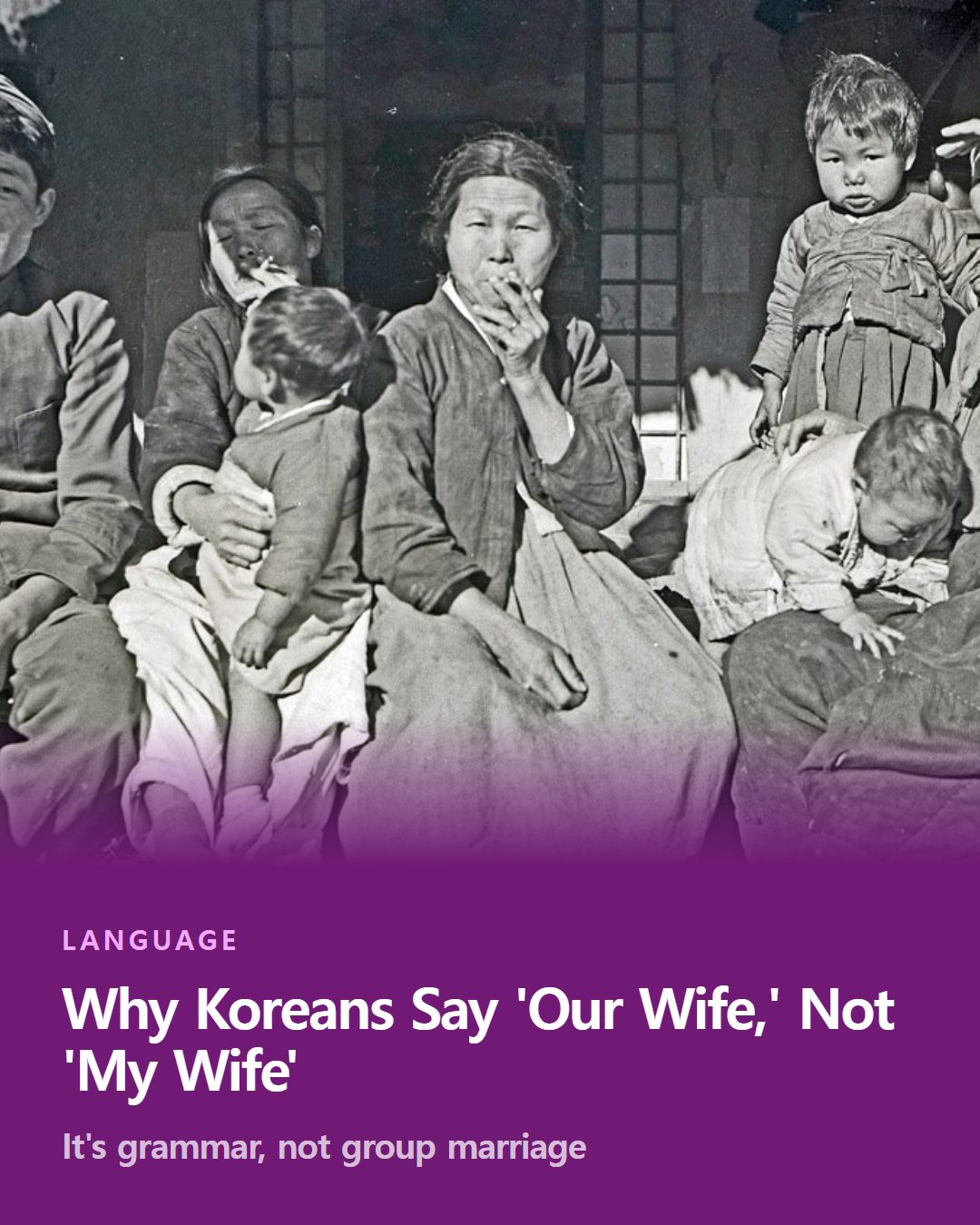
Any English speaker learning Korean eventually runs into the same puzzling sentence. A Korean friend, describing their own mother, says 우리 엄마 (uri eomma) — literally "our mom." The same friend, married to one person, refers to 우리 아내 (uri anae, "our wife") or 우리 남편 (uri nampyeon, "our husband").
There is no shared spouse and no communal parent.
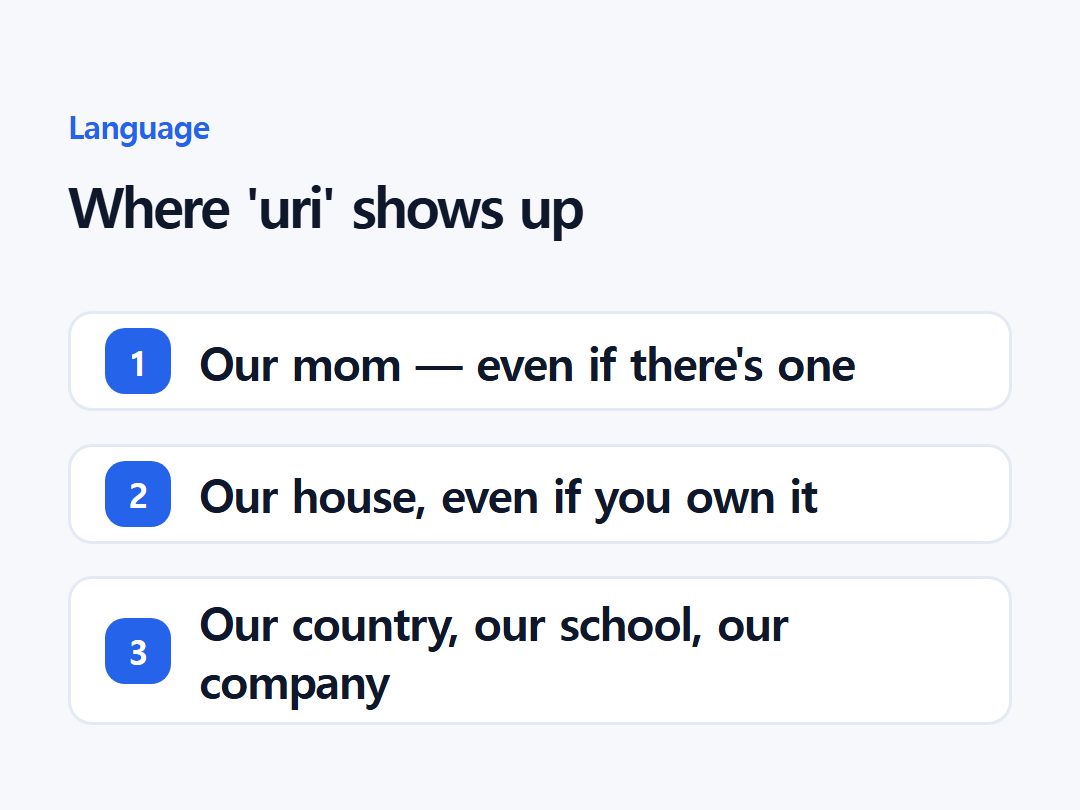
Korean speakers use "our" for a wide range of things that belong to exactly one person in the room: 우리 집 ("our house"), 우리 학교 ("our school"), 우리 회사 ("our company"), 우리 동네 ("our neighborhood"), and famously 우리나라 ("our country"), a compound word used the same way whether one person is speaking or a hundred.
The short version
- Koreans say "our mom" or "our wife" even with only one owner.
- 우리 marks belonging to a group, not literal headcount.
- 우리나라 ("our country") is a fixed word, same alone or in a crowd.
This isn't slang, a meme, or a recent shift in speech. It's a standard, textbook feature of Korean grammar — and it trips up international fans, K-drama subtitle readers, and language learners because English "our" and Korean 우리 don't map onto the same idea.
Why does 우리 mean 'our wife,' not 'my wife'?
In English, "our" is a headcount word. "Our house" means more than one person holds a claim to that house; "our team" means you're one name on a shared roster. Apply that logic to "our wife," and the sentence reads as group marriage — which is exactly the wrong conclusion, and exactly the trap international readers fall into when they see 우리 translated literally.
우리 in Korean is not primarily a counting word. It marks whether a noun belongs to a bounded relational circle — a family, a household, a hometown, a workplace, a nation — rather than to one person's exclusive control.
A mother is something you belong to alongside siblings, a spouse is someone bound to you inside a shared household, a country is something every citizen belongs to together.
Korean grammar marks that relational status by default, regardless of whether the specific person you're talking to actually shares it with you in that moment.
This is also why the reverse sounds strange to Korean ears.
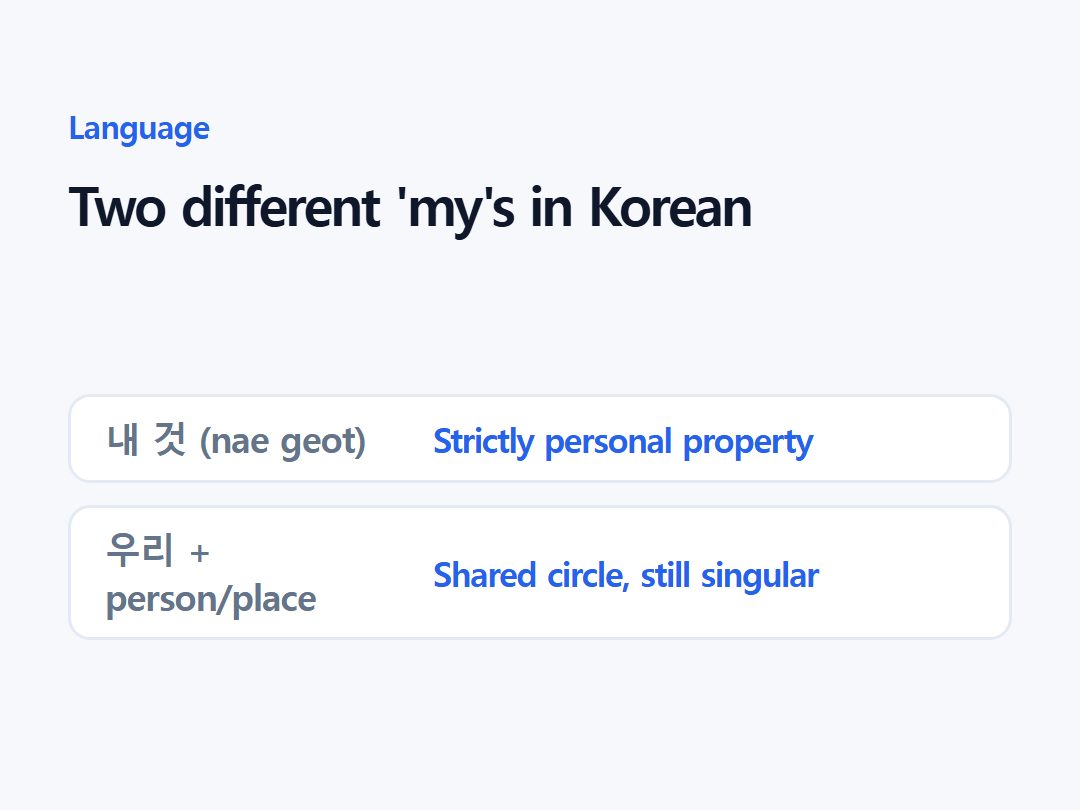
Saying 내 아내 ("my wife," using the exclusive singular 내) can come across as oddly transactional — as if the speaker were asserting personal ownership over a person, the way one might say "my car." 우리 아내 avoids that framing entirely: the wife belongs to a shared household unit, not to an individual's private inventory.
The same logic explains why a Korean speaker with only one older brother still says 우리 형 ("our older brother") rather than 내 형 — the sibling relationship itself is understood as something embedded in a family structure, not a possession assigned to one member.
Crucially, this doesn't mean 우리 replaces "my" everywhere. For objects that are inherently personal and non-relational — 내 폰 ("my phone"), 내 책 ("my book") — Korean speakers use the singular possessive without hesitation.
The switch to 우리 happens specifically with people and groups a speaker belongs to: family members, schools, employers, hometowns, and the country itself.
The test isn't "how many people actually share this," it's "is this the kind of thing a person is naturally embedded in, rather than something a person simply owns." A phone can be owned outright; a mother, a household, or a homeland cannot, because the speaker's own identity is partly defined by belonging to them.
There's also a register layer international readers rarely see explained. In more formal or humble speech, Korean has a separate plural, 저희, which lowers the speaker's own group relative to the listener — used, for instance, when an employee refers to "저희 회사" (my company, humbly) in front of a client.
But 저희 is specifically avoided for the nation itself; saying 저희 나라 ("our country," humble form) is considered inappropriate because it would imply lowering the country's status in front of the listener, while 우리나라 remains fixed and neutral.
That single exception is often cited in Korean grammar guides as proof that 우리 in these fixed expressions has hardened into something closer to a compound word than a live, swappable pronoun.
The same logic shows up outside family vocabulary, too. Korean speakers use 우리 to actively build closeness with people who are not, strictly speaking, part of any shared group yet.
A phrase like 우리 사이에 ("between us," roughly "we're close enough for this") can be said to someone met only recently, functioning less as a factual claim about a relationship and more as an invitation into one.
That's the opposite of how English speakers tend to use "we" — reserved for groups whose membership is already established — and it signals that 우리 is doing social work, not just grammatical work.
How Confucian household norms shaped 우리
The pattern traces back to how family and community were structured in traditional Korea, shaped heavily by Confucian social norms. The 집 (jip, "house" or "household") — not the individual — functioned as the basic social and economic unit.
Family members were commonly addressed and referred to by their role within that household (eldest son, second daughter-in-law, and so on) rather than treated as free-standing individuals with separate claims to people or property.
Language absorbed that structure: referring to family members with the group-oriented 우리 rather than the individual 내 reflected how relationships were actually organized, and that habit extended outward to any group a person was seen as belonging to — school, hometown, workplace, and nation.
Some linguists and language writers point to an etymological theory connecting 우리 to 울타리 (ultari), the Korean word for a fence or enclosure historically used to mark off a house or pen livestock — the idea being that 우리 originally evoked "those inside the same boundary" rather than a strict numerical plural.
This theory is popular in cultural explainers but is not settled among historical linguists, and should be read as one proposed origin rather than a confirmed etymology.
What is well documented is that this usage isn't confined to spoken habit — it shows up in formal grammar references and dictionaries, and 우리나라 ("our country") is standardized as a single fixed word in Korean, used identically whether the speaker is alone or addressing a crowd.
Korean-language teaching materials treat the 우리-for-family-and-groups pattern as a core grammar point precisely because it doesn't behave like an ordinary swappable pronoun — it's closer to a fixed convention attached to certain categories of noun.
What's still debated about 우리's origin and future
A few things remain genuinely open. The 울타리 (fence) etymology is still debated among linguists, and popular cultural explainers sometimes present it as settled fact when it isn't; readers should treat it as a plausible origin story rather than a confirmed one.
Whether younger, increasingly individualized generations of Korean speakers — particularly in casual online writing — lean more on 내 in contexts where 우리 was once automatic is a live question in Korean sociolinguistics rather than a confirmed trend, and it isn't something current sources settle either way.
The clearest ongoing friction point is translation.
As Korean dramas, webtoons, and variety shows reach global audiences, subtitlers and localizers repeatedly hit the same fork: translate 우리 literally as "our" and confuse viewers unfamiliar with the convention, or normalize it to "my" and quietly erase the relational meaning that Korean speakers hear every time they say it.
There's no industry-wide standard for handling it, and it continues to resurface in viewer discussions whenever a subtitle renders 우리 엄마 as "our mom" without explanation — a small phrase that, once understood, says a great deal about how Korean organizes family, belonging, and the self.
Korean's Three 'My/Our' Forms
| Pronoun | Type | Example | When It's Used |
|---|---|---|---|
| 내 (nae) | Personal possessive | 내 폰 ("my phone"), 내 책 ("my book") | Objects that are inherently personal and non-relational |
| 우리 (uri) | Relational "our" | 우리 엄마 ("our mom"), 우리 아내 ("our wife"), 우리나라 ("our country") | Family, groups, and things a speaker belongs to, regardless of actual headcount |
| 저희 (jeohui) | Humble plural | 저희 회사 ("our company," said to a client) | Lowers the speaker's group relative to the listener; never used for 나라 (country) |
Frequently asked
Why do Koreans say 'our wife' instead of 'my wife'?
우리 marks relational belonging rather than headcount, so a spouse is framed as part of a shared household; saying 내 아내 ("my wife") can sound oddly possessive by comparison.
What does 우리나라 mean in Korean?
우리나라 means "our country" and is standardized as a single fixed compound word, used the same way whether one person is speaking or a hundred.
Why isn't 우리 always translated as 'our' in Korean dramas?
Subtitlers face a constant tradeoff: translating 우리 literally as "our" confuses viewers unfamiliar with the convention, while normalizing it to "my" erases the relational meaning Korean speakers intend.
Sources
Every factual claim above is traceable. We do not translate articles — we gather facts from multiple outlets and write them ourselves.
- Why do Koreans say 'our' instead of 'my' when referring to family or country? — Talkpal
- First Person Plural: 우리 vs 저희 — and 'our' Meaning 'my' — Elon.io Korean Grammar
- What cultural values are reflected in the following expressions in Korean? — Indiana University, Korean Language Program
- The Mystery of the 'Our Wife': Understanding Korea's Collective Soul — Medium
- Why Koreans Say 'We/Our' So Much: Korean Culture — Expat Guide Korea