Watch enough Korean variety shows — the loosely scripted comedy and reality programs that dominate prime-time television in South Korea — and a pattern becomes hard to miss. The same three or four MCs turn up hosting unrelated shows. The same idols keep cycling through talk-show panels.
The same duos get paired again on a brand-new format with a different name. International viewers often read this as a lack of imagination. Inside the industry, it is a casting logic that producers openly discuss, and it rests on a fact about Korean variety television that rarely gets explained to outside audiences.
The short version
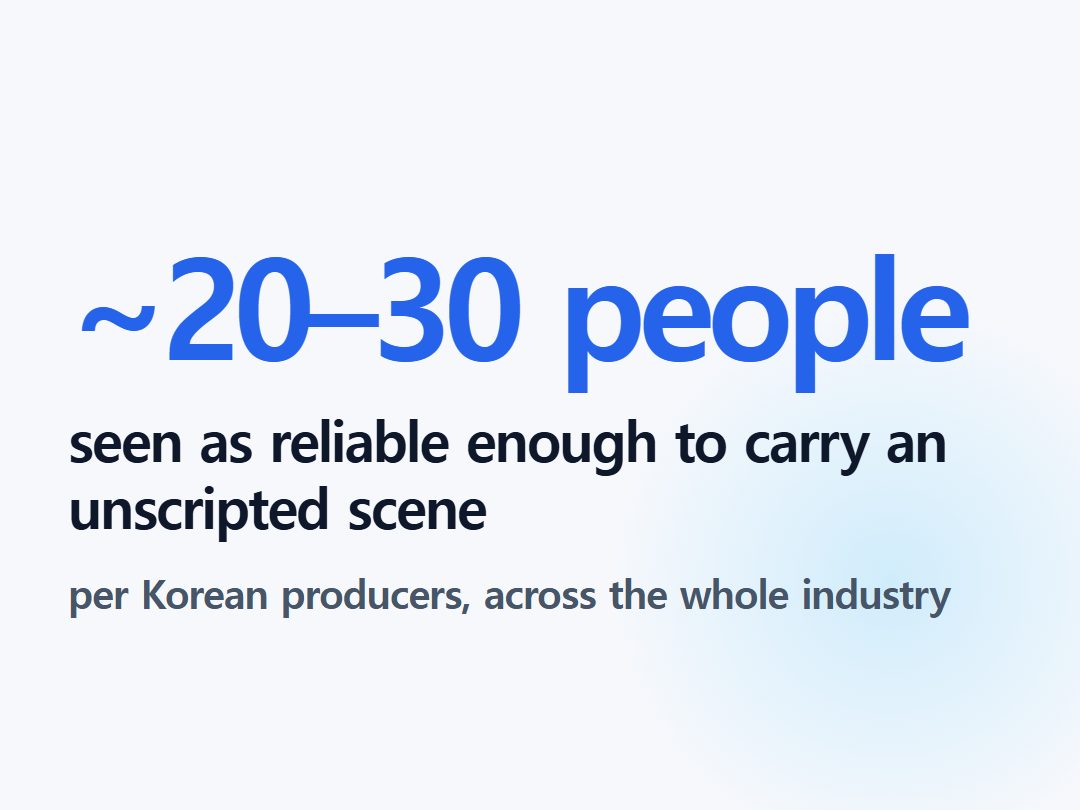
- Only 20 to 30 Koreans can reliably shine in unscripted variety formats, producers say.
- Yoo Jae-suk Camp drew "connections variety" backlash yet topped Netflix charts in seven countries.
- Booking one proven performer makes other stars more willing to join a new show.
What was the Yoo Jae-suk Camp backlash about?
The debate resurfaced publicly in May 2026, when Netflix released Yoo Jae-suk Camp, a guesthouse-format variety show hosted by veteran MC Yoo Jae-suk.
Online critics quickly labeled it 인맥 예능 (in-maek yeneung, "connections variety"), pointing out that director Jung Hyo-min was working with Yoo Jae-suk for the fourth time — after "Sugarman," "Ilro Manna Sai" and "Korea No.
1" — and that co-star Lee Kwang-soo, a former member of "Running Man," was reuniting with Yoo for a fifth separate project.
At the show's press conference, both men addressed the criticism head-on. Jung said simply repeating a past formula "won't win viewers over" and that the team had worked to give the guesthouse concept its own identity.
Yoo Jae-suk was more direct, saying producers "cast the person the show needs — not someone because we're close," and noted that he himself is on the receiving end of casting decisions, not the one making them.
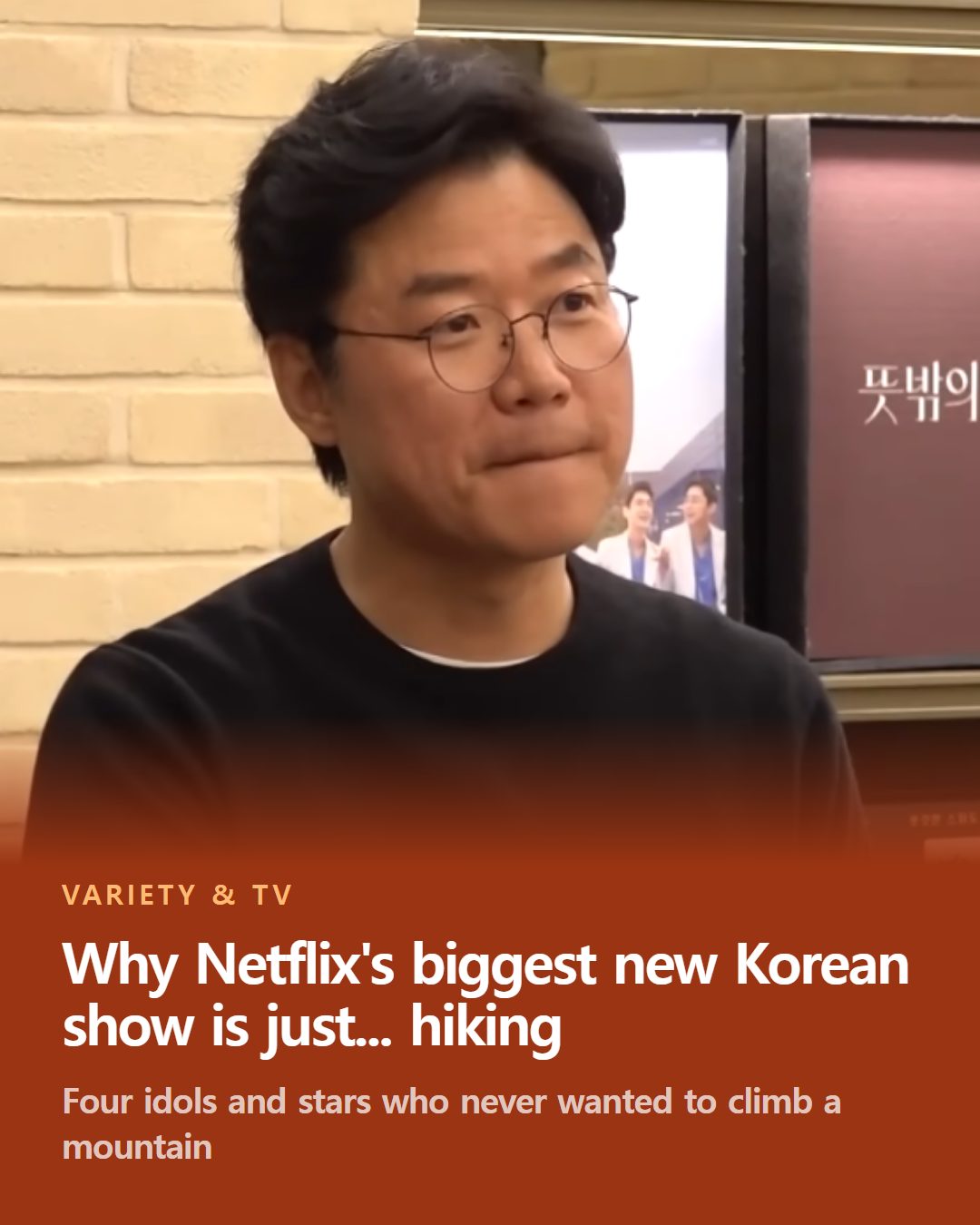
Around the same time, veteran producer Na Young-suk — known for long-running hits such as "Two Days & One Night," "Three Meals a Day" and "Youth Over Flowers" — was asked in a separate interview why his shows so often reuse familiar casts and formats, and gave an unusually candid answer: when a format works, "you naturally tend to keep doing it," comparing the habit to something he can't easily break.
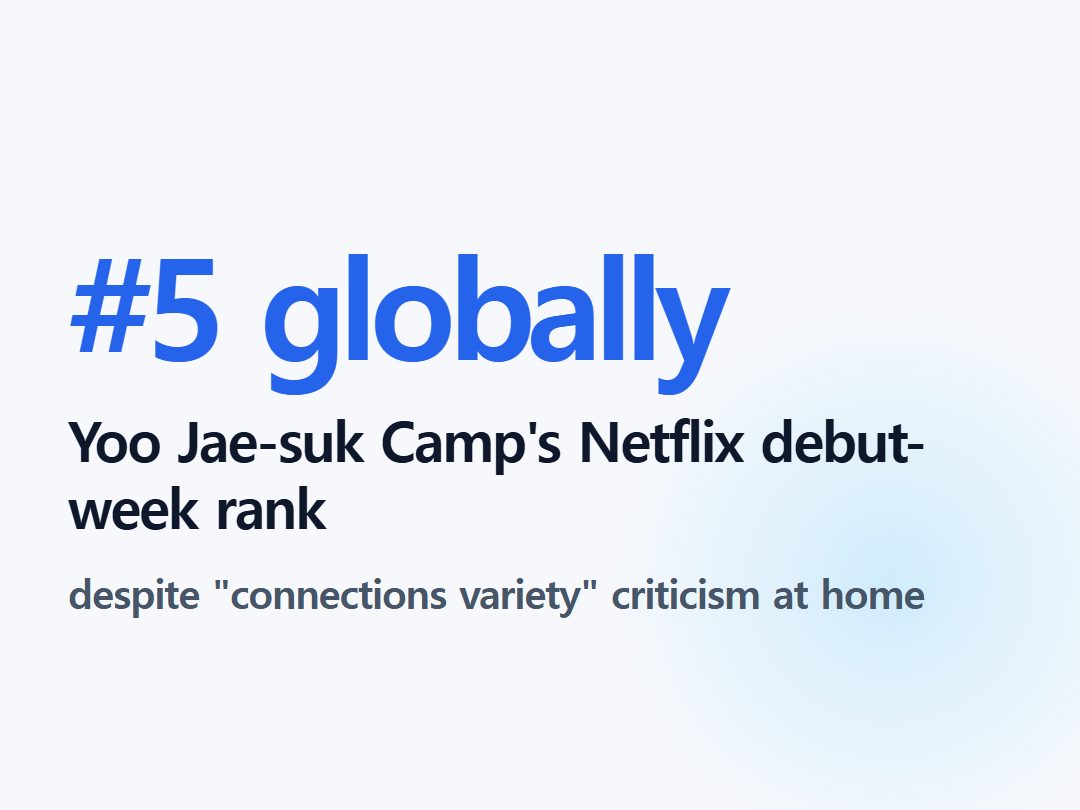
Despite the backlash, Yoo Jae-suk Camp went on to place fifth on Netflix's global non-English TV chart in its release week and topped the chart in seven countries outside Korea.
Why can't Korean variety producers cast just anyone?
To understand why this keeps happening, it helps to know how Korean variety shows are actually built. A PD (production director) in Korean broadcasting is not just a director but effectively the showrunner — the person who designs the format, plans each episode's structure, and decides who gets cast.
Most Korean variety shows are unscripted or only loosely scripted, built around real reactions to games, challenges, or prompts rather than written dialogue.
That means a show lives or dies on whether its cast can generate genuinely entertaining, usable moments on command, take after take, with no script to fall back on.
Industry insiders describe the skill this requires as 예능감 (yeneung-gam), literally "variety instinct": comedic timing, quick wit, and the ability to be watchable even when nothing has been planned to happen.
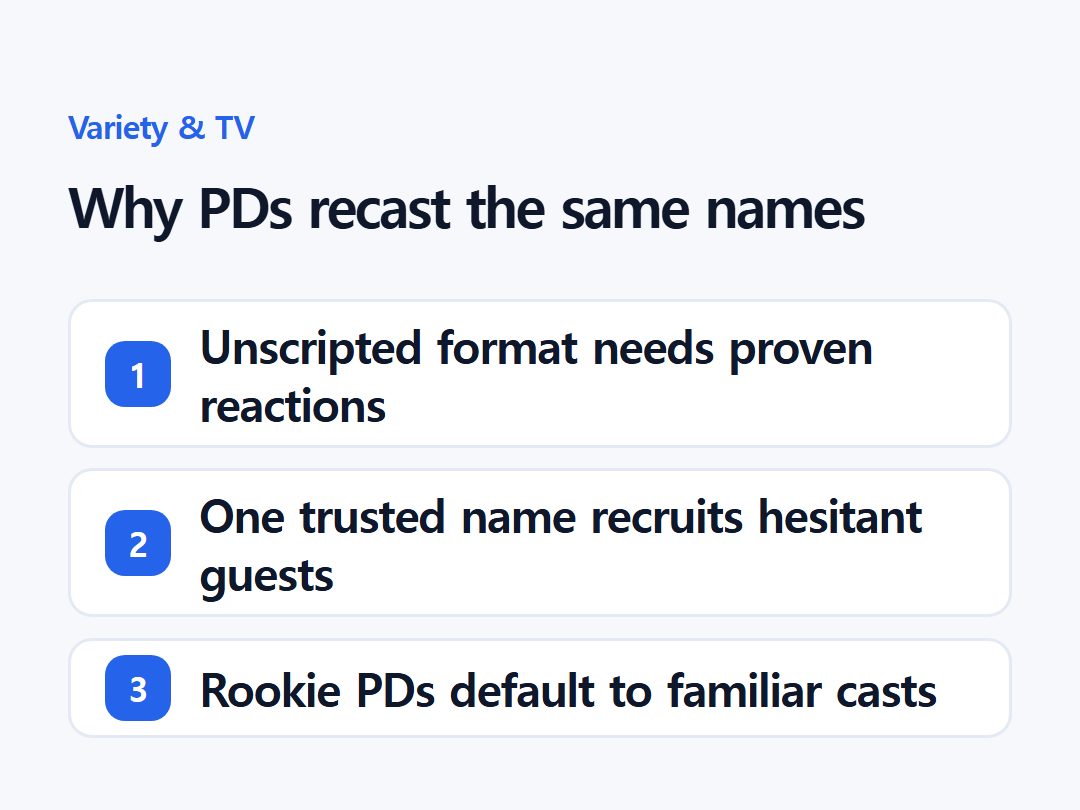
PDs who have spoken publicly about repeat casting have estimated that only around 20 to 30 people across the entire Korean entertainment industry can reliably deliver above-average moments in this kind of unscripted format.
That scarcity, more than habit or favoritism, is the practical root of the problem: producers casting a familiar face are not just picking someone they like, they are picking a known quantity in a format with no retakes.
There is also a recruiting effect that keeps the same names in circulation.
Producers have explained that once one proven variety performer is confirmed for a new show, other public figures who are normally hesitant to appear on unscripted programs become far more willing to sign on, because a trusted name signals the production will be handled competently.
A famous cast member is not simply filling a seat — their presence functions as a guarantee that makes it easier to book everyone else around them.
A generational factor compounds this further. As Korean broadcasters and streaming platforms have multiplied — cable channels, terrestrial networks, and now Netflix Korea and other streamers all commissioning original variety content — the number of newer, less experienced PDs entering the industry has grown too.
Industry observers note that younger producers tend to lean more heavily on familiar casts precisely because they lack the confidence to build a show's rhythm around untested talent, in much the way a first-time film director might chase a bankable lead actor rather than gamble on an unknown.
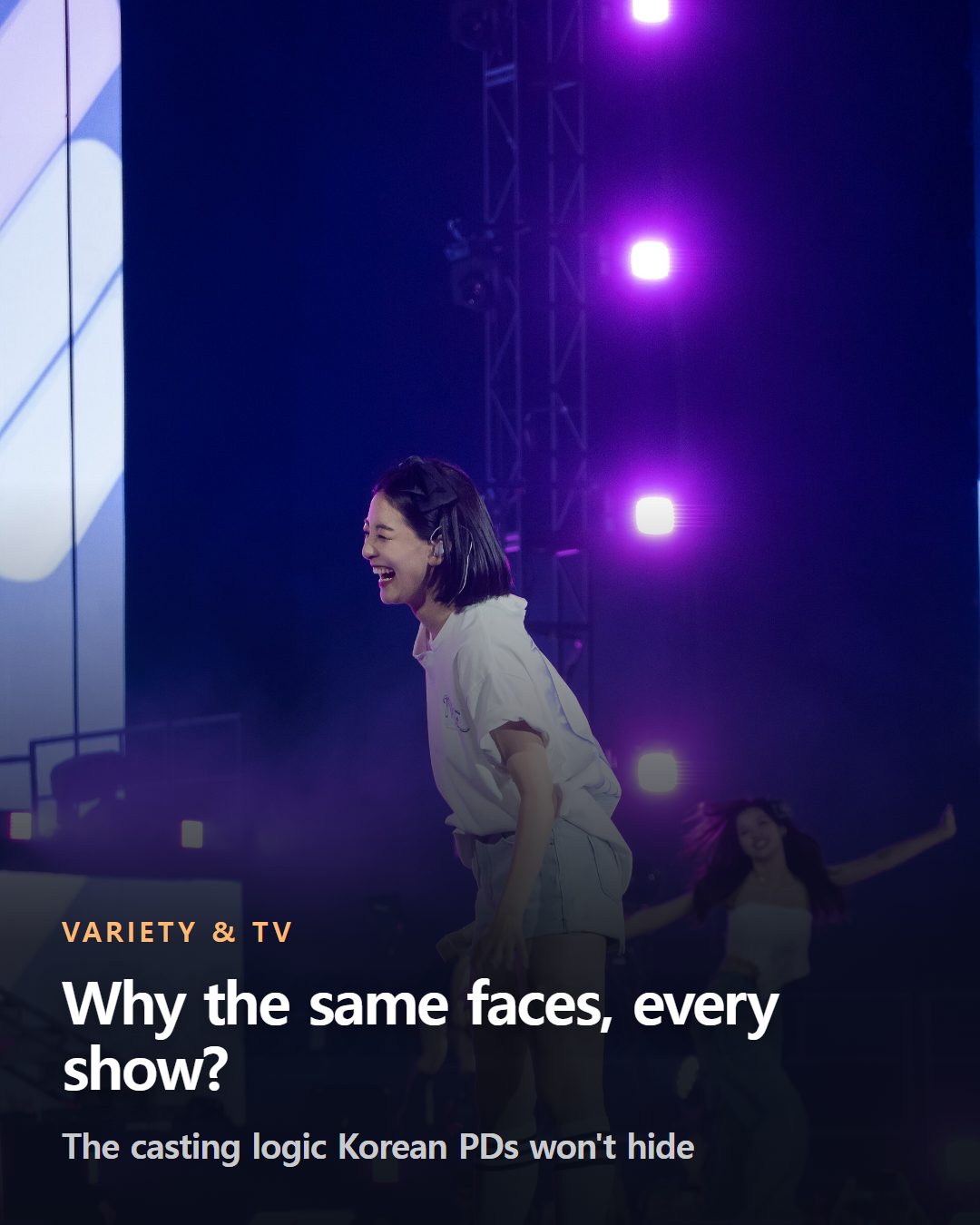
This same logic created its own subculture: the 예능돌 (yeneung-dol, "variety idol"), a K-pop idol who becomes almost as well known for talk-show and reality-show appearances as for music.
Talent agencies — the companies that recruit, train, and manage K-pop idols and actors under multi-year contracts — actively encourage members with strong on-camera charisma to take variety bookings, since these appearances build a personal following independent of group promotions.
VIXX's Ravi became a fixed cast member on KBS's long-running "2 Days & 1 Night" and was recognized industry-wide as a top variety idol; Seventeen's Seungkwan joined tvN's "Racket Boys" as a regular and remains a sought-after guest elsewhere.
More recently, BLACKPINK's Jennie, (G)I-DLE's Miyeon, and IVE's An Yujin have each built recurring panel-show roles built around a distinct, marketable persona — Jennie for calculated gameplay one show's own producers nicknamed "Jennie gaslighting," Miyeon for exaggerated, warm reactions, and An Yujin for composed wit under pressure.
Once a performer proves they have this kind of reliable, camera-ready persona, producers across unrelated networks compete to book them — which is exactly how the same handful of names end up scattered across a dozen shows in a single season.
How 2000s ensemble hits built lasting cast loyalty
This habit traces back to Korea's variety boom of the 2000s and 2010s, when shows such as "Infinite Challenge," "2 Days & 1 Night," and "Running Man" shifted Korean variety television away from single-host talk formats toward ensemble shows built around a fixed cast.
These programs succeeded largely on the strength of 케미 (chemistry) — the rapport built between the same cast members over years of episodes — so audiences returned as much for the relationships between performers as for any single episode's premise.
That model taught both PDs and networks that a proven ensemble was worth more than a rotating cast of strangers, and it produced informal groupings that fans and entertainment media began tracking by name, such as 유라인 (Yoo-line), a term coined for the circle of performers who kept reappearing alongside Yoo Jae-suk across different, unrelated shows.
As the number of channels multiplied through the 2010s and streaming platforms entered the Korean market in the 2020s, the economics reinforced this pattern rather than breaking it.
A new platform commissioning a variety show wants a predictable outcome, and a cast with a track record is the closest thing to a guarantee that an unscripted format offers.
That is part of why even a platform with Netflix's budget and reach, which could in theory cast almost anyone, still built Yoo Jae-suk Camp around performers who had already proven themselves together on other shows.
Netflix's global hit won't end the backlash debate
The industry itself is not united on whether this is even a problem worth fixing.
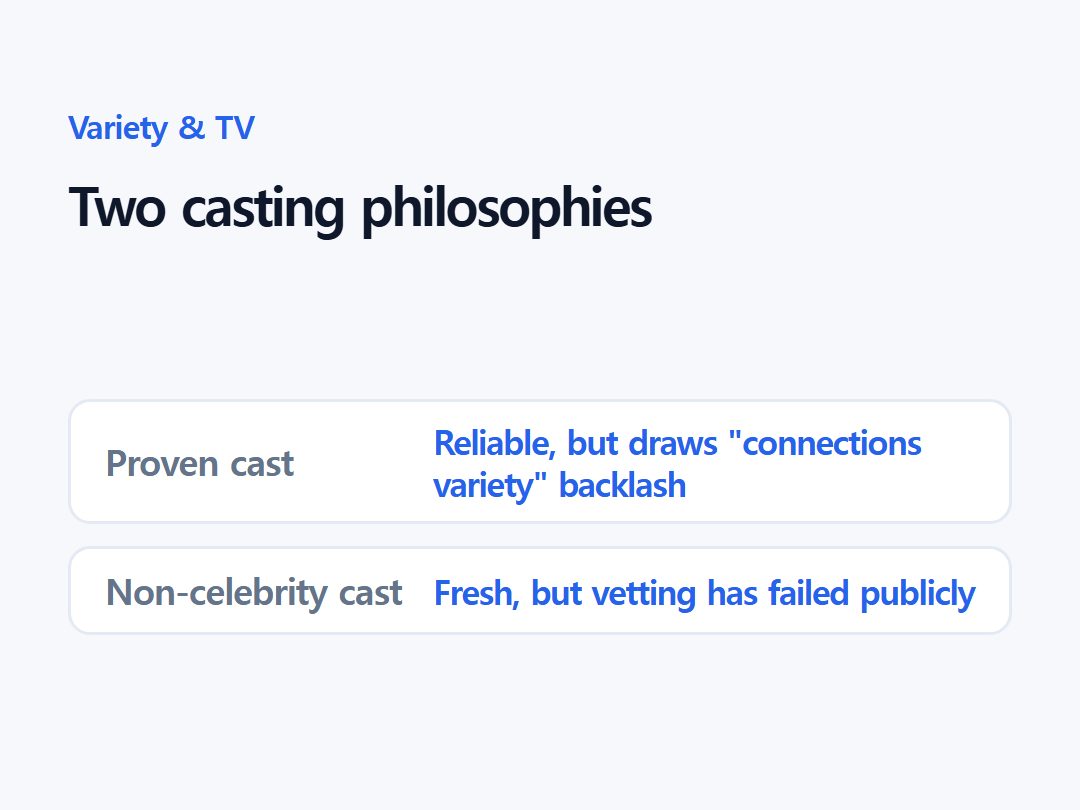
Na Young-suk's on-camera admission that he leans on familiar formats, paired with Yoo Jae-suk and Jung Hyo-min publicly defending their casting choices, shows that producers are aware of the "인맥 예능" and 회전문 예능 ("revolving-door variety") criticism but are not abandoning the approach, particularly when it keeps producing hits.
Some producers have tried the opposite experiment, building shows around non-celebrity participants instead of recycling famous casts, but that approach has brought its own difficulties: several Korean broadcasters and streamers have faced criticism after undisclosed personal histories of non-celebrity cast members surfaced on air, raising separate questions about how thoroughly ordinary participants are screened before appearing on unscripted television.
The clearest open question is whether streaming's global reach changes the calculation.
Yoo Jae-suk Camp topping Netflix's chart in seven countries despite domestic backlash over its familiar cast suggests international audiences are, for now, more forgiving of recycled faces than Korean viewers who have watched the same names cycle through show after show for over a decade.
Whether that gap closes as more international viewers become fluent in Korean variety television's casting habits is still unclear.
K-pop idols who built recurring variety-show personas
| Idol | Show | Known for |
|---|---|---|
| VIXX's Ravi | KBS's "2 Days & 1 Night" | Fixed cast member, top variety idol |
| Seventeen's Seungkwan | tvN's "Racket Boys" | Regular cast member, sought-after guest |
| BLACKPINK's Jennie | Panel shows | Calculated gameplay, nicknamed "Jennie gaslighting" |
| (G)I-DLE's Miyeon | Panel shows | Exaggerated, warm reactions |
| IVE's An Yujin | Panel shows | Composed wit under pressure |
Frequently asked
What does 인맥 예능 mean?
It's Korean for "connections variety," a term critics use for shows accused of casting the same familiar faces instead of new talent.
Why do Korean variety shows always use the same cast?
Producers say only about 20 to 30 people in the industry can reliably deliver funny, usable moments in unscripted formats, so proven performers get rebooked.
Did Yoo Jae-suk Camp do well on Netflix despite the backlash?
Yes — it placed fifth on Netflix's global non-English TV chart and topped the chart in seven countries outside Korea.
Sources
Every factual claim above is traceable. We do not translate articles — we gather facts from multiple outlets and write them ourselves.
- [View기획┃회전문 예능②] 왜 또 똑같은 연예인만 쓰는 건가요? — The Viewers
- 제니·미연·안유진, 방송가 휘어잡는 '아이돌 예능캐'? 아니 '만능캐'! — Sports Khan
- 유재석 '인맥 예능'·나영석 '자기 복제'..피하지 못할지언정 결코 굴한 적 없다 — StarNews
- 또 유재석·이광수? '인맥 예능' 지적, 국민 MC '소신 발언' — OSEN via Nate
- 유재석 캠프, 글로벌 TOP10 오른 넷플릭스 예능의 힐링 완주 — TopStar News