When a Korean drama's final episode posts the highest rating of its entire run, international coverage often treats it as a special achievement worth a headline. Korean entertainment reporters treat it as the expected outcome.
Nielsen Korea and TNMS, the two firms that measure national household viewership, have recorded this arc across more than a decade of hit dramas: a modest premiere, a slow climb, and a finale that outrates every episode before it.
This is not a coincidence limited to one or two beloved shows — it is a structural pattern of how Korean television is broadcast and watched.
The short version
- K-drama finales usually rate higher than premieres — sometimes 14 times higher.
- Twice-weekly airing lets word of mouth build over eight to twenty weeks.
- Koreans watch live (본방사수) to avoid spoiler clips, which inflates finale ratings.
How far ratings jumped from premiere to finale
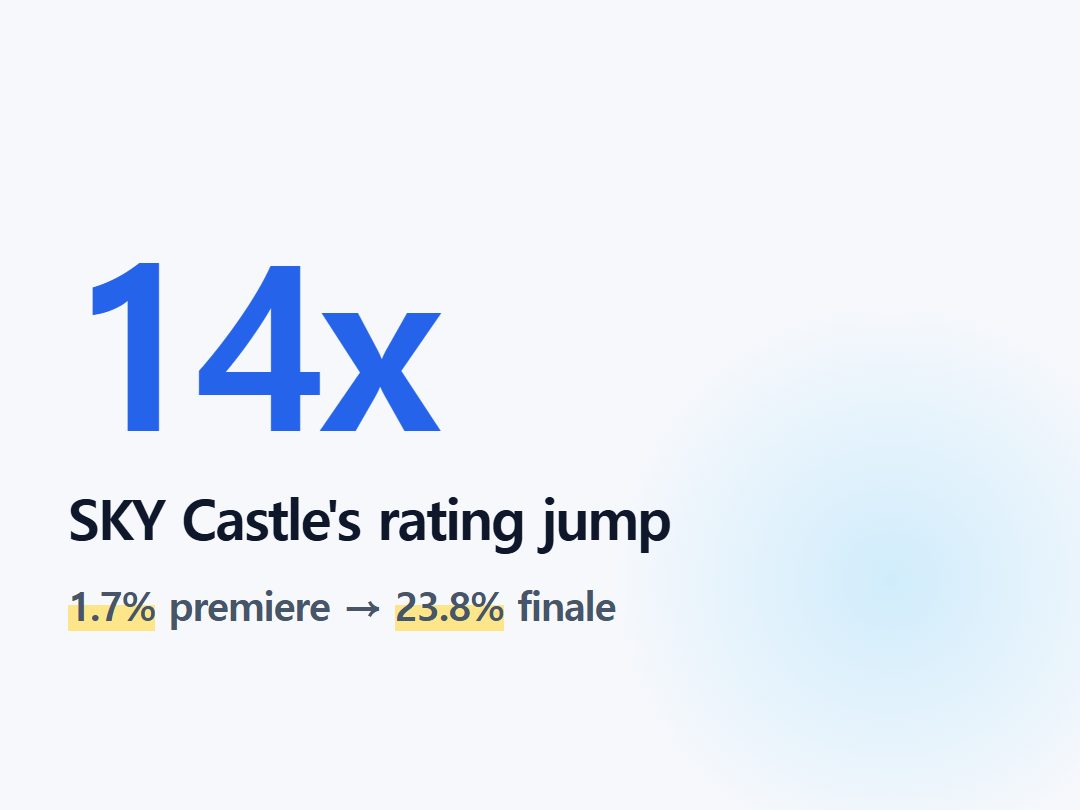
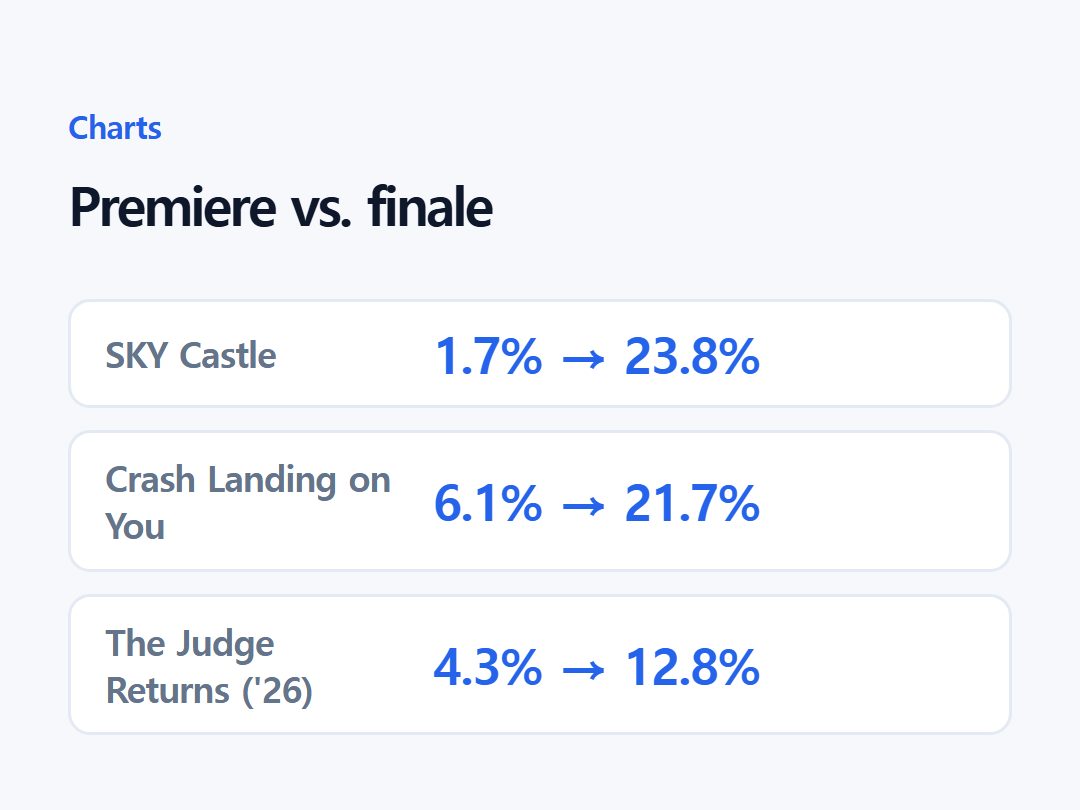
JTBC's SKY Castle (2018–2019) opened to a 1.73 percent nationwide rating for episode one and closed with 23.78 percent for its finale on February 1, 2019 — a roughly 14-fold increase that set a record at the time for the highest rating ever recorded by any Korean cable or general programming channel, drama or otherwise, according to Nielsen Korea data reported by Soompi.
tvN's Crash Landing on You (2019–2020) followed the same shape at a different scale: a 6.1 percent premiere in December 2019 climbed past 10 percent by episode eight, then to 17.7 percent with two episodes left, before the finale posted a 21.68 percent nationwide average (23.25 percent in the Seoul metropolitan area) — enough to overtake Goblin's previous tvN record of 20.5 percent, per Soompi and Rappler.
tvN's Reply 1988 (2015–2016) averaged around 10 percent through most of its run before its finale hit 18.8 percent, the highest cable-drama rating in Korean television history at that point.
The pattern is not confined to prestige cable hits or to the pre-streaming era.
MBC's The Judge Returns, which aired January–February 2026, premiered at just 4.3 percent against strong same-slot competition, broke into double digits by its fifth episode, and closed with a 12.8 percent nationwide average and a 17.4 percent peak in its climactic scene — MBC's best drama performance in over a year, according to Soompi and allkpop.
| Drama | Premiere | Finale |
|---|---|---|
| SKY Castle (2018–19) | 1.7% | 23.8% |
| Crash Landing on You (2019–20) | 6.1% | 21.7% (23.25% Seoul) |
| Reply 1988 (2015–16) | ~7–10% | 18.8% |
| The Judge Returns (2026) | 4.3% | 12.8% avg / 17.4% peak |
Why Korean broadcast habits push ratings upward
For readers used to Western television, where a series premiere is usually the highest-rated episode of a season and viewership erodes from there, this looks backwards. It isn't — it reflects three things about how Korean broadcast television actually works that don't have a direct equivalent elsewhere.
The first is scheduling.
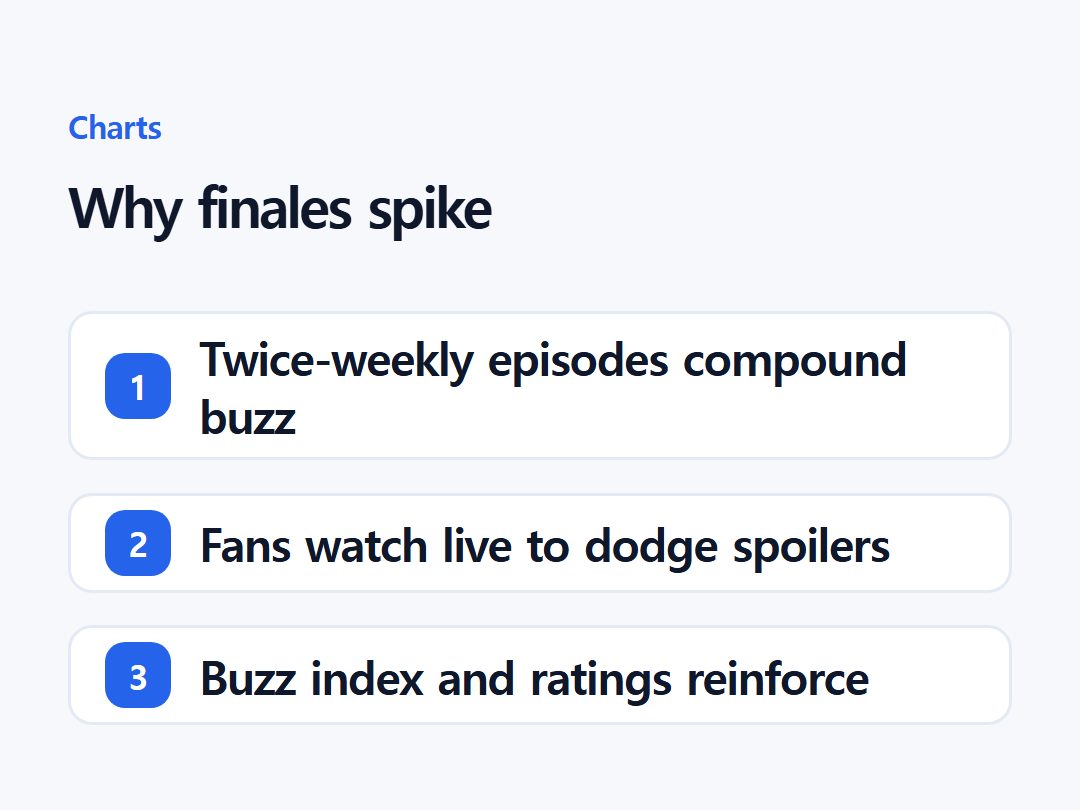
Most Korean dramas air in two-episode weekly blocks — Monday–Tuesday, Wednesday–Thursday, or Friday–Saturday slots — over a run of roughly eight to twenty weeks, rather than a single weekly episode (the standard US network model) or a full-season release on one day (the standard global streaming model).
That twice-a-week rhythm gives word of mouth room to compound: a Tuesday episode generates clips, recaps, and online debate that circulate before Wednesday's episode airs elsewhere, pulling in new viewers who then need to catch up before the following week. Repeated over two to three months, this produces the slow-climb-to-crescendo shape.
The second is a viewing habit called 본방사수 (bon-bang-sasu, literally 'protecting the live broadcast'), the practice of watching an episode live rather than time-shifting it.
Historically this habit was already common in Korea; more recently, industry analysts and Korean entertainment press have pointed to a specific driver behind it intensifying as a show gets more popular — short-form clips of pivotal scenes circulate rapidly on social media and video platforms shortly after broadcast, and viewers who don't watch live risk being spoiled by an algorithm-fed clip before they get the chance.
As a drama's buzz grows, more of its audience shifts toward watching it live specifically to avoid this, which mechanically raises the live rating on top of any increase in total audience. Popularity feeds directly into the rating in a way it does not for on-demand viewing.
The third is that Korean industry and press track two separate numbers side by side, and both tend to rise together. Nielsen Korea and TNMS report the household viewership rating — an estimate, from a sampled panel, of what share of measured households were tuned in.
Separately, a data firm called Good Data Corporation publishes a weekly '화제성' (hwaje-seong, buzzworthiness) index, which measures how much a show is discussed across news articles, blogs, online communities, and social media, independent of who is actually watching.
The two metrics measure different things — one is verified viewership, the other is online chatter — but for a genuinely popular drama they tend to move upward in the same direction and reinforce each other in coverage: rising online buzz pulls in live viewers to avoid spoilers, and each new 'self-record-breaking rating' headline becomes something else for people to discuss online.
Entertainment outlets in Korea publish weekly rating updates for ongoing dramas as a matter of course, which keeps a hit show's rating trajectory visible and newsworthy episode by episode — a feedback loop that a single-day binge release cannot replicate.
None of this means every Korean drama gains momentum toward its ending; plenty of shows peak mid-run or decline, and a rough start can simply mean a show never finds an audience.
What it does mean is that for a show that is actually working, a low premiere rating is not read domestically as an early failure signal the way it often is elsewhere — a slow build toward a finale peak is simply understood as the normal shape of a hit, which is why Korean coverage rarely frames it as a surprise.
How finale records became an expected story
The twice-weekly miniseries slot goes back to Korea's terrestrial broadcasters — KBS, MBC, and SBS — which built their programming grids around Mon-Tue, Wed-Thu, and weekend drama blocks for decades.
When cable channels began producing original dramas in the 2010s, led by tvN (founded 2006, original dramas ramping up from the early 2010s) and JTBC (founded 2011), they adopted the same twice-a-week structure rather than a single weekly episode model.
The finale-record pattern became a recognized media narrative through a run of high-profile cases that each broke the 'highest cable rating ever' mark specifically on their last episode: Reply 1988 in 2016, Goblin later that year, SKY Castle in 2019, and Crash Landing on You in 2020, followed by The World of the Married, which still holds the all-time cable record at 28.4 percent.
Each cycle of a drama breaking a rival's finale record reinforced the expectation among Korean audiences that a hit's rating curve bends upward toward the end.
Good Data Corporation began publishing its weekly buzzworthiness rankings in 2015, giving press a second number to track alongside Nielsen's, and both have since become standard weekly reporting fixtures for any drama with momentum.
The 2025–2026 run of dramas — Our Unwritten Seoul, Big Mouth, and The Judge Returns among them — shows the same arc continuing on both cable and terrestrial networks, which suggests the pattern is tied to the broadcast format itself rather than to any one channel or era.

Will streaming end this finale-ratings pattern?
The open question is whether this pattern survives Korea's own shift toward streaming.
As more dramas are produced for or simulcast on global platforms, and as viewing habits move further from linear appointment television, it is unclear whether the twice-weekly release cadence — and the live-viewing incentive it creates — will continue to shape ratings the way it has for the past decade.
It's also worth international readers keeping in mind that this is a pattern for shows that succeed, not a rule: many dramas never build momentum and simply decline or plateau, and the finale-surge story only applies to the ones that catch on.
The Judge Returns being extended into a follow-up TV movie after its finale, reportedly on the strength of its late-run momentum, is one recent example worth tracking as a sign of whether Korean terrestrial networks can keep replicating the pattern going forward.
Premiere vs. finale ratings for four hit Korean dramas
| Drama | Premiere | Finale |
|---|---|---|
| SKY Castle (2018–19) | 1.7% | 23.8% |
| Crash Landing on You (2019–20) | 6.1% | 21.7% (23.25% Seoul) |
| Reply 1988 (2015–16) | ~7–10% | 18.8% |
| The Judge Returns (2026) | 4.3% | 12.8% avg / 17.4% peak |
Frequently asked
Why do K-drama ratings go up instead of down?
Most Korean dramas air twice a week over roughly two to three months, letting word of mouth build episode by episode, while viewers increasingly watch live to avoid spoiler clips — both push the rating up toward the finale.
What does bon-bang-sasu (본방사수) mean?
It literally means 'protecting the live broadcast' — watching an episode live rather than time-shifting it, a habit that has intensified because spoiler clips of pivotal scenes now circulate quickly online after a broadcast.
What is the highest-rated Korean drama finale ever?
The World of the Married still holds the all-time cable record at 28.4 percent, after SKY Castle (23.78 percent) and Crash Landing on You (21.68 percent) each broke the record in their own runs.
Sources
Every factual claim above is traceable. We do not translate articles — we gather facts from multiple outlets and write them ourselves.
- Crash Landing On You Finale Overtakes Goblin To Achieve Highest Ratings In tvN History — Soompi
- Crash Landing On You Heads Into Finale On Its Highest Ratings Yet — Soompi
- 'Crash Landing On You' finale clocks highest viewership ratings in channel's history — Rappler
- SKY Castle Sets New Record For Highest Ratings In Cable Network History With Final Episode — Soompi
- The Judge Returns Premieres To Promising Ratings As Taxi Driver 3 Remains No. 1 — Soompi
- The Judge Returns Heads Into Finale On Its Highest Ratings Yet — Soompi
- MBC's 'The Judge Returns' reborn as TV movie following 14.9 peak ratings — allkpop
- Good Data Corporation — Wikipedia
- K-drama ratings explained: what the Korean numbers actually measure — Seoul Current