In Korean, grammar itself changes when a relationship does. The same sentence can come out with a different verb ending depending on how the speaker regards the person listening — and that ending isn't a matter of tone or word choice, the way "could you" is politer than "gimme" in English.
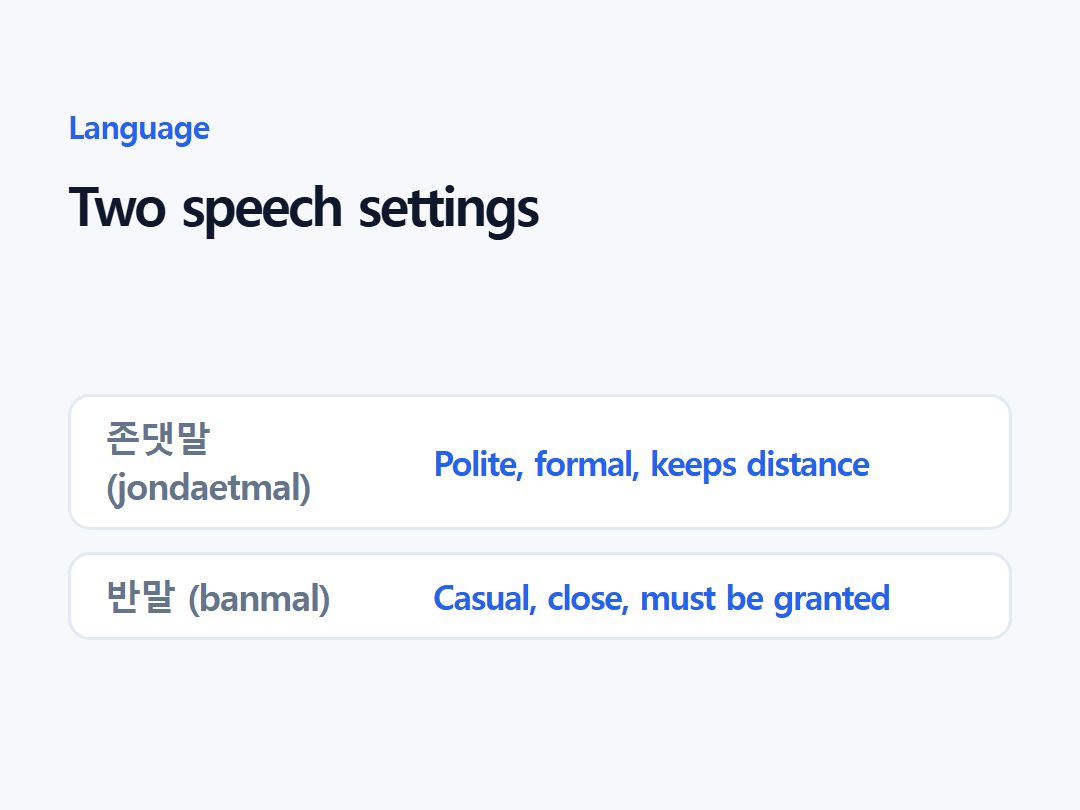
It's a structural switch, built into the end of nearly every verb. Korean speakers call the two settings 존댓말 (jondaetmal, polite or formal speech) and 반말 (banmal, casual speech), and which one a person uses is decided by age, social rank, and closeness — decided, in effect, before the conversation even starts.
The short version
- Korean verb endings force every sentence into a formal or casual register.
- Switching from formal to casual speech is called 말을 놓다, 'drop speech.'
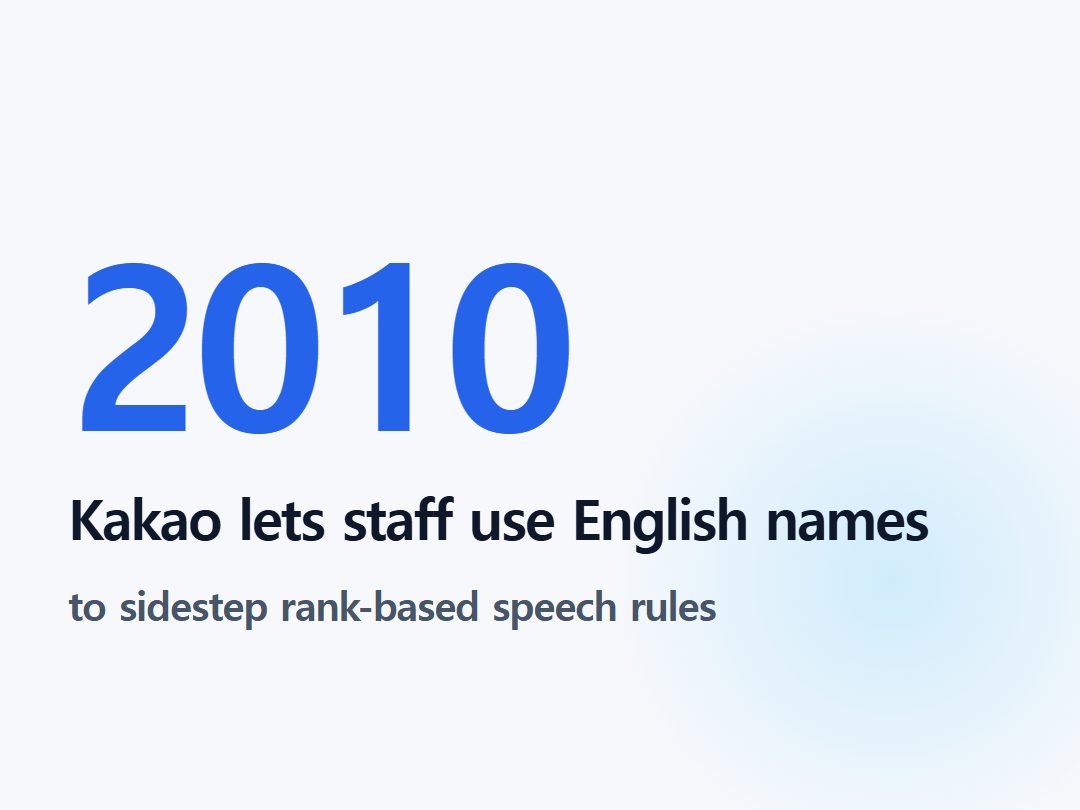
- Kakao started using English names in 2010 to sidestep rank-based speech rules.
This is why one of the most reliably dramatic beats in a K-drama isn't a confession or a first kiss. It's the moment two characters stop using -요 or -습니다 endings and start speaking in banmal instead. International viewers tend to read the scene as "they got closer." Korean viewers read it as something closer to a small, specific contract being signed.

How Korean grammar encodes rank and closeness
English marks social distance through vocabulary and tone — compare "Could you possibly pass the salt?" to "gimme the salt." Korean marks it through grammar itself.
Politeness and formality are encoded directly into sentence-final verb endings, so a speaker cannot produce a neutral sentence; every utterance commits them to a register.
Linguists distinguish two layers within this: speech levels, which show respect toward whoever is being spoken to, and honorifics, a separate set of markers (like the infix -시-) that show respect toward whoever is being spoken about.
A person can use an honorific for their grandfather while still choosing a polite or casual ending depending on who they're actually talking to. The two systems run in parallel, and native speakers track both without thinking about it.
In daily use, most of this collapses into the practical two-way split international readers hear about: jondaetmal for people who are older, senior, or unfamiliar, and banmal for people who are close, younger, or peers who have explicitly agreed to drop formality.
Academic descriptions of Korean actually list up to seven historical speech levels, most now archaic or confined to religious texts, sageuk (historical dramas), and formal ceremony — but the two that matter in contemporary daily life are the polite/formal style and the casual style, plus a semi-honorific hybrid that has emerged more recently as some of the old middle levels fell out of use.
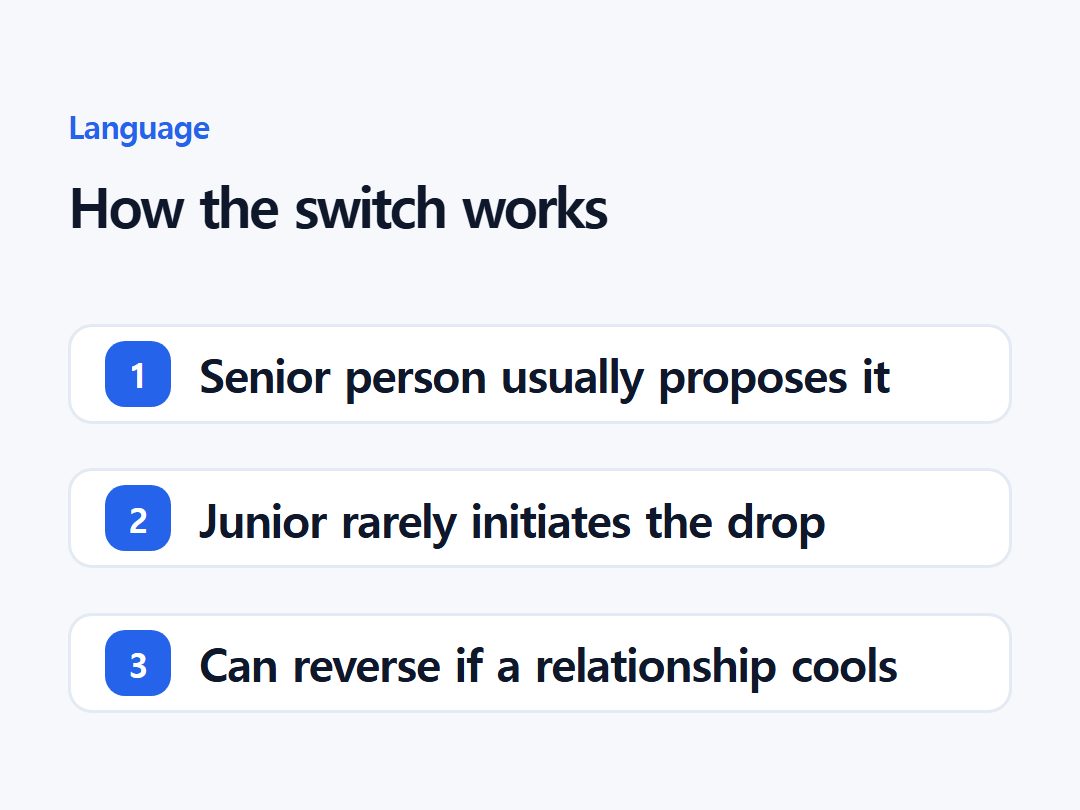
The switch from jondaetmal to banmal has its own name — 말을 놓다, literally "to drop speech" — and its own etiquette.
It is almost always proposed by the older or higher-status person, rarely by the junior one, and it is not automatic just because two people become friendly; someone has to actually suggest it, often with a line like "우리 말 놓을까요?" ("should we drop the formal speech?").
Once granted, it is not always symmetric or permanent — a boss might use banmal downward while an employee keeps jondaetmal upward, and a relationship that cools can slide back into polite speech as a way of re-establishing distance without saying so directly.
Korean drama recap sites that built glossaries for international fans put it plainly: jondaetmal keeps a person at arm's length, while banmal brings them close.
This is also the practical reason Korean speakers ask a new acquaintance's age almost immediately, a habit that puzzles many foreign visitors.
Age (along with school year and workplace rank) is one of the main inputs that decides who defaults to which speech level, so establishing it early isn't small talk — it's a prerequisite for knowing how to speak to someone at all.
The same logic explains kinship-style address terms like hyung, noona, oppa, and sunbae, which get applied constantly to non-relatives in Korean. Each one comes bundled with an implied age gap and an implied speech level, so using one is a compressed way of announcing how formal the conversation is about to be.
Family life shows the system running in both directions. It is common for someone to use banmal with their own parents while switching back to jondaetmal in front of in-laws, or to speak casually with their parents while those parents still use polite speech toward the grandparents.
Children are also expected to shift from banmal to a more formal register with certain adults around the time they enter secondary school — a scheduled formality upgrade with no real English equivalent.
None of this is optional self-expression; it functions closer to a grammar rule that happens to track relationships instead of tense or number.
For viewers of Korean dramas, this turns speech level into a silent subplot.
A relationship's formality curve — polite, to semi-formal, to full banmal, or the reverse — tracks the emotional arc of the story in a way that subtitles usually flatten into nothing, since English has no equivalent grammatical toggle to translate it with.
A romance where two leads spend half the season in jondaetmal and only drop to banmal after a specific turning point is telling international audiences something Korean audiences absorb instantly and without translation.
How Joseon-era Confucianism shaped Korean grammar
Korea's honorific grammar didn't appear on its own; it grew out of Confucian social philosophy imported from China and then intensified locally.
Neo-Confucianism became state ideology under the Joseon Dynasty (1392–1910), organized around the "five cardinal relationships" that ranked people by age, generation, and status.
Korean's grammar — agglutinative and verb-final, meaning endings pile up at the back of a sentence — gave that hierarchy an easy structural home: honorific markers and speech-level endings could be added onto verbs without disrupting word order, so the social ranking system and the grammar system reinforced each other over centuries.
Linguists who study this history describe it as grammaticalization: ordinary words and particles gradually hardening into fixed grammatical markers of respect, driven jointly by Korean's sentence structure, by the culture's emphasis on hierarchy and group harmony, and by the everyday practical need to signal relationships quickly in conversation.
The older, more elaborate seven-level system — including forms once reserved for addressing kings, queens, and Buddhist or Confucian ceremony — survives today mostly in sageuk dialogue, religious language, and academic description, not in ordinary conversation.
Modern Korean uses a narrower, more practical version of that system, which is what gets simplified into "jondaetmal versus banmal" in most explanations aimed at learners.
Do English nicknames really erase Korean hierarchy?
The honorific system hasn't gone away, but Korean workplaces are running a live experiment in loosening its edges — without actually rewriting the grammar.
Since the early 2010s, a growing number of companies have had employees adopt English first names at work instead of titles tied to rank. Kakao pioneered this in 2010, reportedly extending it even to how the CEO is addressed. CJ CheilJedang and Lotte Wellfood began encouraging the practice in late 2022, and it has since spread to parts of Samsung Electronics, Hyundai Motor Group, SK Group, and Kyobo Life Insurance.
The stated goal is to let colleagues address each other without triggering the age- and rank-based calculations that jondaetmal and banmal require — sidestepping the speech-level problem rather than solving it.
Whether this changes anything real is contested. Researchers studying Korean workplaces have linked hierarchical culture to lower commitment and higher turnover among younger employees, which is part of what is pushing companies to experiment.
But critics argue that swapping in an English name changes what colleagues call each other, not how the underlying sentence grammar still forces a formality decision every time someone opens their mouth — the honorific system operates below the level of names, in the verb endings themselves, which an English nickname does nothing to touch.
What's genuinely unresolved is whether Korea's language will change alongside its workplaces, or whether these adjustments will stay cosmetic while the deeper speech-level grammar persists unchanged, as it has through previous waves of modernization.
For international viewers, the more accessible entry point stays the one already built into every K-drama: watch for when the subtitles don't change but the sentence endings do — that's the moment the story is actually telling you something.
The companies that adopted English first names
| Company | When adopted |
|---|---|
| Kakao | 2010 (pioneer; reportedly even for the CEO) |
| CJ CheilJedang | Late 2022 |
| Lotte Wellfood | Late 2022 |
| Samsung Electronics, Hyundai Motor Group, SK Group, Kyobo Life Insurance | Since spread to parts of these companies |
Frequently asked
What is the difference between jondaetmal and banmal?
Jondaetmal is the polite or formal speech style used with people who are older, senior, or unfamiliar, while banmal is the casual style used with close friends, younger people, or peers who have explicitly agreed to drop formality.
Why do Koreans ask your age right after meeting you?
Age is one of the main factors, along with school year and workplace rank, that decides who defaults to which speech level, so establishing it early is a prerequisite for knowing how to speak to someone at all.
What does 말을 놓다 mean?
It literally means 'to drop speech' and refers to the moment two people agree to switch from polite jondaetmal to casual banmal, a switch almost always proposed by the older or higher-status person.
Sources
Every factual claim above is traceable. We do not translate articles — we gather facts from multiple outlets and write them ourselves.
- Korean speech levels — Wikipedia
- Glossary: Jondaemal — Dramabeans
- Glossary: Banmal — Dramabeans
- Evolution of Korean honorifics: A grammaticalization perspective — John Benjamins Publishing / Korean Linguistics
- Why do Koreans create a new identity at work with an English name? — Korea JoongAng Daily
- Moving from Hierarchical to Horizontal — Korea Economic Institute of America