Turn on almost any Korean variety show — Running Man, Knowing Bros, 2 Days & 1 Night — and within seconds the screen is doing more than showing people talk. Cartoonish fonts pop up mid-sentence. A cast member's face freezes with a comic-strip sound effect stamped beside it.
A single punchline gets replayed two or three times from different angles, each with its own new caption. To viewers used to the sparser subtitling of American or European unscripted television, it can look chaotic, even distracting. To Korean audiences, it is simply how variety television is supposed to work.
The short version
- Korean variety captions add commentary and jokes no one said aloud.
- Infinite Challenge averaged 25.51 captions per minute, per a 2019 study.
- Editing PDs write captions as a second script after filming ends.
This is not clutter, and it is not a stylistic accident. It is a second layer of writing, produced after filming is finished, that tells the audience how to feel about what they are watching.
How captions turn raw footage into commentary
The captions on a Korean variety show do far more than transcribe dialogue. They add commentary that no one on screen actually said out loud — noting when a joke has fallen flat, mocking a cast member's overconfidence, or spelling out a subtext the editors want viewers to catch.
The graphics are not uniform: font, color and border style shift depending on function. One style is used to describe the situation on screen, another for what a person is actually saying, and another — often a bouncier, more cartoonish typeface — for shouting, panic or exaggerated reaction shots.
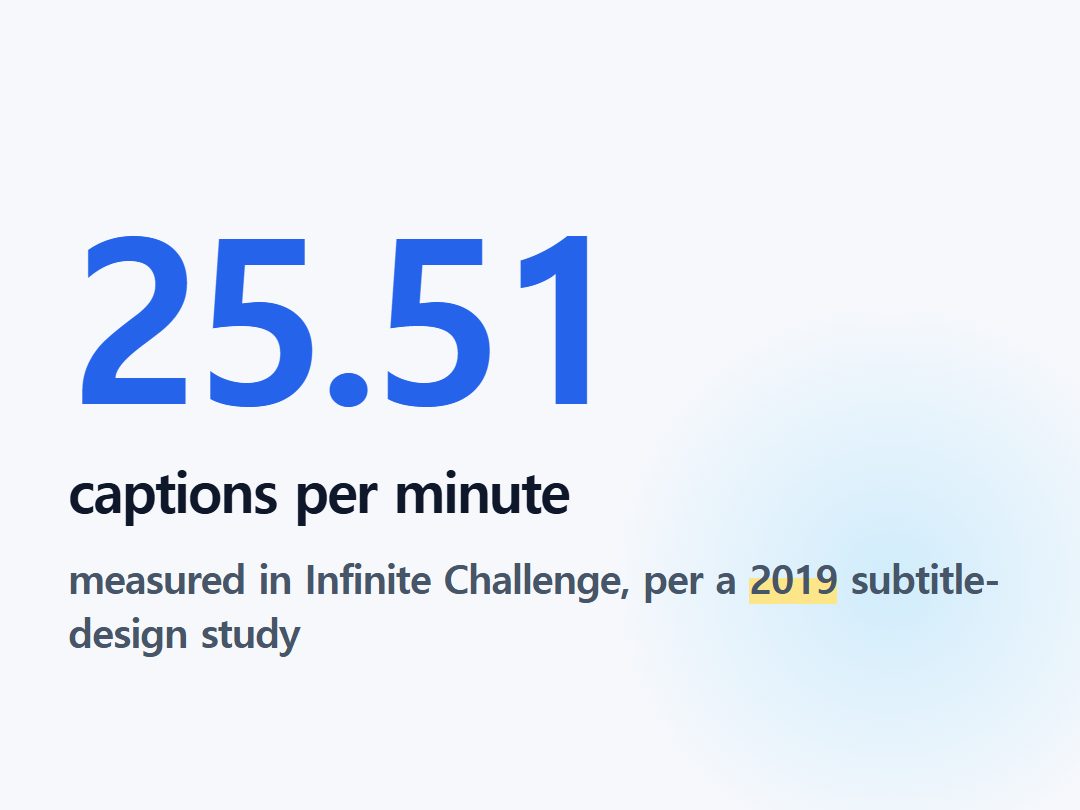
A 2019 academic study of subtitle design in Korean variety programming, focused on the long-running MBC show Infinite Challenge, measured just how dense this gets: an average of 25.51 separate caption instances per minute, each staying on screen for roughly 2.35 seconds, with emoticon-style graphics appearing in 42 percent of them.
Replays work on the same logic. A three-second reaction shot might be shown again in slow motion, then zoomed in, then paired with a fresh caption pointing out a detail the audience missed the first time — stretching one moment of raw footage across several beats of finished television.
Editing is treated as authorship, not assembly
For international viewers, the instinct is to read all of this as decoration layered over content that would work fine on its own. That misses what the captions are actually doing, which is directing.
In the Korean broadcasting industry, editing is not treated as neutral assembly of footage — it is treated as authorship, on par with what a director or showrunner does in scripted television.
The person in charge of a show is a PD, short for producing director, a role that in Korean TV combines what English-language production would usually split between director, showrunner and editor.
A South Korean producer with around seven years of experience in reality and variety programming told The Korea Herald that captions function "like an extra narrator," adding layers of humor or emotion that raw footage alone would not communicate.
Producers describe the caption-writing process as effectively re-scripting the show after it has already been shot.
"It's like writing an additional script after the show is filmed."
That work falls to an editing PD working alongside dedicated subtitle writers, and it is slow: the caption pass on a single episode can take longer than the shoot itself, since every line of on-screen text is chosen to match the tone of that specific moment, whether the intent is comedy, sincerity or discomfort.
There is also a cultural logic behind why Korean shows lean on this so much more heavily than American unscripted formats do.
Lee Seong-min, a media and content production researcher at Korea National Open University, has argued that Korean variety shows aim to build "a shared, synchronized experience" between the cast's reactions and the audience's — captions cue viewers exactly when to laugh, when to feel secondhand embarrassment, when a moment is meant to land as sincere rather than ironic.
American variety and reality formats, by contrast, tend to leave more of that interpretation to the viewer.
Lee has also connected the format's loud, exaggerated humor to South Korea's high-pressure work culture, suggesting variety shows function partly as a release valve — a space where emotion can be performed openly and communally in a way daily life discourages.
There is a practical reason as well. Korean variety shows are frequently built around large, loud ensemble casts talking over each other in unscripted banter — Running Man alone runs seven regular cast members per episode.
Captions do the job a laugh track or a single host does in other formats: they tell the audience which of several overlapping conversations is the one worth following, and why it's supposed to be funny.
Where did Korea's caption-heavy style come from?
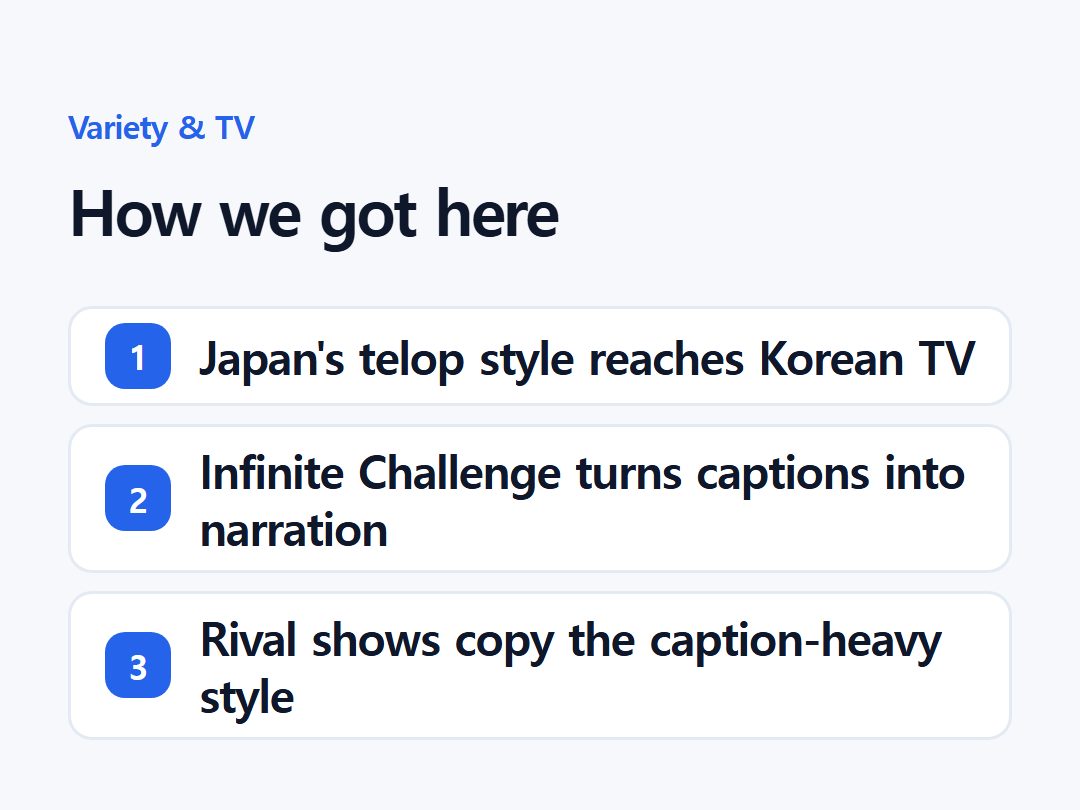
The convention did not start in Korea.
Superimposed on-screen text — known in Japanese broadcasting as telop, a term that traces back to an American television title-projection device from the 1950s — became a defining feature of Japanese variety and game shows from the 1970s and 1980s onward, according to media scholars who have studied the format across East Asian television.
Korean producers borrowed the basic technique from Japanese variety programming and, over the following decades, adapted it into something distinctly Korean: less about labeling who is speaking, more about editorializing on what they said.
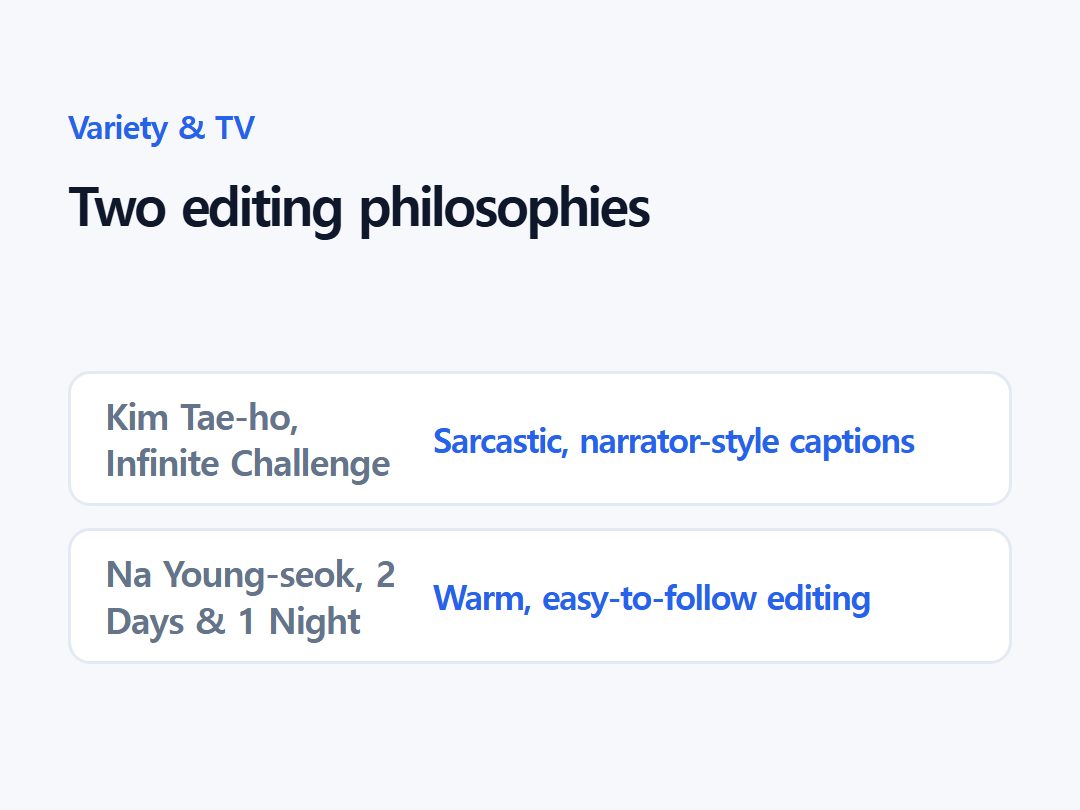
The turning point most often cited in Korean television history is Infinite Challenge (무한도전), the MBC show that ran from 2005 to 2018 under producer Kim Tae-ho. Earlier Korean variety shows had used captions mainly to highlight important lines of dialogue.
Infinite Challenge went further, adding captions that mocked, narrated and second-guessed the cast from an outside perspective — commentary nobody in the room had actually said.
Kim's editing voice became central enough to the show's comedy that fans and commentators began referring to him as its unofficial eighth member, on a cast of seven.
The show is widely credited with normalizing caption-driven, editor-as-narrator storytelling across Korean television, and competing programs adopted variations of the style in the years that followed.
Not every show followed the same caption philosophy, which is itself instructive. 2 Days & 1 Night, the long-running rival travel show produced in its most-watched early seasons by Na Young-seok, built its identity on gentler, easier-to-follow editing aimed at a broad, all-ages audience, rather than Infinite Challenge's sharper, more sarcastic tone. "Caption-heavy" is a spectrum, not a single house style, even within the genre's biggest hits — and the specific tone of a show's captions is often the clearest signal of who is editing it.
Can Korean caption humor be translated for streaming?
The format keeps evolving, and its next test is largely international.
As Korean variety shows reach wider audiences through streaming platforms, producers and localization teams face a problem the original captions were never designed to solve: these graphics are baked directly into the video rather than stored as a separate subtitle file, so they cannot be auto-translated and must be manually recreated, language by language, on top of an already labor-intensive production process.
Reception abroad remains mixed. Some international fans have come to see the caption style as part of the genre's charm and comedic rhythm; others, used to the comparatively minimal on-screen text of Western unscripted formats, describe the effect as sensory overload.
Inside Korea, the style keeps shifting as editing personnel change.
Running Man's captions were criticized through the mid-2010s as stilted, before a change in its producing team was credited with sharpening the show's caption writing into something closer to the confident, sarcastic tone associated with Infinite Challenge.
That pattern — an incoming PD reshaping a show's caption identity for better or worse — suggests the format will keep changing as a new generation of editing PDs takes over Korea's biggest variety franchises, even as the underlying convention stays the same: on screen, the text is not an afterthought. It is the direction.
How caption style differs across three shows
| Show | Caption Style | Notable Detail |
|---|---|---|
| Infinite Challenge (2005–2018) | Sharp, sarcastic, editor-as-narrator | Credited with normalizing caption-driven storytelling; PD Kim Tae-ho called the show's "unofficial eighth member" |
| 2 Days & 1 Night | Gentler, easier-to-follow editing | Aimed at a broad, all-ages audience under producer Na Young-seok |
| Running Man | Criticized as stilted, mid-2010s | Sharpened toward a confident, sarcastic tone after a producing team change |
Frequently asked
Why do Korean variety shows have so much on-screen text?
Editors treat captions as a second layer of writing added after filming that directs how the audience should feel, since editing is considered authorship on par with directing in Korean TV.
What is a PD in Korean television?
PD stands for producing director, a role that in Korean TV combines what English-language production usually splits between director, showrunner and editor.
Which show started the caption-heavy trend in Korean variety TV?
Infinite Challenge (2005–2018), produced by Kim Tae-ho, is widely credited with normalizing caption-driven, editor-as-narrator storytelling across Korean television.
Sources
Every factual claim above is traceable. We do not translate articles — we gather facts from multiple outlets and write them ourselves.
- Why Korean variety shows are so text-heavy — and why it works — The Korea Herald
- Study on Subtitle Design in South Korean Variety Show — ECEI 2019 Conference Proceedings
- Telop, Affect, and Media Design: A Multimodal Analysis of Japanese TV Programs — SAGE — Discourse, Context & Media
- The Magic of Laughter and Editing — The Unique Charm of Korean Variety Shows Captivating the World — Korean Story
- 무한도전/프로그램 구성/자막 (Infinite Challenge / Program Composition / Subtitles) — NamuWiki
- Kim Tae-ho (PD) — NamuWiki