
International fans usually meet the phrase 'slave contract' as a footnote to a 2009 lawsuit. Korean fans know it as a specific checklist of clauses, and one item on that list was plastic surgery.
The short version
- Agencies front surgery costs, then deduct them from an idol's future earnings.
- No contract names 'plastic surgery' — it hides inside general training debt.
- Korea's 2026 contract reform adds protections but still doesn't itemize surgery debt.
There is no single, standard sentence in a K-pop contract that reads 'trainee must undergo surgery.' What is documented, across more than a decade of reporting and at least one court ruling, is something narrower and more durable: agencies routinely pay for a trainee's cosmetic procedures up front, then recover that money from the artist's own future earnings.
That distinction is exactly the context that gets lost in translation. Overseas coverage tends to flatten the story into one shocking clause. Korean reporting, court records, and idols themselves describe something closer to an accounting habit that has outlived three separate rounds of government reform.
The surgery isn't the clause — the debt is
In Korea's agency system, entertainment companies recruit teenagers as trainees, house them, and pay for years of vocal, dance, and language coaching before anyone debuts. None of that is a gift. It is booked as an advance the trainee owes back once they start earning.
Two plastic surgeons who work with idol agencies told Koreaboo in 2019 that this is exactly how cosmetic procedures get financed. 'Agencies introduce hospitals to idols, and when they pay the idols, the money for treatments is deducted from the payment,' one said — meaning the company fronts the bill, then subtracts it later, the same way it subtracts dorm rent or dance lessons.
Most trainees sign that first contract between the ages of thirteen and sixteen, with a parent co-signing. At that age, and with a company deciding who gets to debut, few families are positioned to argue over which costs they will owe back years later.
What a 'training cost' can quietly include
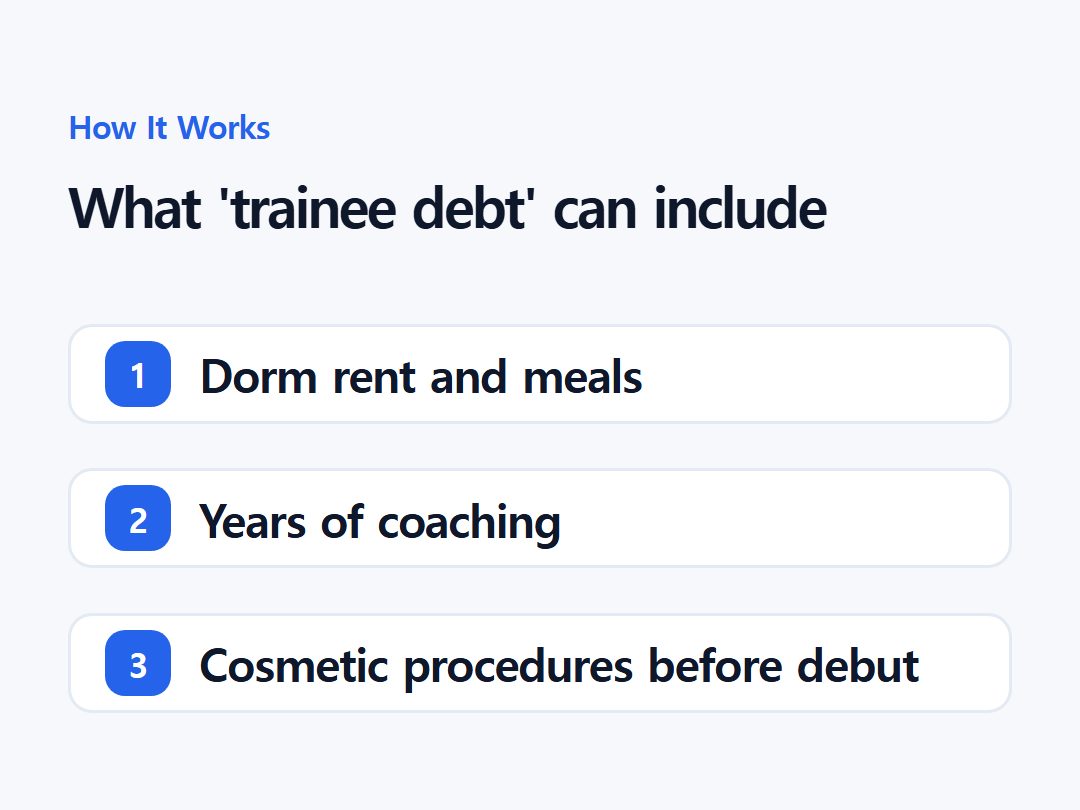
Because Korean contracts and internal ledgers rarely itemize this debt in public, most of what is known comes from leaked figures, court filings, and idols speaking on air. The costs commonly folded into it include:
- Dormitory rent, meals, and transportation
- Vocal, dance, and foreign-language lessons
- Styling, photoshoots, and promotional material
- Cosmetic procedures the company recommends before debut
A 2013 report by the Korean outlet E-News, translated and discussed widely in English-language fan media, described managers admitting that some debut contracts carried vague clauses on required procedures — with no clear language on who was liable if something went wrong.
The same report quoted trainees who said they would accept a required procedure as long as it wasn't 'severely dangerous,' and an acting student who called the practice 'a well accepted fact of the industry' -- language that shows how normal the arrangement felt even to people who hadn't signed a contract yet.
Why clinics and agencies both have a stake
The financing isn't one-sided. The same Koreaboo interview describes agencies negotiating discounted rates with partner hospitals in Gangnam, Seoul's cosmetic-surgery district, in exchange for sending a steady stream of clients their way. Clinics, in turn, use before-and-after photos of idols who trained there as marketing material.
That arrangement doesn't need a written 'plastic surgery clause' to function. It only needs a debt category broad enough to absorb whatever a company decides a trainee needs before debut.
One idol's number: 200,000 won after three debt-free years
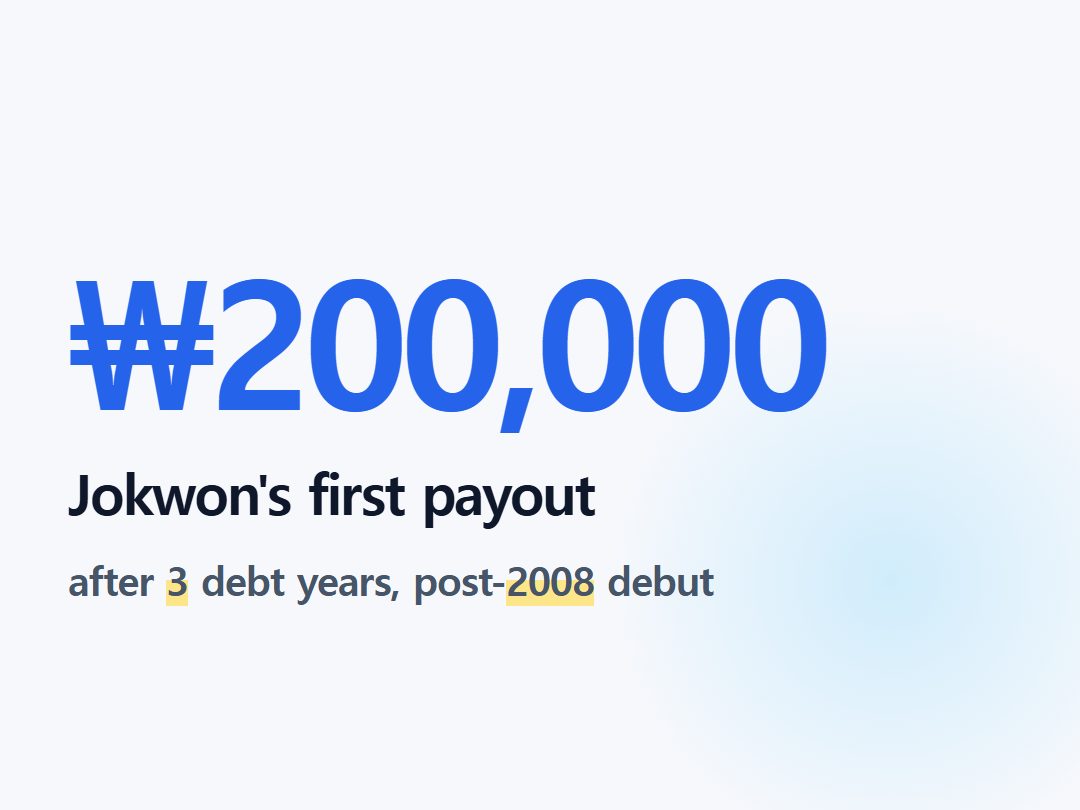
The clearest public illustration of how this debt works has nothing to do with surgery specifically, which is part of the point — it's how normalized the mechanism is. Jokwon of 2AM trained for eight years at JYP Entertainment before debuting in 2008.
Everything invested in a trainee was debt. Housing, meals, training — the company covers it first, and you settle up after you debut.
He said this on the Korean variety show Bap-eun Meokgo Daninya — a talk format where celebrities discuss their careers candidly — recalling that his first settlement, three years after a hit single and multiple ad deals, came to 200,000 won, roughly $150.
The 2009 lawsuit that forced the first rulebook
The term 'slave contract' entered international coverage in 2009, when three members of TVXQ sued SM Entertainment to void a 13-year exclusive contract. They argued it gave the agency near-total control over their schedules, earnings, and personal choices for over a decade.
Later research compiling similar contracts describes a recurring bundle of personal-life restrictions alongside the financial terms: bans on dating, dietary and weight requirements, curfews, and clauses touching on cosmetic procedures. Plastic surgery, in other words, was documented as one item in that bundle, not a standalone scandal.
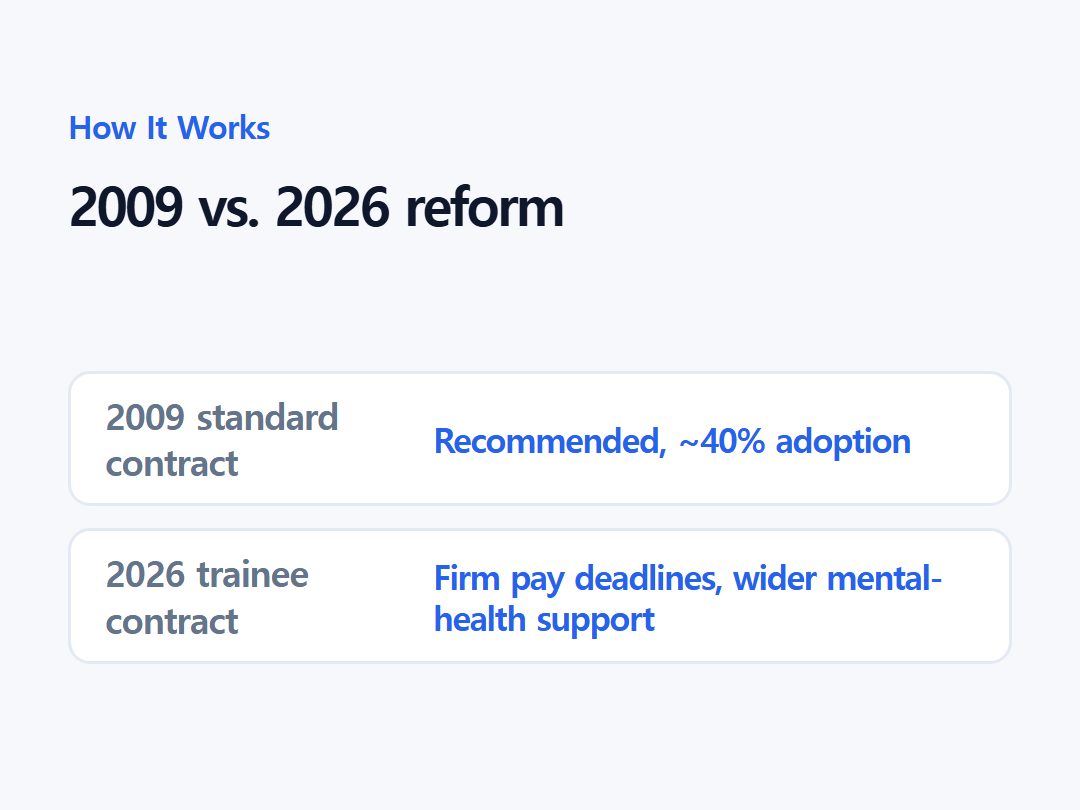
A Korean court sided with them. That ruling pushed the Fair Trade Commission to publish Korea's first standard exclusive contract for entertainers in July 2009, recommending a cap of roughly seven years and clearer terms on profit-sharing and personal restrictions.
A standard contract only four in ten agencies used
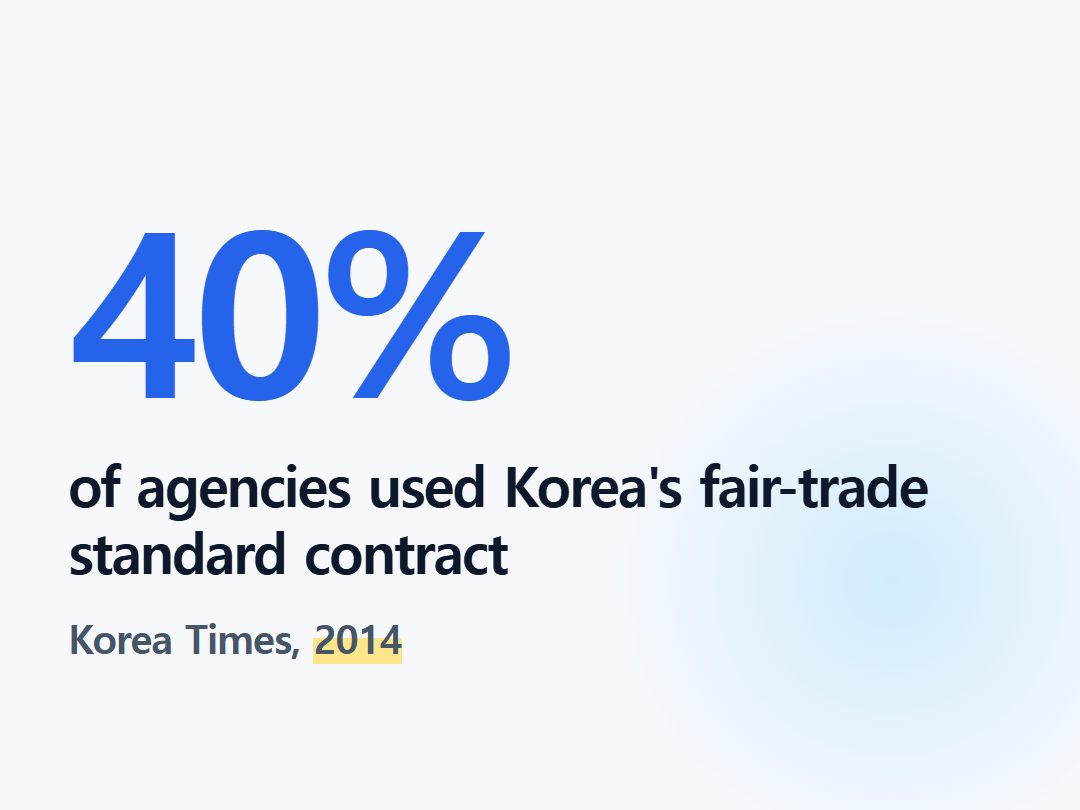
The catch: the FTC's standard contract was a recommendation, not a law. Agencies could still write their own. A December 2014 Korea Times investigation found that only about 40 percent of management agencies actually used it.
An FTC official told the paper plainly that the commission had 'no plans to amend loopholes in contracts, or monitor contract practices in the entertainment market.' A representative for JYP Entertainment — one of the larger agencies — acknowledged the standard terms were fairer, but that adoption across the industry remained voluntary.
An official at the Federation of Korean Music Performers put it more bluntly to the same paper: many agencies used an in-house version of the contract that didn't fully cover the standardized terms, because that version simply carried no legal obligation to follow them.
Courts keep finding the same accounting logic
The specific complaint has shifted over the years, but the underlying structure keeps resurfacing in court. Singer Chuu, formerly of the group LOONA, sued her agency Blockberry Creative in December 2021 to void her exclusive contract.
In June 2024, South Korea's Supreme Court finalized a lower-court ruling in her favor. Judges found that Chuu's activities generated roughly 860 million won (about $620,000) in net profit between 2016 and 2021.
Yet the agency's revenue-split formula meant she could be entitled to nothing unless earnings first cleared a fixed threshold -- a structure the court called unreasonable no matter how much her earnings grew.
The case wasn't about surgery. It illustrates the same cost-first settlement logic that makes surgery debt possible in the first place: a company-authored formula decides what an artist is owed only after every expense the company assigns has been subtracted.
What changed on January 1, 2026 — and what didn't
South Korea's Ministry of Culture, Sports and Tourism rolled out a revised standard trainee contract at the start of 2026, built on an amended Popular Culture and Arts Industry Development Act. Three changes stand out:
- Fixed deadlines for paying damages or penalties, replacing vague 'reasonable period' language
- Mental-health treatment support widened from 'severe depression' to depression generally
- Explicit bans on verbal abuse, coercion, and sexual harassment toward minor trainees
None of that revision creates a specific, named category for cosmetic-procedure costs. Surgery debt, where it exists, still sits inside the same general 'training cost' bucket it always has — now paid back on a clearer timeline, but not separately disclosed or capped.
The accounting gap the new rules don't close
Fifteen years after the TVXQ case forced Korea's first standard contract, and one year into the newest revision, the specific mechanism international fans associate with 'plastic surgery clauses' — an agency-funded procedure recovered as debt — has never been named, banned, or separately itemized in any of the official templates.
That gap matters because it's structural, not accidental. As long as cosmetic costs can be booked as an undifferentiated training expense, an agency isn't required to say, in writing, that it paid for an idol's surgery at all — only that the idol owes money back.
Korea's slave-contract reforms, one court case at a time
| Year | Event | Result |
|---|---|---|
| 2009 | TVXQ sue SM Entertainment to void a 13-year contract | Court rules for TVXQ; FTC issues Korea's first standard exclusive contract |
| 2014 | Korea Times investigates who actually uses that standard contract | Only about 40 percent of agencies had adopted it |
| 2021–2024 | Chuu sues Blockberry Creative over her exclusive contract | Supreme Court calls the agency's revenue-split formula unreasonable |
| 2026 | Revised standard trainee contract takes effect January 1 | Adds payment deadlines, wider mental-health support, abuse bans — no surgery-debt rule |
Frequently asked
Do K-pop idols have to get plastic surgery in their contracts?
No standard clause requires surgery, but agencies commonly pay for procedures upfront and deduct the cost from an idol's future earnings, the same way they deduct dorm rent or lessons.
What is a K-pop 'slave contract'?
The term comes from the 2009 lawsuit where three TVXQ members sued to void a 13-year exclusive contract that combined heavy training debt with personal-life restrictions like dating bans and curfews.
Did Korea change its idol trainee contract rules in 2026?
Yes, a revised standard trainee contract took effect January 1, 2026, adding fixed payment deadlines, wider mental-health support, and explicit abuse bans, but it still doesn't separately itemize cosmetic-surgery debt.
Sources
Every factual claim above is traceable. We do not translate articles — we gather facts from multiple outlets and write them ourselves.
- K-pop stars punished by unfair contracts — The Korea Times
- Slave contract — Wikipedia
- Who Really Pays For Idols' Plastic Surgery? K-Pop Surgeons Reveal The Truth — Koreaboo
- Who pays for Kpop idols' plastic surgery? — KBIZoom
- "데뷔 후 3년 동안 20만원 정산"…연습생에 드는 돈 얼마길래 — Hankyung
- 걸그룹멤버 츄 "번 만큼 못 받았다"… 소속사의 '비정상 정산'을 꼬집은 법원 — 법률신문 (Law Times)
- 아이돌 연습생 정신 건강 치료 확대 — 서울신문 (Seoul Shinmun)
- Agencies force plastic surgery contracts for debuts — Netizenbuzz (via E-News/Nate)