Type "do Koreans eat with their mouths open" into a search bar and the assumption is already baked into the question. It reads like a documented cultural trait, the kind of line that ends up in a travel guide before a trip to Seoul.
The short version
- Korean etiquette actually demands quiet, closed-mouth chewing, not loud eating.
- The loud-eating stereotype comes from mukbang broadcasts, not real dining habits.
- Noodle slurping is practical, not a compliment to the cook.
The documented reality runs the other way. Korean table manners teach the opposite: chew quietly, keep your lips closed, don't let anyone see or hear what's in your mouth. The stereotype didn't come from an etiquette book. It came from a broadcast genre that made eating sound louder than it usually is.
The short version: no, not as a rule. What follows is where that search term actually comes from, and why the real answer is more interesting than a yes or no.
The rule most Koreans were taught growing up
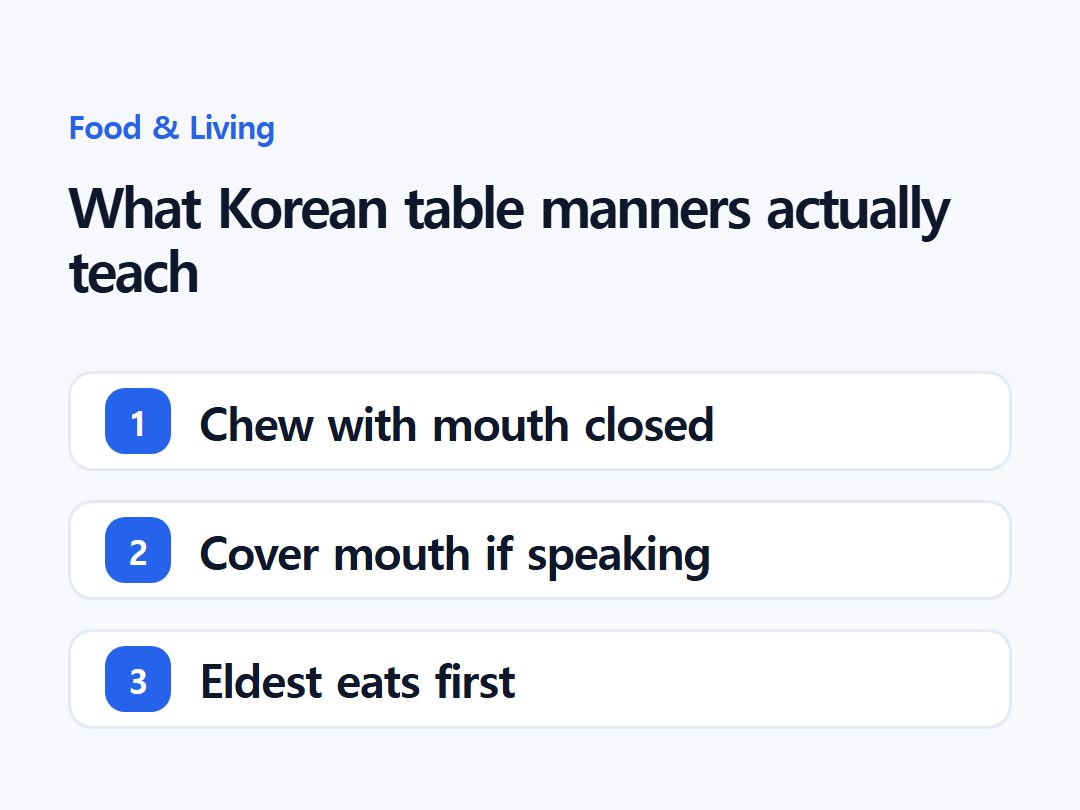
Ask Korean parents what they told their kids at the table and the answer is consistent: chew with your mouth closed, and if you must talk with food still in it, cover your mouth with your hand first.
A 2022 thread on the Korean community site 82cook, started by a woman whose mother-in-law had criticized her chewing, drew dozens of replies defending the closed-mouth rule as basic manners, not personal taste. One reply summed up the consensus bluntly: chewing with an open mouth "makes a smacking sound and shows the food — that's what looks uneducated."
A separate explainer aimed at foreigners living in Korea reaches the same conclusion independently, describing the expected behavior as chewing with a closed mouth and covering it with a hand rather than speaking through food. Two unrelated sources landing on the identical rule is a stronger signal than either one alone.
- Chew with your mouth fully closed
- Cover your mouth if you speak while eating
- Never let food be visible while chewing

The specific sound Korean manners actually police
Korean even has a dedicated word for the behavior people object to: jjeopjjeop (쩝쩝), the wet smacking sound of chewing with an open mouth. It isn't a vague complaint about noise in general — it names one specific sound.
That distinction matters, because it separates open-mouth chewing from something else: slurping a bowl of noodles, which guides to Korean dining treat as a different behavior with its own, much more relaxed rules.
Talking with a full mouth is policed separately again. Even guides that treat slurping as harmless still list open-mouth chewing and speaking through food as the two habits most likely to draw a quiet correction from an older relative.
Why noodles get treated differently
Popular explainer sites often describe noodle slurping in Korea as a "compliment to the cook." A closer look points to something more mechanical: pulling hot noodles through pursed lips draws in cool air along with them, cooling the noodles before they burn your mouth.
That practical function is also why the sound varies by dish. A bowl of hot kalguksu (knife-cut noodle soup) invites slurping; naengmyeon, served cold, produces almost none, because there's no heat to manage in the first place.
The same confusion shows up next door. English-language food writing has long taught readers that slurping ramen in Tokyo is polite, and travelers carry that Japanese rule into Korea, where it was never really the point — the noise is a side effect of eating hot noodles fast, not a gesture of respect.
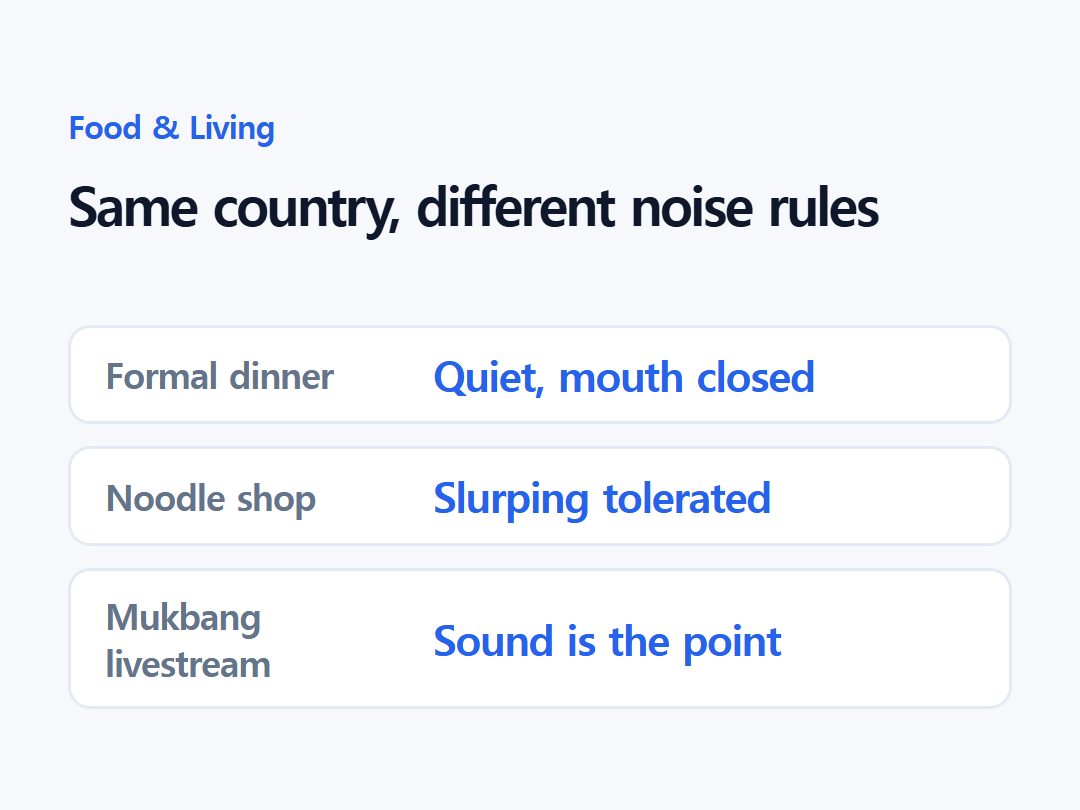
| Setting | Typical noise level |
|---|---|
| Dinner with elders | Quiet, mouth closed |
| Casual noodle shop | Slurping tolerated |
| Mukbang livestream | Sound is the entire point |

Where the loud-eating image actually comes from
Two Korean media exports likely built the stereotype. The first is Korea's outsized presence in mukbang, the eating-broadcast genre, where hosts often exaggerate chewing and slurping sounds on purpose because the microphone is the point.
The second is a variety-show bit sometimes called "myeon-chigi," in which celebrities compete to slurp down noodles as fast and loudly as possible for laughs. It's a performed stunt for television, not a demonstration of how people eat at home.
A livestream for people eating alone became a global genre
Mukbang — a blend of the Korean words for "eating" (meokda) and "broadcast" (bangsong) — is generally traced to South Korea's AfreecaTV livestreaming platform in the late 2000s.
Its early appeal was less about noise than company. As more Koreans began eating alone, watching someone else eat over a live chat gave isolated viewers something close to a shared meal.
Sound only became central later, as one branch among several. Alongside "storytime" and eating-challenge formats, ASMR mukbang turned chewing, slurping, and crunching into the main event. Once the format moved to YouTube, creators outside Korea built entire channels on the same loud-eating formula, detaching the genre from the everyday Korean habits it was never really describing.
That last step matters most for how the stereotype travels. A viewer who has never eaten a meal in Korea, but has watched hundreds of hours of Korean-language mukbang, reasonably assumes the microphone is capturing normal life. It's capturing a job.
A seating order that still starts with the oldest person
The quiet-chewing rule sits inside an older framework of table hierarchy. Korean dining etiquette, shaped by Confucian norms carried over from the Joseon dynasty, has long held that the eldest person at the table eats first, with everyone else following.
Self-restraint at the table — controlling when you eat and how loudly you chew — comes from the same root. A shared meal was a small stage for showing respect, not a private moment to enjoy food however you liked.
Modern restaurant customs still carry traces of this. The MICHELIN Guide's own etiquette notes point to Korean diners preferring private rooms for group meals and letting the youngest person at the table deliver a short toast — small rituals that only make sense if the group, not the individual, sets the pace of the meal.
An Oxford case for chewing the "wrong" way
Not everyone accepts the closed-mouth premise on its merits. Oxford experimental psychologist Charles Spence has argued that chewing with an open mouth can improve flavor, because it lets more aromatic compounds reach smell receptors in the nasal cavity.
Spence has made a related point about texture: people tend to enjoy foods that make more noise when eaten, which is part of why a crisp apple reads as fresher than a soft one. By that logic, a food culture that suppresses eating sounds is suppressing part of the flavor experience along with it.
The idea that noisy eating signals real enjoyment isn't unique to Korea, either. A 2005 UK fried-chicken ad showing people singing with full mouths drew more than 1,600 complaints — evidence that discomfort with open-mouth eating runs deep in supposedly reserved Western etiquette too.
So does Korean etiquette actually forbid it?
On paper, yes. Closed-mouth, low-noise chewing is the standard Korean children are taught and adults are expected to keep. But the 82cook thread that surfaced this rule wasn't really about etiquette in the abstract — it was one woman defending herself against an in-law who was using table manners as a proxy for a different family conflict.
That's a reminder that even a well-documented rule gets applied unevenly, depending on who is doing the judging and why. A rule can be real and still get invoked selectively.
What's still unresolved
Enforcement varies by generation and setting. Younger Koreans eating casually with friends are far more relaxed about noise than the same people would be at a formal dinner with elders, and no source treats the rule as absolute.
Dish type keeps mattering too — a hot noodle shop, a formal family dinner, and a livestreamed ASMR video sit at three different points on the same scale, and none of them is the whole picture on its own.
What stays consistent across sources is the gap the search term reveals. International viewers are watching a produced broadcast genre and mistaking it for a norm, when the actual norm — documented in etiquette guides and defended by Koreans themselves — points the other way.
Noise tolerance by setting
| Setting | Typical noise level |
|---|---|
| Dinner with elders | Quiet, mouth closed |
| Casual noodle shop | Slurping tolerated |
| Mukbang livestream | Sound is the entire point |
Frequently asked
Why do Koreans slurp noodles?
Slurping pulls hot noodles through pursed lips, drawing in cool air that cools them before they burn your mouth — it's practical, not a compliment to the cook.
What is mukbang?
Mukbang is a Korean eating-broadcast genre traced to AfreecaTV livestreams in the late 2000s, where hosts often exaggerate chewing and slurping sounds for the microphone.
Is it rude to chew with your mouth open in Korea?
Yes — Korean etiquette teaches closed-mouth, quiet chewing, and covering your mouth with your hand if you must speak while eating.
Sources
Every factual claim above is traceable. We do not translate articles — we gather facts from multiple outlets and write them ourselves.
- 식사 예절 어긋나도 음식 입 벌리고 소리내 씹어야 더 맛있어 — Segye Ilbo
- Etiquette 101: A Korean's Guide to Dining — MICHELIN Guide
- Slurping Noodles in Korea: Loud Is Fine, These Three Things Aren't — KoreaPlug
- Eating and Drinking Customs in Korea — Facts and Details
- 음식 먹을 때 입 벌리고 씹어야 맛있게 먹는 것처럼 보이나요? — 82cook.com
- Why Do Korean People Eat With Their Mouth Open? — Unpackorea
- Mukbang Meaning: 5 Honest Facts Behind Korea's Viral Food Trend — Korean Glimpse
- What Does 'Mukbang' Mean? Eating on Camera, Explained — Haven Unchi