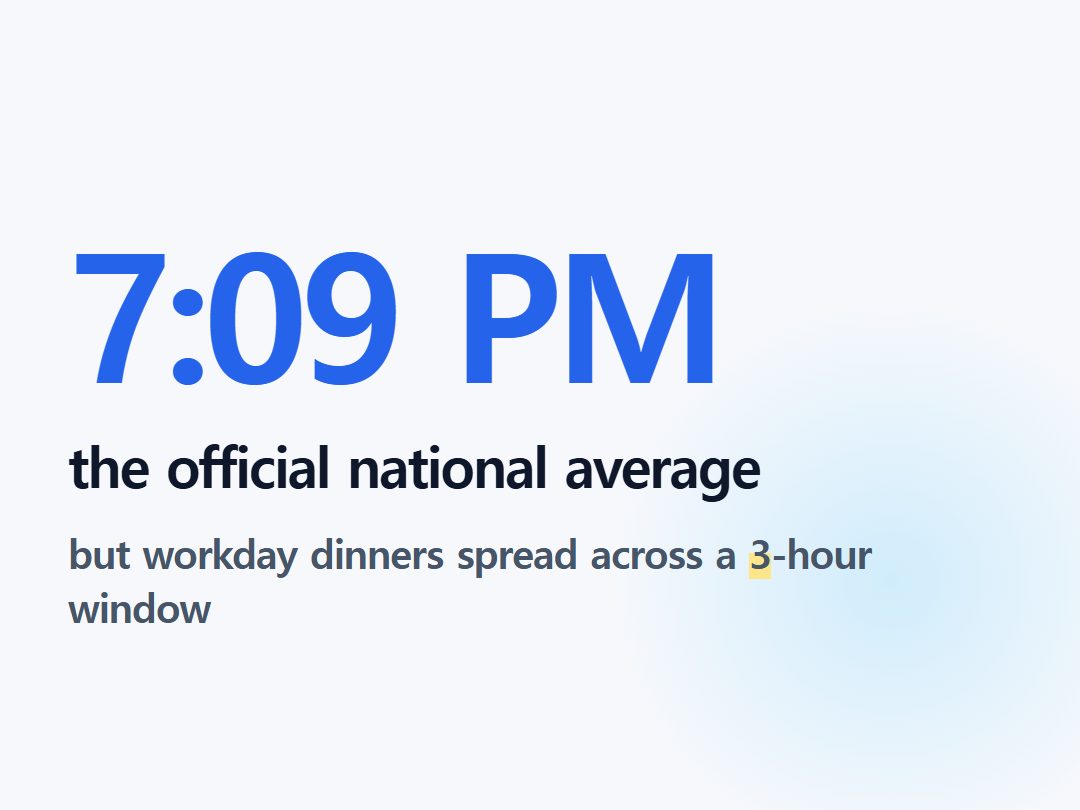
Statistics Korea has an official number for this: Koreans eat dinner at 7:09 p.m. on average, according to the agency's time-use survey. It sits neatly between breakfast at 7:43 a.m. and lunch at 12:32 p.m., a tidy three-meal rhythm.
The short version
- Koreans eat dinner at 7:09 p.m. on average, but the real time varies widely.
- Weekday dinner times spread across three hours because of overtime and hoesik dinners.
- Younger workers are pushing back, preferring alcohol-free lunches over late-night hoesik drinking.
The average is real, and it is also almost useless for predicting when any one person in Seoul actually sat down to eat last night. Academic analysis of the same government dataset found that while breakfast and lunch on workdays cluster inside a two-hour window, dinner on workdays is spread across a full three-hour range — and roughly a third of workday dinners aren't eaten at home at all.
The number that hides the variance behind it
A single average dinner time only makes sense if most people eat around the same hour. In Korea, on a weekday, they don't. The 7:09 p.m. figure blends office workers who left at 6 sharp with colleagues still at their desks, plus everyone in between at a company dinner that hasn't even started yet.
That spread has two causes in Korean workplace life that most international readers never encounter by name: 야근 (yagun, informally expected overtime) and 회식 (hoesik, the team dinner that is mandatory in practice if not on paper). Both push the evening meal later, and neither works the way a Western reader might assume from the English words "overtime" or "team dinner."
The one clue hiding in the government's own data
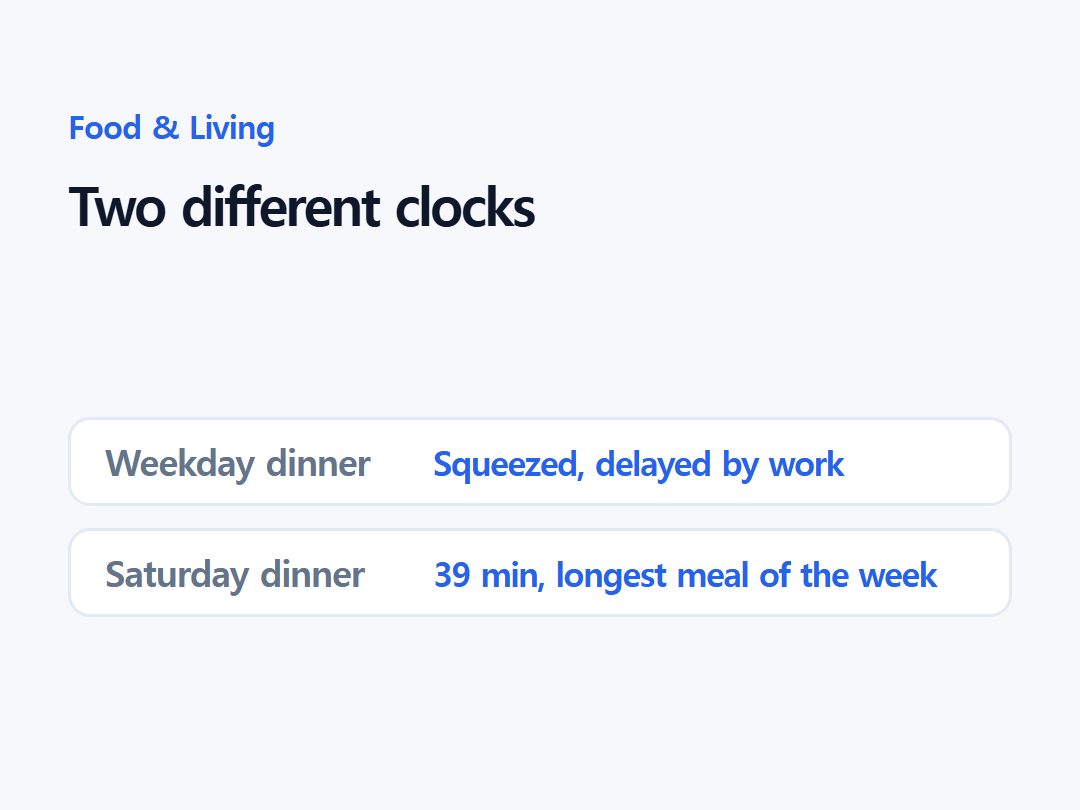
Statistics Korea's 2019 time-use survey recorded not just when people eat, but how long they take. Weekday breakfast was the shortest meal of the week, at 25 minutes. Saturday dinner was the longest, at 39 minutes.
That gap is a rough proxy for who controls the schedule. On a workday, dinner gets squeezed by whatever the office and the hoesik calendar allow. On a Saturday, with no overtime and no team dinner, the same meal nearly doubles in length — which means the 7:09 p.m. average is quietly combining a squeezed weekday meal with a relaxed weekend one.
Why quitting time doesn't mean going home
South Korea's standard workweek is capped by law at 52 hours — 40 regular hours plus up to 12 hours of overtime, a limit that wasn't even extended to weekend work until 2018. Before that amendment, a workweek of up to 68 hours was legal and common.
A 2014 Ministry of Employment and Labor survey of 1,300 workers found that only 26.5% left work on time all five weekdays. Among those who didn't, the reasons workers gave were rarely about the workload itself:
- 25.8% said their company culture simply takes overtime for granted
- 20.9% cited low productivity during official working hours
- 10% said they felt direct pressure to stay
- 6.4% pointed to an unusually heavy workload that week
Underneath the numbers is an unwritten rule: an employee is expected to remain until a supervisor leaves, whether or not their own tasks are finished. That habit alone is enough to turn a 6 p.m. dinner into an 8 p.m. one.
Hoesik: the dinner that isn't officially mandatory
Hoesik translates literally as "gathering to eat," and it is the mechanism that most directly delays the evening meal. Attendance is technically voluntary. In practice, skipping one — especially as a junior employee — can be read as a lack of commitment to the team.
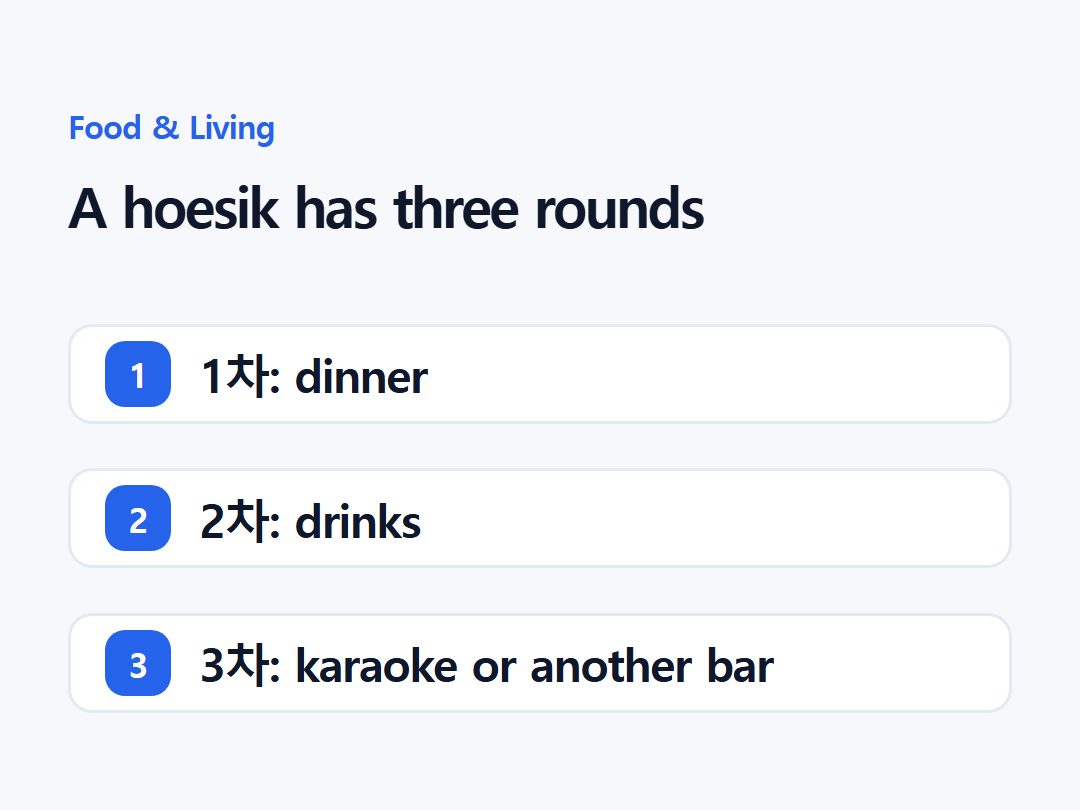
A single hoesik is rarely just one dinner. Korean drinking culture divides the event into numbered rounds, each at a different venue:
- 1차 (il-cha) — the dinner itself, usually grilled meat or a hot pot
- 2차 (i-cha) — a second stop for drinks, typically soju or beer
- 3차 (sam-cha) — often karaoke (노래방) or another bar
Seating and pace follow workplace hierarchy: the most senior person present effectively decides when the group starts eating and drinking. One documented workplace dispute involved a hoesik that ran until 10:50 p.m. — three and a half hours past the national dinner average.
What the delivery apps see instead of one dinner hour
Food delivery data offers an independent line of evidence for the same pattern. Baemin (배달의민족), Korea's largest delivery platform, defines its own internal "dinner peak time" starting around 5 p.m. and intensifying through 6 and 7 p.m. — but unlike a Western dinner rush, that peak keeps running well into the night.
Delivery riders describe the evening as busier and longer than the midday lunch rush, stretching from early dinner orders through late-night 야식 (yasik, late-night snack food) orders placed by people just getting home from a hoesik. The delivery peak doesn't mark one dinner hour — it marks the entire multi-hour window created by staggered quitting times.
How a 52-hour law got written around a much older habit
The legal cap on working hours is recent; the culture that made it necessary is not. Long hours and after-work socializing became normalized during Korea's rapid industrialization from the 1960s through the 1990s, when visible presence — staying late, drinking with the team — functioned as a stand-in for loyalty.
The 52-hour law, finalized in 2018, was meant to break that link. It hasn't fully succeeded: Korea still ranks among the OECD's top five or six countries for annual working hours, at roughly 1,872 hours a year against a French average of 1,490 and a German average of 1,349.
In 2023, the government tested how far the old habit still reached, proposing to raise the weekly cap from 52 to 69 hours by calculating overtime monthly instead of weekly. Younger workers, not employers, killed the proposal — a backlash strong enough that President Yoon Suk Yeol himself walked it back, saying anything past 60 hours would be unhealthy.
Where Korea's dinner drift fits next to other countries
The comparison international readers usually reach for is Spain, where dinner at 9 or 10 p.m. is simply the cultural norm — the whole country runs on the same late clock because the workday itself starts and ends later.
Korea's pattern is different in kind, not just in hour. Americans typically eat dinner in a tight window between 6 and 7 p.m. Korea's spread is wider than either country's, because it isn't one national clock running late — it's a single 7:09 p.m. average built from people eating at very different, individually unpredictable hours on any given weeknight.
The generation trying to end it, and the sectors where it hasn't
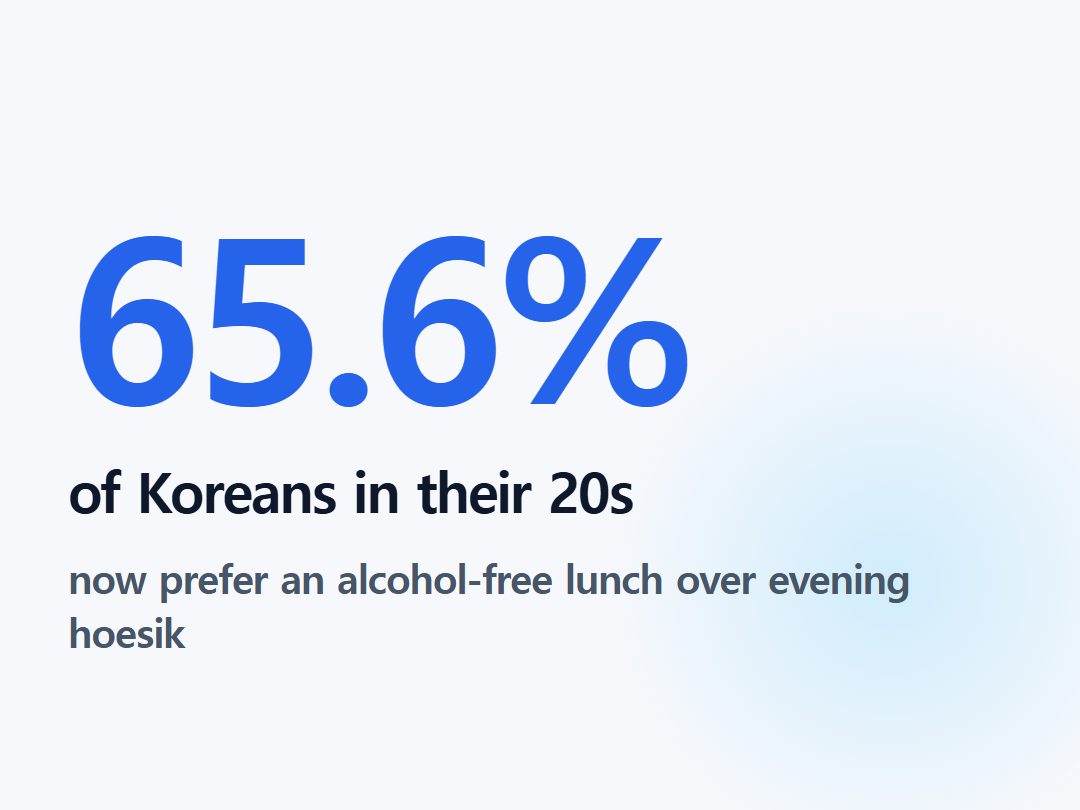
Younger workers are visibly opting out. One survey found 65.6% of people in their 20s now prefer an alcohol-free lunch gathering to an evening hoesik with drinking — a near-total reversal from workers over 50, of whom 68.7% still prefer the evening version.
A separate 2021 survey found just over half of workers, 50.5%, said they were comfortable with hoesik specifically when it wrapped up early and attendance wasn't forced — meaning the practice hasn't disappeared so much as been renegotiated around those two conditions.
That renegotiation is uneven. Banks, government offices, and older manufacturing firms are widely described as holding onto the late, multi-round hoesik far more than tech startups or newer companies. Which means the honest answer to "when do Koreans eat dinner" still needs a follow-up question: at which company, and how senior is the person answering?
The three rounds of a hoesik
| Round | Name | What happens |
|---|---|---|
| 1차 | il-cha | The dinner itself, usually grilled meat or a hot pot |
| 2차 | i-cha | A second stop for drinks, typically soju or beer |
| 3차 | sam-cha | Often karaoke (노래방) or another bar |
Frequently asked
What time do Koreans usually eat dinner?
Statistics Korea's time-use survey puts the average dinner time at 7:09 p.m., though workday dinners actually span a three-hour range.
What is hoesik in Korean work culture?
Hoesik is a team dinner that's technically voluntary but often expected, split into rounds — dinner, then drinks, then sometimes karaoke — that can push the meal well past 7 p.m.
Why do Koreans work such long hours?
South Korea's workweek is capped at 52 hours by law, but a culture of expected overtime (yagun) and staying until a supervisor leaves means many employees don't actually leave on time.
Sources
Every factual claim above is traceable. We do not translate articles — we gather facts from multiple outlets and write them ourselves.
- Koreans go to bed after 11 p.m. — The Korea Times
- 2019년 생활시간조사 결과 — KDI Economic Information & Education Center
- Characteristics of Korean Employees' Meal Structure on Working and Non-working Days: Analysis of the 2014 Korean Time Use Survey — Journal of the Korean Society of Food Culture
- [한-영 대조] 한국의 야근 문화 — The Korea Herald
- 'Hoesik' can help blow off steam, or spark unfortunate events — The Korea Herald
- Thinking food delivery platforms infrastructurally: The practices and politics of Baemin's infrastructuralisation in Seoul — New Technology, Work and Employment (Wiley)
- A 69-hour workweek? That's no way to live, young South Koreans say — NBC News
- Yearly working hours for Koreans fall by 200, but remain far longer than OECD average — The Korea Times
- The Typical Dinner Times In 12 Countries Around The World — The Daily Meal


