To an international reader, "webtoon" often means one thing: a vertically scrolling Korean comic, read on a phone. But inside Korea, which of the two dominant platforms — Naver Webtoon or Kakao Webtoon — carries a title is not a trivia detail.
It changes how creators get paid, how far a series can realistically travel overseas, and even which comics an app decides to put in front of a reader first. The two companies are structured differently enough that the same story can perform very differently depending on where it launches.
The short version
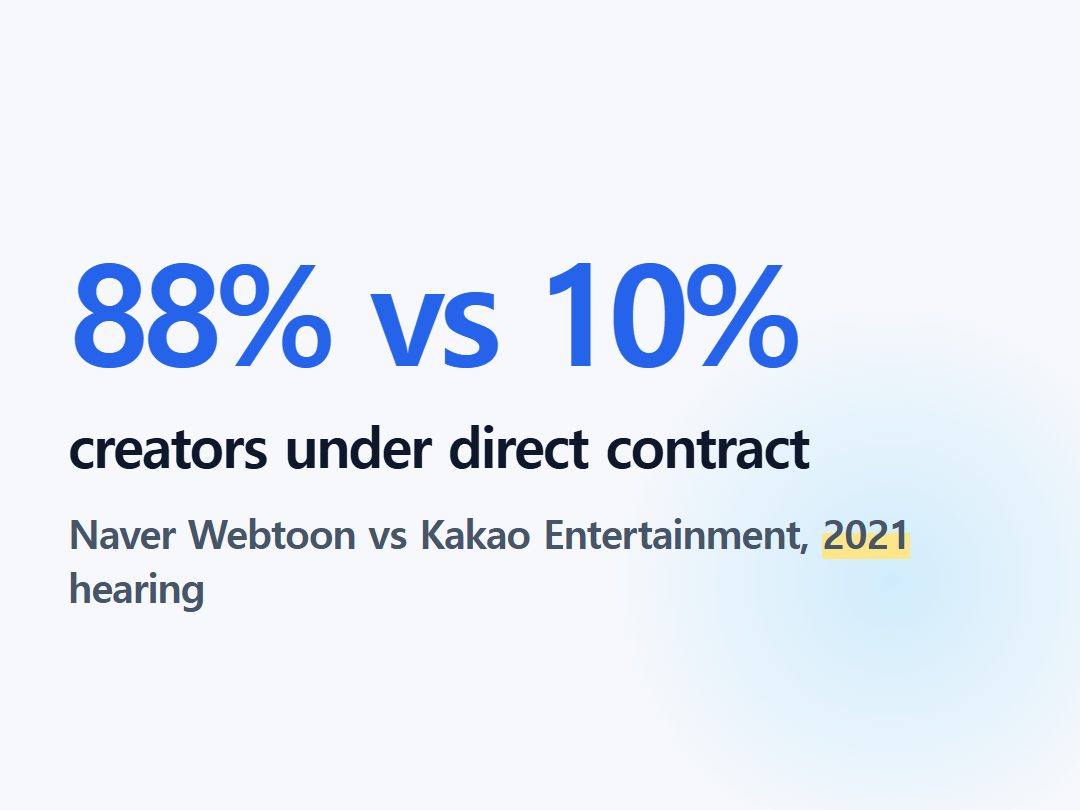
- Naver contracts most creators directly; Kakao relies on CPs for about 90%.
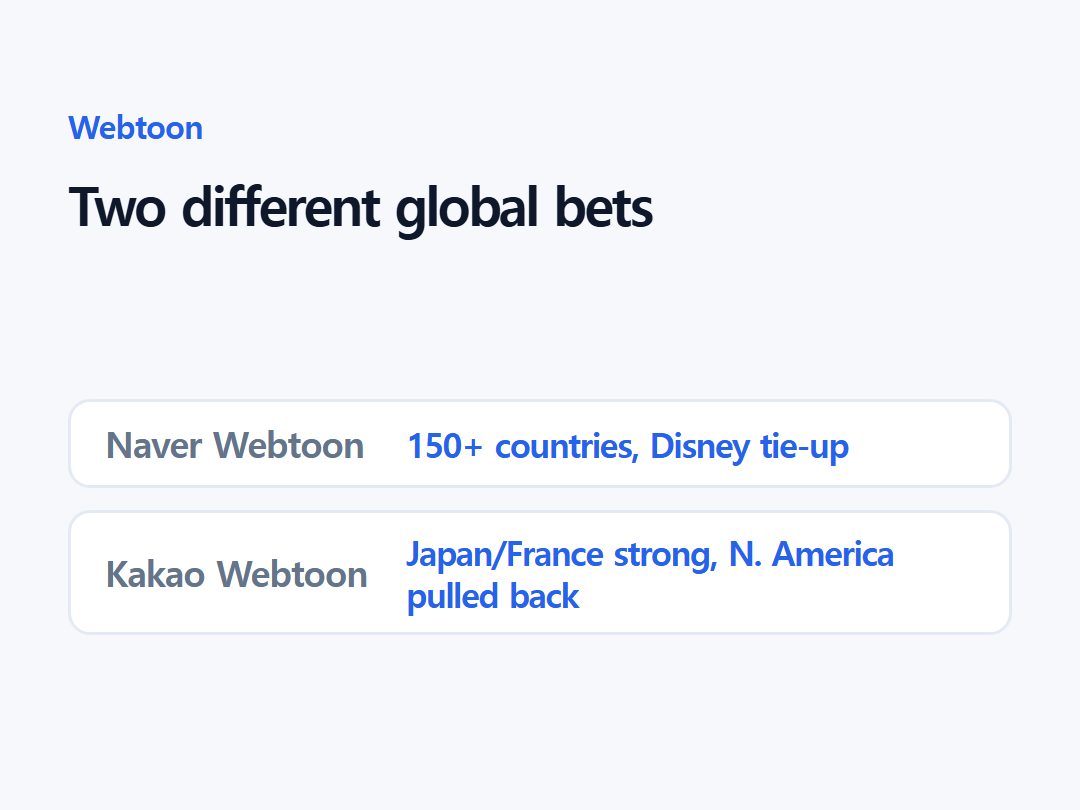
- Naver Webtoon reaches 150+ countries; Kakao's Piccoma dominates Japan instead.
- Kakao's North American bet collapsed — Radish shuts down by 2025.
Why are these platforms drifting further apart?
There is no single news event here — this is a structural gap that has widened as both platforms went global and, in Naver's case, public.
Naver Webtoon's parent, WEBTOON Entertainment, listed on the Nasdaq in June 2024 and reported roughly 1.96 trillion won (about $1.33 billion) in revenue for 2025, with income from IP licensing and adaptations up nearly 32% year-on-year.
Kakao Webtoon, meanwhile, is one of two overlapping apps run by Kakao Entertainment — the other being Kakao Page — and has spent the past two years retrenching its North American ambitions while leaning harder on its Japan-and-France platform, Piccoma.
These are no longer just two rival apps with different logos; they are running different business models.
How platform choice shapes pay, reach, and discovery
Who gets paid, and how
Every series on either platform runs on some version of MG (minimum guarantee — a fixed advance paid to the creator regardless of how the series performs) plus RS (revenue share — a percentage cut of what the series earns once it clears the MG). Where the platforms diverge is in who sits between the creator and that money.
At a 2021 National Assembly hearing on unfair contracts in the webtoon industry, Naver Webtoon CEO Kim Jun-koo testified that 88% of the platform's creators had contracts directly with Naver Webtoon rather than through a CP (content provider — an intermediary studio or publisher that manages a roster of artists and negotiates on their behalf, typically taking its own cut of revenue). Kakao Entertainment's direct-contract rate, by contrast, was about 10% at the same hearing, meaning roughly 90% of its webtoons reached the platform through a CP layer — a figure a later industry report found had stayed close to 90%.
Naver's own direct-contract share has since slipped too, estimated at 60–70% by 2023 as the platform took on more externally supplied content, but the gap with Kakao's CP-heavy model remains wide.
That gap has real financial and administrative consequences.
Every CP layer between a creator and the platform is another party negotiating — and often taking a percentage of — the split before it reaches the artist, and a creator under a CP contract is dealing with a private company rather than the platform directly when a dispute comes up.
Naver has also built a specific revenue-diversification program called PPS (Page Profit Share), launched in 2013, which pays regularly serialized creators a share of preview, advertising, and IP-licensing income on top of manuscript fees while letting them keep copyright.
Naver says PPS payouts grew from about 23.2 billion won in 2013 to roughly 2.03 trillion won in 2022 — an 87-fold increase — with the number of individual titles crossing 100 million won in annual transaction value rising from one to 904 over the same decade.
Kakao offers comparable RS-based payouts but has not published an equivalent long-run disclosure, which makes a direct comparison difficult.
Where the story travels
The platforms' overseas footprints are shaped very differently, which affects how far a hit can realistically go once picked up.
Naver Webtoon's global arm, spun out as WEBTOON Entertainment, already reaches more than 150 countries and has begun leaning on a partnership with Disney — which took a 2% equity stake in the company — to co-produce original series using Marvel, Star Wars, and 20th Century Studios characters; the first, a Formula 1-themed Mickey Mouse series, is scheduled to launch alongside the 2026 Australian Grand Prix.
As of 2022, Naver said 52% of the Korean-language titles serialized on its home platform were already generating revenue overseas, a sign of how systematically the company routes originals into its global pipeline.
Kakao's overseas strategy is narrower but, in one market, more dominant: its Japan-and-France platform Piccoma overtook Naver's LINE Manga to become Japan's top digital comics app, with Korean-origin webtoons reportedly generating roughly half of Piccoma's revenue despite making up only about 1% of its catalog.
Where Kakao has struggled is North America.
After acquiring the web-novel platform Radish for roughly $440 million in 2021 and folding it into Tapas Entertainment, Kakao recorded a 460 billion won (roughly $330 million) impairment on Tapas's value, liquidated Tapas's Korean subsidiary in 2025, and confirmed Radish would shut down entirely by the end of 2025.
In practice, a series that does well on Naver Webtoon inherits an already-built global distribution machine; a series that does well on Kakao Webtoon is more likely to find its clearest overseas opening through Japan and France than through the English-language market.
What the app decides to show you
The two platforms also disagree on how to surface titles, which affects whether a new or niche series gets discovered at all.
In 2021, Kakao Webtoon dropped its star-rating system for AI-driven recommendations that weigh art style, genre, and author similarity alongside reader behavior such as comments, likes, and reading history — an approach that tends to reinforce what is already popular by surfacing more of the same.
Naver Webtoon took a different approach in June 2024, switching its app's default homepage sort from a straightforward "most popular" ranking to a personalized "AI Curator" feed built around individual taste rather than broad popularity.
A Korea University analysis of the change found it measurably reduced concentration around top titles — click-through concentration fell by about 22%, page-view concentration by about 12%, and payment concentration by about 23%, compared with the old popularity-ranked default.
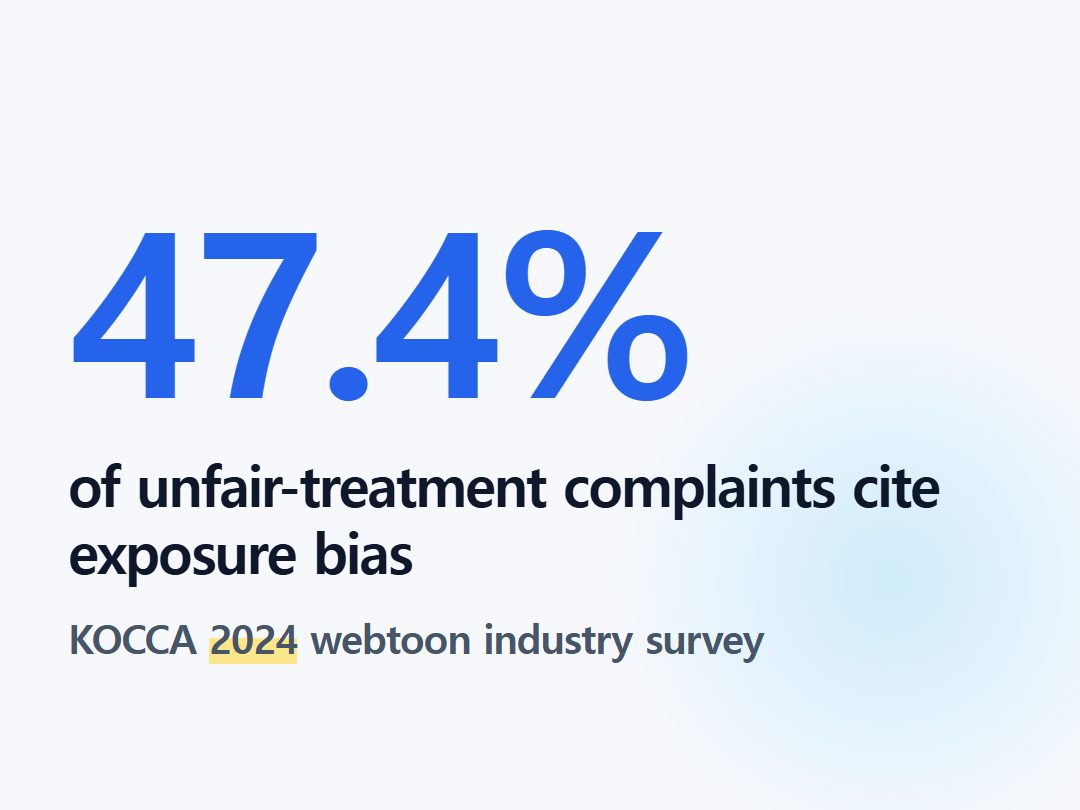
The stakes are not abstract: in the Korea Creative Content Agency's 2024 industry survey, about a quarter of webtoon creators said they had personally experienced or seen a colleague experience unfair treatment, and among the most common complaints were discrimination in marketing, promotion, or exposure ranking compared with other titles (47.4%) and difficulty getting onto a platform at all for being tied to a small agency or publisher (42.1%).
Daum came first, but Kakao's path forked
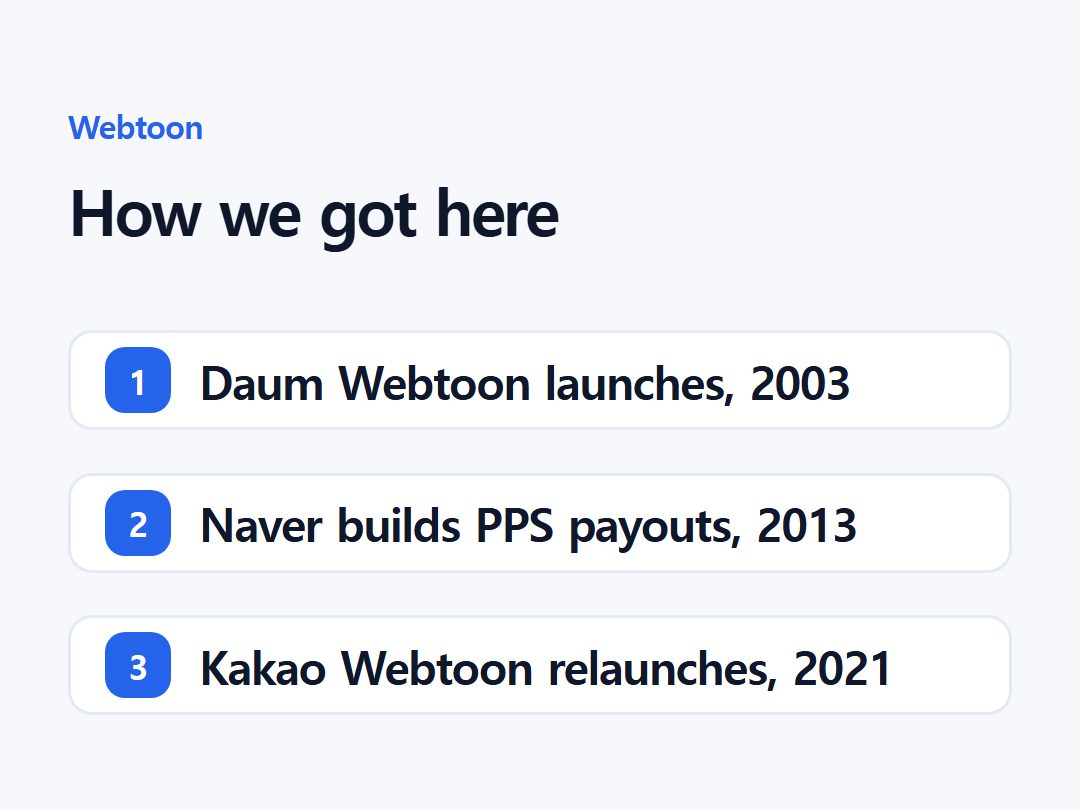
Kakao's webtoon lineage is actually older than Naver's on paper: Daum Webtoon launched in 2003 and is often cited as the world's first dedicated webtoon platform, a year before Naver Webtoon launched in 2004. The two companies took different paths afterward.
Naver built out PPS in 2013 and began its international push the same year, eventually spinning its overseas arm into LINE Webtoon, later rebranded WEBTOON, which culminated in a Nasdaq listing for WEBTOON Entertainment in June 2024 that raised $315 million.
Kakao's path was more fragmented.
After Daum merged into Kakao, and after Kakao Entertainment was formed by merging Kakao Page and Kakao M in 2021, Daum Webtoon and Kakao Page's existing webtoon lineup were folded together and relaunched as "Kakao Webtoon" that August — but Kakao Page kept operating as a separate app, and many of its top titles now run on both simultaneously.
Kakao's overseas bet went through more restructuring: it acquired Tapas and Radish for the North American market, then scaled both back through 2023–2025, while Piccoma quietly became the more durable overseas success.
Most recently, in August 2026, Kakao Entertainment announced it would merge three of its own webtoon and web-novel CP subsidiaries — Samyang C&C, Intime, and Pilyeon Management — into a single company, a move it framed as consolidating scattered IP production capacity.
Will Kakao's new CP merger narrow the gap?
Several threads remain open. Whether Kakao's newly merged CP subsidiary changes the platform's heavy reliance on outside content providers — and whether that eventually narrows the direct-contract gap with Naver — is unresolved.
Whether Naver's Disney partnership grows beyond a handful of co-branded titles into a durable pipeline for Korean-origin webtoons reaching Disney's audience will become clearer as more Disney-branded originals launch through 2026.
And with unfair-treatment complaints still concentrated around exposure and promotion, Korean regulators and KOCCA continue pushing both platforms toward standardized contracts — a process that, if it succeeds, could narrow some of the gaps described here regardless of which platform a creator signs with.
Naver Webtoon vs. Kakao Webtoon at a glance
| Dimension | Naver Webtoon | Kakao Webtoon |
|---|---|---|
| Direct-contract rate | 88% in 2021; ~60–70% by 2023 | ~10% in 2021; ~90% still via CP |
| Overseas strength | 150+ countries; Disney co-productions | Piccoma is Japan's top digital comics app |
| North America bet | Global pipeline via Nasdaq-listed WEBTOON Entertainment | Radish shutting down by end of 2025 after $330M impairment |
| Discovery algorithm | AI Curator feed (June 2024) cut concentration around top titles | AI recommendations (2021) tend to reinforce already-popular titles |
Frequently asked
Is Naver Webtoon or Kakao Webtoon better for creators?
Naver contracts a much higher share of creators directly (88% in 2021, still 60–70% by 2023) versus about 10% for Kakao, so most Kakao creators go through a CP intermediary that takes its own cut.
Which webtoon platform is bigger internationally?
Naver Webtoon's global arm reaches more than 150 countries and now partners with Disney, while Kakao's overseas strength is concentrated in Piccoma, which is Japan's top digital comics app.
Why is Kakao shutting down Radish?
Kakao acquired Radish for roughly $440 million in 2021 but took a 460 billion won ($330 million) impairment on Tapas's value and confirmed Radish will shut down entirely by the end of 2025 as it scales back its North American push.
Sources
Every factual claim above is traceable. We do not translate articles — we gather facts from multiple outlets and write them ourselves.
- [2021 국감] 문체위, 네이버·카카오 웹툰에 '노예 계약' 비판 — Sisajournal-e
- "사람이 경쟁력" 네이버·카카오, 웹툰 작가 처우개선에 사활 — Bizhankook
- 네이버웹툰 PPS 프로그램 10년만에 연간 규모 2조로 성장 — Datanews
- Korean Webtoons: Naver, Kakao, and Global K-Comics — Daebak
- Naver Webtoon Partners With Disney, Launches Japanese AI Chat in Global Push — Seoul Economic Daily
- Webtoon Entertainment Nears 2 Trillion Won in Annual Revenue, Expands IP Business with Full-Scale Disney Collaboration — BigGo Finance
- Kakao Entertainment to Shut Down Web Novel Platform Radish by End of 2025 — Anime News Network
- Kakao's Global Entertainment Strategy — Design Compass
- 네이버웹툰 "AI 추천으로 인기 작품 쏠림 현상 완화" — AI Times Korea
- 카카오엔터, 웹툰·웹소설 자회사 3곳 합친다…IP 경쟁력 강화 — Digital Daily
- 웹툰 산업 2조 시대…작가 10명 중 4명 불법사이트 피해 — Media Today