Open almost any murim webtoon — the Korean genre built around sprawling martial arts worlds — and the villain roster looks suspiciously familiar. A robed order calling itself the Demonic Cult, worshipping raw strength above all else, squares off against "orthodox" sects that claim the moral high ground.
Readers outside Korea often assume this is a failure of imagination. It is closer to the opposite: a genre convention with a paper trail going back more than sixty years.
The short version
- Murim's 'Demonic Cult' villain traces back to a real 14th-century Chinese uprising.
- Jin Yong's mid-20th-century novels turned that history into wuxia's permanent orthodox-vs-demonic template.
- Modern webtoons often flip the trope, making the 'demonic' cult the actual hero.
The same villain, series after series
In Return of the Mount Hua Sect, one of Naver Webtoon's longest-running hits, the hero wakes up a century after dying in a war against the "Heavenly Demon" and his Demonic Cult. Across dozens of competing titles, the antagonist faction wears a different name but the same job description.
The cult is rarely just "evil." It worships power instead of virtue, operates outside the rules the orthodox sects claim to uphold, and gets blamed for a war that happened generations before the story starts. That specificity is the tell — it is a template, not a coincidence.
A rebellion that really happened, six centuries ago
The trope's root is an actual historical episode. The Ming Cult (明教) in Jin Yong's fiction is loosely modeled on the Manichaean-influenced White Lotus movements that helped topple China's Yuan dynasty in the 14th century — a heterodox religious network the Confucian establishment branded as heretical and dangerous.
Manichaeism itself entered China centuries earlier along trade routes, absorbed local folk-religion elements, and was repeatedly banned by successive dynasties precisely because it operated outside state-sanctioned temples. That real pattern — a foreign, unlicensed faith surviving underground and eventually backing an uprising — is what wuxia authors kept borrowing wholesale.
Jin Yong borrowed the label the establishment used, "demonic," and kept it as the group's in-story name, letting readers watch a real revolutionary movement get recast as a monster by the people it threatened.
Jin Yong turned a real uprising into a permanent template
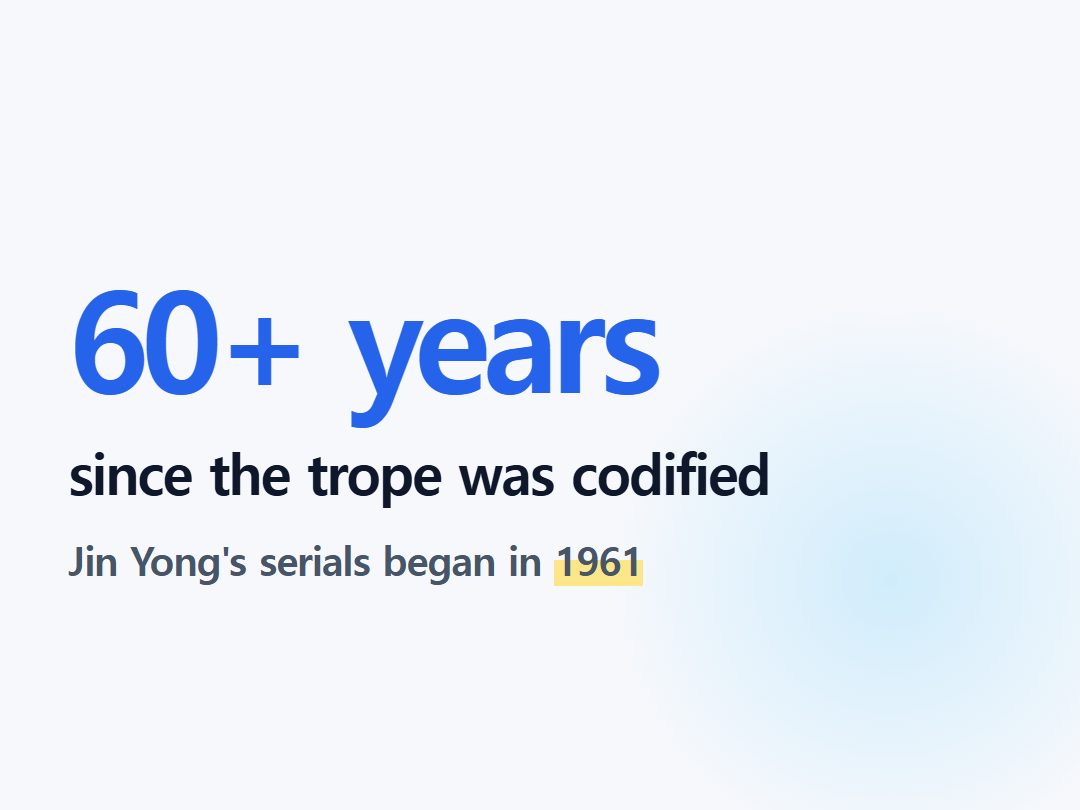
Jin Yong, alongside Gu Long and Liang Yusheng, is credited with founding modern wuxia fiction in the mid-20th century. His serialized novels — including The Heaven Sword and Dragon Saber and The Smiling, Proud Wanderer — repeated the same structure: an orthodox establishment (정파) versus a demonic or heterodox outsider faction (마교).
By the time Jin Yong's serials ended in the 1970s, this conflict was no longer one author's invention. It had become the load-bearing wall of an entire genre.
Korean fans imported the term wholesale in the 1990s
Murim (무림, literally "martial forest") is the Korean term for wuxia's fictional world of martial artists — the direct equivalent of the Chinese wulin. Korean martial fiction had its own scene going back to 1970s comic-rental shops, but the genre restarted in the 1990s on Hitel, an early PC communication network, where a message board called "Murimdong" hosted amateur serials and writing contests.
That generation, later labeled "sin-muhyeop" (new wuxia), inherited Jin Yong's vocabulary directly — including 마교 (Demonic Cult) and 사파 (rogue or heterodox sects) — rather than inventing new terms of its own.
The switch from print to bulletin-board serialization also changed how the genre was written. Amateur authors posted chapters for free feedback, so the fastest way to signal "this is a murim story" to a reader skimming a message board was to reuse the faction names everyone already recognized from Jin Yong translations.
Three factions keep a plot running longer than two can
A simple hero-versus-villain story runs out of road fast. Murim worldbuilding solves that by splitting the map into competing blocs, so there is always somewhere else for the plot to go once one conflict resolves.
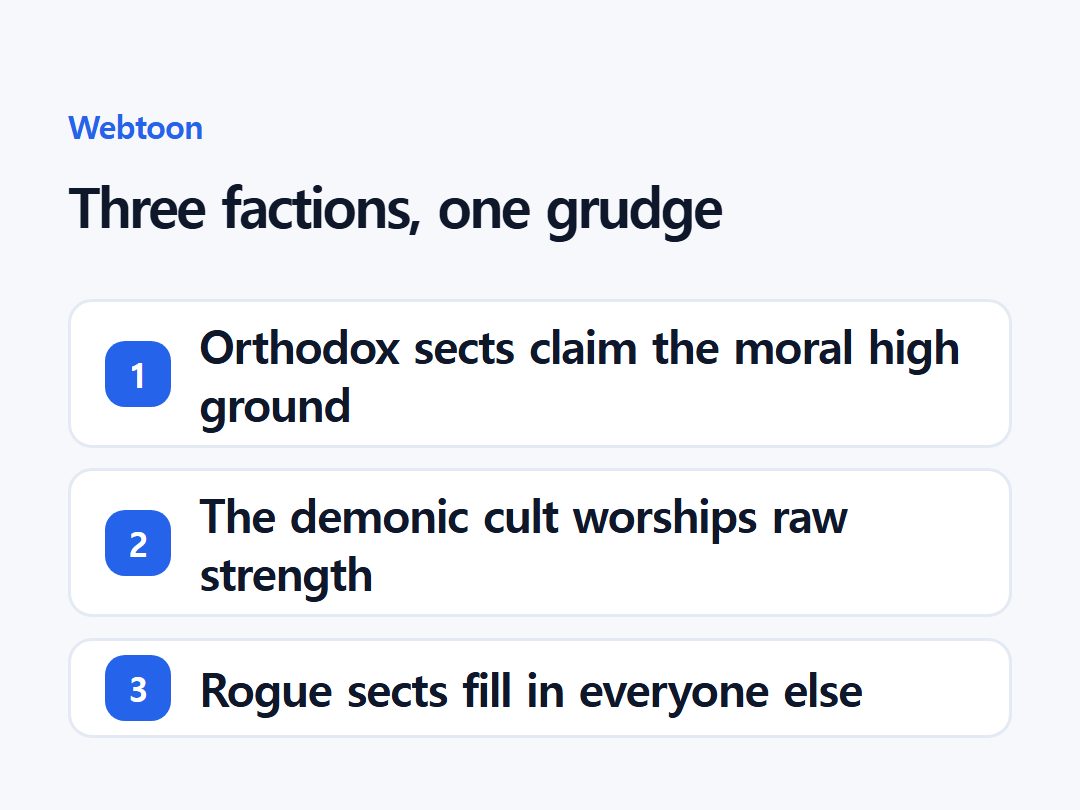
- Orthodox sects (정파) — the establishment, claiming the moral high ground
- The demonic cult (마교) — a rival power bloc built around strength, not virtue
- Rogue sects (사파) — everyone who fits neither category
With three blocs instead of two, alliances can shift without breaking the world's internal logic — a rogue sect can side with the "good guys" this arc and the cult the next, which is exactly what keeps thousand-chapter web novels moving.
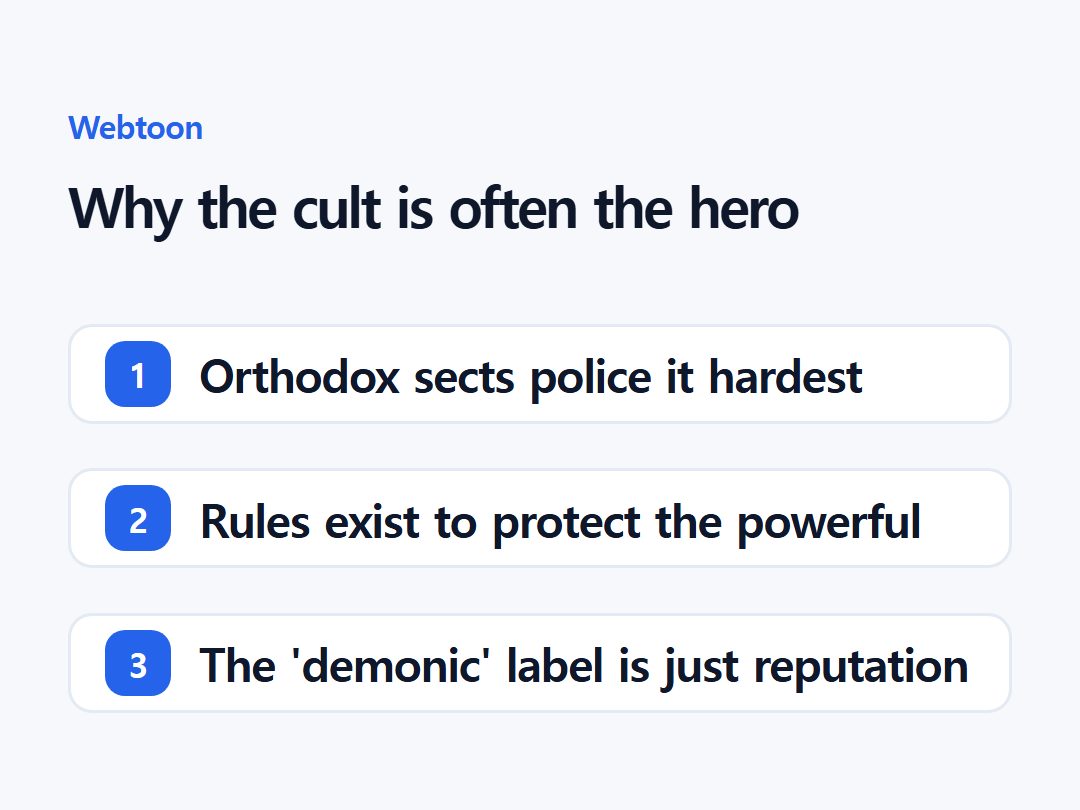
The 'demonic' cult is usually the story's real hero
The other reason the trope survives is that writers keep using it to ask who actually gets to decide what "demonic" means. In Jin Yong's own novels, the Ming Cult ends up fighting Mongol occupation while the orthodox sects squabble over reputation — heroism dressed as heresy.
Modern murim webtoons push this further by making the protagonist a cult member outright. In Murim RPG Simulation and Iljin Demonic Cult, the hero belongs to the faction everyone else fears, and the "orthodox" world is the one shown to be self-serving. The villain label turns out to be a plot device, not a moral verdict.
마교 and 사파 stopped meaning the same villain
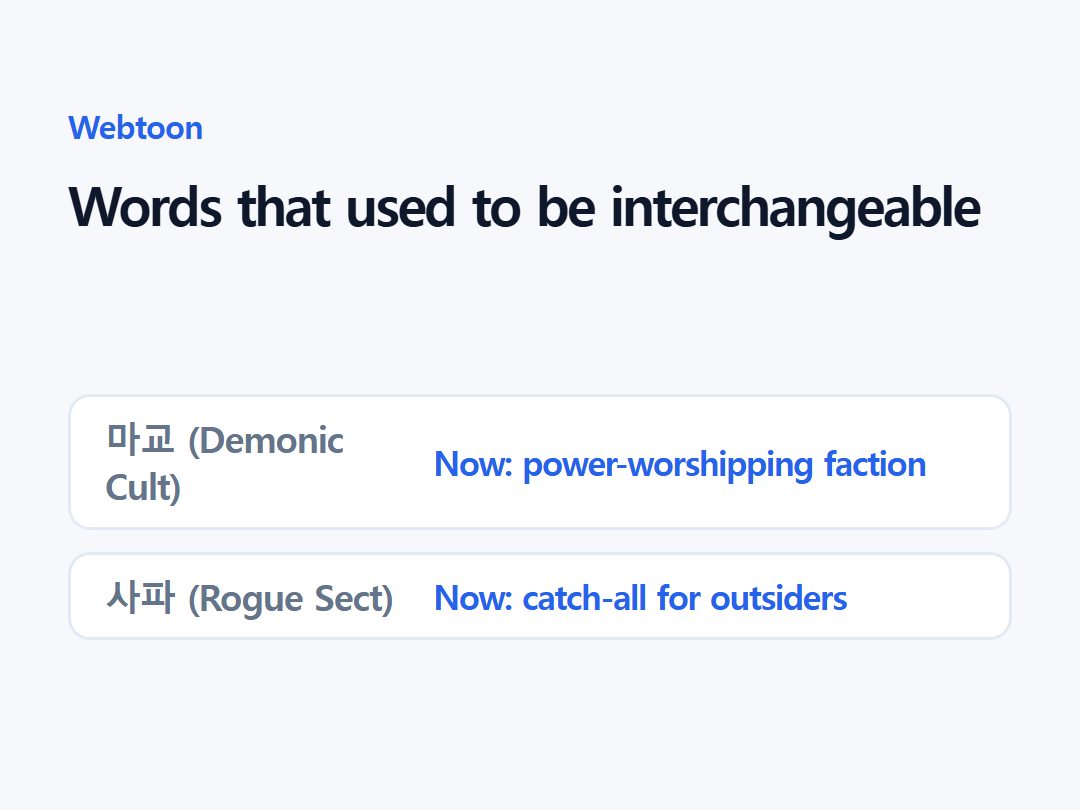
The two Korean terms were not always distinct. In older wuxia and its early Korean imitators, 마교 described a sinister quasi-religious cult performing human sacrifice — practically synonymous with 사파, the broader label for "not orthodox."
As the genre matured, the terms split. 마교 increasingly came to mean a militaristic faction that worships a strong-survive, weak-perish code rather than a religion, while the cult-like, sacrifice-performing villain role migrated to a newer term, 혈교 (Blood Cult). 사파 became a looser catch-all for the dozens of outsider factions that fit neither the orthodox establishment nor the demonic cult.
One fallen sect's revenge restarted the whole genre
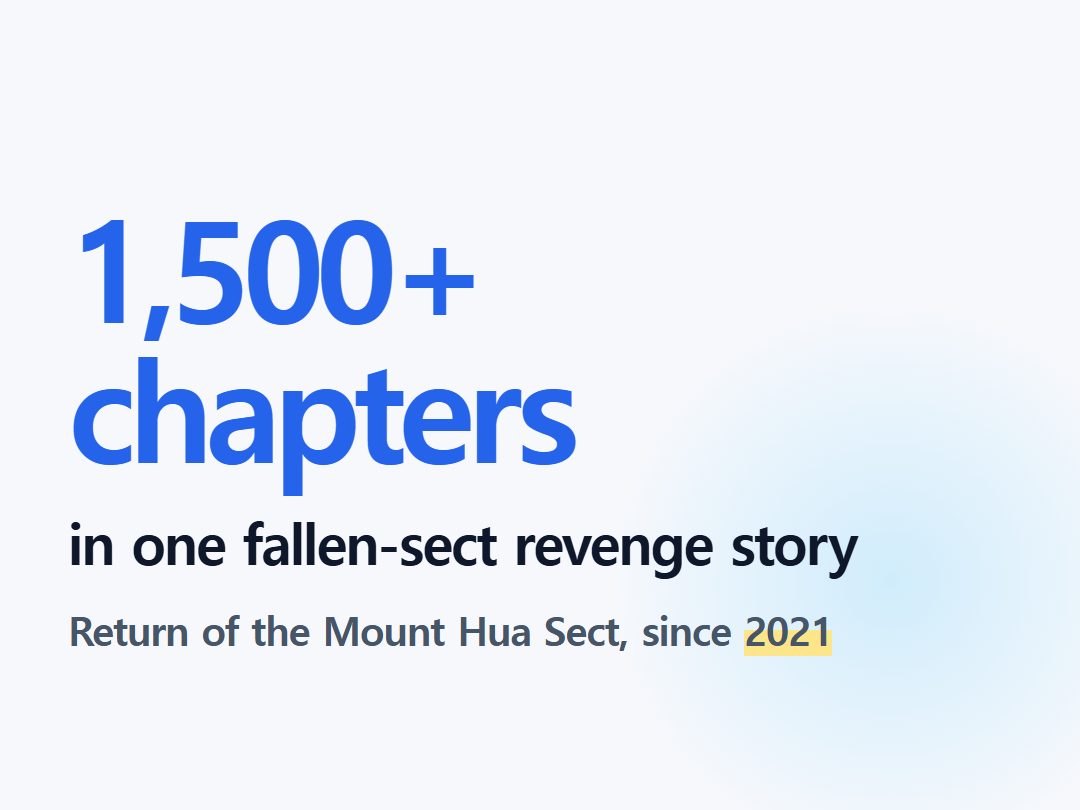
Murim fiction cooled in print through the 2000s but came roaring back once web novels and webtoons gave it a new distribution channel. Return of the Mount Hua Sect, running on Naver since March 2021 with more than 1,500 novel chapters behind its webtoon adaptation, is widely credited with the current boom.
Its premise — a warrior wakes up a century later to find his once-great sect in ruins after a war against the Demonic Cult, and rebuilds it from nothing — spawned a wave of imitators. Fans call this the "jaegeonmul" (재건물, "rebuilding story") subgenre, and nearly all of them keep the same demonic-cult backstory as the reason the sect fell in the first place.
The subgenre's name traces to an earlier print novel, Rule of the Murim (군림천하), which established the template decades before webtoons existed: a great sect is broken by the demonic cult, and the rest of the story is spent clawing it back. Newer titles borrow the skeleton and swap in a different sect, a different protagonist, and a slightly different reason the cult attacked in the first place.
Murim stays a men's-skewing corner of a much bigger market
Murim has never been the biggest genre on Korean platforms — romance-fantasy and regression stories dominate KakaoPage's overall charts. But ranking data from April 2026 shows murim titles consistently placing high on Naver's real-time charts among male-skewing readerships, even while trailing romance-fantasy on Kakao's official listings.
That demographic split matters for why the trope persists: readers who specifically follow murim are following it for the factional power struggles the demonic-cult setup exists to generate, not despite them.
What the formula still can't settle
What remains unresolved is whether the trope has room left to subvert. Decades of "actually, the demonic cult are the real heroes" twists have made the reveal itself a cliché — some newer titles now play the cult straightforwardly evil again, betting that readers' familiarity with the swerve makes the straight version feel fresh.
Whether that fatigue slows the current boom, or whether authors find another angle on the same three-faction map, is not settled by anything published so far. The genre has already survived one full cycle of subverting itself.
The three-faction structure of murim worldbuilding
| Faction (Korean term) | Role in the story |
|---|---|
| Orthodox sects (정파) | The establishment, claiming the moral high ground |
| Demonic cult (마교) | Rival power bloc built around strength, not virtue |
| Rogue sects (사파) | Everyone who fits neither category |
Frequently asked
What does 마교 (Demonic Cult) mean in murim webtoons?
It's the standard villain faction that worships raw power instead of virtue, operates outside the orthodox sects' rules, and is usually blamed for a war that happened generations earlier.
Is the murim Demonic Cult trope based on real history?
Yes — it traces to the Ming Cult in Jin Yong's fiction, loosely modeled on the Manichaean-influenced White Lotus movements that helped topple China's Yuan dynasty in the 14th century.
What's the difference between 마교 and 사파 in murim stories?
They used to mean roughly the same thing, but 마교 now refers to a militaristic strength-worshipping faction, while 사파 became a looser catch-all for outsider sects that fit neither the orthodox establishment nor the demonic cult.
Sources
Every factual claim above is traceable. We do not translate articles — we gather facts from multiple outlets and write them ourselves.
- Wuxia — TV Tropes
- Ming Cult — Wikipedia
- Dongfang Bubai — Wikipedia
- 마교 (Demonic Cult) — Namuwiki
- 사파(무협 소설) (Rogue Sects in Wuxia Fiction) — Namuwiki
- 무협 웹소설 (Wuxia Web Novels) — Namuwiki
- Demonic Cult — Fandom
- Return of Mount Hua — Fandom
- Korean Webtoon Rankings Report, April 9-23, 2026 — KLit Reads
- 신무협의 탄생, 클리셰에서 키치로! — Brunch