On July 11, 2025, Naver Webtoon canceled Wind Breaker, a cycling series by artist Jo Yong-seok that had run for twelve years across more than 500 chapters. Readers had noticed that episode 176 lined up almost exactly with panels from the Japanese manga Tokyo Ghoul.
The short version
- Naver canceled Wind Breaker after tracing accusations tied to Tokyo Ghoul.
- Weekly deadlines, thin pay, and no plagiarism check enable repeated scandals.
- A lead artist earns just 24 won per 200-won episode sold.
Jo quietly edited the disputed art instead of addressing the accusations directly. Each silent edit only drew more scrutiny, and fans combing back through older chapters found further matches to other manga and fan art over the following two weeks.
Naver said the manuscript showed "compositional and directorial similarities with another work" and stopped the series. Jo apologized, writing that reference material he had used "ended up being very similar to — or nearly identical in expression to — those from other works." The platform began processing refunds for readers who had paid for episodes.
Plagiarism cancellations are now a pattern, not an incident
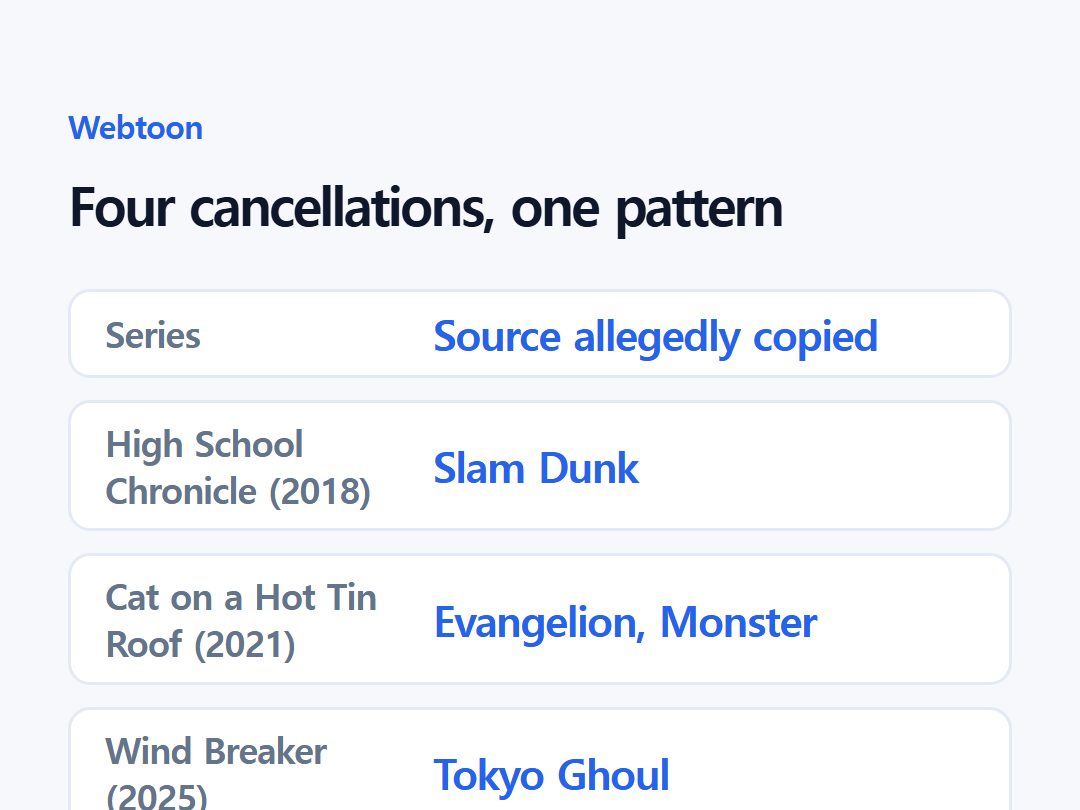
Wind Breaker was not an isolated case. Naver Webtoon has pulled hit series over plagiarism findings repeatedly over the past decade:
- High School Chronicle (2018) — traced panels from Takehiko Inoue's Slam Dunk
- Cat on a Hot Tin Roof (2021) — character designs and panel layouts matching Evangelion and Naoki Urasawa's Monster, ended a month after launch
- Desperate to Date (2023) — scripting and layouts resembling Kaguya-sama: Love Is War
- A Munpia web novel (January 2026) — pulled after its author admitted using a Chinese novel's setting and structure without a license
Four different series, four different genres, spread across eight years. The common thread is not one careless artist — it is a production system that keeps producing the same failure.
Some working artists have pushed back on treating every case as career-ending. After earlier tracing accusations against colleagues, one Naver Webtoon artist argued publicly that tracing was unethical but should not automatically end a career, a sign the industry itself is unsettled about how severely to punish a practice it has not built tools to prevent.
The real question is why copying keeps working, not who did it
Each scandal gets covered as an individual betrayal: an artist who cut corners, a platform that apologized and moved on. That framing skips the part international readers usually never see — how Korean webtoons actually get made.
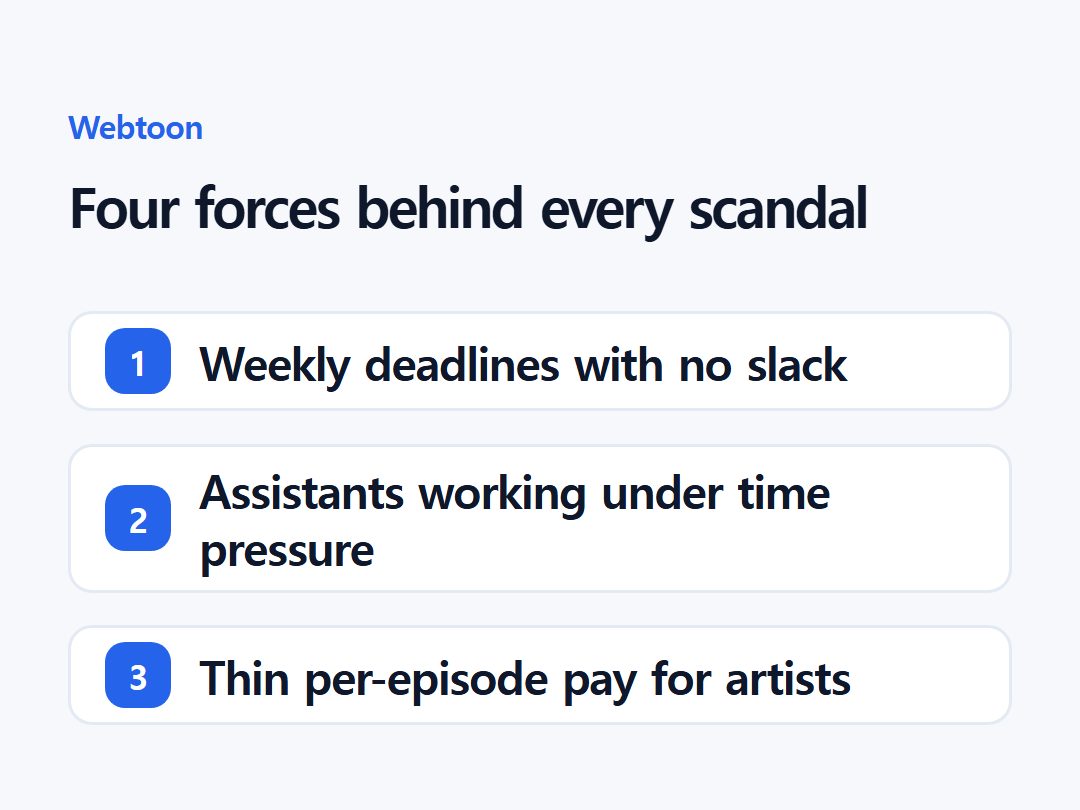
Four conditions recur across nearly every case above: a fixed weekly deadline, a studio system that outsources art to assistants, thin per-episode pay, and a platform review process built to check content ratings, not originality. None of them excuses tracing. Together, they explain why it keeps happening.
A new episode is due every seven days, with no room to slip
Almost all professional webtoons in Korea run weekly. A 2022 survey by the Korea Institute of Labor Safety and Health found that 63% of working webtoon artists serialize on a weekly cycle, and most have no real ability to change that pace once a series is running.
The same survey measured the workload behind it: writers average 9.9 hours a day, 5.7 days a week — roughly 51 hours weekly — to produce an average of 68 panels per episode, well above the 52 panels they themselves said would be a reasonable target.
There is no built-in pause between episodes to double-check a background, a pose, or a panel composition against its source material. The next deadline is already running before the last one is finished.
Where reference material quietly becomes tracing
To hit that pace, most working artists rely on assistants for backgrounds, coloring, and effects — a division of labor Korean webtoon studios call the studio system, similar to how Japanese anime production splits work across specialists rather than one author drawing every frame.
Artists and their assistants commonly work from reference photos, existing manga, and purchased digital asset libraries just to hit weekly volume. Under Korean copyright law, tracing counts as an act of reproduction, and courts do not require an exact match — "substantial similarity" is enough to establish infringement.
But the line between referencing a pose and reproducing a panel is a judgment call made under deadline pressure, by the artist alone, before anything reaches an editor.
Six unpaid months before the first paycheck
Pressure toward shortcuts starts before a series is even approved. As platform competition has intensified, publishers increasingly ask unpublished artists to submit around 20 finished episodes before signing a contract, according to Kwon Chang-ho, secretary-general of Korea's webtoon writers association.
Kwon has explained that a 20-episode submission effectively demands more than six months of unpaid production work. Artists who need income during that stretch often sign with whichever content-production company offers funding first, even on unfavorable terms — a partner chosen under financial pressure, not creative fit, before a single episode has earned a cent.
A 200-won episode gets split five ways
Even after a series launches, per-episode revenue is thin. Industry figures reported in Korean trade press describe a typical structure for a 200-won (roughly 15 US cents) episode purchase:
- Platform: 40 won
- Content-production company: 80 won
- Writers and sub-writers: 56 won
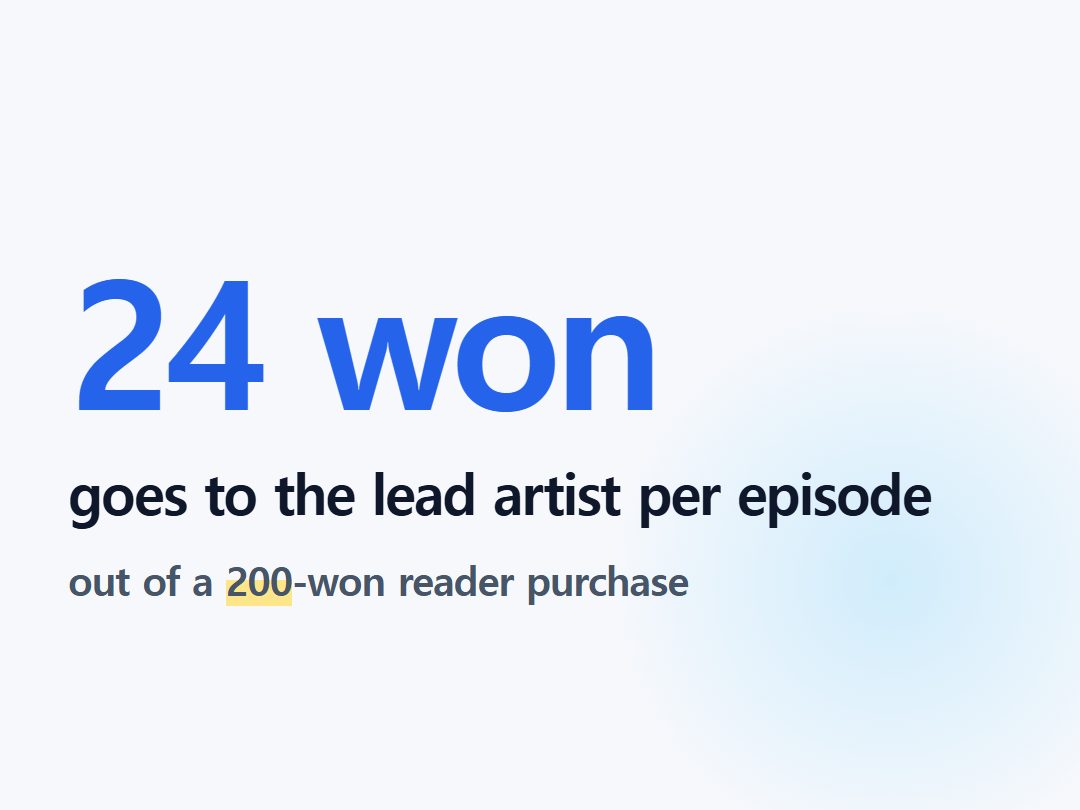
- Lead artist: 24 won
That split leaves little budget to hire enough assistants, or to spend extra time verifying that a reference image sits far enough from its source. Cutting corners is not a moral failing limited to a few artists — it is close to the default outcome when the margin for a career-ending mistake is 24 won.
One platform runs roughly 700 series with no dedicated plagiarism check
Naver Webtoon serializes around 700 titles at once. Editorial producers, known internally as PDs, review new submissions mainly for content ratings and potentially controversial material — not for visual similarity to existing manga or webtoons.
Content-production companies conduct their own initial review before a series even reaches the platform, but neither layer runs a systematic plagiarism check. According to Korean industry reporting, no major Korean webtoon platform currently operates a system specifically designed to catch plagiarism before publication.
Why platforms have not built a plagiarism filter
The gap is not accidental. Seo Beom-gang, chairman of the Korea Webtoon Industry Association, has said that if platforms built a formal plagiarism-detection review system, it would risk resembling censorship — something creators would resist.
That tension is real. Distinguishing intentional tracing from coincidental stylistic overlap is a legal and creative judgment call, not a simple image match, and applying it consistently across roughly 700 ongoing series is a different problem than defining it in principle.
International readers often assume a global platform like Naver Webtoon reviews originality the way a publisher vets a manuscript before print. It does not. A webtoon reaches millions of readers on the same review track built for checking whether a scene needs an age rating.
What still has no fix
Enforcement in Korea is complaint-based: without the original rights holder filing a claim, a case rarely becomes a legal matter, no matter how obvious the overlap looks to readers comparing panels online. So far, detection has depended on fan comparisons and platform apology statements, not a standing review process.
Penalties are also inconsistent. Some artists lose their series outright, as Jo did with Wind Breaker. Others, like the Munpia author in January 2026, face platform-imposed restrictions on future work without any public legal ruling. Until the deadline structure, the pay split, and the review process change together, the industry has no mechanism that catches the next case before its readers do.
How a 200-won episode purchase gets split
| Recipient | Share (won) |
|---|---|
| Platform | 40 |
| Content-production company | 80 |
| Writers and sub-writers | 56 |
| Lead artist | 24 |
Frequently asked
Why did Naver Webtoon cancel Wind Breaker?
Episode 176 lined up almost exactly with panels from Tokyo Ghoul, and after two weeks of scrutiny Naver said the manuscript showed compositional and directorial similarities with another work and pulled the series, refunding readers.
Is tracing illegal under Korean copyright law?
Yes — tracing counts as an act of reproduction, and Korean courts don't require an exact match; "substantial similarity" is enough to establish infringement.
Why don't webtoon platforms catch plagiarism before it's published?
Editorial review at platforms like Naver Webtoon mainly checks content ratings, not originality, and no major Korean platform runs a systematic plagiarism check across its roughly 700 ongoing series.
Sources
Every factual claim above is traceable. We do not translate articles — we gather facts from multiple outlets and write them ourselves.
- Naver Webtoon's 'Wind Breaker' joins growing list of plagiarism controversies — The Korea Herald
- Popular Naver webtoon 'Wind Breaker' canceled over plagiarism allegations — The Korea Times
- Naver Webtoon Offers Refunds for Wind Breaker Series After Plagiarism Controversy — Anime News Network
- Cat On a Hot Tin Roof Manhwa Ends Serialization After Plagiarism Accusations of Japanese Manga — Anime News Network
- Naver Webtoon Halts Serialization of Web Novel After Plagiarism Admission — Anime News Network
- '표절과 검열 사이' 국내 최대 플랫폼 네이버웹툰의 고민 — Bizhankook
- Webtoon writers' working conditions (2022) — Korea Institute of Labor Safety and Health