WEBTOON Entertainment, the company behind Naver's global comics platform, has started turning its own hit webcomics into a new kind of video: vertical, one-minute-episode dramas built for a phone screen. Six long-running romance titles now exist as live-action "Short Dramas" on the English and French versions of the platform, sitting one scroll away from the comics that made them famous.
The short version
- WEBTOON turned six hit webcomics into one-minute vertical dramas in 2026.
- Comics revenue fell 2.8% in Q2 while the company chases short-video growth.
- Creators have fought WEBTOON over pay and AI use for two years.
The move looks small on its face — a handful of test titles inside an app people already use. But it lands at a moment when the company's core comics business is losing readers and revenue, and when creators have spent two years publicly fighting the platform over contracts and pay. That backdrop is why a format announcement has turned into a trust question.
Six romance webcomics became one-minute dramas
On August 17, 2026, WEBTOON released its first live-action content ever: adaptations of Love Bites, Maybe Meant to Be, Swolemates, Rules for Dating Trash, Dirty Deeds, and I'll Marry Your Brother. Four of the six began as Korean-language webtoons before finding English readerships; two were English-original comics.
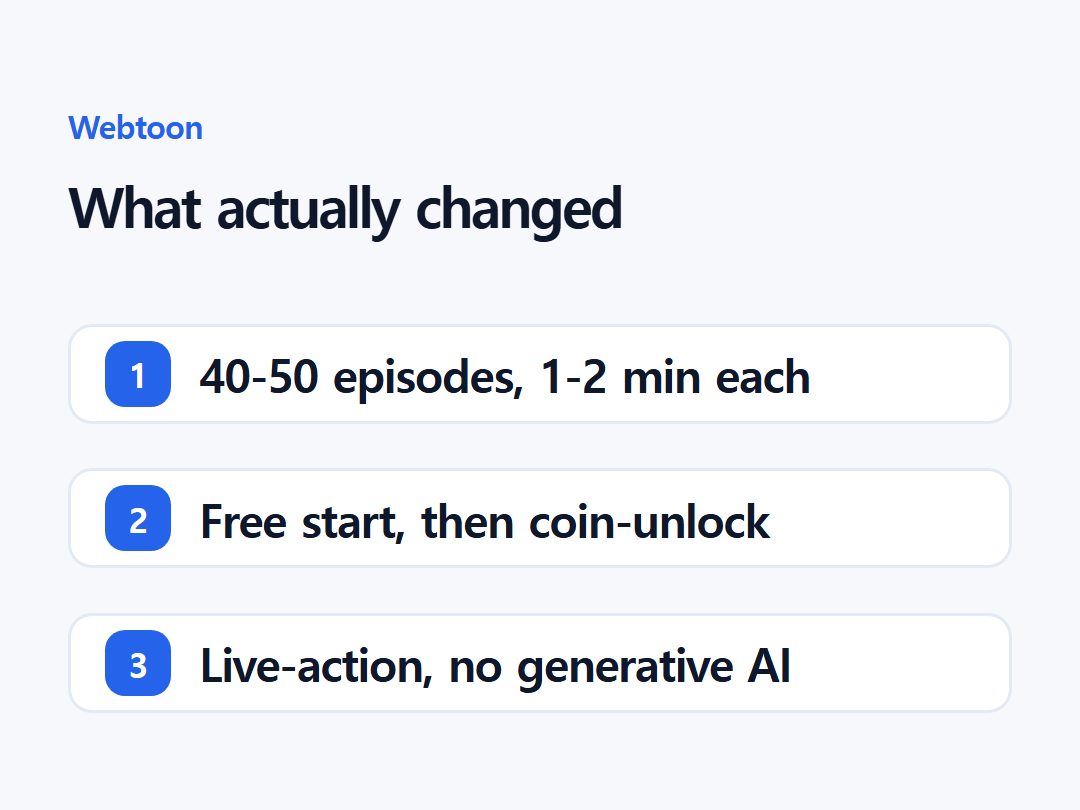
Each series runs 40 to 50 episodes of one to two minutes apiece — short enough to finish several on a commute. A handful of episodes are free, then a coin-based paywall unlocks the rest, the same currency WEBTOON already uses for early access to comic chapters.
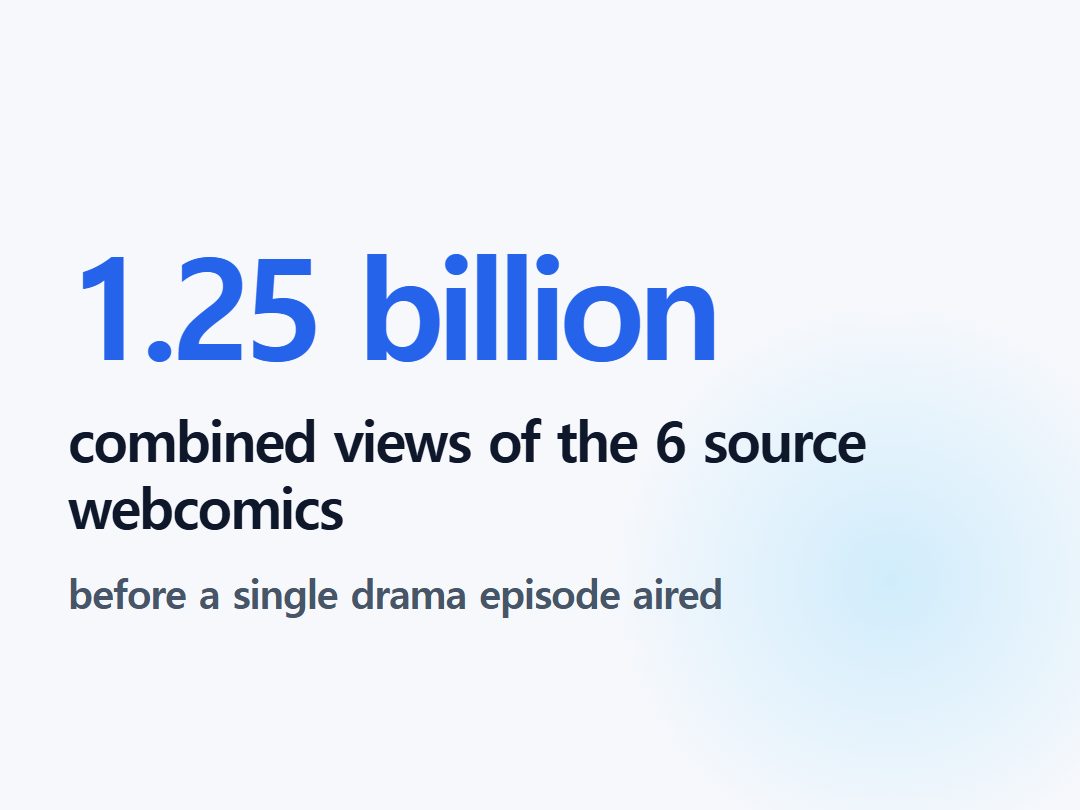
The six source webcomics have logged more than 1.25 billion combined views, with Maybe Meant to Be alone accounting for 650 million. That built-in readership, not an untested script, is the entire premise of the format.
An "experiment," not a pivot — the company says
WEBTOON executive Fred Lee described the move as additive rather than a change of business model: "We're not solely built on microdramas. We already have an established ecosystem, and web comics are our core business."
The company also addressed the most obvious reader fear directly, stating the new videos "are not designed to supplant web comic readership." Lee said the studio contacted all six original creators before production began, and that all six supported the adaptations.
The episodes were shot with a Los Angeles production house over roughly three months, using actors and crew rather than generative AI — a detail WEBTOON highlighted given how sensitive the wider comics and microdrama industry has become about AI-made content.
The comics business is shrinking where video is growing
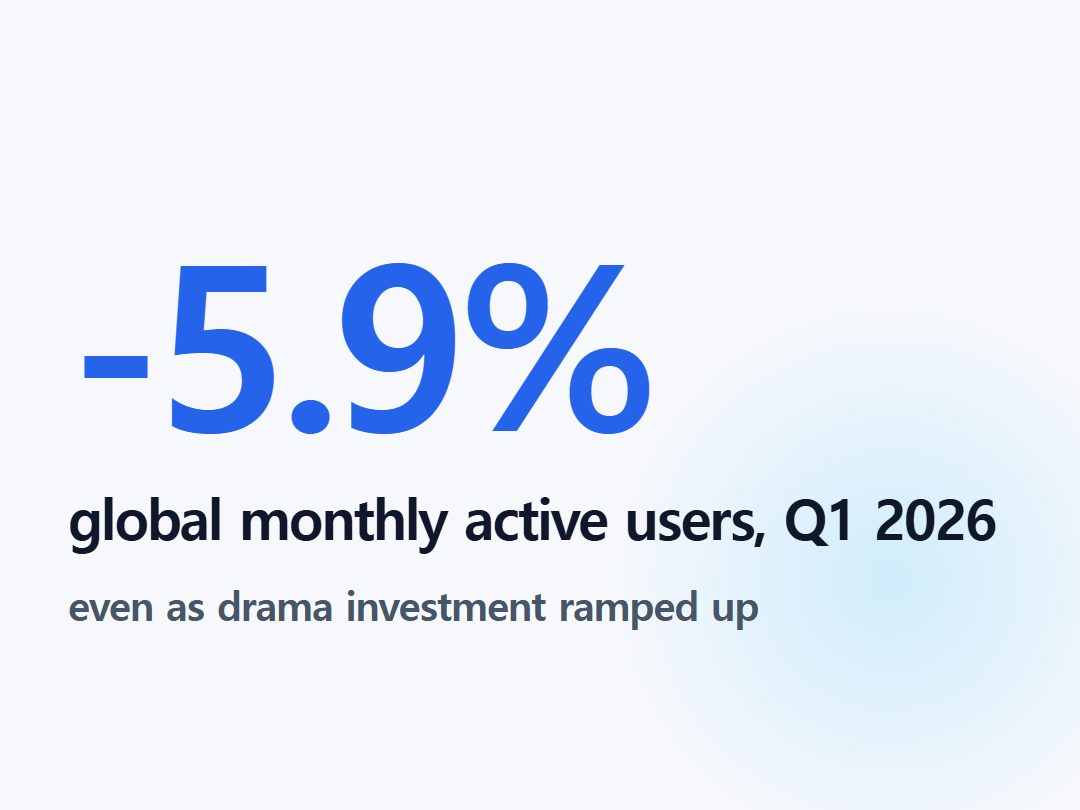
The reassurance arrives while the numbers behind it are uneven. In WEBTOON Entertainment's first quarter of 2026, revenue fell 1.5% year-over-year to $320.9 million, missing Wall Street's $346.8 million forecast. Global monthly active users dropped 5.9%, with the core webcomic app down 3%.
The second quarter told a similar story: reported revenue of $338.5 million, down 2.8%, with both Paid Content and IP Adaptations declining even as advertising grew. Net loss widened to $14.6 million, which the company attributed largely to higher marketing spend — some of it funding exactly this kind of new-format push.
Management has paired the comics slowdown with bets outside comics: a $40 million IP fund and a planned $100 million stake in gaming company RI Games. Short-form video is where the growth is being chased, whether or not it is where the company calls its "core business."
Compressing years of story into fifty minutes of screen time
Adapting is harder than it sounds precisely because these comics already succeeded at length. A webcomic that ran for years and drew 650 million views did so through slow-burn arcs, side characters, and callbacks — the opposite of a microdrama's compressed, cliffhanger-every-episode structure.
Fitting that into 40 to 50 episodes of a minute or two means someone decides which arcs survive and which readers' favorite subplot gets cut. WEBTOON has not published how those choices were made for these six titles, only that the original creators agreed to try.
Creators said yes to this — after two years of fighting other terms
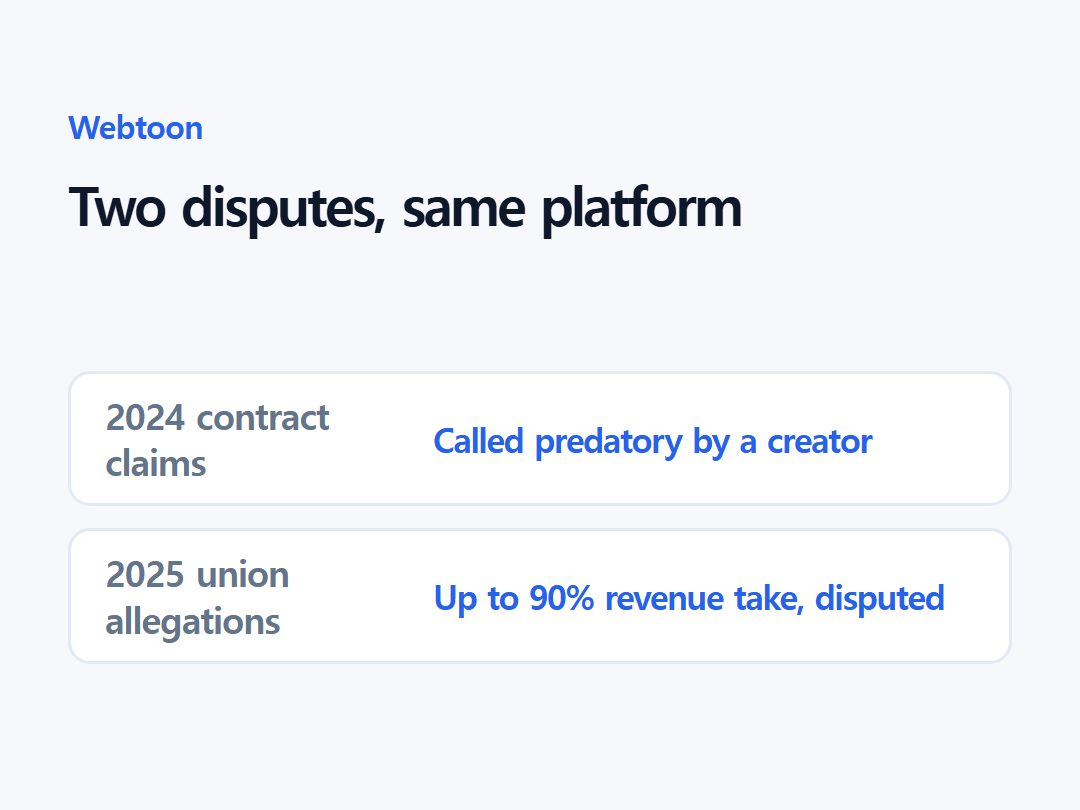
The line "all six creators were supportive" carries more weight in context. In April 2024, a WEBTOON Originals creator posted contract terms online calling them predatory, including a clause letting the platform buy physical publishing rights for as little as $2,000 against an industry rate above $500,000.
WEBTOON disputed the "predatory" framing, saying such rights are capped at three years past a series' completion at industry-standard rates — but did not deny the clauses exist.
In November 2025, a creators' union went further, alleging that:
- Contest winners write several free episodes before any contract is signed
- Some contracts allow using creators' work for AI training without separate consent
- Overseas revenue splits leave creators with as little as 10% in some markets
WEBTOON vice president Kiel Hume disputed the specifics, calling the 90%-take figure "inaccurate and unrepresentative" and saying the company does not train AI on creators' work. Separately, Naver's Korean webtoon service reported paying creators a cumulative 4.15 trillion won ($3 billion) between 2021 and 2025.
Both things are true at once: creators are being paid at platform scale, and creators are still fighting over what counts as a fair cut. A splashy new video format lands differently on a platform with that history than it would on one without it.
Why readers worry the app is quietly becoming something else
For readers, the unease is simpler: attention is finite. WEBTOON's scrolling comics already compete with the same short-video feeds — TikTok, Reels, Shorts — that trained a generation to expect content in bites. A drama tab inside the comics app is, structurally, one more feed drawing from the same pool of minutes.
WEBTOON's stated position is that drama should funnel readers back to the comic, not replace it. Whether that holds depends on choices the company controls but has not disclosed — how its recommendation algorithm weighs drama against comics, and whether future investment follows engagement toward video.
Korea's own drama industry is having the identical argument
This tension is not unique to WEBTOON. A 2025 survey by South Korea's content agency found 58.6% of Koreans now consume short-form content regularly, and 76% of them cite "it's short, no commitment" as the reason. Vertical-drama platforms such as Lezhin Snack have already pulled established film directors into short-episode productions.
Korean industry commentary has flagged a related worry: television drama production volume is shrinking as budgets and attention shift toward cheaper, faster short-form formats. A platform that owns both the comics and now a drama arm sits at the center of that shift rather than on its sidelines.
The global microdrama boom gave WEBTOON a template
None of this happened in a vacuum. Analysts at Omdia estimated the global short-drama market at roughly $11 billion in 2025, driven first by China and then by fast-growing U.S. apps built entirely around one-minute vertical episodes and pay-per-unlock coins.
WEBTOON's pitch is that it already had the hard part solved: readers who scroll vertically through cliffhanger-paced chapters were, in the company's framing, already halfway trained for microdrama pacing before microdramas existed as a category. Naver's Korean service has leaned into the same logic domestically, launching a separate short-form animated video feature called Cuts for fan- and creator-made clips.
That framing is also a business argument aimed at investors as much as readers: it recasts a new production cost — actors, a Los Angeles studio, months of shooting — as a natural extension of assets WEBTOON already owns, rather than a costly diversification away from comics.
What WEBTOON has not yet promised
Several questions remain open past the launch announcement. WEBTOON has not said how drama revenue is split with the six original creators, whether that split differs from standard IP-adaptation deals, or whether future comics will be picked for adaptation potential rather than purely for comic merit.
The company also has not said what happens if a drama outperforms its source comic — whether that success flows back to the comic's creator, into more dramas, or elsewhere. For now, six titles and about three months of production are the entire trial. How WEBTOON scales it, and who benefits when it works, is the part the announcement left out.
WEBTOON Entertainment's 2026 quarterly results
| Quarter | Revenue | YoY change | Key detail |
|---|---|---|---|
| Q1 2026 | $320.9 million | -1.5% | Global MAU down 5.9% |
| Q2 2026 | $338.5 million | -2.8% | Net loss widened to $14.6 million |
Frequently asked
What is WEBTOON's Short Dramas feature?
Short Dramas are one-to-two-minute live-action episodes adapting six popular WEBTOON romance webcomics, currently live on the English and French versions of the app with a coin-based paywall after the first few episodes.
Why are WEBTOON creators upset with the platform?
A creators' union has alleged unpaid trial episodes, contract clauses allowing AI training without separate consent, and overseas revenue splits as low as 10%, though WEBTOON disputes these specifics and says it does not train AI on creators' work.
Is WEBTOON's comics business struggling financially?
Revenue fell 1.5% in Q1 2026 and 2.8% in Q2, with global monthly active users down 5.9% and net loss widening to $14.6 million, even as the company calls comics its core business.
Sources
Every factual claim above is traceable. We do not translate articles — we gather facts from multiple outlets and write them ourselves.
- WEBTOON Entertainment Debuts Short Dramas — WEBTOON Entertainment
- Webtoon Entertainment Dives into Vertical Shorts, Setting 'Love Bites' and 'Maybe Meant to Be' as Microdramas — Variety
- WEBTOON Disputes Union's Unpaid Labor Allegations — Anime News Network
- Webtoon Defends Against 'Predatory, Exploitative' Contract Claims From Originals Creators — CBR
- 웹툰작가 수익 4조…IP 공급원 키우는 네이버 — 한국경제
- 네이버웹툰, 인기작 10억뷰 IP로 '숏드라마' 실험…세로형 콘텐츠 확장 — 블로터 (via Daum)
- WEBTOON Entertainment Inc. Reports Second Quarter 2026 Financial Results — GlobeNewswire
- WEBTOON Entertainment Inc. Reports First Quarter 2026 Financial Results — WEBTOON Entertainment IR
- 숏폼 드라마로 향하는 스타 감독·배우들 — PD저널
- [포럼] 숏폼 시대에 K드라마의 미래 — 파이낸셜뉴스