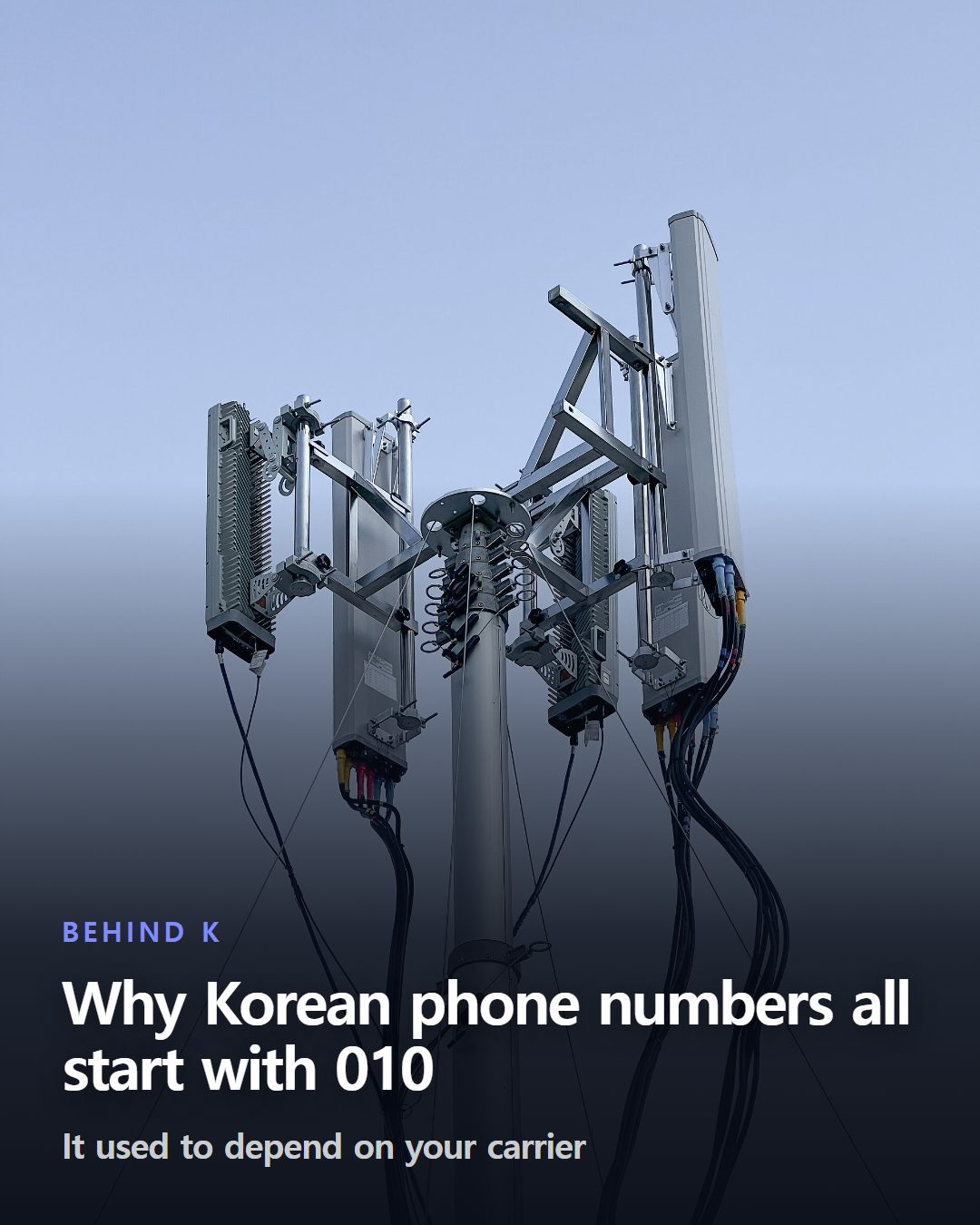
Every mobile number in South Korea starts with 010. To an outside observer this looks like nothing more than a country code convention, similar to how UK mobiles start with 07.
The short version
- Korea merged five carrier-tied prefixes into one neutral 010 number starting 2003.
- 011 numbers signaled wealth and status before number portability existed in Korea.
- Korea's Constitutional Court upheld the forced switch in 2013; old prefixes died by 2021.
It is not. As recently as the early 2000s, the first three digits of a Korean phone number told you exactly which company you paid every month — and, for a while, roughly how much money you had.
The 010 you see today is the end point of a government policy that took almost twenty years, several lawsuits, and one Constitutional Court ruling to finish.
Where the other prefixes went
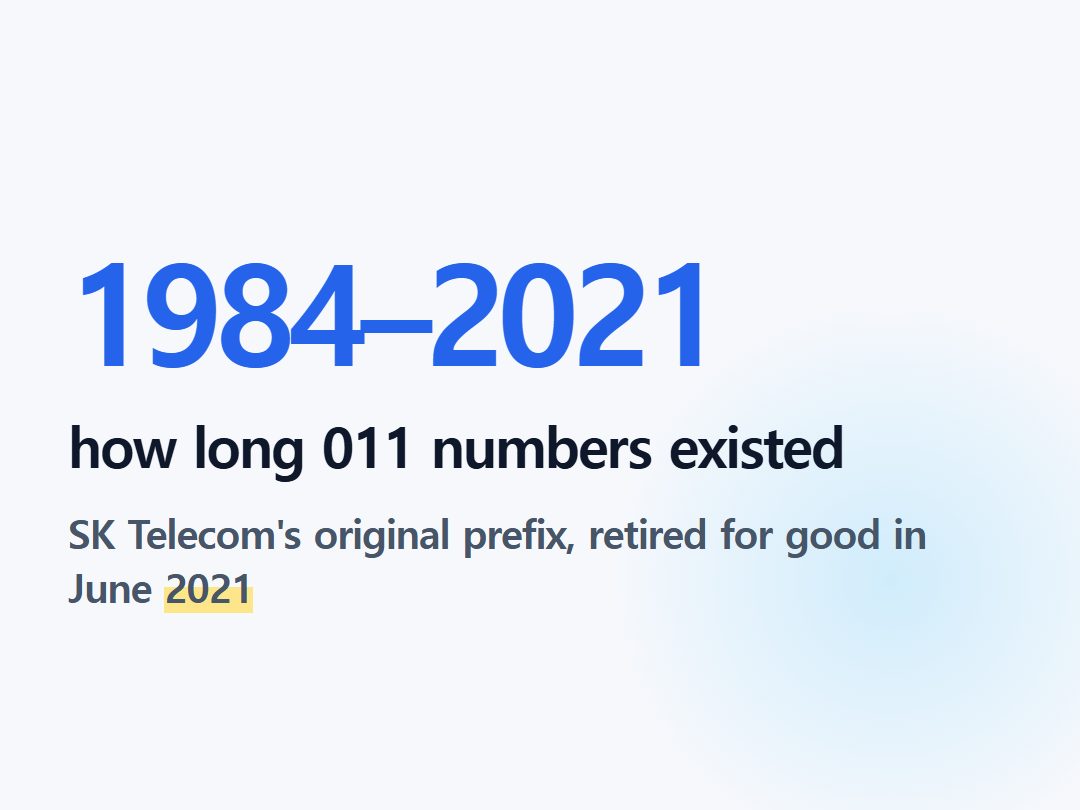
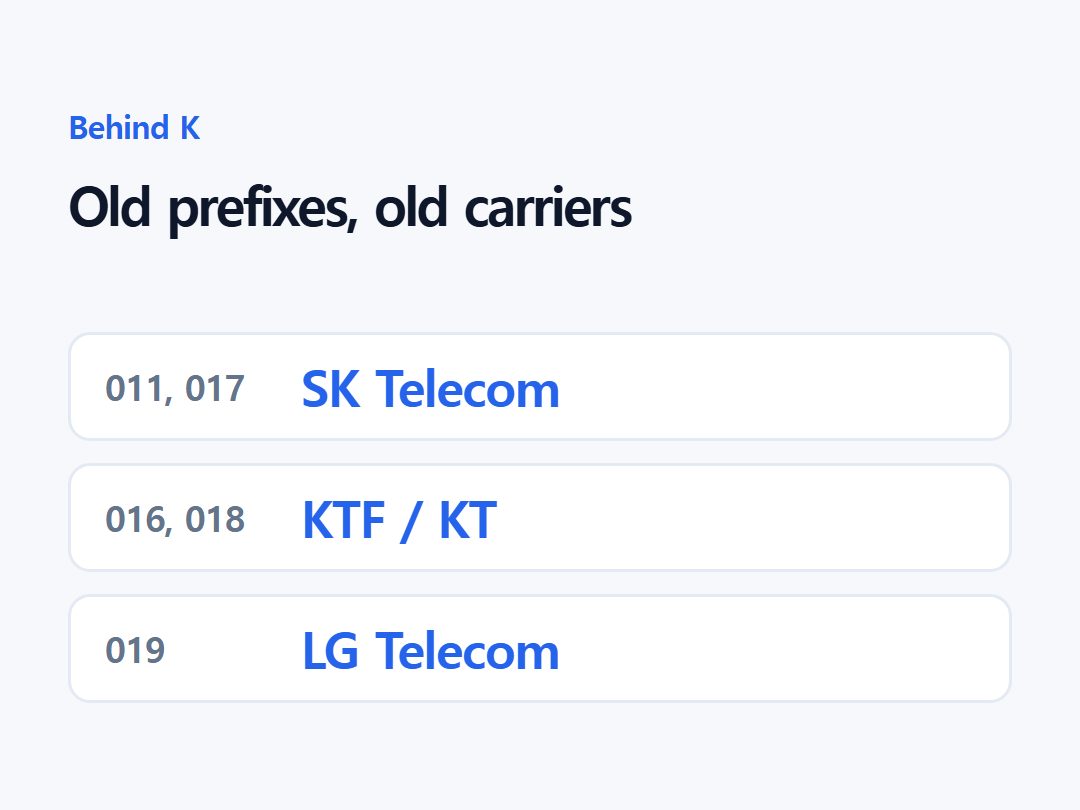
Before 2004, Korea's mobile carriers each held their own three-digit identification codes. SK Telecom's predecessor, Korea Mobile Telecom, launched service in 1984 using 011. When competitors entered the market in the late 1990s, they were assigned different digits: KTF (now part of KT) used 016 and later 018, and LG Telecom (now LG U+) used 019.
None of these numbers were owned by the carriers. They were blocks of digits leased from the state's numbering plan, the same way area codes are. But in daily use, a phone number and a carrier became the same thing.
Why 011 was a status symbol, not just a prefix
For more than a decade, SK Telecom was Korea's only mobile carrier, so 011 effectively meant “mobile phone” itself. Handsets in the early-to-mid 1990s cost around one million won, monthly fees and deposits were high, and getting a line took a long and complicated application process — mobile service itself was a marker of wealth.
By 1996, before any competitor had even launched, about three million people already held 011 numbers.
From 1997, SK Telecom marketed its network as "Speed 011," built partly on a genuine technical edge: the carrier's 800MHz frequency band gave clearer call quality than the 1.8GHz band used by newer PCS rivals, and it was the only Korean network offering automatic roaming abroad at the time.
Industry reporting from the period describes customers openly saying they wanted better service from rival carriers but would not switch, because leaving SK Telecom meant giving up the number.
One 2003 industry account put it directly: 011 carried “high-end, high quality, and sophisticated” associations that rivals selling 016, 018, or 019 numbers simply could not match, regardless of price or service quality.
The competition problem the government wanted to fix
By the early 2000s, regulators saw several structural problems with carrier-owned prefixes.
- Switching carriers meant losing your number, so subscribers stayed with SK Telecom even when they preferred a rival — a lock-in effect that entrenched the dominant carrier
- The identification-number space was nearly full, with 011 through 019 already assigned across pagers, modems, and mobile services
- Any new carrier entering the market had no prefix left to be assigned, since going beyond 019 risked numbers that looked identical to Seoul-style area codes
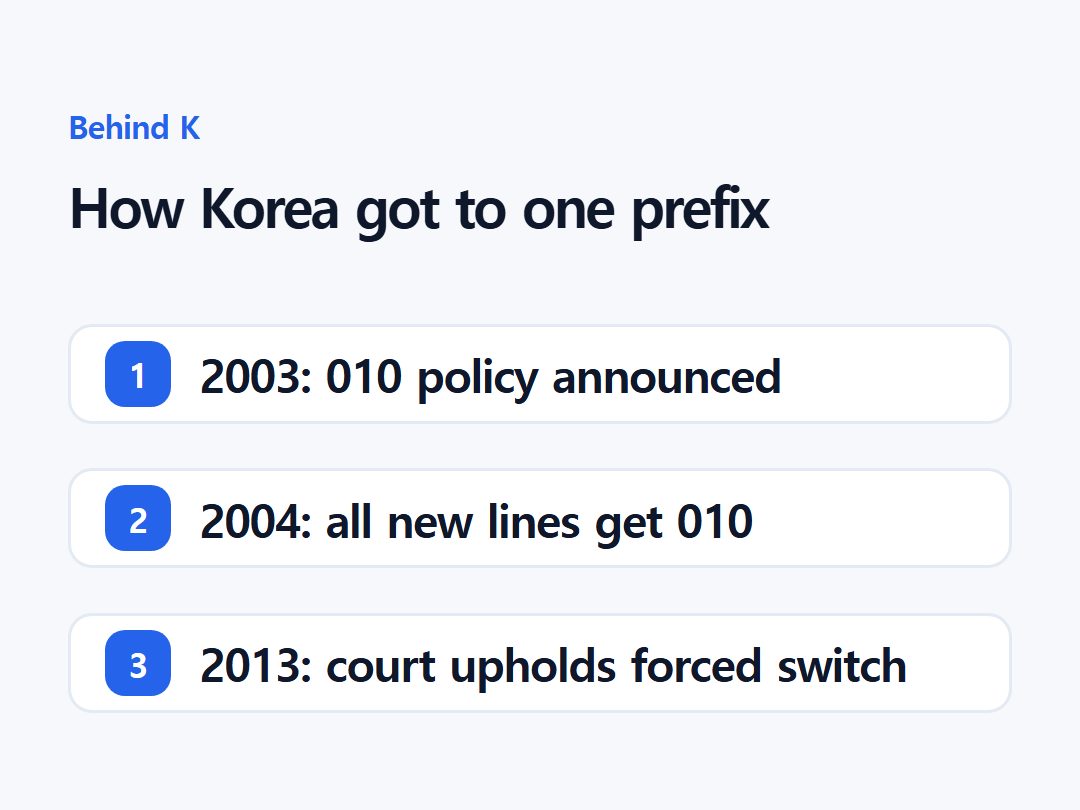
On January 16, 2003, Korea's Ministry of Information and Communication announced the 010 number integration policy: a single, carrier-neutral prefix that any operator could issue.
The reform hiding inside this one: keeping your number
Renumbering alone would not have broken SK Telecom's lock-in. Regulators paired it with something more consequential: number portability, the ability to switch carriers without changing your digits at all. Until then, that was simply not possible in Korea.
Portability rolled out unevenly, precisely to protect smaller rivals from an immediate exodus toward SK Telecom. SK Telecom subscribers could port their numbers away starting January 1, 2004; KTF customers had to wait until July 2004; LG Telecom subscribers waited until January 2005.
In the first eight days alone, nearly 83,000 SK Telecom subscribers switched to a competitor while keeping their number, a volume that would have been unthinkable a year earlier.
How the switch actually rolled out
The transition happened in stages rather than overnight. New 3G subscribers began receiving 010 numbers in 2003. From January 1, 2004, every newly issued mobile number — regardless of carrier or generation of network — used the 010 prefix.
Existing 01X holders were not forced to change immediately. They were grandfathered in, which meant Korea ran two parallel numbering systems for years.
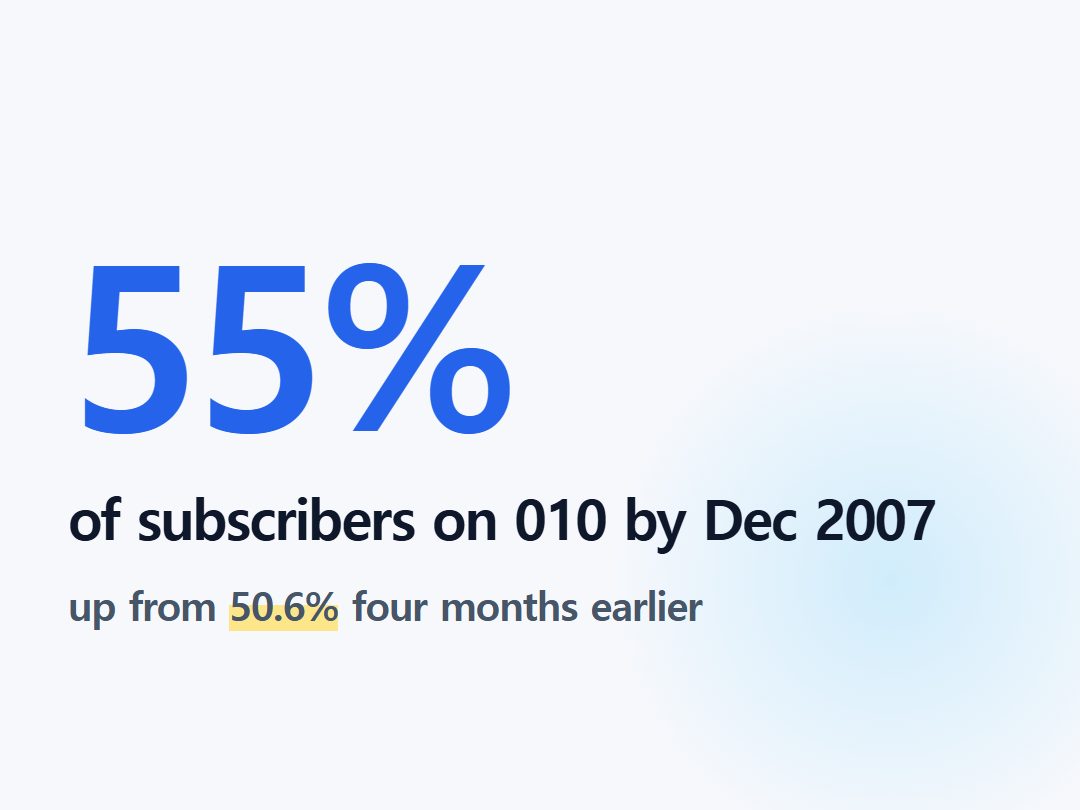
By December 2007, 010 numbers had reached 55 percent of all subscribers — about 24 million of Korea's 43.5 million mobile users — up from just over 50 percent four months earlier. Regulators had already signaled their endgame: once adoption passed 80 percent, they said, the remaining 01X prefixes would be retired by force.
Why some users refused to give up their old numbers
Not everyone went quietly. A group calling itself the “010 Integration Opposition Movement Headquarters,” representing hundreds of long-time 01X subscribers, argued that being compelled to change a number they had used for years violated their rights to self-determination and to pursue happiness.
The case reached South Korea's Constitutional Court, which ruled on July 25, 2013 that the integration policy was constitutional.
The court's reasoning was narrow but decisive: a phone number, it held, is not tied to personal dignity or identity — it exists only because of a service contract with a carrier, so requiring a change did not infringe on any constitutional right. That ruling removed the last legal obstacle to full unification.
Why SK Telecom's 2G network kept 011 alive until 2021
KT shut down its 2G network in 2011, converting its remaining 016 and 018 subscribers to 010 in the process. LG U+ followed later. SK Telecom's 2G network — the same one that had launched with 011 back in 1984 — held on the longest, largely because it was still home to the original, most prized numbers.
By May 2020, only about 860,000 phones nationwide still ran on any 2G network, roughly 1.2 percent of the country's subscriptions, with around 380,000 of those on SK Telecom specifically. The company received government approval in June 2020 and began shutting the network down region by region starting July 6, finishing nationwide by the end of that month.
Remaining 011 and 017 holders were given until June 30, 2021 to migrate. Users could keep their old number displayed as caller ID for a transition period even after switching handsets, and SK Telecom offered conversion incentives — including contract discounts and device subsidies — to ease the move. After that date, any digits that were not 010 stopped working as a live mobile prefix in Korea.
What is still unresolved
The technical transition is complete — every active Korean mobile number has used the 010 plus eight-digit format since mid-2021. What lingers is cultural rather than technical.
Older Koreans who held 011 numbers for two or three decades lost more than a set of digits; they lost a number that, for a stretch of the 1990s, functioned as a visible marker of when — and how successfully — someone had entered the mobile phone era.
Government officials justified the forced retirement partly by arguing the freed-up 011–019 blocks could be repurposed for newer technologies such as connected vehicles and Internet-of-Things devices, though large-scale reuse of those old blocks has not been widely reported since.
Why this matters for reading Korea today
If you come across an old Korean number in a document, a contact list, or a piece of media that starts with 011, 016, 017, 018, or 019, you now know two things: it predates 2004, and — if it is an 011 number specifically — its original owner was likely an early, often well-off, adopter of mobile phones in a country where owning one was once itself a status marker.
What happened to Korea's old carrier prefixes
| Prefix | Carrier | What happened |
|---|---|---|
| 011 | SK Telecom (launched 1984) | Held on longest via 2G network; retired June 30, 2021 |
| 016 / 018 | KTF (now KT) | Converted to 010 when KT shut down its 2G network in 2011 |
| 019 | LG Telecom (now LG U+) | Converted to 010 after KT, following its own 2G shutdown |
| 010 | All carriers | Universal for every new number issued from January 1, 2004 |
Frequently asked
Why do all Korean phone numbers start with 010?
South Korea merged carrier-specific prefixes like 011, 016, and 019 into a single neutral 010 prefix starting in 2004, so phone numbers no longer reveal which carrier a person uses.
What happened to old 011 phone numbers in Korea?
011 holders were grandfathered in for years, but SK Telecom's 2G network, the last place 011 still worked, shut down in 2021, and remaining users had until June 30, 2021 to switch to 010.
Why was an 011 number a status symbol in Korea?
In the 1990s SK Telecom was Korea's only mobile carrier and owning a phone at all was expensive, so an 011 number signaled that someone was an early, often wealthy, adopter of mobile service.
Sources
Every factual claim above is traceable. We do not translate articles — we gather facts from multiple outlets and write them ourselves.
- [Reporter's Notebook] Time to let go of '011' phone numbers — The Korea Times
- SK Telecom starts to terminate 2G services — The Korea Herald
- 55% of Subscribers Use '010' — The Korea Times
- 우리도 '011'쓰고 싶다, 이동통신 식별번호체계 달라진다 — inews24
- 헌재, 010 번호통합 합헌…이통사 2G 종료 분쟁 줄어들듯 — DigitalDaily
- Thousands take advantage of LNP in Korea — RCR Wireless