At a Korean dinner table, watch what happens when someone in their twenties is handed a drink by someone in their fifties or sixties. The younger person takes the glass with both hands, turns their upper body away from the elder, and covers the cup with a free hand before drinking.
The short version
- Younger Koreans turn away and cover their mouth when elders pour drinks.
- The gesture signals age-based rank in Korea, not personal affection.
- It persists strongest today in hoesik company dinners and family gatherings.
The gesture takes about two seconds. There is no rulebook that spells it out, yet almost every Korean can perform it without being taught, and almost every Korean over 40 notices immediately if it's skipped.
International viewers who watch Korean variety shows or period dramas have likely seen the motion without knowing it had a name or a logic. It shows up whenever a younger cast member is poured a drink by an older one, and it is never explained on screen — it doesn't need to be, for a Korean audience.
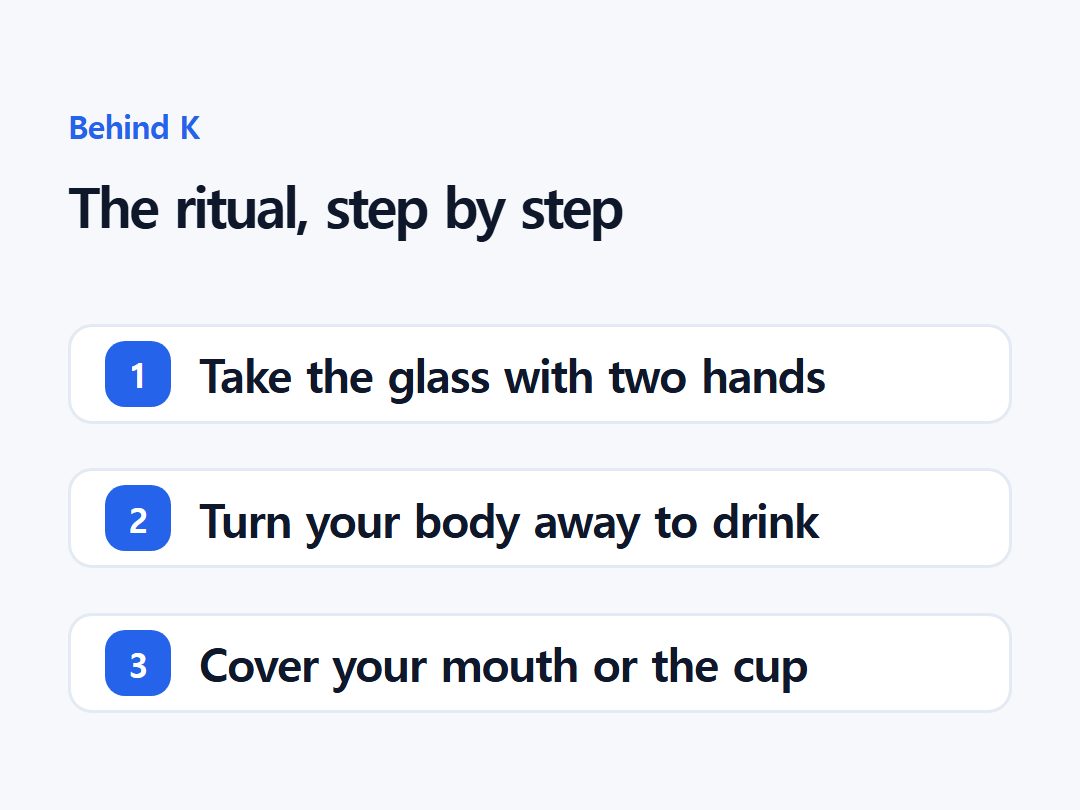
The two-hand turn: what the ritual actually looks like
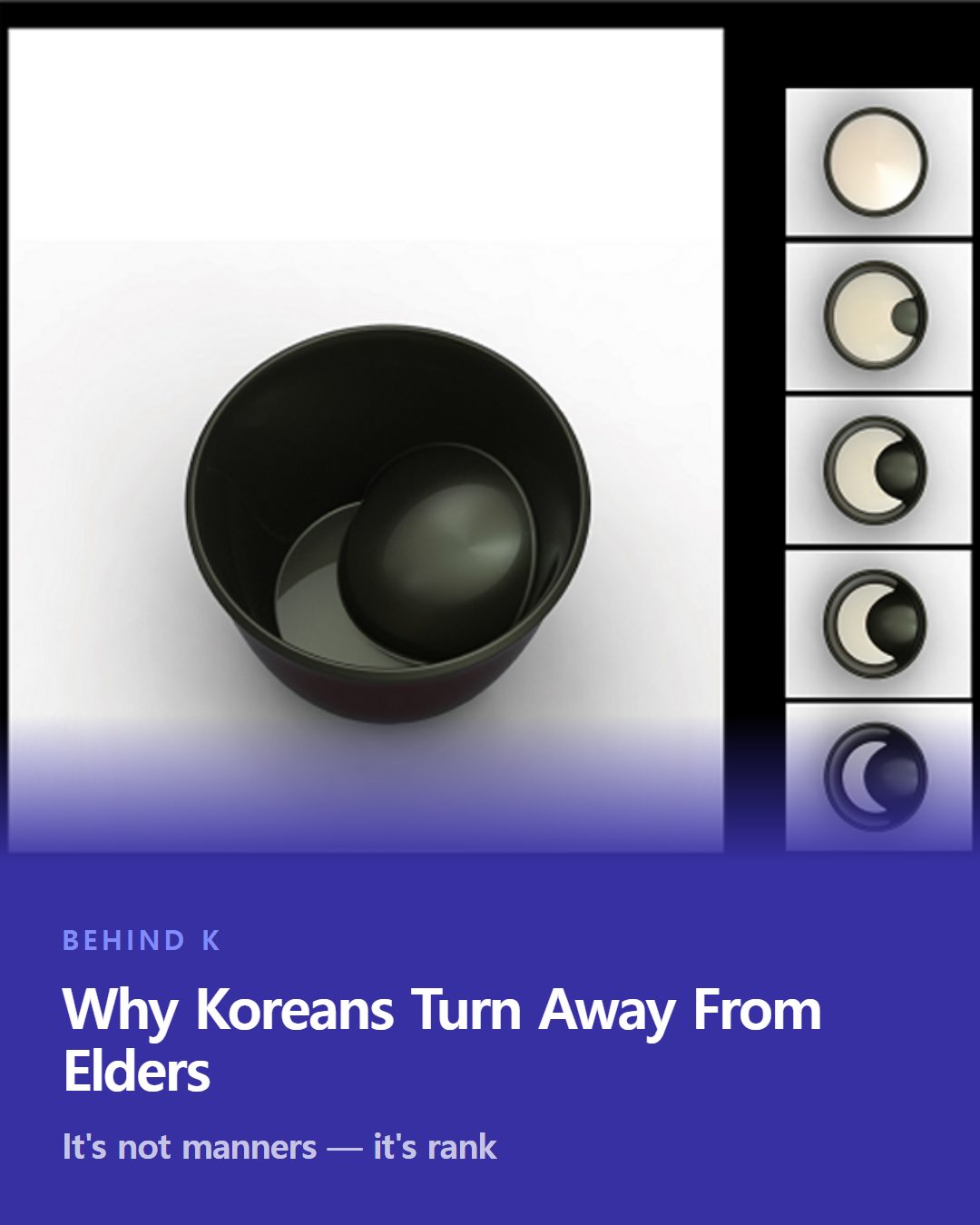
The full sequence has three parts. First, the glass is received with both hands, or with the right hand steadied by the left touching the wrist. Second, before the first sip, the drinker rotates the shoulders away from the elder, not just the head. Third, a hand or the cup itself covers the mouth while swallowing.
- Applies most strictly with someone from a parent's generation or older
- Applies loosely, or not at all, with older siblings, cousins, or same-age colleagues
- A first drink poured by an elder is typically finished in one go, not sipped
None of it is written down as law. It is absorbed the way children absorb which fork to use — corrected once, in front of family, and remembered after that.
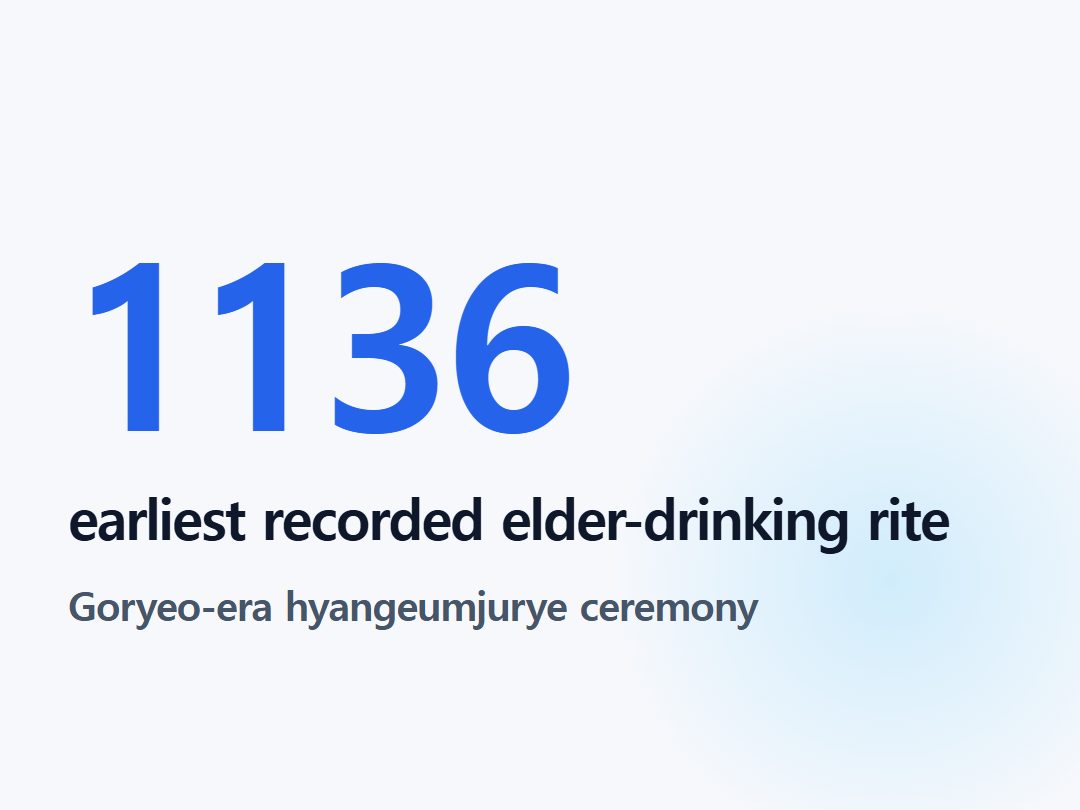
Age is treated as a moral fact, not just a courtesy
To an outside reader this can look like an elaborate version of "don't be rude." That undersells it. In the Confucian framework that still shapes Korean social behavior, age functions as a real rank, not a polite fiction — closer to a job title than a birthday.
Drinking as if you were an elder's equal — facing them directly, matching their pace, meeting their eyes over a glass — reads as a quiet claim to that rank. Turning away removes the claim before anyone has to name it out loud.
This is why the rule scales down to strange precision. A person born in December can outrank a person born the following January by only a few weeks in Korean age reckoning, and that gap is enough to trigger the same two-handed pour and the same turned shoulder.
The gesture doesn't measure how much someone respects an elder personally — it measures where the line of rank falls, and then makes both people perform standing on the correct side of it.
Why looking away defuses the eye contact, not the alcohol
Direct eye contact while drinking puts two faces at the same level, doing the identical thing, at the same moment. In a culture where a two-year age gap can decide who speaks first in a meeting, that visual symmetry is the actual problem.
By turning the body and covering the cup, the younger drinker leaves the elder as the only person facing the table head-on. The elder's position stays visually unchallenged even while both people are doing the exact same act of drinking soju.
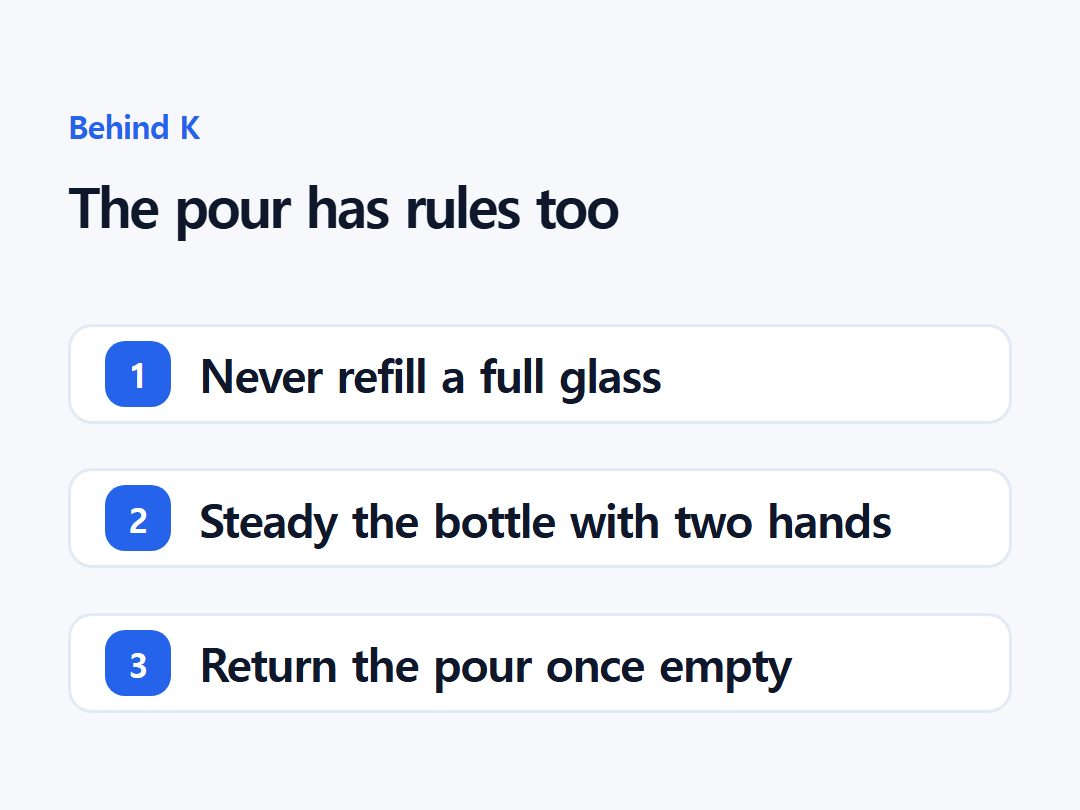
The pour has its own rulebook, separate from the sip
The turn-away gesture is one piece of a wider etiquette system Koreans call judo (주도), literally "the way of alcohol." Most of judo governs the pour, not the sip.
- A glass is never refilled while liquor remains in it — that gesture is reserved for ancestral memorial rites
- The bottle is poured with the right hand, steadied by the left at the wrist
- Glasses are filled to roughly 70 percent, never to the brim
- Whoever receives a pour is expected to return it once their glass is empty
Skipping the turn-away is a minor lapse. Topping off a glass that isn't empty is a bigger one, because it accidentally echoes a gesture set aside for honoring the dead.
A Joseon-era rite that used drinking to teach rank
The idea that drinking should be a structured display of respect for elders is documented as far back as 1136, under Goryeo's King Injong. The ceremony, called hyangeumjurye (향음주례), had local officials host a district's most respected elders once a year, pour wine for them in a fixed order, and close with a reading urging attendees to honor their parents and keep peace with neighbors.
Joseon's dynastic rulebooks of state ceremony later formalized hyangeumjurye as an annual event held in every county. It wasn't really about the drinking — it used alcohol, something everyone shared, as the setting to publicly rehearse who outranked whom.
Nobody agrees on where the head-turn itself began
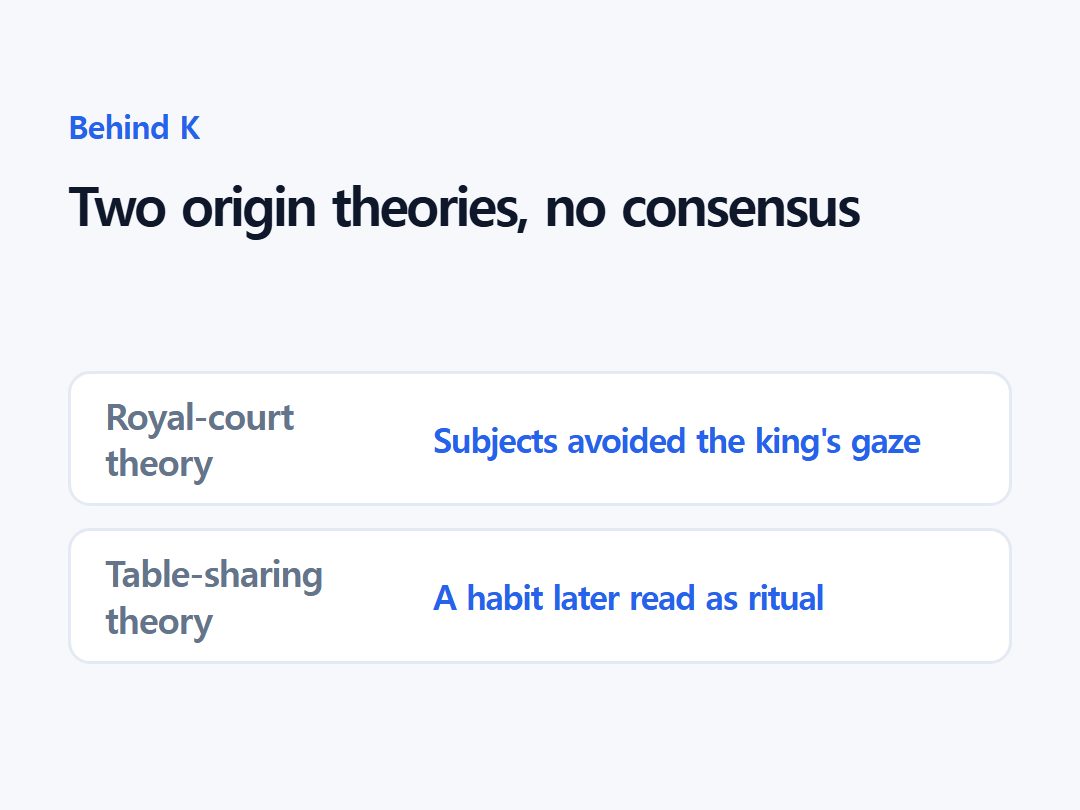
The specific act of turning away and covering the mouth is less documented than hyangeumjurye, and Koreans themselves cite competing explanations for it.
One theory ties it to the royal court: subjects receiving wine directly from a king reportedly avoided facing him while drinking, the same reflex that kept them from meeting a monarch's eyes.
A second, more skeptical theory circulated on Korean reference sites argues the gesture is an exaggerated descendant of ordinary shared-table manners, reinforced over generations partly for the practical reason that showing the inside of one's mouth while drinking looks unappealing. Neither claim is backed by a single settled academic source.
How the ritual scales from family dinners to the office
The clearest place to watch this system operate today isn't a holiday table but a hoesik — a company dinner that functions as an extension of the workday. Seating, pouring order, and who proposes the first toast all map onto job rank.
Junior employees pour for senior ones using the same two-handed etiquette; the most senior person sets the pace and often pays. Dinners frequently extend into a second or third venue, each stage called a "cha," with a karaoke room as the common next stop.
South Korea's own tourism ministry describes hoesik as a defining feature of workplace life, which shows how far the hierarchy-through-drinking format has traveled from the family table that originally produced it.
The dinners also do something the office itself can't: they build jeong (정), a sense of accumulated warmth and obligation between people that Koreans distinguish from simple friendliness. A boss who is rigid at his desk can loosen considerably three rounds into a hoesik, and that shift is treated as meaningful, not as alcohol simply working as it does everywhere.
What's changing, and what still isn't
Attitudes are shifting. Younger employees increasingly decline shots or leave hoesik early, and South Korea's Ministry of Employment and Labor now treats pressuring a subordinate to drink as a form of workplace harassment — a legal framework that didn't exist when this custom took its current shape.
Even so, the two-hand-and-turn combination has proven more durable than most surrounding rules. Cultural writers describe it as one of the few etiquette points that persists even among Koreans who consider the rest of drinking culture outdated, precisely because it survives around the two relationships hardest to opt out of: actual bosses, and grandparents.
Foreigners aren't expected to know any of this going in. But performing the turn correctly, even once, tends to register with older Koreans as a specific, legible sign of respect — proof that in Korea, hierarchy is something you show with your body, not just something you're told to feel.
The judo (주도) pour rulebook
| Judo Pour Rule |
|---|
| A glass is never refilled while liquor remains in it |
| The bottle is poured with the right hand, steadied by the left at the wrist |
| Glasses are filled to roughly 70 percent, never to the brim |
| Whoever receives a pour is expected to return it once their glass is empty |
Frequently asked
Why do Koreans turn away when drinking with elders?
Facing an elder directly while drinking reads as a claim to equal rank, so turning the shoulders and covering the cup removes that claim before it has to be named out loud.
What is judo (주도) in Korean drinking culture?
Judo is the wider etiquette system governing how drinks are poured: never refill a glass that still has liquor in it, pour with the right hand steadied by the left, fill to about 70 percent, and return a pour once your glass is empty.
What is a hoesik and why does it involve drinking rituals?
A hoesik is a company dinner that functions as an extension of the workday, where seating, pouring order, and toasts map onto job rank, and junior employees pour for seniors using the same two-handed etiquette used with family elders.
Sources
Every factual claim above is traceable. We do not translate articles — we gather facts from multiple outlets and write them ourselves.
- It's hoesik time — Korea.net (Ministry of Culture, Sports and Tourism)
- 유교 의례를 통한 교화 활동 (Confucian rites as social education) — 우리역사넷, National Institute of Korean History
- Etiquette in South Korea — Wikipedia
- 알아두면 좋은 한국의 소주 예절 총정리 — GQ Korea
- 주도 (judo, the way of alcohol) — Namu Wiki
- Korean Drinking Culture: Hoesik, Etiquette, and Why Koreans Turn Away — YourKorea.life