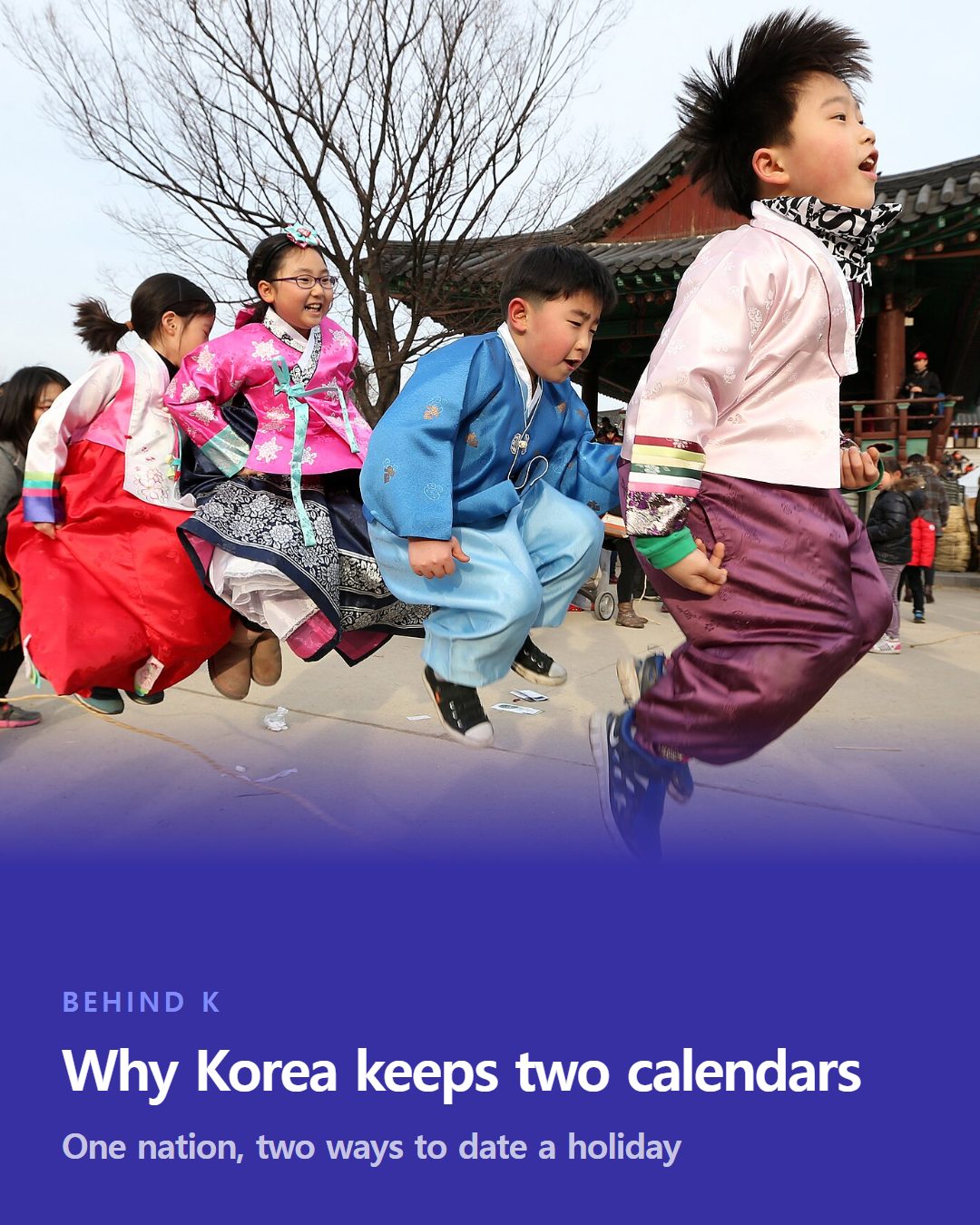
Open a Korean calendar app and two systems run side by side. Seollal (Korean New Year) and Chuseok, the autumn harvest festival, land on a different date every year. Liberation Day and Children's Day never move at all.
The short version
- Lunar holidays honor ancestral rites; solar holidays mark fixed modern events.
- Japan and later Korean governments suppressed Seollal from 1910 to 1989.
- A 1985 survey found 80 percent of Koreans still observed it anyway.
To an outsider, that looks like an oversight — pick one calendar and use it. Inside Korea, it's the visible remainder of a fight over which calendar counted as authentically Korean, one that ran through most of the twentieth century.
Which Korean holidays are lunar, and which are solar
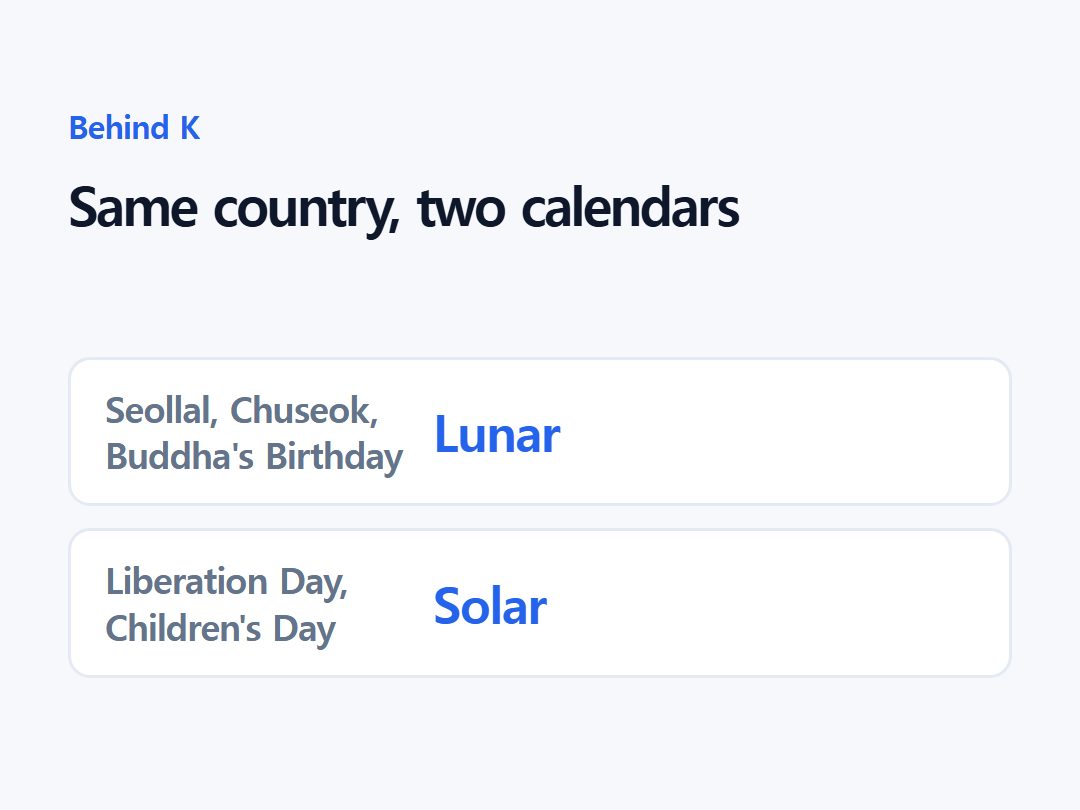
The split has a clean rule once you see it. Holidays inherited from pre-modern ritual life — ancestral rites, harvest thanks, the Buddhist calendar — follow the moon. Holidays created to mark a specific dated event in modern history follow the sun.
| Holiday | Calendar basis |
|---|---|
| Seollal (Lunar New Year) | Lunar |
| Chuseok (harvest festival) | Lunar |
| Buddha's Birthday | Lunar |
| Independence Movement Day (Mar 1) | Solar |
| Children's Day (May 5) | Solar |
| Liberation Day (Aug 15) | Solar |
| National Foundation Day (Oct 3) | Solar |
Chuseok always falls on the 15th day of the 8th lunar month, timed to the full moon nearest the autumn harvest, while Seollal simply marks the first day of the lunar year.
Every lunar holiday on that list predates Korea's adoption of the Western calendar. Every solar holiday commemorates something that happened after Korea was already using it — a detail that explains the rest of this piece.
Why the moon and the sun disagree by up to a month
Korea's traditional calendar isn't purely lunar — it's lunisolar. Twelve months tracking the moon's 29.5-day cycle add up to roughly 354 days, eleven short of a solar year.
Left uncorrected, that drift would push Seollal through every season within a few decades, the way it does in the purely lunar Islamic calendar. Korea corrects it by inserting a leap month (윤달) every two to three years, which is why Seollal can fall anywhere between January 21 and February 21.
The 1896 edict that tried to make January 1 the only new year
Korea didn't drift into using two calendars — it was ordered to stop using one. In 1894, Japan intervened in Korea's Donghak Peasant Revolution and pushed the Joseon court into the sweeping Gabo Reform, which dismantled the class system, banned the traditional topknot, and eventually reached the calendar itself.
On January 1, 1896, King Gojong's government adopted the Gregorian calendar by royal edict, arriving in the middle of what had been the eleventh lunar month. Most Koreans kept marking the old new year anyway.
Japan turned the old new year into a slur
Colonial rule from 1910 gave the new calendar an enforcer. Officials began calling January 1 sinjeong ("new new year") and the lunar new year gujeong — literally "old new year," a label meant to sound backward rather than traditional.
The policy hardened through the 1930s instead of relaxing. Colonial authorities banned ancestral rites during Seollal, prohibited households from brewing alcohol or making rice cakes for the holiday, and shifted market days nationwide onto the solar calendar.
Two Korean presidents kept the ban alive after liberation
Independence in 1945 didn't restore Seollal. President Syngman Rhee, a Protestant modernizer, left it out of his 1949 holiday decree entirely — despite Christians making up roughly 2 percent of the population at the time. His decree recognized only January 1 through 3 as the new year holiday.
Park Chung Hee's government, which openly modeled its development plans on Meiji-era Japan, went further to discourage it:
- Cut train service during the Seollal travel period
- Fined companies that gave employees the day off
- Restricted cinema advertising tied to the holiday
None of it stopped most households from marking the day privately.
A government survey exposed how little the ban had worked
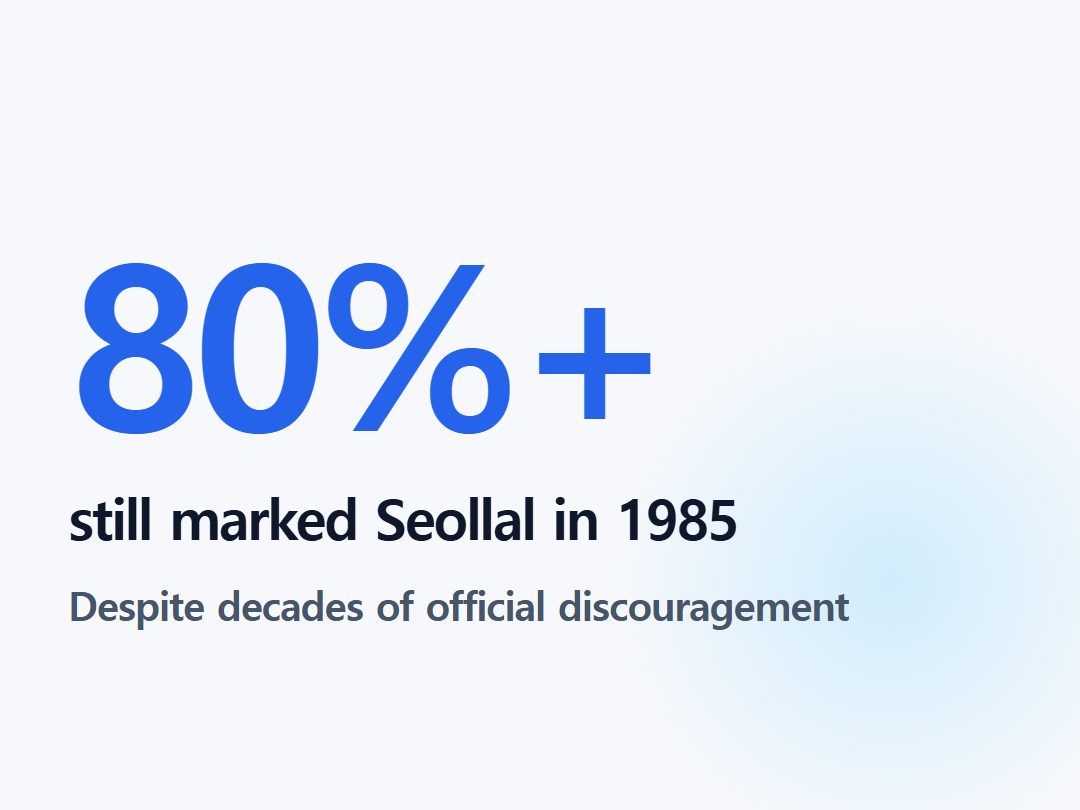
By 1985, the numbers were hard to ignore. A nationwide survey found that more than 80 percent of Koreans still observed Seollal in some form, decades of official discouragement notwithstanding.
Chun Doo-hwan's government answered with a compromise that avoided saying the quiet part out loud: it made the day a single paid holiday under the deliberately neutral name "Folk Customs Day" — not Seollal, not New Year.
1989 finally settled it — Seollal became a three-day holiday
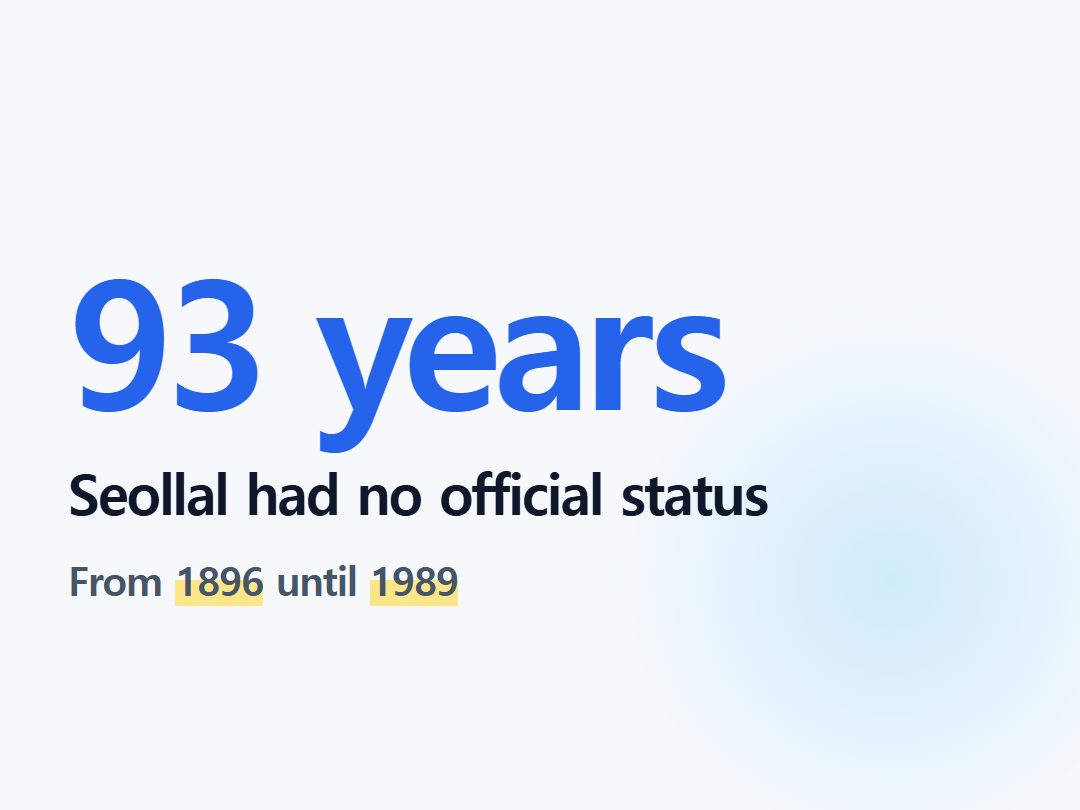
Full restoration came under Roh Tae-woo's government in February 1989, 93 years after the 1896 edict had stripped the lunar new year of official status. The holiday was renamed Seollal and extended to three days, matching how long it actually takes families to travel and hold ancestral rites.
The reversal held. When Kim Dae-jung's government floated shortening it during the 1998 Asian financial crisis to add a working day, public opposition killed the idea within weeks.
By then the government was catching up to reality rather than setting it. Many factories had already been closing for three or four days every Seollal regardless of the official calendar, simply because workers stopped showing up to travel home.
Why the solar holidays never needed this fight
Compare that history to Children's Day. It began in 1922 as a movement led by child-welfare advocate Bang Jeong-hwan, moved dates twice to avoid overlapping with Labor Day, and only became a mandatory paid holiday in 1975 — on the fixed solar date of May 5.
Liberation Day marks August 15, 1945, and the founding of the Republic of Korea on that same date in 1948. Neither holiday carries an ancestral ritual tied to the moon, so neither was ever a candidate for suppression or restoration — both were simply added to a calendar Korea already used.
An astronomy institute decides Seollal's exact date every year
Nobody counts the moon by hand anymore. The Korea Astronomy and Space Science Institute (KASI) calculates every lunar date from real astronomical observation and publishes the ephemeris the government uses to fix Seollal and Chuseok years in advance.
That calculation is precise enough to occasionally put Korea's Lunar New Year a day off from China's, because the two countries base the same lunar math on different observatories and time zones. The calendars share an origin; they don't share a clock.
The loophole that can turn a three-day holiday into two
South Korea's substitute holiday system, first tried in 1959 and revived in 2013 as a campaign pledge under Park Geun-hye, adds a weekday off when a major holiday lands on a weekend. It initially covered only Seollal, Chuseok, and Children's Day, and later expanded to more of the calendar.
But Seollal and Chuseok still play by a stricter rule than newer additions: a Saturday inside the three-day span doesn't trigger a substitute, only a Sunday does.
Holidays added to the solar calendar more recently don't carry that restriction. When Liberation Day falls on a Saturday, it still gets a substitute Monday — a small asymmetry that occasionally leaves Seollal on the losing side of a long weekend.
The solar list keeps growing; the lunar list hasn't moved since 1989
Starting in 2026, South Korea made Labor Day a universal paid holiday and restored Constitution Day after an 18-year gap — both fixed solar dates. The lunar side of the calendar hasn't gained a single new holiday since Seollal's three-day format was locked in.
Whether that gap ever gets revisited — a longer Chuseok, or a Buddha's Birthday break extended the way Seollal's was — is the one part of Korea's calendar arithmetic that's still unsettled.
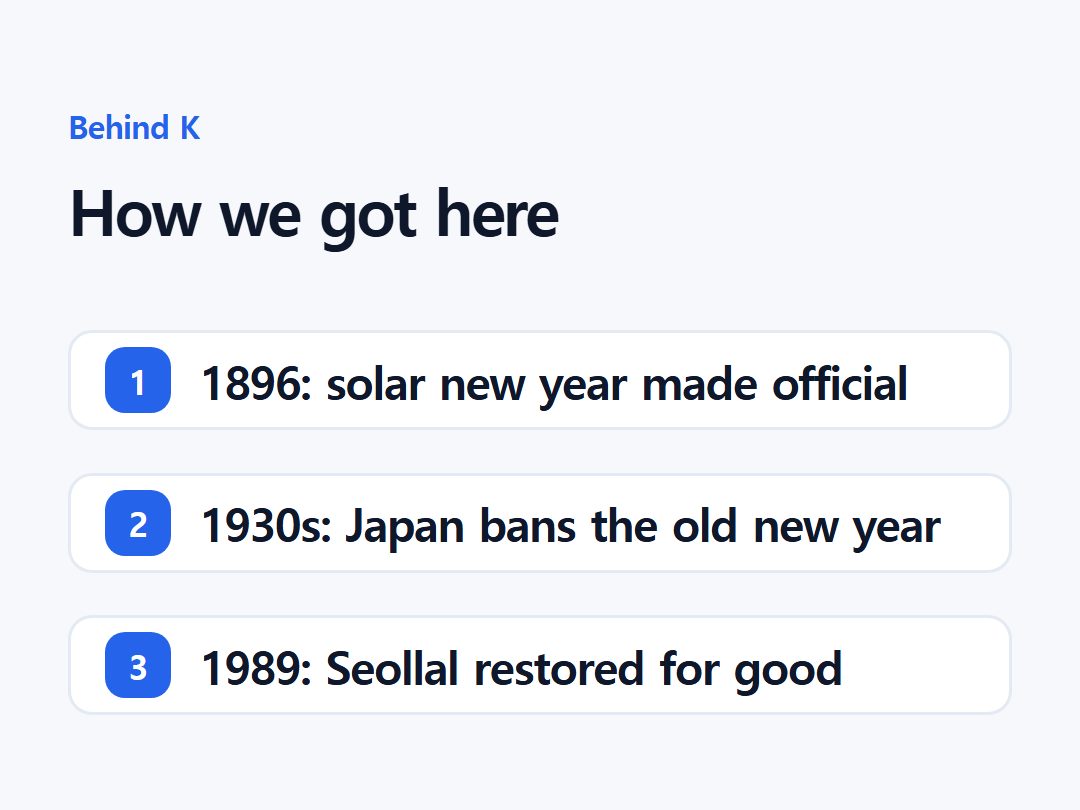
Seollal's road from banned to restored
| Year | Event |
|---|---|
| 1896 | Gregorian calendar adopted by royal edict; most Koreans keep the lunar new year anyway |
| 1910s–1930s | Japan bans Seollal ancestral rites and labels it "gujeong" (old new year) |
| 1949 | Syngman Rhee's holiday decree omits Seollal entirely |
| 1960s–1970s | Park Chung Hee cuts train service and fines companies that give the day off |
| 1985 | Government renames the day "Folk Customs Day"; survey finds 80 percent still observe it |
| 1989 | Seollal restored by name and extended to a three-day holiday |
| 1998 | Public opposition blocks a plan to shorten Seollal during the financial crisis |
| 2013 | Substitute holiday system revived, covering Seollal, Chuseok, and Children's Day |
| 2026 | Labor Day and Constitution Day added as solar holidays; lunar list unchanged since 1989 |
Frequently asked
Why does Korea celebrate two new years?
Korea adopted the Gregorian calendar by royal edict in 1896, but most Koreans kept marking the lunar new year anyway, so both January 1 and Seollal survive today.
Why did Korea ban the Lunar New Year?
Japan's colonial government banned Seollal's ancestral rites and called it "gujeong" (old new year) to make it sound backward; Presidents Rhee and Park kept discouraging it until it was fully restored in 1989.
How is the date of Seollal decided each year?
The Korea Astronomy and Space Science Institute calculates the lunar dates from real astronomical observation and publishes them years in advance, which is why Seollal falls anywhere between January 21 and February 21.
Sources
Every factual claim above is traceable. We do not translate articles — we gather facts from multiple outlets and write them ourselves.
- How Koreans came to celebrate the New Year twice — Korea JoongAng Daily
- Kabo Reform explained: How Joseon Korea's 1894 modernization drive collapsed — Korea JoongAng Daily
- Kabo Reform — Wikipedia
- Korean New Year — Wikipedia
- Korean calendar — Wikipedia
- Bang Jeong-hwan — Wikipedia
- The origin and meaning of Children's Day in Korea — Korea.net
- Korea Astronomy and Space Science Institute — Wikipedia
- Korea's 2026 holiday calendar: Fewer days off, longer breaks — The Korea Herald
- Government, ruling party agree on extra holidays — The Korea Herald
- Seollal is over. When is Korea's next big break? — The Korea Herald