Korean public schools break for summer in late July and are back in session by mid-August. That's roughly four to five weeks — a fraction of the ten to thirteen weeks most American students get.
The short version
- Korea's ~220-day school year is longer overall, not just rearranged.
- Hagwon academies fill vacation because one exam decides university admission.
- Regulators have targeted hagwon since the 1980s, but bans keep failing.
To an international reader, that might sound like the whole story: a shorter calendar, a stricter system, end of explanation. It isn't. What Korean audiences already understand, and what the calendar alone doesn't show, is where those missing weeks actually went.
A four-week break inside a 220-day school year
Korea's academic year doesn't follow the September-to-June rhythm most Western readers grew up with. It starts in early March and runs into the following February, split into two semesters with summer break falling in the gap between them — typically late July to mid or late August, depending on the region and school.
That structure adds up to roughly 220 instructional days a year, against about 180 in the United States. The shorter summer isn't a scheduling quirk; it's the trade-off for a longer school year overall.
Winter, the longer break, comes with an asterisk
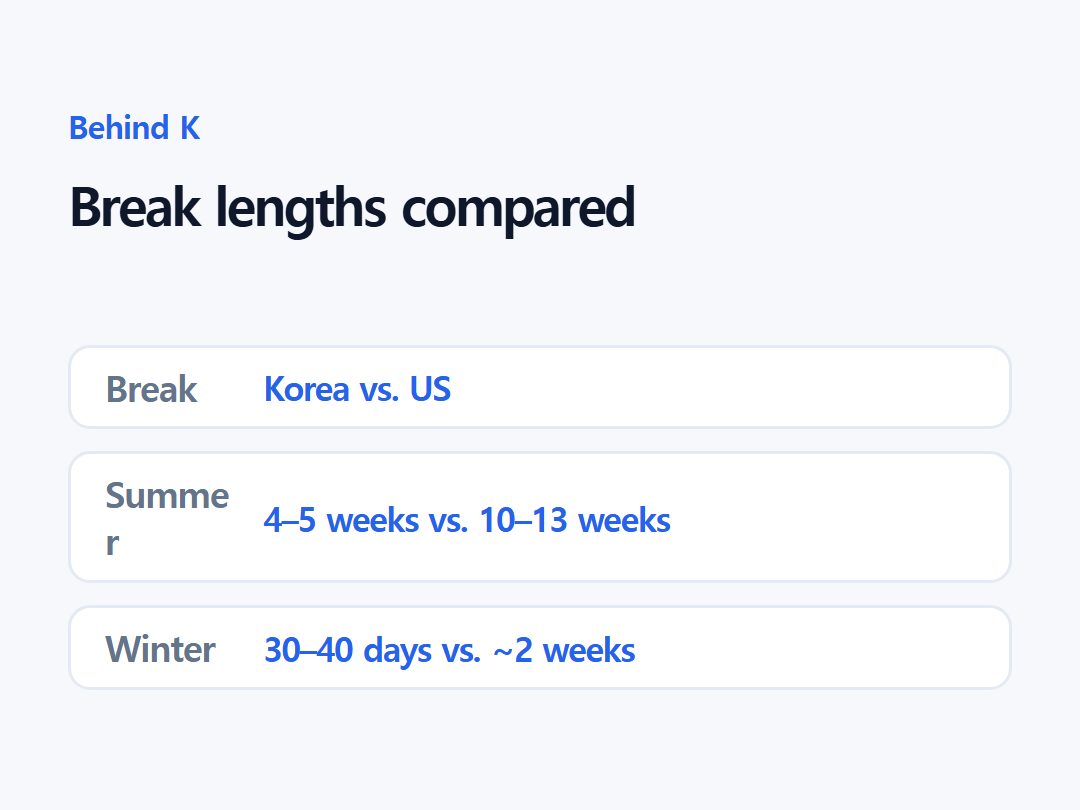
Korean schools compensate with a longer winter break, usually late December to early February — 30 to 40 days, well beyond the roughly two weeks typical in American schools. On paper, Korean students end up with a comparable total amount of time off, just distributed differently.
On paper is the key phrase. High school students in particular are often required to attend supplementary or self-study sessions during both breaks, which can shrink their actual free time to as little as two weeks in either season.
| Break | South Korea | United States |
|---|---|---|
| Summer | 4–5 weeks | 10–13 weeks |
| Winter | 30–40 days | ~2 weeks |
| School year | ~220 days | ~180 days |
The academy schedule that fills the empty weeks
This is the part international coverage tends to skip. When Korean public school lets out, it doesn't hand students free time — it hands them over to hagwon, the for-profit private academies that run alongside the public system.
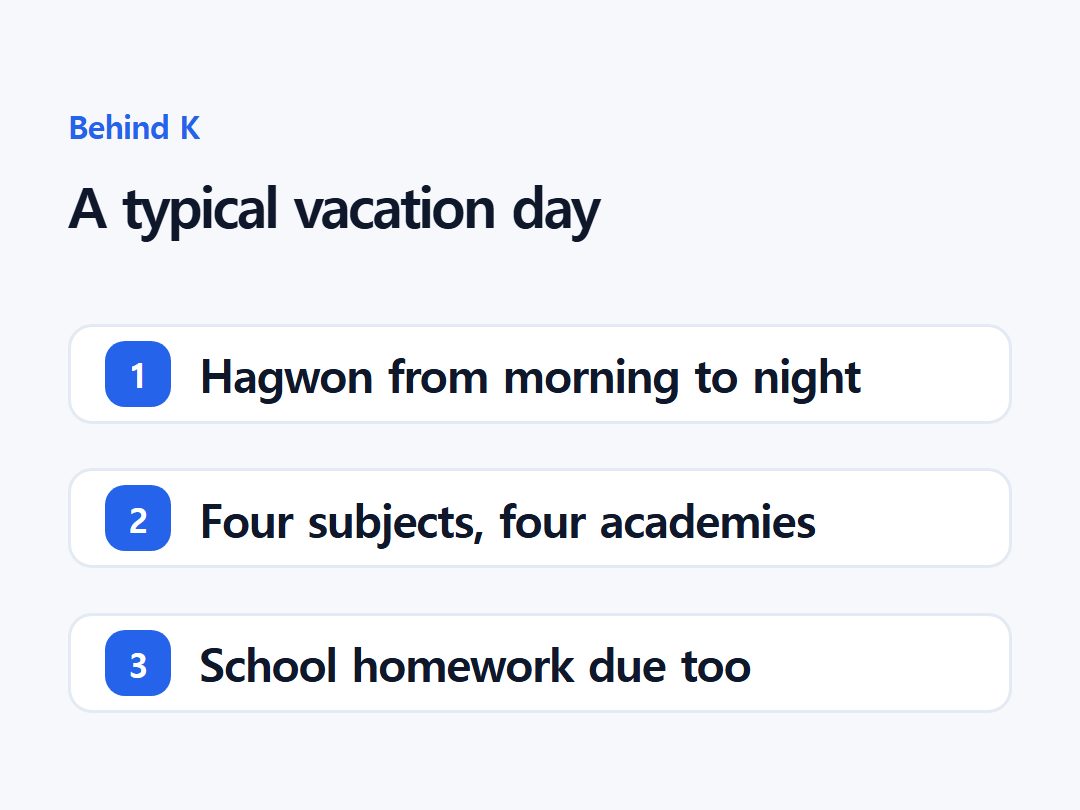
During the school term, a single student attending hagwon for Korean, English, math, and science after the regular school day is unremarkable. During vacation, those same academies simply extend into the hours school used to occupy.
The reason families accept this comes down to one exam: the College Scholastic Ability Test (CSAT, or suneung), a single annual test that heavily determines which university a student enters — and which university a student enters is widely treated as a proxy for lifetime job prospects. Vacation isn't downtime in that calculation; it's uncontested study time competitors won't waste.
- Morning-to-evening academy blocks replacing the school day
- Multiple subjects, multiple academies, same student
- Vacation-specific "intensive" courses layered on top
One frequently cited account describes a student drilling math problems for seven hours a day, four weeks straight, over a single summer — enough to put her a full year ahead of classmates by fall. That kind of story isn't presented as extreme in Korea; it's presented as strategy.
A camper van outside Daechi-dong's hagwon towers
In January 2026, a photo of a large white camper van parked near an apartment complex in Seoul's Daechi-dong went viral. Daechi-dong, inside the Gangnam district, is Korea's most concentrated hagwon neighborhood — a strip of multistory buildings where a single child can move between three to five academies in a week.
The van wasn't a road trip. It was a rest stop. Parents were using it as a place for children to eat or nap between back-to-back hagwon sessions, because renting even a small studio nearby costs upward of 1.4 million won ($982) a month, and short-term space can run into the millions of won.
The story circulated precisely because it made visible something Korean readers already knew: during vacation, some students effectively work a commuting schedule between academies, not a holiday.
Forty years of trying — and failing — to shorten the school day
Governments have tried to rein in private tutoring since the 1980s, when a military government banned it outright. That ban lasted until 2000, when Korea's Constitutional Court struck it down as a violation of parents' and students' educational freedom — a ruling that still shapes what regulators can and can't do today.
Since then, policy has focused on regulating hours rather than banning academies:
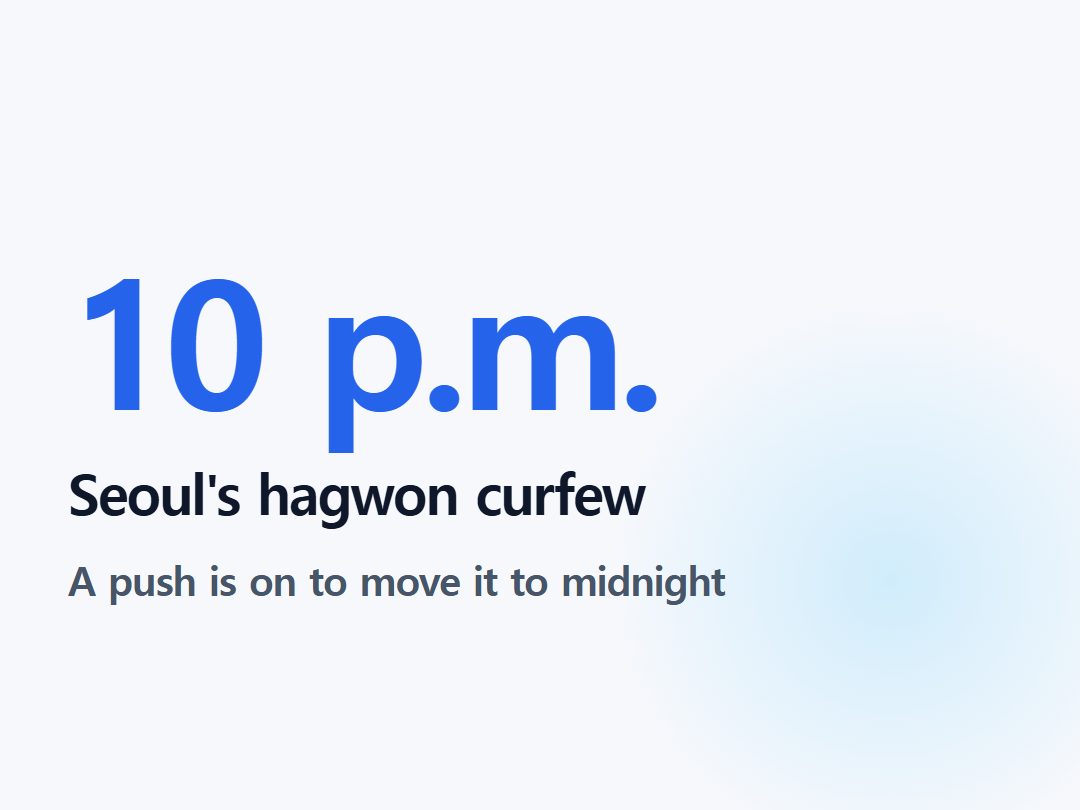
- 2008 — Seoul introduces a 10 p.m. hagwon curfew
- 2009 — a citizen-reporting reward system pays out over 100 million won in its first month
- 2020–2023 — recorded curfew violations in Seoul rise from 49 to 174 cases
The curfew still varies by region — Gyeonggi Province allows secondary students until 11 p.m. — because the 2008 reform let each province set its own limit rather than impose one nationwide.
A law that targets "prior learning" — but not the academies teaching it
In 2014, Korea passed the Public Education Normalization Act, aimed at curbing schools from teaching material far ahead of the standard curriculum. It's the law's gap, not its text, that matters most: it binds public schools tightly but leaves hagwon largely untouched, because the 2000 court ruling makes outright restrictions on private academies constitutionally risky.
Lawmakers are still trying to close that gap. A 2025 legislative proposal would ban English and other subject-specific hagwon for children under 36 months and cap daily instruction for young children at 40 minutes — the most direct attempt yet to reach academies the 2014 law couldn't touch.
Lawmakers backing the change point to academies that teach calculus roughly five years ahead of the standard curriculum as the kind of gap they're trying to close.
A record industry, even as total spending finally dipped
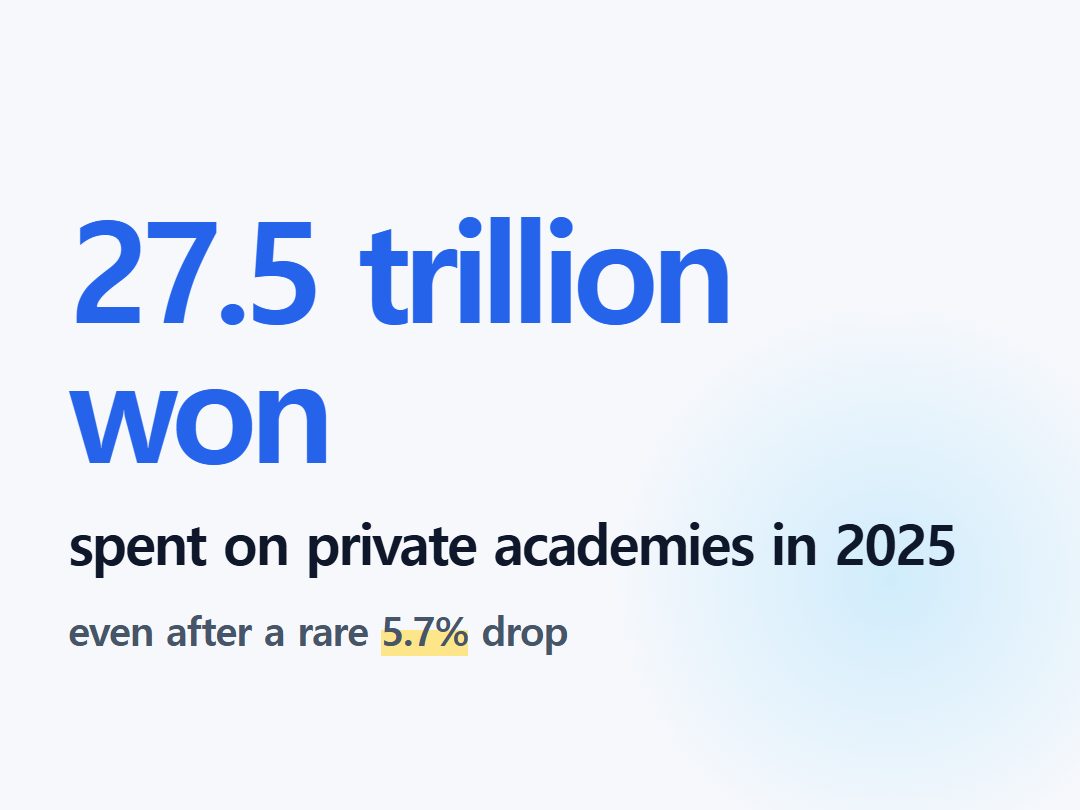
Private education spending hit an all-time high of 29.2 trillion won ($20.1 billion) in 2024. In 2025, total spending fell for the first time in five years, down 5.7 percent to 27.5 trillion won — but that drop tracks a shrinking school-age population, not cooling demand.
Among families who actually pay for it, monthly spending per student hit a record 604,000 won ($430) in 2025, and participation held at 75.7 percent of all K-12 students. High schoolers in paying households average 793,000 won a month. Fewer students are paying more, not less.
The spending isn't spread evenly. Households earning over 8 million won a month spend roughly three times what households earning under 3 million won spend on private education, and students in Seoul spend more than double what students in South Jeolla Province do. The academy system that fills Korean vacations is also a system that compounds existing income gaps.
Will Seoul's midnight curfew debate change anything?
In December 2025, a Seoul city councilor proposed extending the hagwon curfew from 10 p.m. to midnight, arguing the current limit is unenforced anyway and out of step with regions that already allow later hours. Some educators backed it on the grounds that students already study past 10 p.m. in 24-hour cafes and study rooms regardless of the law.
Students themselves largely disagree: a survey of 2,655 students found 95 percent opposed, and Seoul's education superintendent has publicly opposed the ordinance. As of this writing, the proposal remains under committee review, with no resolution yet on whether Korea's most famous study curfew will move later or stay put.
Seoul's Hagwon Curfew Timeline
| Year | Development |
|---|---|
| 2008 | Seoul introduces a 10 p.m. hagwon curfew |
| 2009 | Citizen-reporting reward system pays out over 100 million won in its first month |
| 2020–2023 | Recorded curfew violations in Seoul rise from 49 to 174 cases |
Frequently asked
Why is Korea's summer break so short?
Korea's school year runs about 220 days versus roughly 180 in the US, so the shorter summer is the trade-off for more total instructional days, not a lack of time off overall.
What is hagwon in Korea?
Hagwon are for-profit private academies that run alongside public school, and during vacations they extend into morning-to-evening blocks covering subjects like Korean, English, math, and science.
Why do Korean students study so much during vacation?
Vacation time gets poured into hagwon prep for the CSAT (suneung), a single annual exam that heavily determines university admission, which families treat as a proxy for lifetime job prospects.
Sources
Every factual claim above is traceable. We do not translate articles — we gather facts from multiple outlets and write them ourselves.
- School Holidays in South Korea 2024-2025 — TutorChase
- When school's out, Daechi-dong doesn't rest — The Korea Herald
- Private education spending hits record despite fall in student numbers — The Korea Herald
- Summer School: The Perpetual Studies of Students in South Korea — Reach To Teach
- Private education spending for grade school students hits record high in 2025 — Korea JoongAng Daily
- Ordinance to extend hagwon hours in Seoul sparks debate over regulating cram schools — Korea JoongAng Daily
- Lawmaker proposes ban on med school prep courses for young kids — The Korea Herald