South Korea's flag looks simple from a distance: white, a red-and-blue circle, four black bars. Up close, it is closer to a diagram from a philosophy textbook than a piece of graphic design, and most of what it represents is not obvious just from looking at it.
The short version
- Korea's flag encodes I Ching philosophy, not decorative heraldry.
- Even Koreans often place the four trigrams incorrectly.
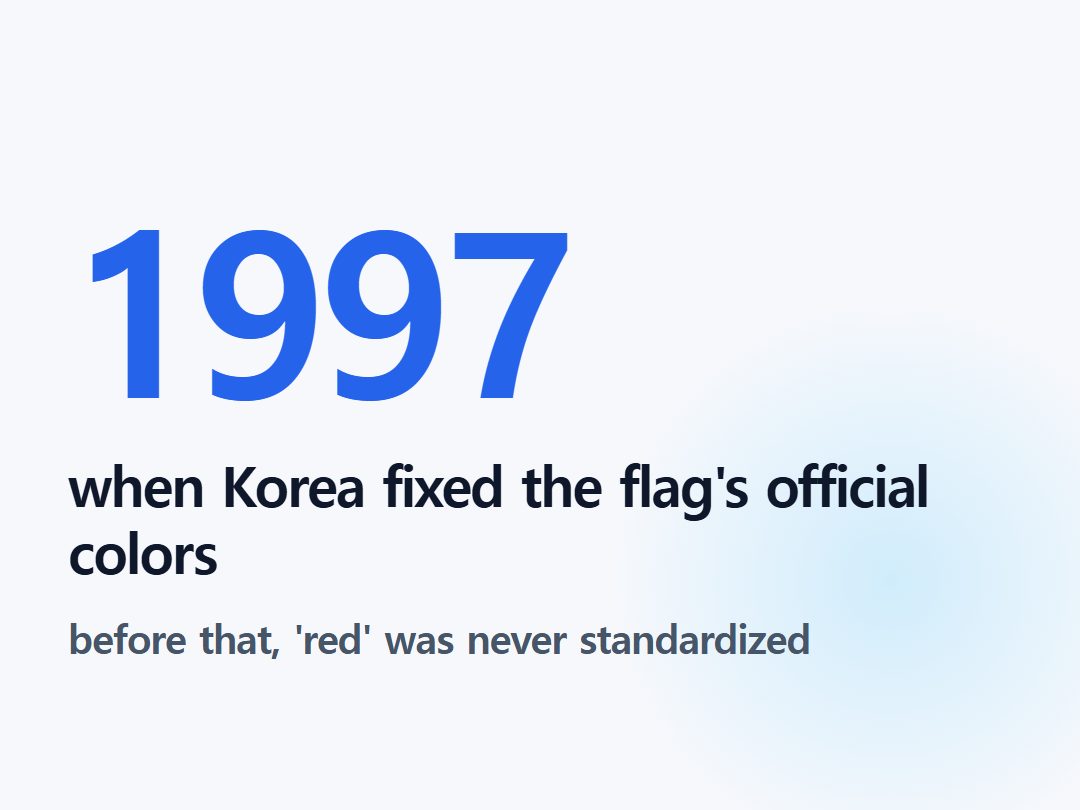
- Official flag colors weren't fixed until Pantone standards in 1997.
A flag borrowed from a 3,000-year-old philosophy text
Most national flags rely on heraldry — a lion, a star, a stripe per founding state. Korea's flag does something different. Its central shapes come directly from the I Ching (Book of Changes), an East Asian classic on cosmic order that predates the Korean state by centuries.
The flag's official name, Taegeukgi, reflects this. "Taegeuk" is the swirled circle at the center — literally "supreme ultimate." "Gi" just means flag. Every shape on the flag corresponds to a specific philosophical term, not a decorative choice.
The center circle is yin and yang, not just two colors
The circle splits into two interlocking halves, red curving into blue. International readers often read this as a generic yin-yang graphic, the kind sold on keychains. It is the same concept, applied without simplification.
According to South Korea's Ministry of the Interior and Safety, red stands for yang, the active cosmic force, and blue for yin, the receptive one. Neither color outranks the other — the design's point is that the two depend on each other to form a whole.
That official reading is not the only one on record. Scholar Kim Sang-sup has argued the colors originally carried a social meaning instead — that an early Qing adviser proposed red for the king and blue for ordinary subjects.
The theory is disputed and unproven. But its existence shows that even the flag's "basic" symbolism has more than one accepted history behind it.
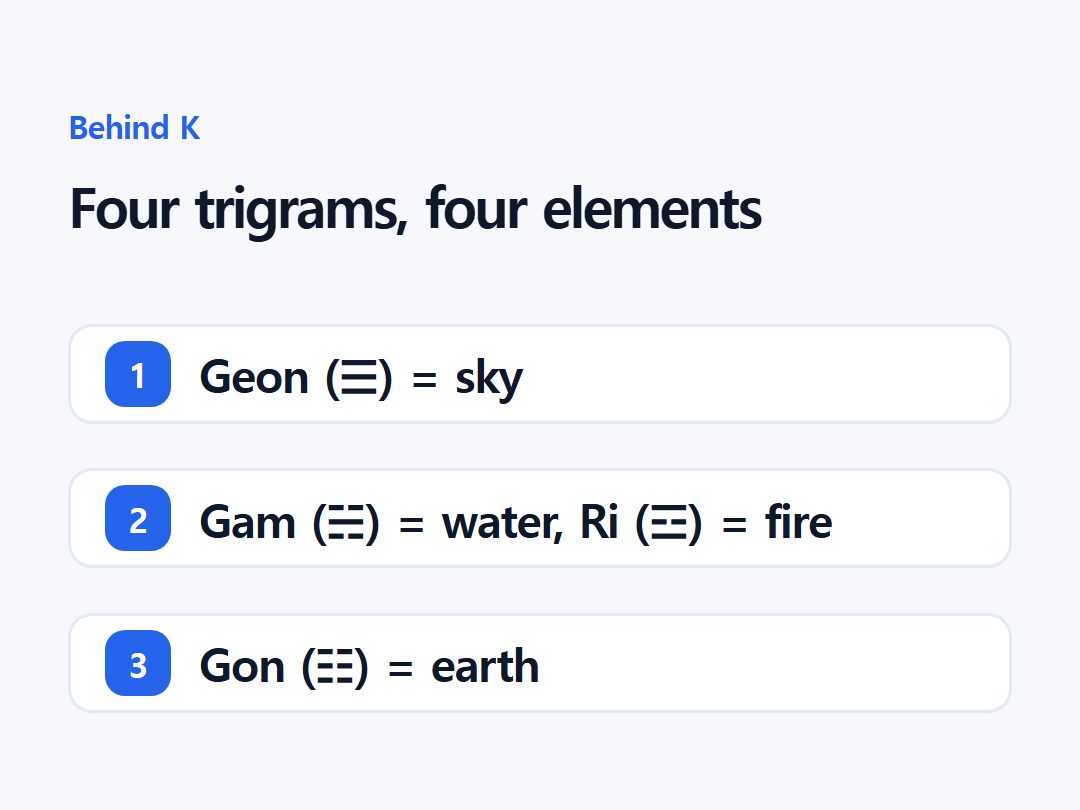
Four black trigrams spell out sky, water, fire, and earth
The four symbols in the corners, three stacked bars each, are called geon, gon, gam, and ri — together known as geongongamri. Each is a trigram from the I Ching's original set of eight; only four made it onto the flag.
A trigram is built from two line types: unbroken for yang, broken for yin. Stack three and you get one of eight possible patterns.
- Geon (☰): three unbroken lines — sky
- Gon (☷): three broken lines — earth
- Gam (☵): broken, unbroken, broken — water
- Ri (☲): unbroken, broken, unbroken — fire
The same four bars also encode a family
Sky, earth, water, and fire is the reading most guidebooks give, but classical I Ching texts stack a second layer of meaning onto the same four trigrams: family roles.
Geon is read as the father, gon as the mother. Gam and ri are their "middle" children, a son and a daughter, the pair said to inherit the balance struck between the two parent trigrams. On this reading, the flag's corners are not just natural elements — they form a household, arranged around a couple at the center.
Almost no English-language guide to the flag mentions this layer. Most stop at "sky, earth, water, fire," which is accurate but skips the reading a classically trained observer would likely reach for first.
Where each trigram sits, and why it cannot be swapped
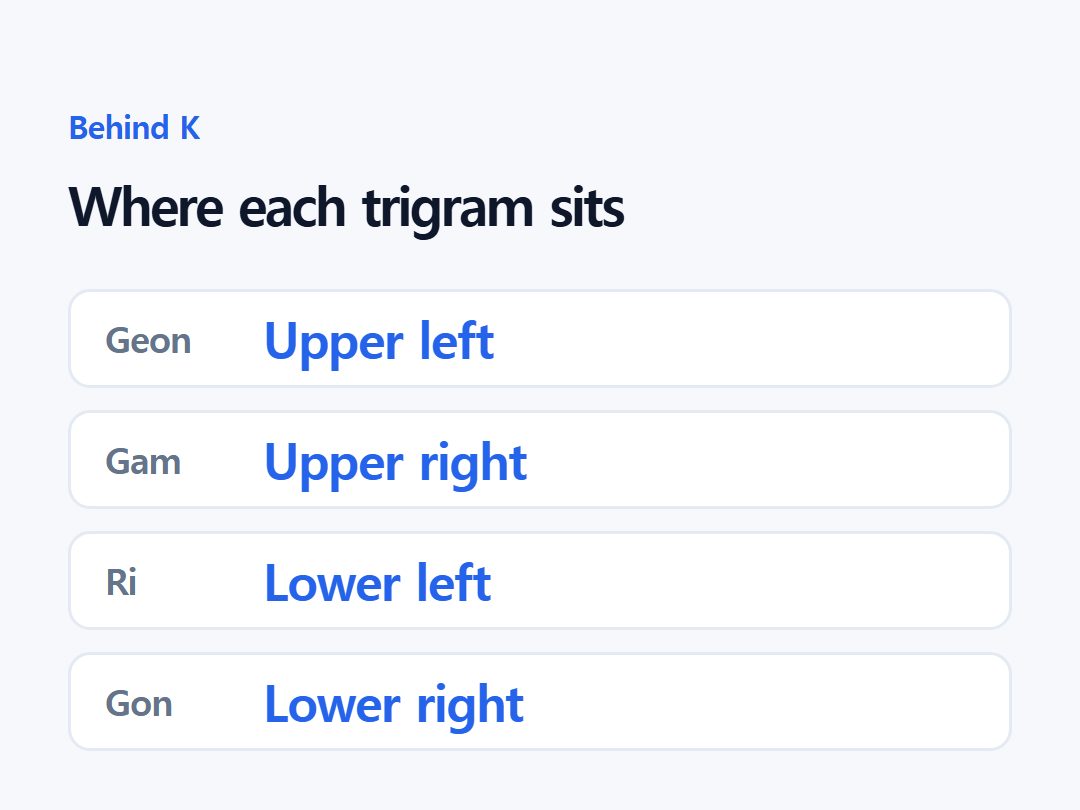
The four trigrams occupy fixed corners. Under the I Ching's logic, swapping any two would pair different elements diagonally and change what the whole design communicates.
| Trigram | Position | Element |
|---|---|---|
| Geon | Upper left | Sky |
| Gam | Upper right | Water |
| Ri | Lower left | Fire |
| Gon | Lower right | Earth |
Even Koreans use memory tricks to get the layout right
This is the detail that surprises international readers most: native Koreans regularly place the trigrams incorrectly, on hand-drawn flags, school assignments, and casual signage.
Korean-language explainers on the topic tend to open with mnemonics rather than definitions. One matches the broken-and-unbroken line pattern to the rhythm "up-down-up, up-up-down." Another borrows the national anthem's opening line about the East Sea and Baekdu Mountain, pairing "deep" with the lower corners and "high" with the upper ones.
If the country most invested in this flag still needs a rhyme to remember its layout, that says more about how abstract the underlying philosophy is than about how much people care.
A British ship captain cut eight symbols down to four
The current design dates to September 1882. Joseon official Park Yeong-hyo sailed to Japan as an envoy shortly after Korea ratified a treaty with the United States, and an early draft floated by Qing Chinese official Ma Jianzhong used eight trigrams around the central circle.
Aboard the steamship Meiji Maru, a British captain named James reportedly told Park that eight symbols were too complicated to read at a distance. Park cut the design to four, working with Korean officials Kim Man-sik and Soh Kwang-pom and British consul William George Aston.
Park's own journal records the flag flying for the first time on September 25, 1882. King Gojong proclaimed it the official national flag six months later, on March 6, 1883.
Envoy or king: historians still argue over who actually drew it
Korean textbooks generally credit Park Yeong-hyo. The paper trail is messier than that.
The flag design Park described in his letter to Gojong did not fully match the version published that same month in a Japanese newspaper — meaning the pattern was not actually locked down until the formal proclamation months later.
Researchers have since found four-trigram Korean flags recorded in U.S. Navy documents and, in 2018, at the Library of Congress, dated as early as May 1882, before Park ever left port. That timeline suggests the concept originated with Gojong's court, not one envoy improvising at sea.
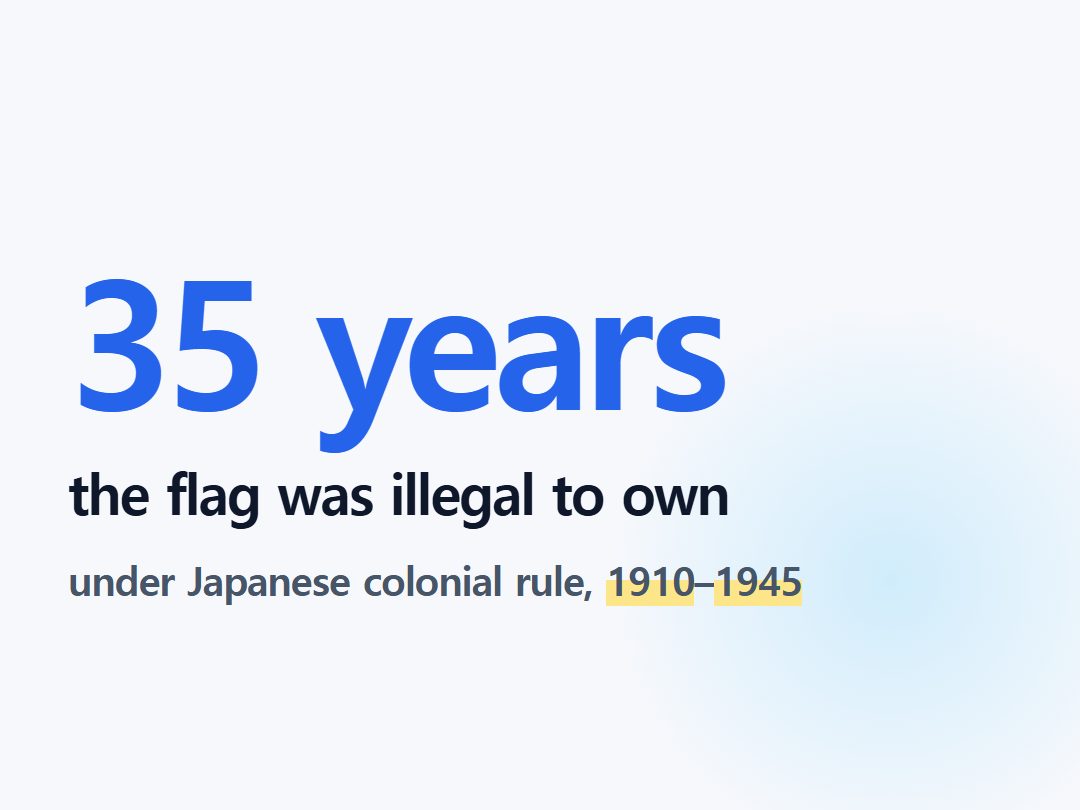
Owning the flag was a crime for 35 years under Japanese rule
Japan annexed Korea in 1910, and the Taegeukgi became contraband. Making, owning, or displaying it was a punishable offense under colonial administration, which flew a different flag in its place.
The ban backfired in one respect: hiding a Taegeukgi, or risking punishment to display one, turned it into an act of resistance rather than routine civic decoration. That association with sacrifice, not just national pride, still shapes how the flag is treated today.
Korea split into two states after liberation in 1945. South Korea formally readopted the Taegeukgi as its national flag when the Republic of Korea was established on August 15, 1948.
Officials did not fix the exact color until 1997
For nearly 50 years, the government never specified an exact red or blue. A 1949 education ministry notice described the colors only as "crimson" and "azure" — descriptive words, not measurable standards, so flags from different decades and factories genuinely varied in shade.
Officials finally locked in standard values in 1997, cross-referencing three color systems (CIE, Munsell, and Pantone) and landing on Pantone 186C for red and 294C for blue.
Even that fix was incomplete: the government has never issued an official RGB value for digital use, so flag graphics from different Korean ministries still do not match exactly.
What is still unresolved
Two questions remain open. Historians have not settled whether Park Yeong-hyo, King Gojong, or an unnamed earlier designer deserves credit for a flag that, according to archival finds, existed in some form before the ship voyage traditionally cited as its origin.
And technically, South Korea still has no legally binding digital color code for its own flag, only a 1997 printed-ink standard that different agencies interpret slightly differently. For a national symbol this old and this loaded with meaning, the exact version citizens are supposed to fly remains, on paper, unfixed.
Timeline of the Taegeukgi
| Date | Event |
|---|---|
| May 1882 | Four-trigram flag documented in U.S. Navy records, before Park's voyage |
| September 25, 1882 | Park Yeong-hyo's flag flies for the first time |
| March 6, 1883 | King Gojong proclaims it the official national flag |
| 1910 | Japan annexes Korea; owning the flag becomes a crime |
| August 15, 1948 | Republic of Korea formally readopts the Taegeukgi |
| 1997 | Government fixes official colors: Pantone 186C red, 294C blue |
Frequently asked
What do the colors on the Korean flag mean?
Red represents yang, the active cosmic force, and blue represents yin, the receptive force, according to South Korea's Ministry of the Interior and Safety.
What do the four trigrams on the Korean flag stand for?
The four black trigrams—geon, gon, gam, and ri—represent sky, earth, water, and fire, and classical texts also read them as father, mother, and their two middle children.
Who designed the South Korean flag?
Textbooks credit envoy Park Yeong-hyo with the 1882 design, but records found in U.S. Navy documents and the Library of Congress show a four-trigram flag existed earlier, suggesting it may have originated with King Gojong's court.
Sources
Every factual claim above is traceable. We do not translate articles — we gather facts from multiple outlets and write them ourselves.
- The National Flag - Taegeukgi — Ministry of the Interior and Safety (Korea)
- History of the South Korean flag — Flags of the World (CRW Flags)
- 태극기 건곤감리·4괘 무슨 뜻일까? — Money Today
- 태극기 건곤감리 뜻? 하얀 바탕 가운데 네 모서리 '4괘'…의미는? — Kyeongin Ilbo
- 건곤감리, 뜻은 무엇?…태극기 달 때 위치 기억하기 — TOPSTARNEWS
- 국기의 제작 (태극기 표준색도) — Guri City
- 「조미수호통상조약」 당시 고안된 최초의 태극기 — Korean government museum webzine (MUCH)
- 괘의 명칭과 상징 — Gyeongnam Maeil