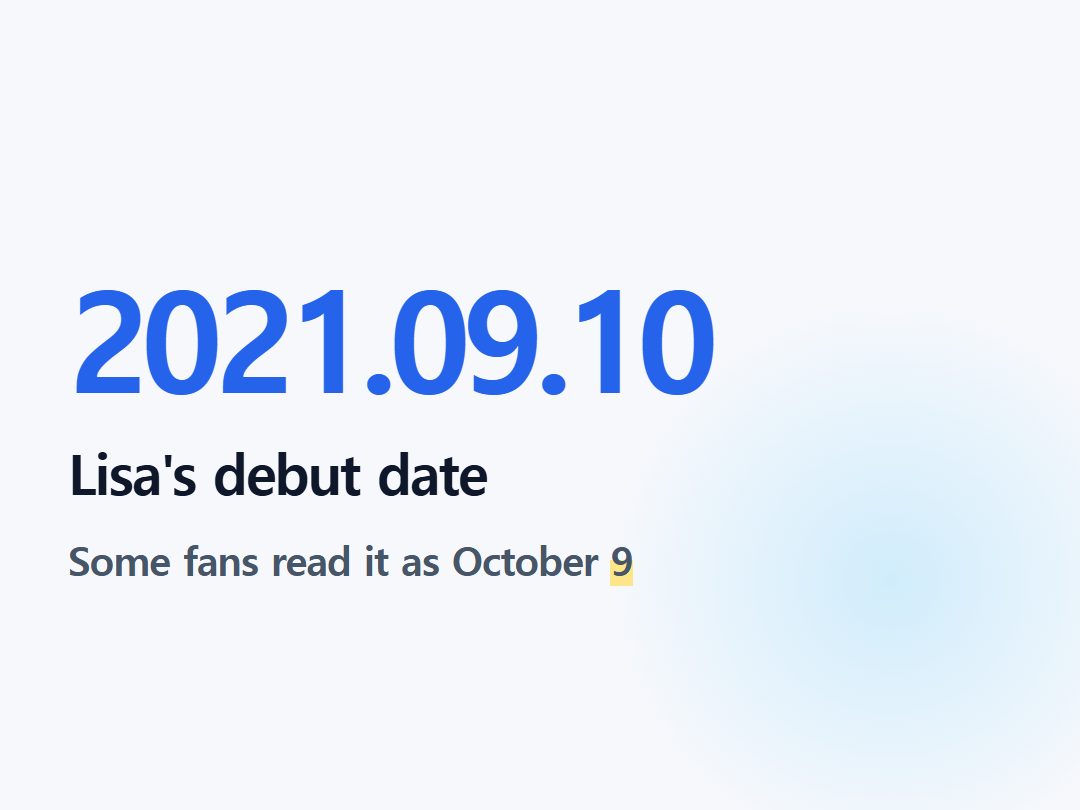
When BLACKPINK's Lisa announced her solo debut in August 2021, the caption from her agency read "MY FIRST SINGLE ALBUM RELEASE 2021.09.10 1PM (KST)." Some international fans marked September 10 on their calendars. Others were certain it said October 9.
The short version
- Korea always writes dates year, month, then day — never month first.
- Your first six ID digits are your birth date, in that order.
- Korea dropped its add-a-year-every-January age system on June 28, 2023.
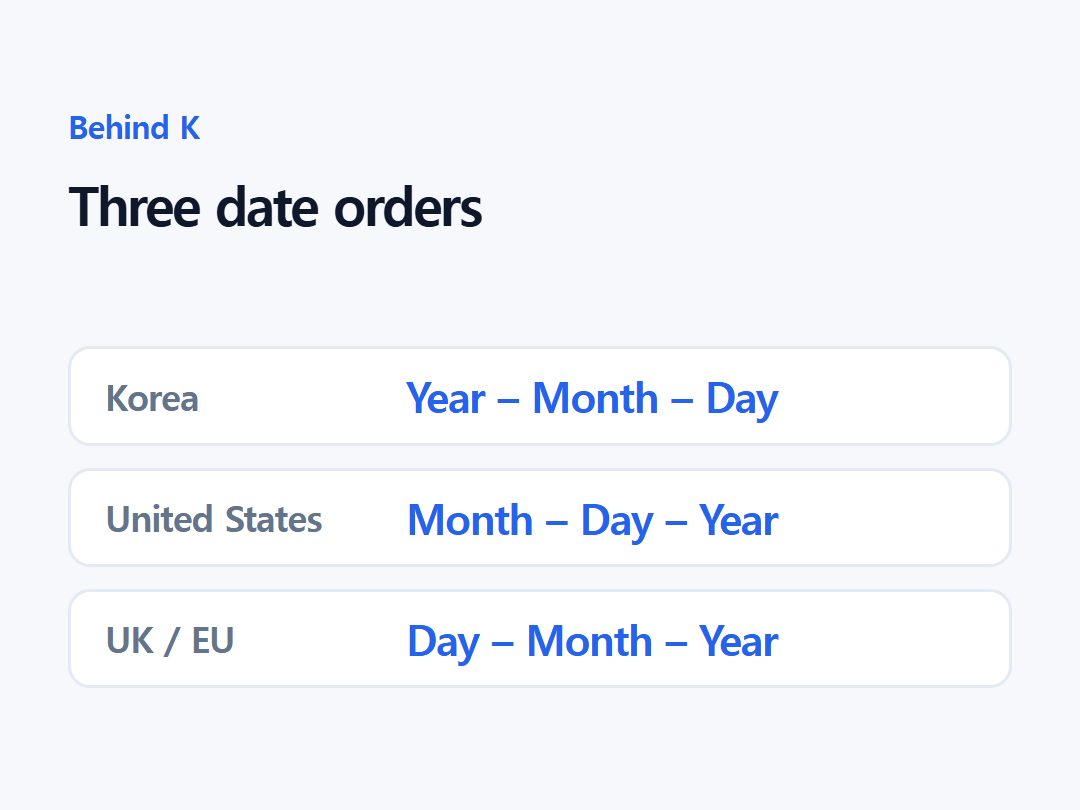
Both were looking at the same eight digits. The disagreement wasn't a typo — it was a date order. Korea writes dates year first, then month, then day, the reverse of the American month-day-year habit and different again from the day-month-year order used across the UK and most of Europe.
Korea writes the year first, every time
In spoken and written Korean, 2026년 8월 20일 reads year, month, day, matching the order in English underneath. When the date switches to Arabic numerals, the National Institute of Korean Language's style guidance replaces each unit marker with a period, so the same date becomes "2026. 8. 20." — with a period after the day, not only between the numbers.
That final period is not decorative. Korean orthography treats a date missing its trailing period as incomplete, partly to stop extra digits being appended to an official date after it's issued.
| Region | Order | Aug 20, 2026 written as |
|---|---|---|
| Korea | Year – Month – Day | 2026. 8. 20. |
| United States | Month – Day – Year | 8/20/2026 |
| United Kingdom / EU | Day – Month – Year | 20/8/2026 |
How "09.10" split BLACKPINK fans into two camps
Lisa's announcement wasn't actually ambiguous by Korean convention — her agency, YG Entertainment (the company that trains, manages, and promotes her career, a standard setup in Korean pop music known as the agency system), wrote the full year first. Under year-month-day order, 09 was always the month and 10 was always the day.
But fans scanning the caption out of habit read the two-digit pair as if U.S. order applied, and the release date became a genuine point of disagreement online before it was resolved. The date itself never changed — only which convention the reader assumed.
Your birthdate is the first six digits of your ID number
The year-first habit isn't limited to comeback announcements. It's built into how Korea identifies its own citizens. Every Korean resident is issued a 13-digit resident registration number, and the first six digits are their birth date, always in year-month-day order.
Someone born on August 20, 2000 has a number that starts "000820." The seventh digit encodes sex and century of birth, and the rest of the number is used for regional coding and verification. Foreign residents in Korea receive a separate registration number built on the same birth-date-first structure.
That means the format isn't a style preference that could quietly change later. It's embedded in how Korea does identity verification — banking, hospital registration, phone contracts — all of which ask for this number by heart.
Why Koreans ask for birth year, not age
Korean social speech has two broad registers: formal, polite language (존대말) and casual language (반말) used between close friends or toward someone younger. Which one applies often depends on relative age, so Koreans meeting for the first time frequently ask each other's birth year rather than their age directly.
Birth year is treated as a fixed, checkable fact — phrased as "neun-saeng," attached to the last two digits of the year, so someone born in 1995 is casually called a "95-saeng." Age, by contrast, used to depend on which counting system was in use, which made it the less reliable number to lead with.
Your birth year got simpler in 2023 — except when it didn't
Until 2023, Korea ran a separate age system alongside the international one. A baby was considered one year old at birth, and everyone gained a year together every January 1 — not on their individual birthday.
That meant a person born on December 31 turned two years old the following day. It also meant a Korean's casual "age" was routinely one or two years ahead of the birthday-counted age used almost everywhere else.
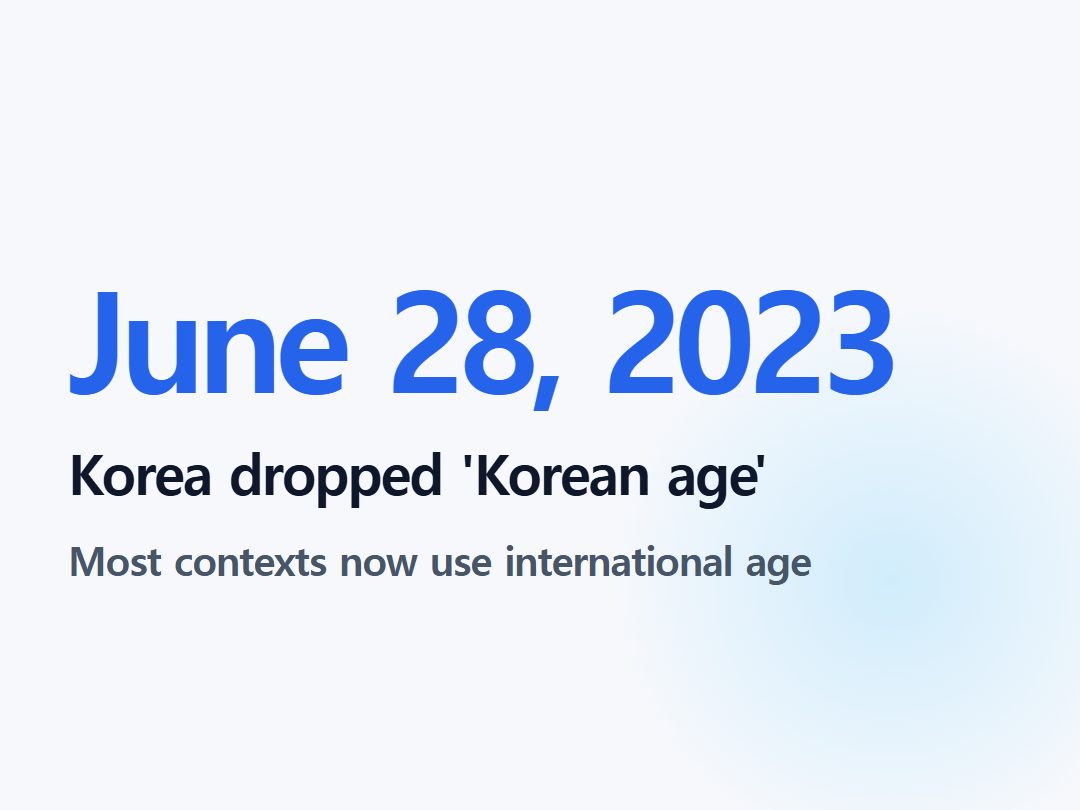
South Korea's Ministry of Government Legislation standardized on the international counting method — age based on completed years since your actual birthday — effective June 28, 2023. Then-minister Lee Wan-kyu said the change was meant to reduce the "social and administrative confusion" the dual system had caused for decades.
Year-first didn't start with computers
It's tempting to assume Korea adopted year-first order for the same reason spreadsheets like it: it sorts correctly. That gets the history backwards. Korean, like Japanese and Chinese, has written dates biggest-unit-first for centuries, following the same logic used for addresses and formal names — largest category first, most specific detail last.
Computing didn't create the convention. It simply gave Korea's existing habit an international ally.
The world agreed on this order — Korea just actually follows it
That ally is ISO 8601, the international standard for writing dates and times without ambiguity, first published in 1988. It recommends the same year-month-day order Korea already used, specifically because formats like "01/05/22" are genuinely unreadable without knowing which country wrote them — January 5 or May 1, depending on the convention in the writer's head.
Korea's national standards body maintains its own version of the rule — renumbered in 2024 from KS X ISO 8601 to the split standard KS X ISO 8601-1, though the substance, year before month before day, hasn't changed. In practice, Korea's spoken habit and its administrative paperwork were never fighting each other, unlike the United States, which uses ISO order in databases but month-day-year in everyday speech.
Where "Korean age" still survives
The 2023 reform didn't erase every exception. A few areas still calculate age by calendar year rather than by birthday, because changing them required separate legislation the reform didn't touch.
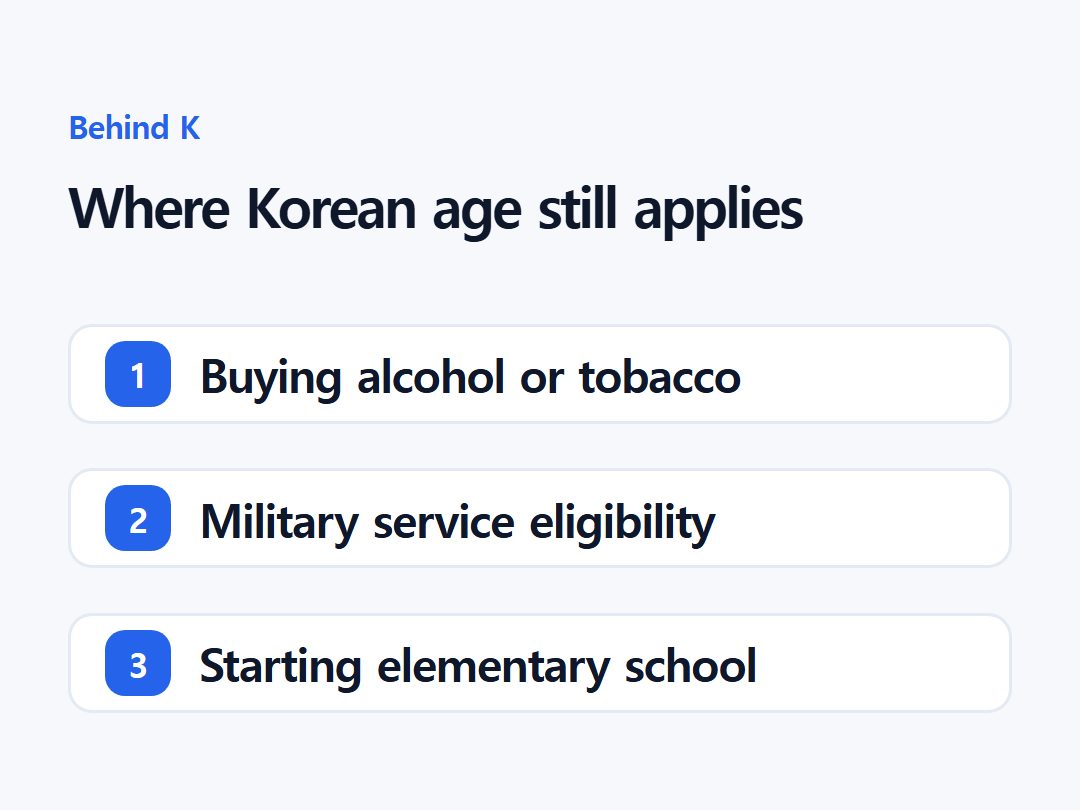
- Alcohol and tobacco purchase age still uses "counting age" — zero at birth, plus one every January 1
- Military conscription eligibility is still tied to birth year rather than birthday
- Elementary school enrollment is still keyed to the calendar year a child turns seven
So a Korean asked their age today might give one of two correct answers depending on the context — a small residue of the old system inside a country that has officially retired it.
Do Koreans ever write the month first?
Rarely — and Lisa's own caption is the proof. Even when a Korean agency switches its wording to English for an international audience, the date format usually doesn't switch with it. The words translate; the number order stays Korean.
That consistency is exactly why the confusion happens. A reader sees English text and unconsciously expects an English date convention, when what they're actually looking at is a Korean date wearing English words. If a date appears without any other language cue, year-first is the safer default assumption.
Official English-language paperwork issued in Korea — immigration forms, university admissions portals, bank applications — tends to follow the same pattern: the labels are in English, but the expected input order is still year, then month, then day. Travelers filling these out on autopilot, in the format they use at home, are the ones most likely to enter their own birth date wrong.
What to check before you trust a date
For international readers, the practical fix is simple: when a Korean source gives a date as three numbers, assume the longest one is the year, and read the order as year, then month, then day — even when the year is abbreviated to two digits.
The Lisa case shows the stakes are usually low, a scheduling mix-up sorted out within hours. But the same format shows up on ticket sale windows, visa deadlines, and legal documents, where a misread digit carries more consequence than a missed comeback.
How date order differs by region
| Region | Order | Aug 20, 2026 written as |
|---|---|---|
| Korea | Year – Month – Day | 2026. 8. 20. |
| United States | Month – Day – Year | 8/20/2026 |
| United Kingdom / EU | Day – Month – Year | 20/8/2026 |
Frequently asked
Why does Korea write dates year-month-day instead of month-day-year?
Korean has written dates biggest-unit-first for centuries, the same logic used in addresses and names, and it matches the international ISO 8601 standard rather than the US month-day-year habit.
Was Lisa's solo debut September 10 or October 9?
It was September 10, 2021. Her agency's caption read "2021.09.10" in Korean year-month-day order, so 09 was the month and 10 was the day, even though some international fans read it as October 9.
Did Korean age counting change in 2023?
Yes, South Korea standardized on international age counting effective June 28, 2023, ending the old system where everyone gained a year on January 1 — though alcohol/tobacco purchase age, military conscription, and school enrollment still use calendar-year-based counting.
Sources
Every factual claim above is traceable. We do not translate articles — we gather facts from multiple outlets and write them ourselves.
- Online Gana-da: date-writing style guidance — National Institute of Korean Language
- BLACKPINK's Lisa Announces Solo Debut Single 'LALISA' — Billboard
- Fan confusion over LALISA release date — Sportskeeda
- New foreigner ID card format explained — The Korea Herald
- ISO 8601 date and time format — International Organization for Standardization
- KS X ISO 8601 national standard record — Korean Agency for Technology and Standards
- Korea to unify age-counting system from June 28 — Korea.net
- South Korea drops 'Korean age' system — CNN
- Exceptions that remain after Korea's age reform — The Korea Herald