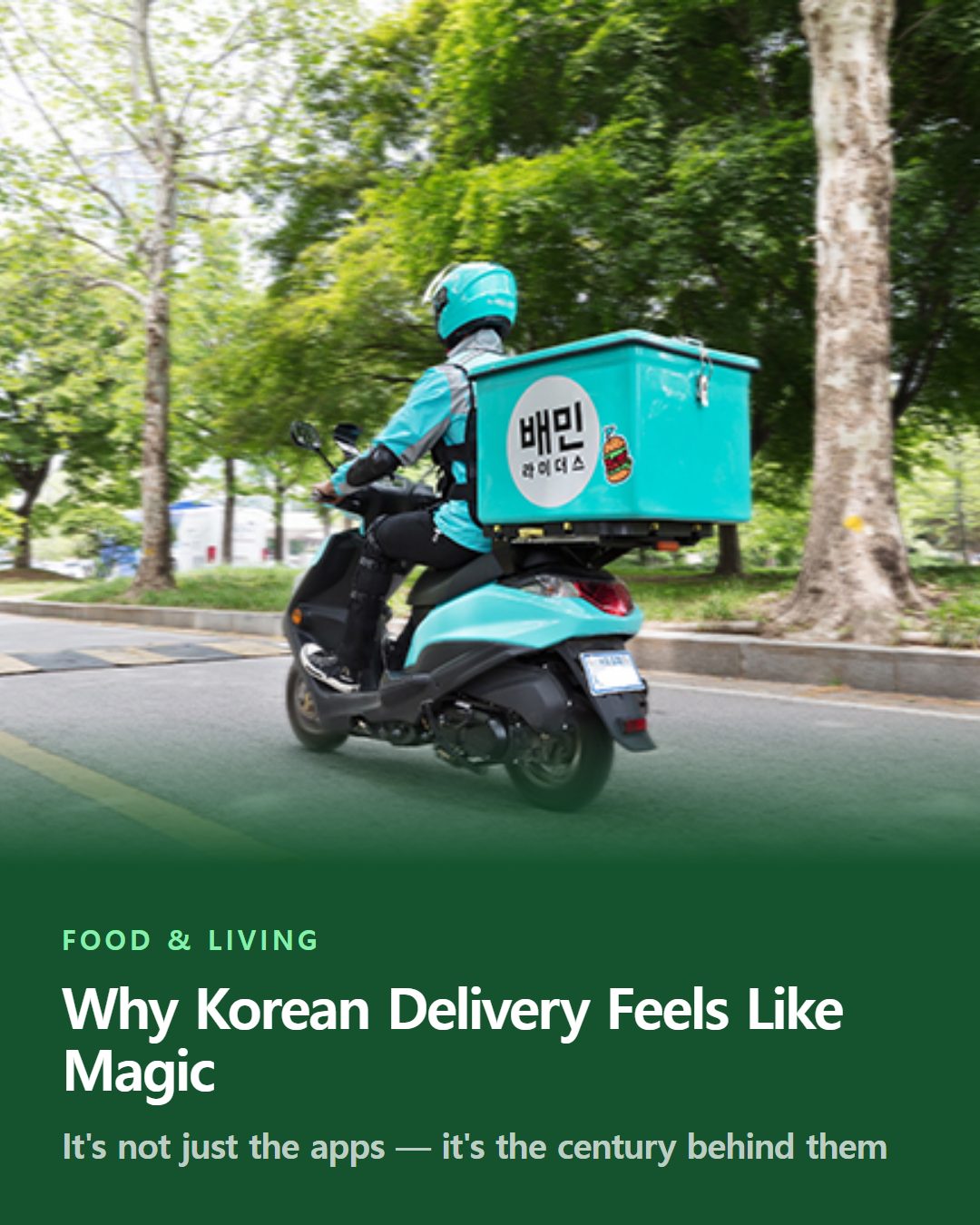
Open a delivery app in Seoul and a rider's dot moves across a live map in real time, often arriving with a single bowl of noodles in under 30 minutes. That precision did not start with smartphones. It sits on top of a delivery culture that predates the apps by more than a century, and a market structure that has consolidated hard in the past two years.
The short version
- Baemin and Coupang Eats now control 88.3% of Korea's delivery market.
- Jajangmyeon's sauce was thickened in 1948 specifically to survive delivery trips.
- Delivery riders lack labor protections; more than 14 died in 2020.
Two companies, Baedal Minjok (Baemin) and Coupang Eats, now handle the large majority of Korea's food delivery orders, a market that Statistics Korea measured at roughly 29 trillion won in 2024. Understanding how that system got this fast, and who actually pays for the convenience, means looking past the app icon.
Three companies, then two: how the market got here
Baedal Minjok launched in 2011 under a company called Woowa Brothers, digitizing something Koreans already did by phone: ordering from the paper delivery menus stuck to apartment doors.
In 2019, Berlin-based Delivery Hero — which already owned Korea's second-largest app, Yogiyo — agreed to buy a majority stake in Woowa Brothers for close to $4 billion.
Because the deal would have combined the top two apps into a single company controlling an estimated 97% of the market, the Korea Fair Trade Commission (KFTC), the country's antitrust regulator, refused to approve it outright.
In December 2020 it granted conditional approval on one condition: Delivery Hero had to sell 100% of its Korean Yogiyo business within six months.
Coupang, Korea's largest e-commerce company, entered the same race in 2019 with Coupang Eats, differentiating itself through single-order delivery — one rider carries one order at a time instead of batching several. Uber tried too: Uber Eats launched in Seoul in 2017 and shut down in October 2019 after stalling at a single-digit market share against Baemin's roughly 75%.
| App | Founded | Where it stands now |
|---|---|---|
| Baemin | 2011 | Market leader, majority-owned by Delivery Hero |
| Coupang Eats | 2019 | Fastest-growing, built on one-rider-one-order |
| Yogiyo | 2012 | Divested from Delivery Hero in 2021; user base shrinking |
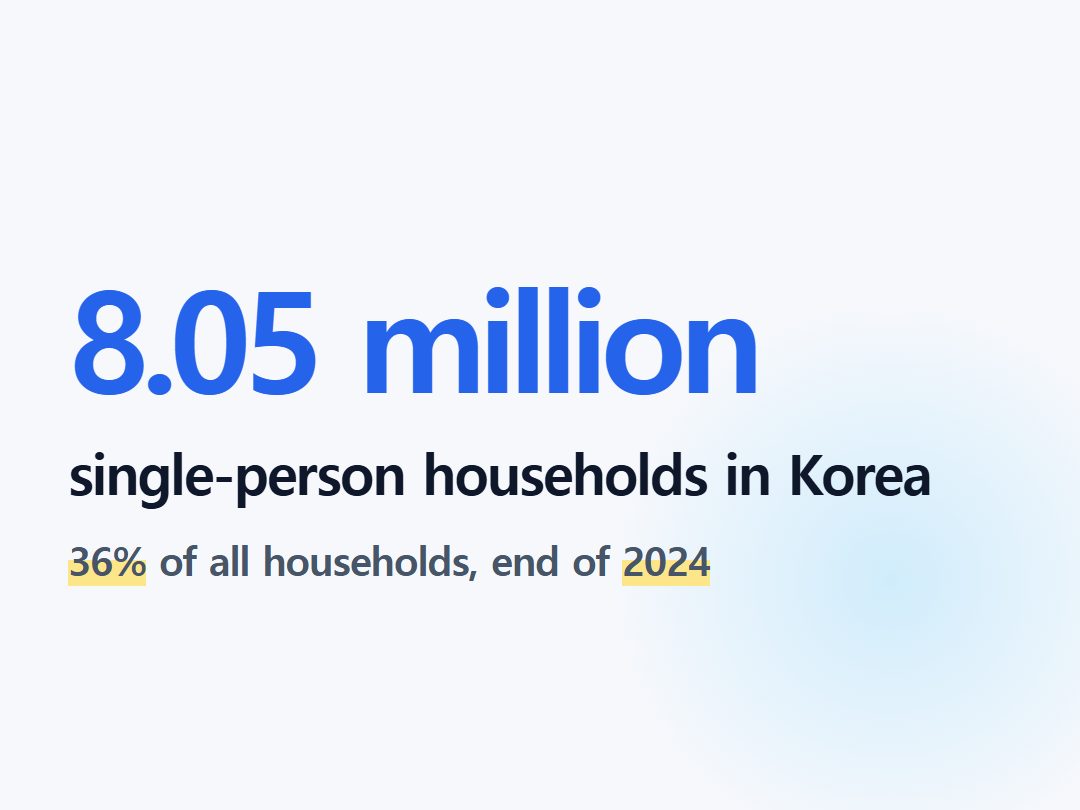
By 2026 that three-way contest had narrowed into a duopoly. Baemin and Coupang Eats together accounted for 88.3% of the market in May 2026, while Yogiyo's weekly users fell to roughly 2.03 million.
A noodle dish invented specifically to survive the trip
Korea's delivery reflex is older than the internet. Jajangmyeon — wheat noodles in a black bean sauce — arrived with Chinese migrant workers who settled near Incheon port in the 1880s, and the dish was first sold commercially at a Chinese restaurant in Incheon in 1905.
Its black color and thick texture aren't original to the Chinese dish it descends from. A domestic manufacturer began mixing caramel into the fermented bean paste in 1948, which both darkened the sauce and softened its flavor for Korean tastes.
Separately, cooks thickened the sauce with a starch slurry so it would cling to the noodles and hold its heat during transport — a change made specifically so the dish would survive a delivery trip.
By the 1980s, neighborhood Chinese restaurants delivering jajangmyeon to nearby households were established enough that food historians point to this decade as the formal starting point of Korea's delivery industry, decades before the first delivery app existed.
Why apartment towers made delivery this efficient
Much of Korea's terrain is mountainous, which left little room for postwar housing to expand outward, so development pushed upward instead. The country's first apartment complex, Mapo Apartment, opened in Seoul in 1964; today, large, standardized high-rise complexes are the default housing type in most cities.
That layout turns out to be unusually convenient for delivery riders navigating on motorcycles:
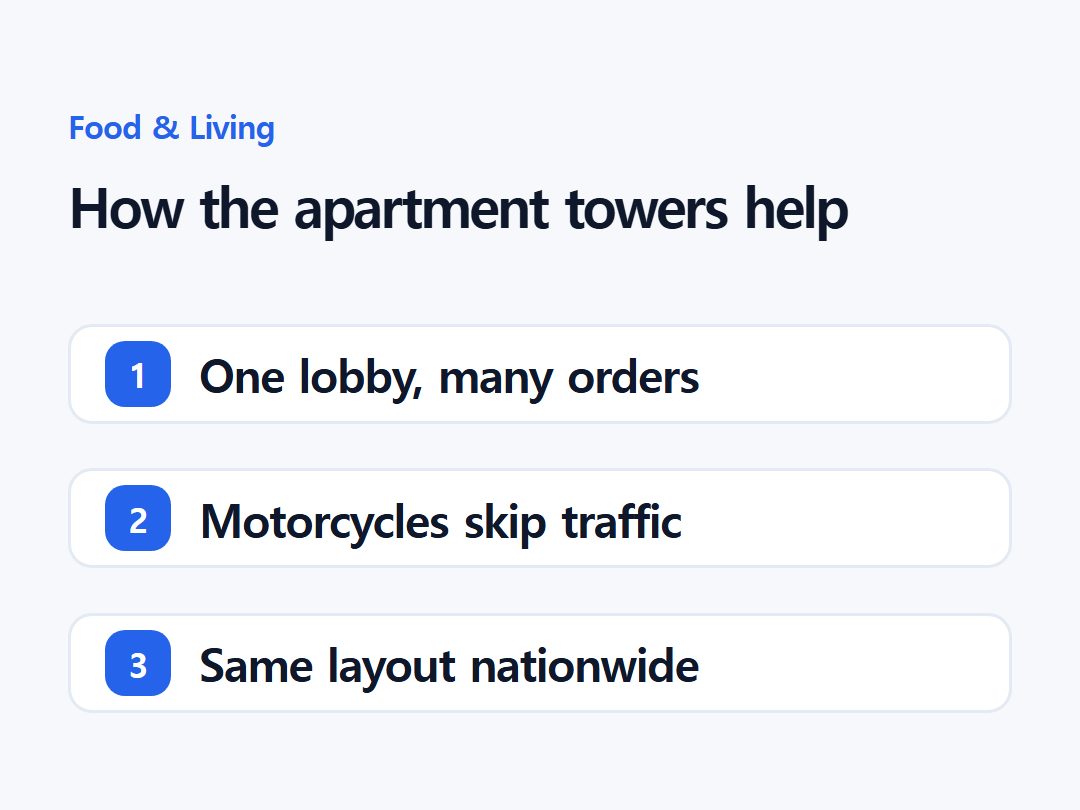
- Buildings share one main gate and lobby, so a rider can drop several orders in a single stop instead of hunting for scattered driveways.
- Complexes are numbered and mapped in a consistent format nationwide, so navigation apps can route riders with little ambiguity.
- Motorcycles can weave between parked cars and use routes cars can't, cutting minutes off each trip in dense traffic.
One in three households now eats alone
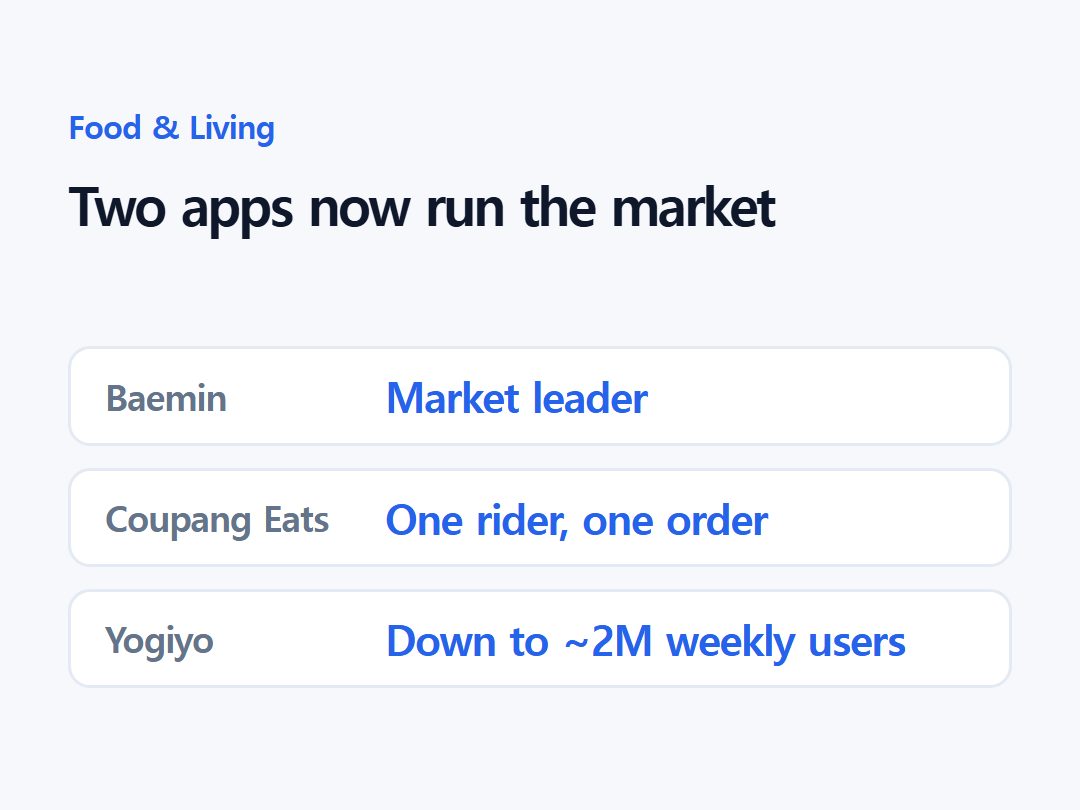
Korea's household structure has shifted quickly. Single-person households reached 8.05 million by the end of 2024 — 36.1% of all households, up from 31.7% in 2020 and just 5.2 million in 2015, according to national statistics agency data.
Delivery apps are built around exactly this unit: a single serving, ordered on a phone, paid for and tracked without a phone call. Researchers studying municipal waste data have directly linked the rise in single-person households to both higher delivery frequency and more packaging waste per capita.
How a pandemic year became a permanent habit
COVID-19 did not create Korea's delivery culture, but it compressed years of growth into months. Online food delivery transactions jumped 78.6% in 2020 to 17.4 trillion won, according to Statistics Korea — nearly 6.4 times the 2.7 trillion won recorded in 2017, the first year the agency tracked the category.
Growth did not reverse once social distancing ended. The market kept expanding to 26.6 trillion won in 2022 and roughly 29 trillion won in 2024, driven less by lockdowns than by a fresh round of fee competition between the major apps.
Free delivery turned into a subscription arms race
In March 2024, Coupang Eats became the first major app to offer free delivery, limited to customers paying for Coupang's Wow membership. Baemin and Yogiyo both followed within weeks, unwilling to risk losing customers to a rival's free-delivery offer.
Coupang doubled down by raising its Wow membership fee 58%, from 4,990 won to 7,890 won, while bundling in perks like its Coupang Play streaming service. The bet paid off: Coupang Eats' active users grew from 6.26 million in March 2023 to 10.26 million by early 2025, overtaking Yogiyo for second place.
Baemin answered with its own paid tier, Baemin Club. Yogiyo, unable to match either rival's ecosystem of bundled perks, saw its transaction volume fall 42.7% year-over-year in February 2025 — its steepest drop on record.
The riders who make 20-minute delivery possible
None of this speed runs on the apps alone. Korea counted roughly 883,000 platform workers in 2023, including 485,000 in delivery and driving services — nearly all classified as "special-type workers," a legal category outside the standard Labor Standards Act that leaves them without guaranteed minimum wage, working-hour limits, or automatic accident coverage.
That gap has had a measurable cost. More than 14 delivery workers died in 2020 alone, with unions pointing to overwork driven by per-delivery pay that spikes during bad weather. During one Seoul snowstorm, per-trip fees reportedly jumped from about 1,000 won to 6,000 won, pushing riders to keep working on icy roads rather than lose the bonus.
- July 2023: Industrial accident insurance dropped its "exclusivity" rule, so riders working across multiple apps also qualify for coverage.
- 2024: Seoul granted the Rider Union formal legal status, citing an "economic, systematic and subordinate relationship" between riders and platforms.
- July 2026: A Seoul appellate court ruled that a delivery rider should be treated as an employee under labor law, reasoning that riders cannot secure their own orders and that pay is effectively set by the platform.
A broader bill is pending. In January 2026, the Ministry of Employment and Labor proposed a "presumption of worker status" that would shift the burden of proof onto companies in future disputes, though it had not passed into law as of this writing.
Restaurants pay an entry fee international customers never see
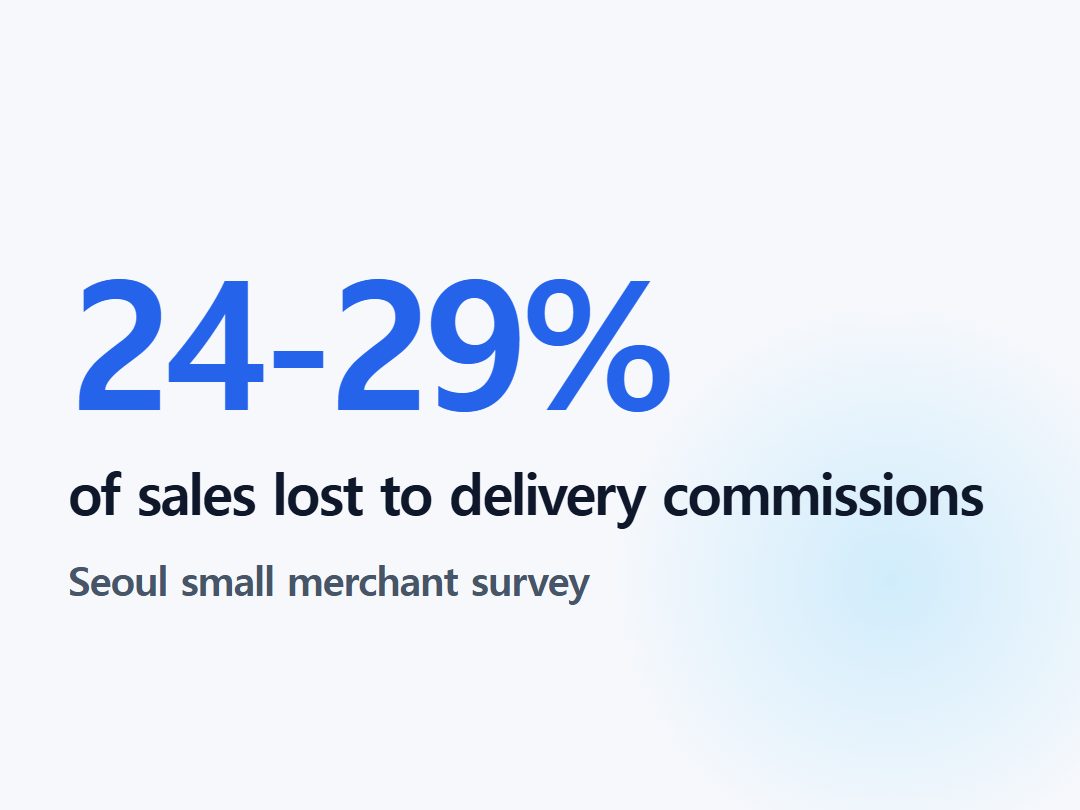
The speed and convenience customers experience is subsidized, in part, by commission fees restaurant owners pay on every order. A Seoul city survey found delivery platform commissions consume 24% to 29% of sales for small merchants, with some chicken restaurants paying more in delivery fees than in labor costs.
The scale of the imbalance is visible in the numbers: Baemin reported 4.32 trillion won in revenue and 640.8 billion won in operating profit for 2024, a 15% margin roughly three times the average for Korean manufacturing. One restaurant owner in Incheon told reporters he deleted the delivery app to save on fees, but sales fell by half within a month, so he re-registered.
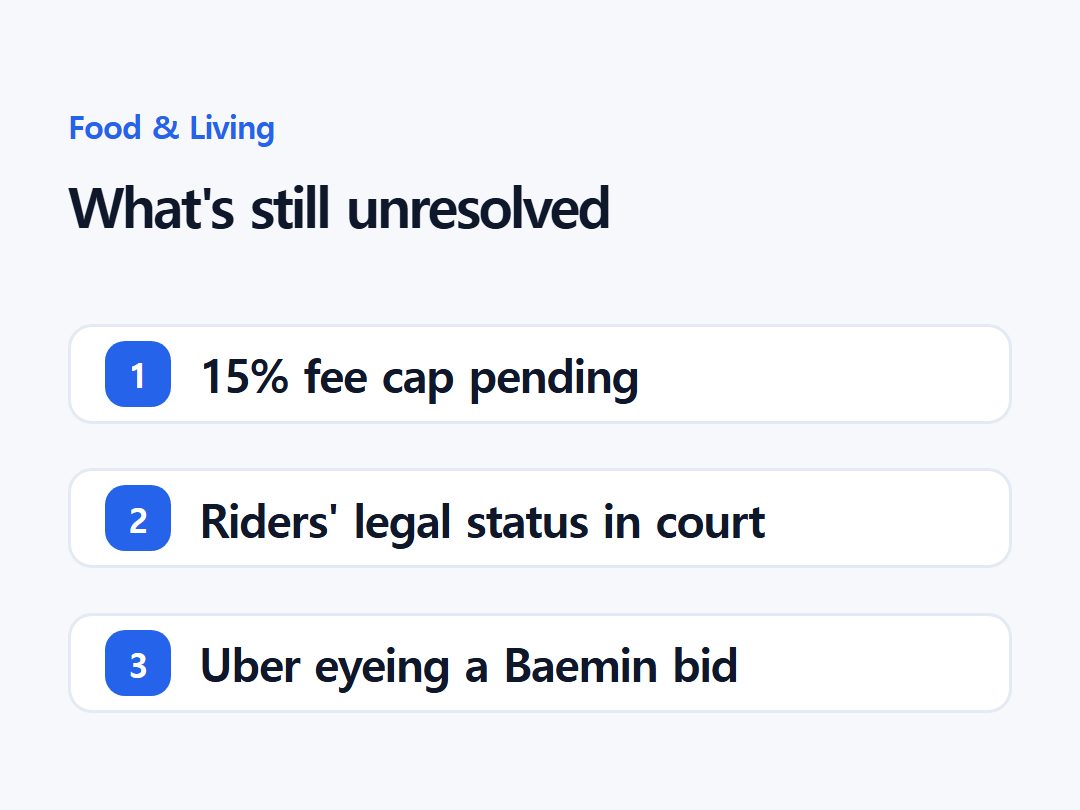
A November 2024 industry agreement lowered the standard 9.8% commission to a tiered 2%–7.8% based on merchant revenue, but merchant groups say it "showed no clear results."
A 15% fee cap that consumers don't actually want
By late 2025, lawmakers had drafted legislation to cap delivery commissions at 15%, and in August 2026 President Lee Jae-myung ordered regulators to force platforms to disclose their fee breakdowns. Baemin has countered by proposing to cap combined transaction fees at 35% of order value for orders under 15,000 won, a figure merchant groups call inadequate.
Consumers are skeptical the fight will actually help them. In a December 2025 survey, 62.3% said menu prices would not fall even with a fee cap, and 58% named the possible loss of free delivery as their biggest concern — the very perk that triggered the current round of consolidation.
The commission fight remains unresolved as of mid-2026, and it is playing out alongside another open question: Uber has reportedly shown renewed interest in Korea, this time by exploring a bid for Baemin itself, which could reshape the market yet again.
Timeline: Delivery riders' legal status
| Date | Development |
|---|---|
| July 2023 | Industrial accident insurance drops its "exclusivity" rule, covering riders who work across multiple apps |
| 2024 | Seoul grants the Rider Union formal legal status |
| January 2026 | Labor Ministry proposes shifting the burden of proof onto companies (not yet law) |
| July 2026 | Seoul appellate court rules a delivery rider should be treated as an employee |
Frequently asked
Why is food delivery so fast in Korea?
Dense, uniformly numbered apartment complexes let riders drop several orders in one stop, and motorcycles can weave through traffic cars can't, cutting minutes off each trip.
Is Baemin or Coupang Eats bigger in Korea?
Baemin remains the market leader, but Coupang Eats grew fastest after launching free delivery in 2024; together the two now hold 88.3% of the market.
How much commission do Korean restaurants pay delivery apps?
A Seoul city survey found commissions consume 24% to 29% of small merchants' sales, and a November 2024 industry deal only lowered the standard 9.8% rate to a tiered 2%-7.8%.
Sources
Every factual claim above is traceable. We do not translate articles — we gather facts from multiple outlets and write them ourselves.
- Top Two Delivery Apps Hold 90% Share; Uber's Baemin Bid May Cement Duopoly — Seoul Economic Daily
- South Korea Tells Delivery Hero to Sell Unit for Woowa Deal — Bloomberg
- Uber Eats exits Korea amid fierce competition — The Korea Times
- [Visual History of Korea] Jjajangmyeon, Korean Chinese dish invented in Incheon by Chinese migrant workers — The Korea Herald
- Korean Jajangmyeon History: The Black Noodle That Isn't Chinese — Seoulz
- Why Do Koreans Live In Apartments? — Korea Market Notes
- No. of single-person households tops 8m in 2024: data — The Korea Herald
- Online food delivery market grows 79% in 2020 — The Korea Times
- S.Korea's food delivery apps relish fresh boom in demand — KED Global
- Baemin, Yogiyo see record transaction drops in Feb amid Coupang's rise — KED Global
- Food delivery platforms compete with free delivery — The Korea Herald
- South Korea: Delivery platforms criticised for pay incentives which forced delivery drivers to work in dangerous conditions during snowstorm — Business & Human Rights Resource Centre
- Court Rules Delivery Riders Are Legal Employees, Set to Reshape Platform Labor — Seoul Economic Daily
- Korea moves to extend labor protections to 8.6 mil. freelancers, platform workers — The Korea Times
- [Second Half Policy Briefing] Lee Orders Ministry of SMEs and Fair Trade Commission to Disclose Delivery App Commission Breakdown — The Asia Business Daily
- "Delivery Orders May Drop by 300 Million"... 75% Oppose Fee Cap System, Search for Solutions Intensifies — The Asia Business Daily
- Delivery Platforms' Commissions Remain a Major Strain for Korean Small Businesses — Be Korea-savvy (KoreaBizWire)


