
Almost every K-pop group that reaches an international audience went through the same invisible process first: years of unpaid training inside a talent agency, followed by a debut where the artist does not fully own their own earnings until the company has been paid back. International fans see the polished debut stage.
What they usually do not see is the financial structure underneath it — one that has produced lawsuits, government intervention, and, as of January 2026, a new set of legal protections in South Korea.
The short version
- K-pop trainees train for years unpaid before any earnings are split.
- Agencies deduct training costs from earnings first, a process called 'jeongsan.'
- New 2026 rules add protections, but smaller agencies face less pressure to follow.

Are K-pop trainees paid before they debut?
The K-pop "agency system" works differently from the Western model of a record label signing an artist who already performs.
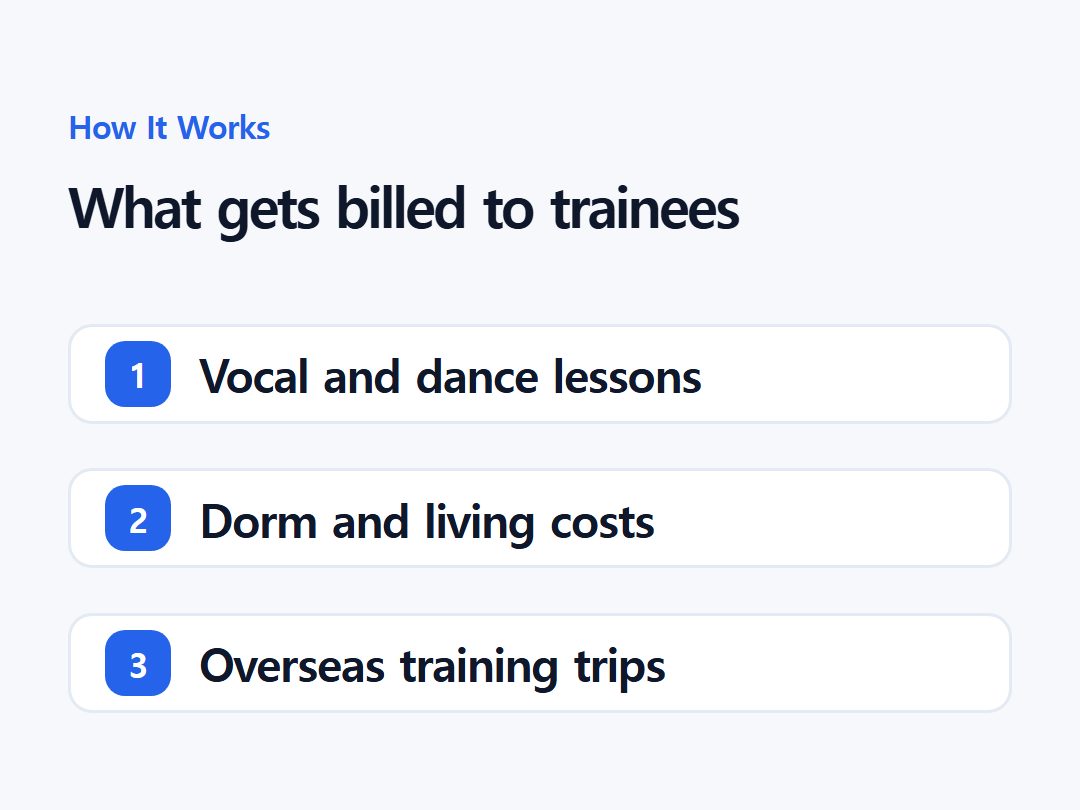
In Korea, the agency (기획사) recruits mostly teenagers through open auditions or street-casting, then trains them in-house — vocal lessons, dance, language classes, and often years of dormitory living — before they ever perform publicly. Trainees are not paid a salary during this period.
If a trainee is chosen to debut, the agency's accumulated training costs are typically treated as an investment that gets deducted from the group's future earnings before any profit is split with the members, a process Korean industry insiders call "settlement" (정산, jeongsan).
If a trainee is dropped before debut, in many cases they leave with nothing to show for the years spent, and historically some contracts even tried to charge trainees a penalty for leaving early.
This is not a new practice, and it is not breaking news — it is the operating model of the industry, largely unchanged in its basic shape for more than two decades, though increasingly regulated.
Why trainee debt is not a salary advance
For readers outside Korea, the biggest gap in understanding is usually this: a K-pop "trainee" is not an intern or a hopeful with a part-time deal.
For years, they are effectively unpaid full-time performers-in-training, often living together in company-run dormitories, attending lessons on a schedule that can run from morning until 10 p.m. six days a week, with school fitted around it.
None of this time is compensated, and there is no guarantee a trainee will ever debut. Some spend a decade in training and never appear on a stage.
The financial structure that follows debut is the part that surprises international audiences most. Lessons, styling, dormitory costs, and — for many trainees — periods of overseas training are tracked by the agency as expenses attached to that trainee.
When the trainee debuts, those accumulated costs are recouped from the group's income: album sales, streaming, event fees, and endorsements first pay down what the company spent, and only after that does profit-sharing with the members begin.
This is functionally closer to a debt than a salary advance — the company decides what counts as a legitimate cost, and in the past, disclosure of exactly what was being deducted was often vague or opaque, a practice critics called "phantom debt."
This is different from how debut economics tend to work for pop acts in the United States or United Kingdom, where a record label typically advances money against future royalties under contracts with clearer accounting standards and shorter typical terms.
In Korea, the training-and-recoupment model, combined with historically long exclusive contracts, is what critics dubbed "slave contracts" in Korean media in the 2000s — a term serious enough that it prompted the government to intervene.
South Korea's Fair Trade Commission (FTC), the country's antitrust and consumer-protection regulator, has repeatedly stepped in because trainee contracts are considered a market-fairness issue, not just a labor dispute between an agency and a minor.
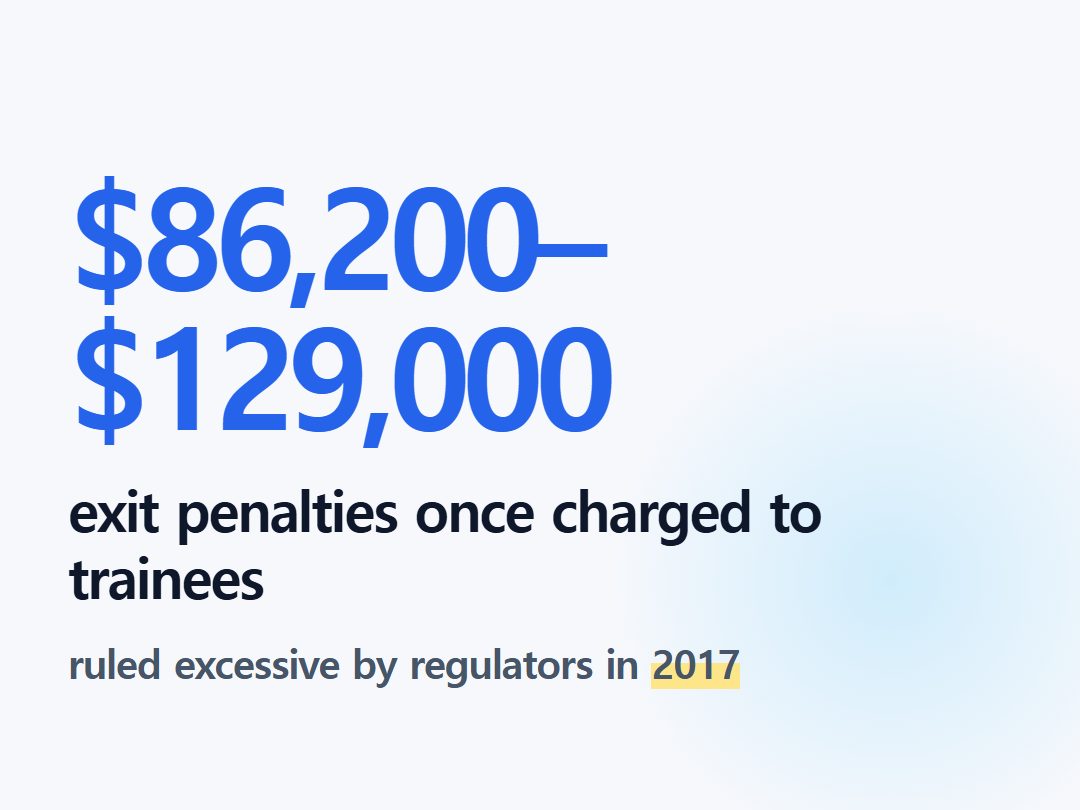
In 2017, the FTC inspected contracts at eight major agencies — including SM Entertainment, YG Entertainment, JYP Entertainment, Cube, FNC, and DSP Media — and found the termination penalties charged to trainees who left early ranged from roughly $86,200 to $129,000, well beyond what regulators judged to be the agencies' actual losses.
Three of the agencies were also found to have tried to recoup double their training investment from trainees who left before debut. All eight agreed to revise the clauses.
The penalty-clause problem has not fully disappeared even under reformed contracts.
In one 2025 case reported by The Korea Herald, a Seoul court ordered a trainee at Majesty Entertainment to pay 5 million won (about $3,665) after violating dormitory and appearance rules — she had left the dorm without permission and gotten a small tattoo — even though the agency's contract had specified a 30 million won penalty per violation, which the court ruled excessive.
The case shows that behavioral clauses controlling trainees' personal choices, from tattoos to curfews, are still standard in contracts, even as courts increasingly push back on how harshly they can be enforced.
How regulators reined in 'slave contract' deals
The current rules trace back to a wave of contract disputes in the late 2000s, when several prominent idol groups challenged agencies over contracts running as long as 13 years combined with unclear earnings splits.
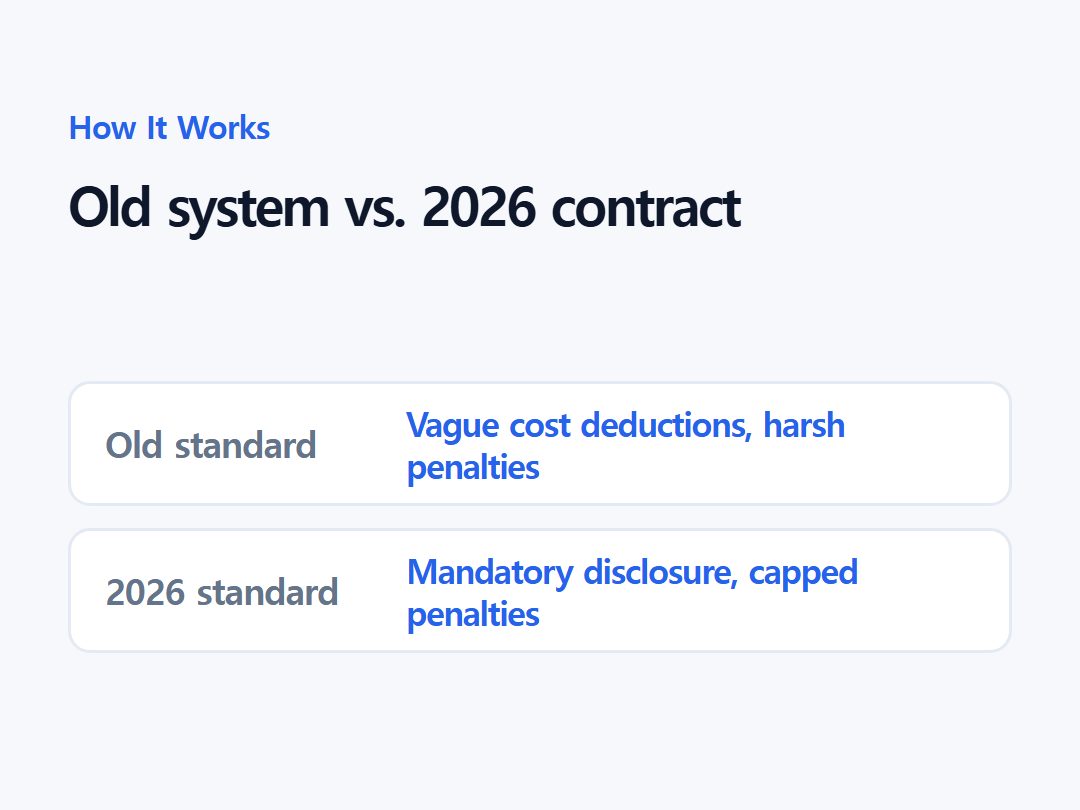
The scandals were serious enough to enter the Korean public vocabulary as "slave contracts." In response, the Fair Trade Commission introduced a standard entertainment contract in 2009 that capped exclusive agency deals at seven years — a limit still referred to in the industry as the "seven-year curse," since it has historically been the point at which groups renegotiate, leave, or disband.
The FTC returned to the issue in 2017 with the broader review of eight major agencies described above, correcting six categories of unfair contract terms covering trainees specifically, not just debuted idols.
Complaints about vague accounting of training-cost deductions persisted for years afterward, prompting further government action.
In 2025, the FTC pushed YG, JYP, SM, and Cube to amend contracts with ambiguous termination conditions and penalty terms, and South Korea's Ministry of Culture, Sports and Tourism finalized a fully revised standard contract for trainees and a separate supplementary agreement for underage trainees, both taking effect January 1, 2026.
The new versions require clearer payment timelines, expand access to mental-health counseling, explicitly ban pressuring minors to skip school, and require agencies to appoint a designated youth-protection officer for underage trainees.
Large agencies such as HYBE, SM, JYP, and YG have also shifted some of their practice ahead of regulation, increasingly treating trainee development costs as a general business investment rather than debt attached to a specific individual, particularly for newer groups — a change that reduces, though does not eliminate, the recoupment structure for the members involved.
That shift matters because it is not required by law; it is a business choice some of the largest companies have made partly in response to public scrutiny, which means smaller agencies with less brand reputation to protect have less incentive to follow the same path voluntarily.
Will South Korea's new trainee protections hold?
The revised standard contract only took effect at the start of 2026, so there is no track record yet on how consistently it will be enforced, especially at the mid-size and smaller agencies that make up much of the industry beyond the "Big Four." The standard contract sets a template, but it is not automatically mandatory for every company, and past FTC interventions in 2009 and 2017 show that abuses have resurfaced in new forms even after regulation.
Whether the new disclosure requirements around training-cost accounting actually end the "phantom debt" complaints — where trainees say they cannot verify what is being deducted from their earnings — will depend on enforcement, not just the text of the contract.
It is also worth watching whether courts continue narrowing the penalty clauses agencies can enforce for personal conduct, following the pattern set in the 2025 tattoo and dormitory case.
Timeline of South Korea's trainee-contract regulation
| Year | Regulatory action | Result |
|---|---|---|
| 2009 | FTC introduces standard entertainment contract | Exclusive agency deals capped at seven years |
| 2017 | FTC inspects contracts at eight major agencies | Termination penalties found up to $86,200–$129,000; agencies revise clauses |
| 2025 | FTC pushes YG, JYP, SM, Cube to amend contracts; court rules in tattoo/dormitory case | Ambiguous penalty terms flagged; excessive penalty clause struck down |
| 2026 | Revised standard contract and minor-trainee agreement take effect (Jan 1) | Clearer payment timelines, counseling access, youth-protection officer required |
Frequently asked
Do K-pop trainees get paid?
No, trainees are not paid a salary during training, and if dropped before debut many leave with nothing to show for years spent.
What is 'jeongsan' in K-pop contracts?
Jeongsan is the settlement process where an agency's accumulated training costs are deducted from a group's earnings before any profit is split with members.
Why are K-pop agency contracts limited to seven years?
South Korea's Fair Trade Commission introduced a standard contract in 2009 capping exclusive agency deals at seven years after 'slave contract' scandals in the late 2000s.
Sources
Every factual claim above is traceable. We do not translate articles — we gather facts from multiple outlets and write them ourselves.
- Is the '7-year itch' a thing of the past? — The Korea Herald
- K-pop trainee ordered to pay damages to agency over tattoo and dorm rule violations — The Korea Herald
- SM, YG, JYP busted for unfair contracts — The Korea Times
- 8 Major Entertainment Companies Face Reforms In Unfair Contract Clauses — Soompi
- Korea to revise standard trainee contracts to strengthen rights protections — allkpop
- Korean Talent Agencies Ordered to End Slave Contracts — Variety